
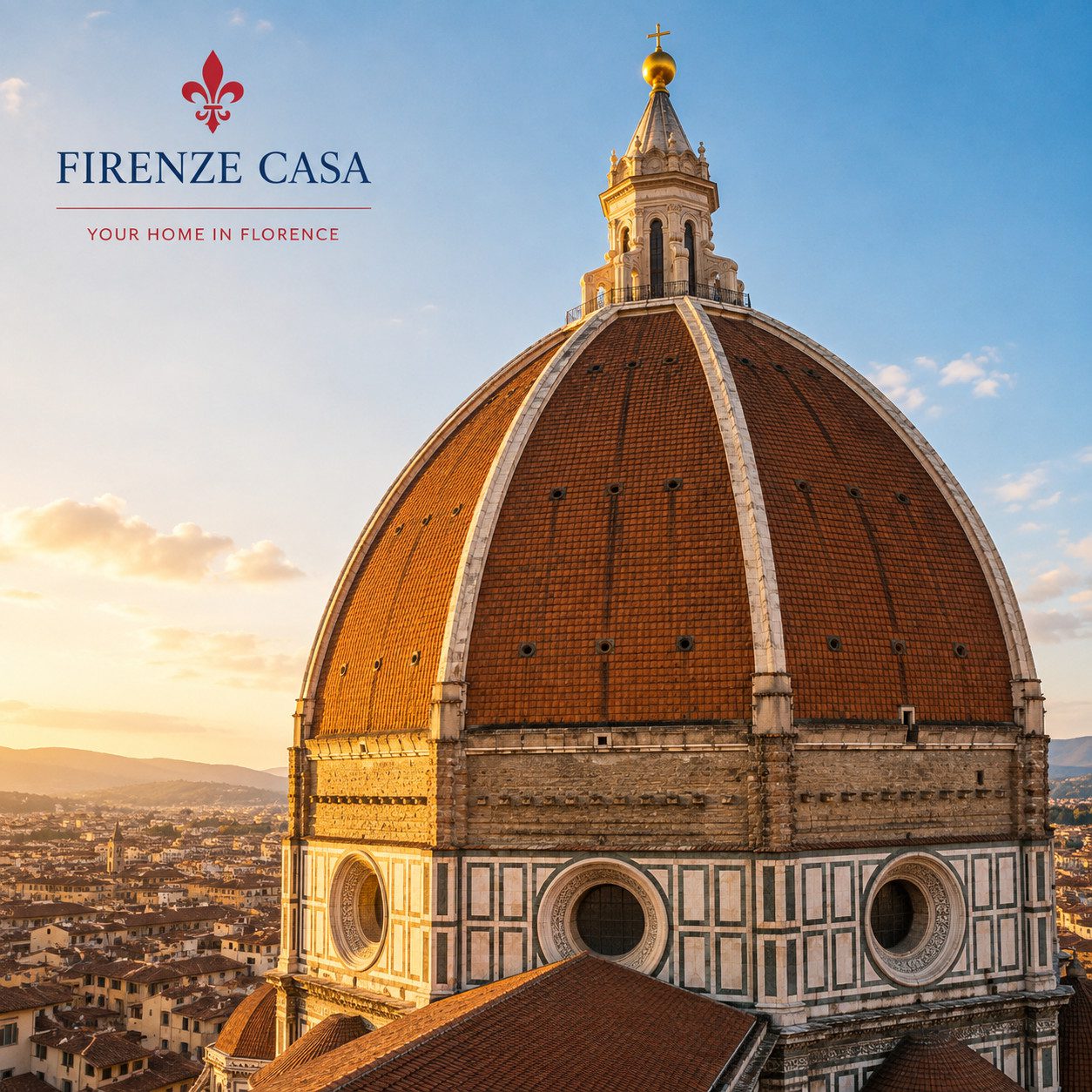
Brunelleschi’s Dome rises above Florence as one of the greatest engineering achievements of the Renaissance. Completed in 1436, it crowns Florence Cathedral and remains the largest masonry dome ever constructed. Its immense terracotta-covered structure has defined the city’s skyline for almost six centuries.
The achievement becomes even more remarkable when we remember that the builders of Santa Maria del Fiore had created an enormous octagonal opening without knowing exactly how it could be covered. Filippo Brunelleschi solved the problem through a combination of geometry, double-shell construction, innovative brickwork, structural reinforcement and purpose-built machinery. The surrounding urban setting and development of the cathedral complex are explored separately in our History of Piazza del Duomo.
Architect: Filippo Brunelleschi
Construction: 1420–1436
Cathedral: Santa Maria del Fiore
Span: approximately 45.5 metres
Structure: Double-shell masonry dome
Climb: 463 steps
Interior fresco: The Last Judgment by Giorgio Vasari and Federico Zuccari
Why it matters: One of the defining achievements of Renaissance architecture and engineering
Timeline at a Glance
| Year | Milestone |
|---|---|
| 1296 | Construction of Florence Cathedral begins. |
| 1418 | Florence announces a competition to solve the problem of the cathedral dome. |
| 1420 | Brunelleschi begins construction. |
| 1436 | The dome is completed and the cathedral is consecrated. |
| 1446 | Brunelleschi dies and is later buried within the cathedral complex. |
| 1461 | The lantern crowning the dome is completed. |
| 1572–1579 | Giorgio Vasari and Federico Zuccari create The Last Judgment. |
| Today | The dome remains the world’s largest masonry dome. |
The Challenge That Seemed Impossible
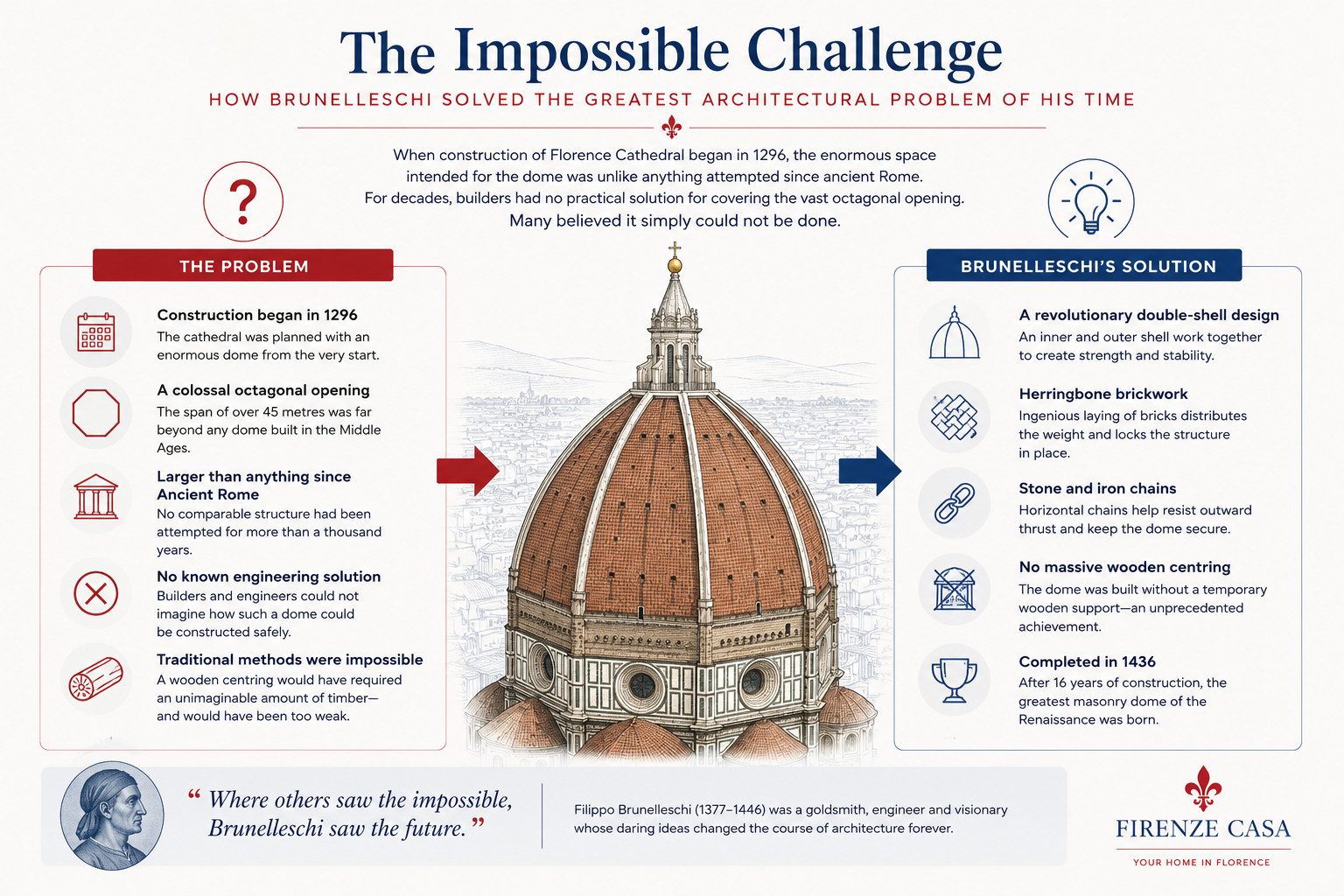
By the beginning of the fifteenth century, Florence Cathedral was largely complete. Its walls, aisles and enormous octagonal crossing had already been built, yet one crucial element remained missing: the dome that would cover the vast opening at the centre of the church.
The challenge was unprecedented. The opening measured approximately 45.5 metres across, creating a span not attempted on such a scale since antiquity. Traditional construction normally relied on enormous wooden centring to support masonry until a dome became self-supporting.
For Santa Maria del Fiore, however, such temporary scaffolding would have required immense quantities of timber and presented serious technical difficulties. The cathedral therefore stood for decades with its great crossing unfinished.
Abandoning the project was unthinkable. Florence had become one of Europe’s wealthiest and most ambitious republics, and completing its cathedral had become a matter of civic prestige. The wider transformation of the city during this period forms part of our guide to the Renaissance in Florence.
Filippo Brunelleschi – The Visionary Behind the Dome
Filippo Brunelleschi was not originally trained as an architect. Born in Florence in 1377, he began his career as a skilled goldsmith and acquired practical knowledge of precision, mechanics and metalworking.
After competing with Lorenzo Ghiberti for the bronze doors of the Baptistery, Brunelleschi turned increasingly towards architecture and engineering. His study of ancient Roman buildings became particularly important to his development, although he did far more than simply imitate antiquity.
Instead, Brunelleschi investigated how buildings worked. This combination of observation, mathematical thinking and practical craftsmanship ultimately allowed him to approach the cathedral problem in an entirely new way.
The dome was his most spectacular achievement, but Brunelleschi also transformed Florentine architecture through buildings such as San Lorenzo, Santo Spirito and the Ospedale degli Innocenti.
The Competition of 1418
In 1418, the Opera di Santa Maria del Fiore announced a competition to find a practical solution for the cathedral’s unfinished crossing. Brunelleschi and Lorenzo Ghiberti became the most famous participants.
The two men already shared a history of artistic rivalry from the earlier competition for the Baptistery doors. This time, however, Florence needed more than an elegant design. The winning proposal had to explain how an enormous masonry dome could actually be constructed.
Brunelleschi was famously reluctant to reveal every detail of his method before work began. He and Ghiberti initially shared supervisory responsibilities, but Brunelleschi gradually emerged as the indispensable technical mind behind the project.
Construction began in 1420. Over the next sixteen years, Brunelleschi turned what had seemed an impossible architectural problem into the defining monument of Florence.
How Brunelleschi Built the Dome
Brunelleschi’s solution combined several structural ideas rather than relying on one single invention. The dome had to remain stable while it was being built and after completion, all without the enormous temporary timber structure traditionally used to support masonry.
Double-Shell Construction
The dome consists of an inner and outer shell connected by structural elements. The inner shell carries much of the structural load, while the outer shell protects the structure and creates the distinctive profile visible across Florence.
Between the shells runs a system of passages and stairways. Visitors climbing the dome still move through these spaces today, making the ascent an unusually direct encounter with Brunelleschi’s engineering.

The Herringbone Brick Pattern
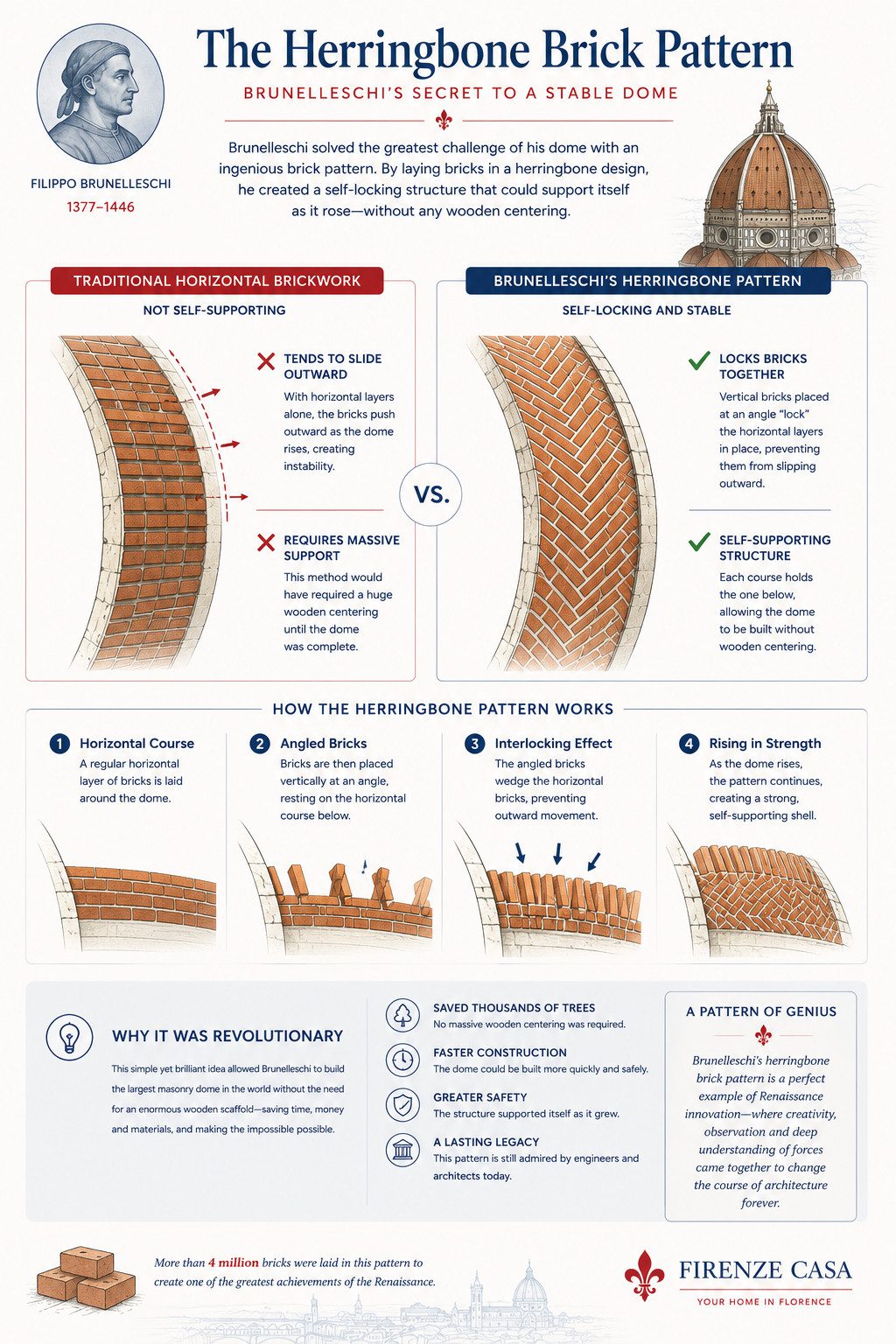
One of the most famous features of Brunelleschi’s construction method is the use of herringbone brickwork. Selected bricks were placed vertically within the masonry, helping to organise and stabilise the courses as construction progressed upwards.
The pattern formed part of a much larger structural system rather than functioning as a single secret responsible for the dome’s success. Nevertheless, it remains one of the clearest visible examples of Brunelleschi’s practical ingenuity.
Stone and Wooden Chains
Brunelleschi incorporated horizontal reinforcing elements within the masonry to help resist forces pushing the dome outward. Stone chains, supplemented by other structural elements, effectively acted as rings around the enormous structure.
These hidden reinforcements were essential because Florence Cathedral did not use the massive external flying buttresses characteristic of many northern Gothic churches.
Building Without Massive Wooden Centring
The most extraordinary achievement was constructing the dome without the enormous full-scale wooden centring normally required for a masonry vault of this size. As construction rose, the geometry and arrangement of the masonry allowed completed sections to contribute increasingly to the stability of the structure.
This approach avoided the enormous practical and financial problems of constructing a timber framework more than forty metres across and high above the cathedral floor.


No single technique explains the dome. Its success came from the interaction of geometry, double-shell construction, ribs, brickwork, reinforcement and carefully controlled building methods.
Brunelleschi’s Revolutionary Machines
Designing the dome was only part of the challenge. Stone, bricks, timber and marble had to be lifted more than fifty metres above the ground, and existing construction equipment was inadequate for work on this scale.
Brunelleschi therefore designed specialised hoists, cranes and lifting devices. Among his most ingenious machines was a reversible hoist powered by oxen. A system of gears allowed workers to change the lifting direction without turning the animals around.
He also developed cranes capable of positioning heavy materials with considerable precision high above the cathedral. These inventions dramatically increased efficiency and demonstrate why Brunelleschi should be understood as an engineer as well as an architect.

The Lantern – Completing Brunelleschi’s Vision
Although the dome itself was completed in 1436, Brunelleschi’s vision included an octagonal lantern crowning its summit. The lantern would provide both an architectural conclusion and additional weight at the meeting point of the eight principal ribs.
Construction began before Brunelleschi’s death in 1446 and continued afterwards according to his design. The marble lantern was completed in 1461.
Above it, a gilded copper sphere later provided the final visual accent. The result strengthened the vertical emphasis of the cathedral and created the silhouette still visible from viewpoints across Florence.
The lantern is not simply decoration added to the completed dome. Brunelleschi conceived it as part of the architectural and structural resolution of the entire project.
The Last Judgment Inside the Dome
More than a century after Brunelleschi completed the structure, the vast interior became the setting for one of Florence’s largest painted compositions. Giorgio Vasari began The Last Judgment in 1572, and Federico Zuccari continued the work after Vasari’s death.
The enormous decoration covers roughly 3,600 square metres. Christ, angels, saints and the blessed occupy the upper areas, while increasingly dramatic scenes of judgment and Hell appear below.
Visitors climbing the dome pass remarkably close to the frescoes before entering the narrow passages between the two shells. This makes the ascent unusual: within a relatively short distance, visitors experience sixteenth-century painting and fifteenth-century engineering almost simultaneously.
Brunelleschi’s Dome and Florence Cathedral
The dome cannot be fully understood in isolation from Santa Maria del Fiore. The cathedral project began more than a century before Brunelleschi started work, and its enormous crossing created the technical challenge he ultimately solved.
Our complete guide to Florence Cathedral explores the wider church, including Santa Reparata beneath the floor, Giotto’s Campanile, Paolo Uccello’s clock and Michelangelo’s Pietà Bandini in the Museo dell’Opera del Duomo.
The cathedral, Baptistery and bell tower also developed within a changing urban setting. Their relationship with the streets and open spaces surrounding them is explored in Piazza del Duomo – Florence’s Cathedral Square.
Brunelleschi and the Birth of Renaissance Architecture
The dome is Brunelleschi’s most famous achievement, but his importance extends far beyond Santa Maria del Fiore. He developed a new architectural language based on geometry, proportion and renewed study of classical forms.
At the Basilica of San Lorenzo, Brunelleschi created one of the clearest early statements of Renaissance architectural order. His later work at Santo Spirito further developed these ideas.
His broader role in the transformation of Florence places him among the central figures of our Great Artists of Florence – Complete Guide.
Brunelleschi did not simply solve one extraordinary engineering problem. His buildings helped establish principles of proportion and classical order that became fundamental to Renaissance architecture.
Climbing Brunelleschi’s Dome
Climbing the dome is one of the most memorable architectural experiences in Florence. The route follows narrow staircases and passages between the inner and outer shells, allowing visitors to experience the structure from inside.
The ascent involves 463 steps and includes steep and confined sections. Part of the route passes close beneath Vasari and Zuccari’s Last Judgment before continuing upwards through the masonry.
At the top, the terrace around the lantern offers panoramic views over Florence’s historic centre, the Arno and the surrounding hills. Looking down towards Piazza del Duomo also reveals the compact relationship between cathedral, Baptistery and Giotto’s Bell Tower.
Steps: 463
Lift: None
Route: Narrow stairways and passages between the two shells
Reservation: Required according to the current Duomo ticketing system
Before visiting: Check current access rules and opening arrangements
Brunelleschi’s Tomb Beneath the Cathedral
Filippo Brunelleschi died in 1446 and received an extraordinary honour: burial within the cathedral complex whose skyline he had transformed.
His tomb was rediscovered beneath Santa Maria del Fiore in the archaeological area associated with the earlier Church of Santa Reparata. The burial demonstrates the exceptional esteem in which Florence held the architect.
For visitors, seeing Brunelleschi’s tomb after climbing his dome creates an unusually direct connection between the man and the monument that made him famous.
Interesting Facts About Brunelleschi’s Dome
- Brunelleschi’s Dome remains the largest masonry dome ever built.
- Its span is approximately 45.5 metres.
- The structure consists of interconnected inner and outer shells.
- Brunelleschi used distinctive herringbone brickwork as part of the construction system.
- He designed specialised hoists and cranes for the project.
- The dome was completed in 1436.
- The lantern was completed in 1461.
- Visitors climb 463 steps to reach the top.
- Vasari and Zuccari’s Last Judgment covers roughly 3,600 square metres.
Frequently Asked Questions
Why is Brunelleschi’s Dome so famous?
It solved an extraordinary structural problem on an unprecedented scale and became one of the defining achievements of Renaissance architecture. It remains the world’s largest masonry dome.
How was the dome built without massive wooden centring?
Brunelleschi used a carefully integrated system of double shells, ribs, brickwork, reinforcement and controlled construction methods that allowed the structure to support itself progressively as it rose.
How many steps lead to the top?
Visitors climb 463 steps to reach the terrace around the lantern. There is no lift.
Who painted the fresco inside the dome?
Giorgio Vasari began The Last Judgment in 1572, and Federico Zuccari completed the project after Vasari’s death.
Can visitors walk between the dome’s two shells?
Yes. Part of the climbing route passes through the space between the inner and outer shells, providing a close view of Brunelleschi’s construction.
Where is Brunelleschi buried?
Brunelleschi is buried within the cathedral complex, in the archaeological area beneath Santa Maria del Fiore.
Why Brunelleschi’s Dome Is Worth Visiting
Brunelleschi’s Dome is worth visiting because it allows you to experience one of the decisive moments in architectural history from the inside. The structure is not merely a beautiful symbol seen above Florence; it is an extraordinary solution to a problem that had challenged builders for generations.
The climb reveals how closely art, engineering and craftsmanship were connected in Renaissance Florence. Visitors move beneath Vasari’s frescoes, through Brunelleschi’s double-shell structure and finally onto the roof of a monument completed almost six centuries ago.
The dome also provides an ideal introduction to Brunelleschi himself. His work at San Lorenzo and Santo Spirito demonstrates that the architect who solved Florence Cathedral’s greatest challenge also helped establish an entirely new architectural language.
Seen from the streets, Brunelleschi’s Dome defines Florence. Seen from within, it explains why the city became one of the great laboratories of Renaissance innovation.
Further Reading on Firenze Casa
- Florence Cathedral
- Piazza del Duomo – Florence’s Cathedral Square
- Filippo Brunelleschi – The Architect Who Changed Florence
- The Renaissance in Florence
- Giorgio Vasari – Artist, Architect and Chronicler of Florence
- Basilica of San Lorenzo – The Medici Church of Florence
- Basilica of Santo Spirito – Brunelleschi’s Renaissance Church
- The Great Artists of Florence – Complete Guide
References
- King, Ross. Brunelleschi’s Dome: The Story of the Great Cathedral in Florence.
- Opera di Santa Maria del Fiore.
- Murray, Peter. The Architecture of the Italian Renaissance.
- Hartt, Frederick. History of Italian Renaissance Art.
- UNESCO World Heritage Centre – Historic Centre of Florence.
- Biblioteca Nazionale Centrale di Firenze.

