
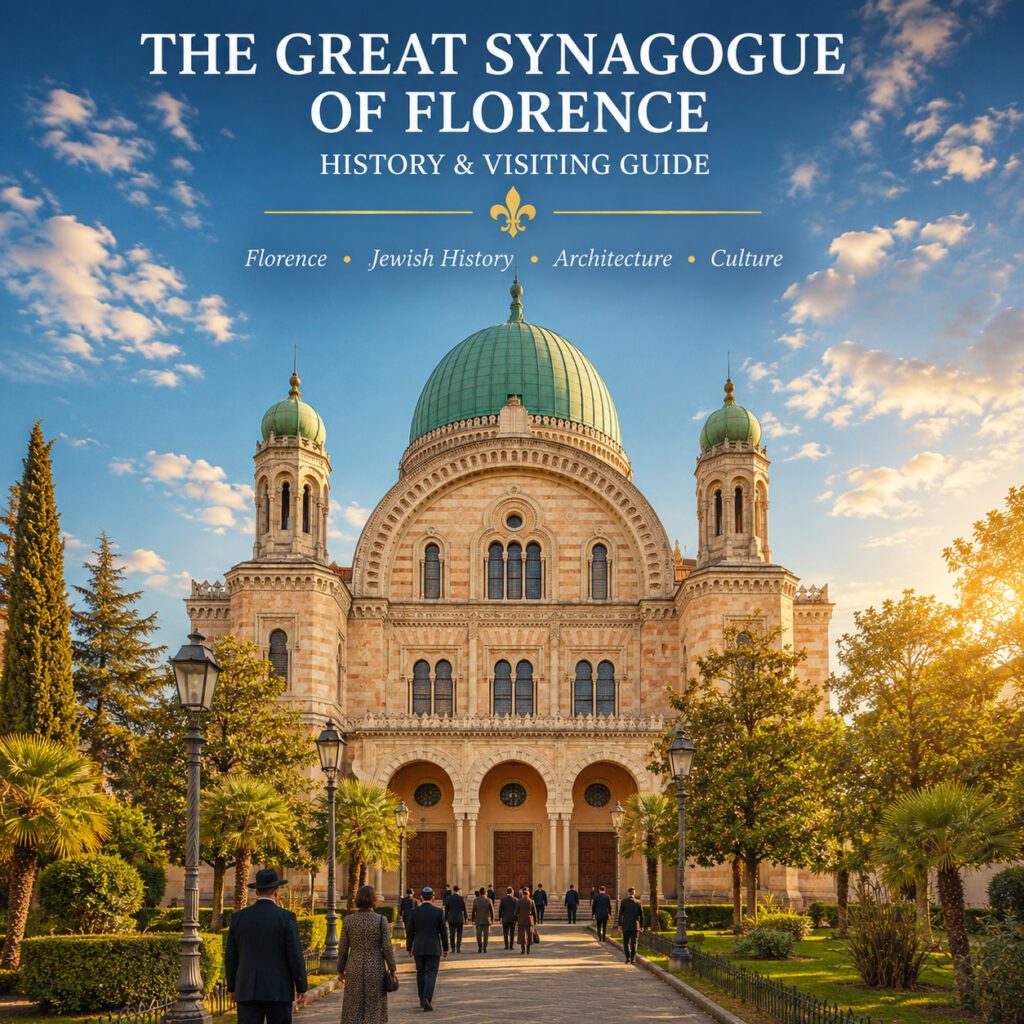
Few buildings in Florence are as unexpected as the Great Synagogue of Florence. Its distinctive green copper dome rises above the eastern part of the historic city. The synagogue introduces visitors to a chapter of Florentine history far beyond Renaissance churches, Medici palaces and famous museums.
The monumental synagogue opened in 1882 in the former Mattonaia area, close to today’s Sant’Ambrogio neighbourhood. It remains an active place of worship and also houses the Jewish Museum of Florence. Together, the synagogue and museum offer a fascinating introduction to the history, religion and culture of Florence’s Jewish community.
What: Great Synagogue of Florence and Jewish Museum
Italian name: Tempio Maggiore Israelitico di Firenze
Address: Via Luigi Carlo Farini 4, Florence
Opened: 1882
Architects: Mariano Falcini, Vincenzo Micheli and Marco Treves
Known for: monumental nineteenth-century architecture, green copper dome, richly decorated interior and Jewish Museum
Neighbourhood: eastern historic Florence, near Sant’Ambrogio
A Monument to Jewish Emancipation in Florence
The story of the Great Synagogue of Florence reflects the changing position of Jewish communities in nineteenth-century Italy. Jews in the Grand Duchy of Tuscany achieved civic equality in 1848. The following decades brought profound political and social change.
A monumental new synagogue could therefore express more than religious identity. It represented a community increasingly able to participate openly in Florentine civic life and in the newly unified Italian state.
David Levi played a decisive role in the project. As a prominent member and president of Florence’s Jewish community, he wanted the city to have a monumental synagogue. In his will, he left a substantial part of his estate for its construction. Work began in 1874, and the new temple opened in 1882.
The synagogue belongs to a remarkable period in Florence’s urban history. During these decades, new boulevards, neighbourhoods, public buildings and markets transformed the city. The historic food markets of Florence, including Sant’Ambrogio, also reflect this nineteenth-century transformation.
Why the Synagogue Looks So Different
Visitors familiar with Florence’s historic churches immediately notice the synagogue’s different architectural language. Mariano Falcini, Vincenzo Micheli and Marco Treves designed the building. Their design combines nineteenth-century Italian historicism with elements often described as Moorish Revival.
The enormous central dome forms the building’s most recognisable feature. Its green copper covering makes it visible from many viewpoints across Florence. Smaller towers and domes surround the central structure. Coloured masonry, arches and decorative details further distinguish the exterior from Florence’s medieval and Renaissance churches.
For travellers interested in sacred architecture, the contrast is fascinating. Compare the synagogue with the buildings in our guide to the most important churches in Florence. It shows how dramatically religious architecture changed during the nineteenth century. It also adds another religious tradition to the architectural landscape of the city.
Inside the Great Synagogue of Florence
The interior is even more elaborate than the exterior suggests. Decorative patterns cover walls, arches and architectural surfaces. Rich ornament, geometric motifs and warm colours guide the eye towards the central sacred spaces.
Look upward when you enter. From inside, the scale of the dome becomes particularly impressive. Architecture and decoration combine to create a strong sense of height and ceremony. The richly decorated interior deserves more than a quick visit.
Florence encourages visitors to look upward. Brunelleschi’s dome dominates the Renaissance city, while the green dome of the Great Synagogue belongs to another period entirely. Seeing both reveals how Florence continued to develop long after the Renaissance.
The Jewish Community Before the Great Synagogue
Jewish history in Florence began centuries before the synagogue opened. Jewish merchants, physicians, lenders, scholars and families formed part of Florentine society from the late Middle Ages onward. However, their legal position changed repeatedly according to political circumstances.
Under Cosimo I de’ Medici, Florence eventually confined its Jewish population to a ghetto. The sixteenth-century quarter stood near what is now Piazza della Repubblica. It remained part of the dense historic centre until Florence underwent major urban redevelopment in the nineteenth century.
The old ghetto was later demolished, and little of it remains visible today. The Great Synagogue therefore provides an important physical connection with Jewish Florentine history. This vanished neighbourhood also belongs to the many layers of the city explored in our Hidden Stories of Florence – Complete Guide.
The Jewish Museum of Florence
The Great Synagogue is much more than a religious monument. The complex also houses the Jewish Museum of Florence. The museum provides essential context for understanding both the synagogue and the long history of Florence’s Jewish community.
Its displays explore Jewish life in Florence and Tuscany over several centuries. Visitors encounter ceremonial objects connected with worship, religious festivals and community life. These objects help explain traditions that architecture alone cannot reveal.
Jewish Ceremonial Art and Craftsmanship
The collection includes examples of Jewish ceremonial art, Torah ornaments, textiles, silverwork and ritual furnishings. Many objects combine religious meaning with exceptional craftsmanship. They also connect Jewish culture with Florence’s wider traditions of metalworking, textiles and decorative arts.
The museum gives these objects a historical setting. It explains the changing position of Florence’s Jewish population, from periods of restriction to nineteenth-century emancipation. The construction of the Great Synagogue forms an important part of this story.
Jewish Florence in the Twentieth Century
The twentieth-century displays address a much darker period. They document the Fascist racial laws, persecution during the Second World War and the German occupation. This part of the museum connects individual objects and memories with the wider history of Florence’s Jewish community.
The museum also offers a special architectural perspective. From the upper level, visitors can look into the richly decorated synagogue interior. This viewpoint makes many details easier to appreciate than from the ground floor.
For anyone interested in Florence’s museums, the Jewish Museum offers a rewarding alternative to the city’s famous collections. It complements the institutions in our Florence Museums – Complete Guide. More importantly, it reveals a part of Florentine history that many visitors never encounter.
Allow enough time for both the synagogue and the Jewish Museum. The museum turns an architectural visit into an introduction to centuries of Jewish life in Florence. Its upper level also offers particularly interesting views of the synagogue interior.
The Synagogue During the Second World War
The twentieth century brought one of the darkest periods in the history of Florence’s Jewish community. Fascist racial laws introduced in 1938 stripped Italian Jews of fundamental rights. They also excluded Jewish citizens from many areas of public life.
During the German occupation of Florence, Jewish residents faced persecution, arrest and deportation. German forces also occupied the synagogue and used it as a storehouse. In 1944, retreating troops placed explosives inside the building.
The attempt to destroy the synagogue ultimately failed. People managed to defuse most of the explosives, although the building suffered wartime damage. Its survival gives the synagogue significance far beyond its architecture. Today it stands as a monument to emancipation, a witness to persecution and the home of a living Jewish community.
The Green Dome in Florence’s Skyline
Florence is a city of domes and towers. Brunelleschi’s vast dome of Santa Maria del Fiore dominates the historic skyline. Giotto’s Campanile, Palazzo Vecchio and numerous church towers surround it.
The green dome of the Great Synagogue adds something very different. Built more than four centuries after Brunelleschi’s masterpiece, it represents nineteenth-century Florence. The city was expanding beyond its Renaissance identity and adapting to the political changes of modern Italy.
The dome’s visibility also carries symbolic importance. Earlier Jewish religious life often took place within restricted urban spaces. By contrast, the new synagogue became a monumental and highly visible part of Florence.
The Synagogue and the Sant’Ambrogio Area
The synagogue’s location makes it easy to combine with one of Florence’s most enjoyable neighbourhoods. Sant’Ambrogio lies east of the heavily visited streets around the Duomo and Piazza della Signoria. The area still retains a strong connection with everyday Florentine life.
The nearby Mercato di Sant’Ambrogio is one of the best places to experience Florence as a living city. Food shops, cafés and residential streets create a noticeably different atmosphere from the busiest parts of the historic centre.
Visitors can also walk from the synagogue towards Piazza Santissima Annunziata and the Basilica della Santissima Annunziata. Seeing these very different religious buildings on the same walk offers an unusual perspective on Florence’s architectural and spiritual history.
The synagogue is especially rewarding because it takes visitors beyond the usual Renaissance itinerary. Combine it with Sant’Ambrogio, the local market and the streets east of the historic centre. Together, they make an excellent quieter half-day in Florence.
Visiting the Great Synagogue of Florence
The synagogue remains an active place of worship as well as a museum and historic monument. Visitors should therefore approach it differently from an ordinary tourist attraction. Security procedures may apply at the entrance.
Access can also change during Jewish holidays, religious services or special events. Check current opening hours and admission arrangements shortly before your visit. Modest and respectful clothing is appropriate.
The synagogue stands at Via Luigi Carlo Farini 4. Visitors can easily reach it on foot from the eastern part of central Florence. Its location also makes it convenient to combine with Sant’Ambrogio and nearby attractions.
The complex functions as both a museum and an active synagogue. Check current visiting hours, closures, admission conditions and security requirements before setting out.
Staying Near the Great Synagogue
The area around the synagogue is ideal for travellers who want a quieter base close to central Florence. Our Florence Apartment lies in this part of the city, near the synagogue and Sant’Ambrogio area. Major sights remain within comfortable walking distance.
From here, visitors can walk towards Santa Croce, Piazza Santissima Annunziata, the Duomo and the historic centre. Yet the surrounding streets feel noticeably calmer than Florence’s busiest tourist areas. Sant’Ambrogio Market is also convenient for everyday shopping and offers a glimpse of local life.
Why the Great Synagogue of Florence Is Worth Visiting
The Great Synagogue of Florence deserves a place on a Florentine itinerary because it tells a story many visitors otherwise miss. Its architecture reflects the confidence of Florence’s Jewish community after emancipation. The Jewish Museum adds centuries of history, religious traditions and personal memories.
The building’s twentieth-century history also recalls persecution, war and survival. At the same time, the synagogue changes the way we see Florence itself. The city did not stop developing when the Renaissance ended. New communities, political changes and architectural ideas continued to shape it.
Stand beneath the synagogue’s green dome and then walk towards Brunelleschi’s red-tiled dome in the historic centre. The contrast tells an extraordinary story. Florence is not the product of a single golden age, but a city shaped by many generations, communities and traditions.
Further Reading on Firenze Casa
Continue exploring Florence’s religious heritage, museums, neighbourhoods and lesser-known history with these Firenze Casa guides:
- The Most Important Churches in Florence – Complete Guide
- Florence Museums – Complete Guide
- Hidden Stories of Florence – Complete Guide
- Basilica della Santissima Annunziata – Florence’s Sanctuary
- Historic Food Markets of Florence – Complete Guide
References
- Jewish Community of Florence – Synagogue and Jewish Museum of Florence.
- Jewish Florence – historical information on the Great Synagogue and the Jewish community of Florence.
- Fondazione per i Beni Culturali Ebraici in Italia – Jewish cultural heritage in Italy.
- Comune di Firenze – historical and cultural resources on Florence and its nineteenth-century urban development.
- Gallerie degli Uffizi – historical studies on the Jewish ghetto of Florence and Jewish culture in the city.
- Milano, Attilio – Storia degli ebrei in Italia.
- Historical studies on Jewish emancipation, the Florentine Jewish community and nineteenth-century synagogue architecture in Italy.

