
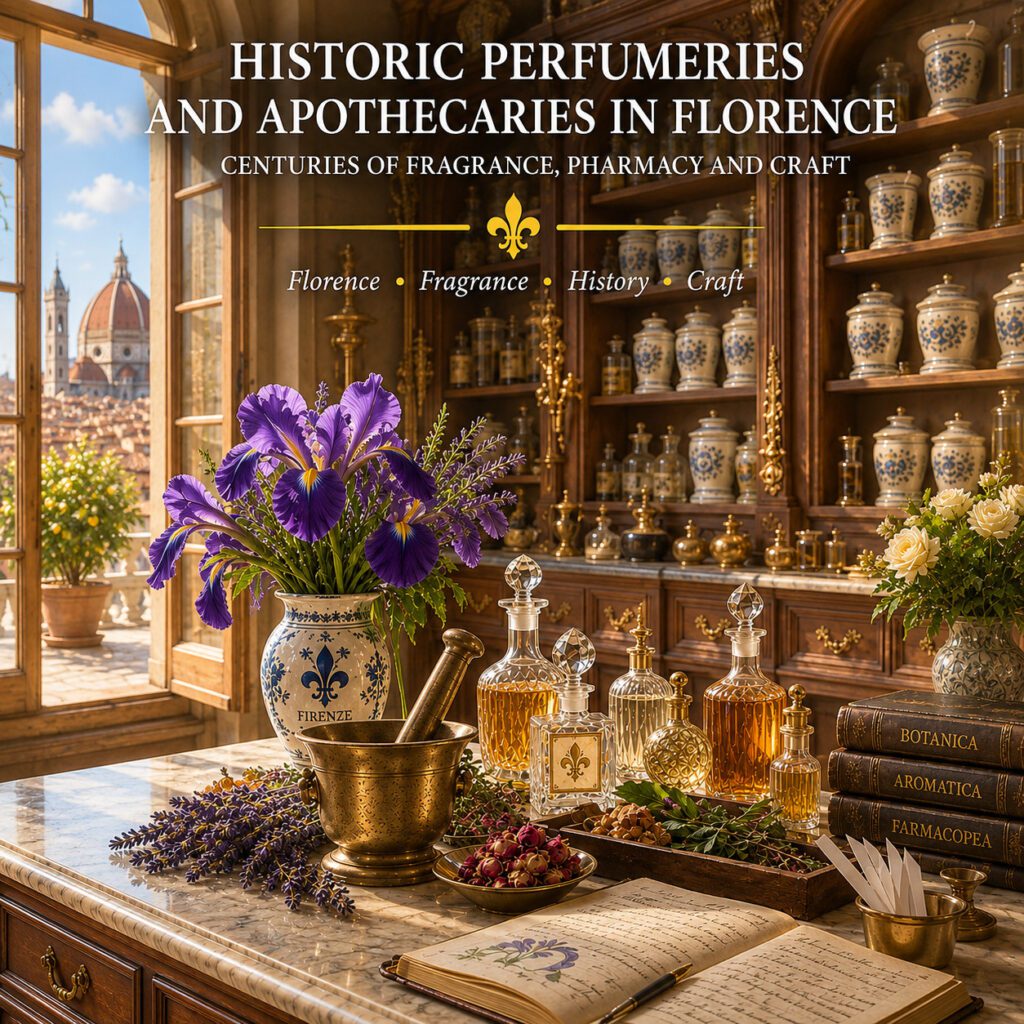
Historic perfumeries in Florence offer a fascinating way to explore the city beyond its museums and monuments. Behind elegant shopfronts and centuries-old interiors lies a tradition in which pharmacy, botanical knowledge, cosmetics and fragrance were once closely connected.
This guide focuses on three particularly interesting Florentine houses: the Officina Profumo-Farmaceutica di Santa Maria Novella, Farmacia SS. Annunziata 1561 and the former British Legation Pharmacy associated with the Profumeria Inglese. Rather than repeating the wider history of fragrance, which we explore in our guide to Florentine Perfume – From Renaissance Apothecaries to Today, here we concentrate on the places themselves, their individual stories and what makes each one worth discovering in Florence.
🌿 At a Glance
Essential historic houses: Santa Maria Novella, Farmacia SS. Annunziata 1561 and the former British Legation Pharmacy
Oldest tradition: Santa Maria Novella, with roots dating to 1221
Renaissance spezieria: Farmacia SS. Annunziata, founded in 1561
19th-century chapter: British Legation Pharmacy, founded in 1843
What connects them: Pharmacy, cosmetics, fragrance and Florentine craftsmanship
Best approach: Visit them as historic places, not simply as shops
Three Houses, Three Different Florentine Stories
The most interesting aspect of Florence’s historic perfume and pharmacy culture is that it did not develop from a single institution. Each of the three houses in this guide represents a different period and a different environment.
Santa Maria Novella emerged from a medieval Dominican monastery. Farmacia SS. Annunziata began as a Renaissance spezieria on Via dei Servi. The British Legation Pharmacy belongs to cosmopolitan 19th-century Florence, when the city had a substantial international community and was developing into a modern European centre.
Together, they form an unusually compact journey through more than six centuries of Florentine urban history.
👃 Firenze Casa Perspective
Do not expect three versions of the same historic perfume shop. Their differences are precisely what make them interesting: monastic tradition, Renaissance commerce and 19th-century international Florence.
Officina Profumo-Farmaceutica di Santa Maria Novella
The Officina Profumo-Farmaceutica di Santa Maria Novella is by far the most famous of Florence’s historic perfumeries and apothecaries. Its roots reach back to 1221, when Dominican friars established themselves at Santa Maria Novella and cultivated medicinal plants for their community.
The institution developed over centuries rather than beginning as a conventional shop. Aromatic waters and botanical preparations became part of its activity, the pharmacy opened officially to the public in the 16th century, and in 1612 it received formal recognition from Grand Duke Cosimo II de’ Medici.
For visitors today, however, dates tell only part of the story. The great attraction is the historic setting on Via della Scala. Entering the Officina feels closer to visiting a decorated historic interior than walking into an ordinary perfume boutique.
What to Look For
Take time to look beyond the products. Historic rooms, painted ceilings, old furnishings and pharmaceutical objects preserve the atmosphere of an institution that evolved gradually from monastic medicine towards cosmetics and fragrance.
The setting also makes more sense when understood together with the nearby Basilica of Santa Maria Novella. The perfume house and the Dominican complex belong to the same much larger historical story.
🌸 Firenze Casa Tip
Allow yourself time to explore the rooms before choosing a fragrance. Santa Maria Novella is one of those rare Florentine places where the historic interior is as memorable as what is being sold.
Why Santa Maria Novella Is More Than a Perfume Shop
Santa Maria Novella has become an internationally recognised luxury name, but reducing it to a perfume brand misses much of its appeal. The extraordinary continuity of place is what distinguishes it.
The institution still operates in the area associated with its historic Dominican origins, creating a tangible connection between medieval Florence and contemporary city life. Few commercial establishments in Florence allow visitors to experience that continuity so directly.
Its history also connects naturally with the Medici family, whose court helped support Florence’s culture of specialist craftsmanship, luxury and scientific curiosity.
Farmacia SS. Annunziata 1561
The second essential stop among the historic perfumeries in Florence has a very different origin. Farmacia SS. Annunziata 1561 traces its history to Domenico Brunetti, who opened a spezieria in Via dei Servi in 1561.
The location is significant. Via dei Servi forms the great straight connection between Florence Cathedral and Piazza della Santissima Annunziata. Walking along the street today means following an urban axis that had already become important centuries before Brunetti opened his shop.
The establishment evolved gradually from spezieria to pharmacy. Historic furnishings dating from the 17th century became part of its identity, while in 1876 an image of the Annunciation was placed above the entrance and the establishment became known as the pharmacy under the sign of the SS. Annunziata.
From Pharmacy to Fragrance
Unlike Santa Maria Novella, SS. Annunziata did not emerge from a monastery. Its story belongs instead to the commercial world of the Florentine speziale – a specialist whose work could encompass medicinal preparations, aromatic substances and products for personal care.
The business changed substantially during the 20th century. Cosmetics became increasingly important, and later the historic name developed its own perfume and home-fragrance collections. The original pharmaceutical activity selling medicines eventually moved elsewhere, while Via dei Servi became the historic headquarters of the brand.
This makes SS. Annunziata particularly interesting for visitors: it is not simply an old pharmacy preserved as a historical curiosity. It demonstrates how a Florentine business can evolve while continuing to use its historical identity as the foundation for contemporary products.
🌿 Look at the Street Too
Before entering, look along Via dei Servi in both directions. One view leads towards the Duomo, while the other opens towards Piazza della Santissima Annunziata and its Renaissance architecture. The pharmacy belongs to this historic urban setting.
The Connection with Santissima Annunziata
The name of the pharmacy also creates a natural opportunity to explore another part of Florence. Continue along Via dei Servi and you soon reach the Basilica della Santissima Annunziata, Florence’s great Marian sanctuary.
The pharmacy and basilica are separate institutions, but their proximity and shared reference to the Annunciation place the historic shop within one of Florence’s most distinctive urban environments. Piazza della Santissima Annunziata, Brunelleschi’s Ospedale degli Innocenti and the view back towards the Cathedral make this one of the most rewarding short walks in the historic centre.
A Florentine Iris for the 450th Anniversary
One detail illustrates particularly well how Farmacia SS. Annunziata uses Florentine history without remaining trapped in the past. For its 450th anniversary in 2011, the house created a fragrance centred on iris as a tribute to Florence and its emblematic flower.
Later home fragrances drew inspiration from the historic Florentine guilds, connecting contemporary scent with the world of merchants and craftspeople that once shaped the city’s economy.
These are modern creations rather than surviving Renaissance recipes. That distinction matters: the interest lies in seeing how a historic Florentine identity continues to inspire contemporary perfumery.
The British Legation Pharmacy – A Different Florence
The third story takes us forward almost three centuries. In 1843, British pharmacist Henry Roberts founded the Pharmacy of the British Legation in Florence.
This was a very different city from the Florence of Dominican friars or Renaissance spezierie. During the 19th century, Florence attracted large communities of foreign residents, particularly from Britain and other parts of northern Europe. Writers, artists, wealthy travellers and expatriates became part of the city’s social life.
The British Legation Pharmacy belonged to this cosmopolitan Florence. Its historic premises were located on Via de’ Tornabuoni, one of the city’s most prestigious streets.
Today, Via de’ Tornabuoni remains synonymous with elegance and luxury. Its Renaissance palaces and modern boutiques make it a fitting setting for the story of a pharmacy that served Florence’s international community. The street also preserves the name of the influential Tornabuoni family, one of the great dynasties of Renaissance Florence.
Henry Roberts and the Birth of Borotalco
The British Legation Pharmacy is particularly interesting because of Henry Roberts himself. In 1878, within the historic Via Tornabuoni premises, he developed a preparation combining fine ventilated talc with boric acid.
Several decades later, the product became famous under the name Boro-Talcum, or Borotalco. Its familiar green packaging eventually made Borotalco one of the most recognisable Italian personal-care products.
The story demonstrates how the boundaries between pharmacy, cosmetics, hygiene and fragrance remained fluid well into the modern era. The same establishment could supply pharmaceutical products while participating in a growing culture of personal grooming and luxury retail.
💡 Did You Know?
Borotalco may now feel like an unmistakably Italian household product, but its story began with an English pharmacist working in 19th-century Florence.
From the British Pharmacy to Profumeria Inglese
In 1974, the pharmaceutical business was separated from the perfumery. The perfume business continued under the name Profumeria Inglese, while the pharmacy followed a different path.
The historic Via Tornabuoni location subsequently changed use, and the Profumeria Inglese became associated with Piazza dell’Olio. This means that the third stop in our story differs from Santa Maria Novella and SS. Annunziata: visitors should understand it primarily as the surviving legacy of a historic institution rather than expect an unchanged 1843 pharmacy operating in its original location.
That distinction actually makes the story more interesting. Florence is full of buildings and businesses whose functions have changed while their histories remain embedded in the city. The British Legation Pharmacy is a good example of this continual urban transformation.
How the Three Historic Houses Compare
| Historic House | Origins | What Makes It Distinctive |
|---|---|---|
| Santa Maria Novella | Dominican tradition from 1221 | Monastic botanical knowledge, magnificent historic interiors and centuries of fragrance production |
| Farmacia SS. Annunziata 1561 | Florentine spezieria founded in 1561 | Renaissance commercial pharmacy tradition evolving into cosmetics and contemporary fragrance |
| British Legation Pharmacy / Profumeria Inglese | Founded by Henry Roberts in 1843 | Cosmopolitan 19th-century Florence, personal care, perfumery and the origins of Borotalco |
🏛 Three Centuries of Florence
Think of the three houses as historical landmarks rather than simply places to buy perfume. Together they introduce medieval monastic Florence, the Renaissance city of merchants and spezierie, and the cosmopolitan Florence of the 19th century.
Can You Visit All Three in Florence?
Santa Maria Novella and Farmacia SS. Annunziata are the clearest choices for visitors who want to experience living historic perfume houses. Their locations also make them easy to incorporate into a day exploring central Florence.
Santa Maria Novella lies beside the western edge of the historic centre. From there, a walk through central Florence eventually leads towards the Duomo and Via dei Servi, where SS. Annunziata provides the second major historic stop.
The story of the British Legation Pharmacy can be connected with a walk along Via de’ Tornabuoni and through the elegant streets around Piazza Santa Trinita and the Duomo. Even where the original function of a historic premises has changed, knowing the story adds another layer to streets that visitors might otherwise experience only as luxury shopping areas.
A Short Historic Perfume Walk Through Florence
If you enjoy discovering Florence through themes rather than checking monuments off a list, these locations can form the basis of an unusual walk through the historic centre.
Begin at Santa Maria Novella and explore the historic Officina on Via della Scala. Afterwards, walk towards the centre and continue through the streets around Via de’ Tornabuoni, recalling the story of Henry Roberts and the British community of 19th-century Florence.
Continue past the Duomo into Via dei Servi and visit Farmacia SS. Annunziata 1561. From there, follow the street to Piazza della Santissima Annunziata and the basilica. In only a few kilometres, the route connects pharmacy, perfume, Renaissance architecture, international Florence and several very different periods of the city’s history.
🚶 Firenze Casa Tip
Do not rush this route as a shopping itinerary. The pleasure lies in looking at the streets and buildings between the stops. Florence’s historic trades make most sense when seen as part of the city around them.
Historic Apothecaries Beyond the Three Perfume Houses
Florence has other pharmacies with remarkable histories, including establishments whose roots can be traced back for centuries. They demonstrate how important the speziale once was to everyday Florentine life.
We have deliberately not included them as principal stops in this guide because their historical importance lies primarily in pharmacy and medicine rather than perfume. This article focuses on establishments where the connection between apothecary culture, cosmetics and fragrance is especially strong.
That narrower approach also helps distinguish this guide from our broader article on Florentine perfume and its development from Renaissance apothecaries to contemporary perfumery.
Perfume as Part of Florentine Craftsmanship
These historic houses make most sense when viewed as part of Florence’s wider culture of specialist craftsmanship. A Florentine speziale needed knowledge of materials, recipes and processes just as other artisans needed an intimate understanding of leather, silk, metal, stone or paper.
That broader culture is explored in our Florentine Crafts – Complete Guide. The connection is particularly visible in traditions such as Florentine leatherworking, where scented gloves once brought leather craftsmanship and fragrance into the same world of luxury.
Florence’s historic perfumeries therefore belong to something larger than the history of scent. They are surviving examples of a city in which specialist knowledge could be preserved, refined and handed from one generation to another.
Which Historic Perfumery Should You Visit?
If you have time for only one, Santa Maria Novella offers the most spectacular combination of history, architecture and fragrance. Its historic rooms make it an attraction even for visitors who have little interest in buying perfume.
If you want to discover a less famous Florentine tradition, Farmacia SS. Annunziata 1561 is particularly rewarding. Its Via dei Servi location also makes it easy to combine with the Duomo and Santissima Annunziata.
The British Legation Pharmacy and Profumeria Inglese story is different. It is most interesting for travellers who enjoy tracing the hidden history of Florence’s streets and discovering the international community that transformed the city during the 19th century.
Ideally, however, do not choose. Together the three stories explain far more about Florence than any one of them can alone.
Why Florence’s Historic Perfumeries Are Worth Discovering
Historic perfumeries in Florence reveal a side of the city that is easy to miss when concentrating only on Renaissance masterpieces. They tell stories of monks cultivating medicinal plants, spezierie serving a growing commercial city, pharmacists developing new products and international residents bringing their own traditions to Florence.
They also demonstrate that Florence’s heritage is not confined to museums. In some places, centuries-old traditions continue inside functioning businesses; elsewhere, the original activity has changed but its story remains attached to a street or building.
Visiting these places adds something particularly appropriate to the experience of Florence: another sense. The city can be understood not only through architecture, paintings and sculpture, but also through herbs, cosmetics and fragrance.
Frequently Asked Questions About Historic Perfumeries in Florence
What is the oldest historic perfumery in Florence?
Santa Maria Novella has the oldest tradition, with roots in the Dominican community established in 1221. Its aromatic production developed from the medicinal and botanical activities of the monastery.
Is Santa Maria Novella still open to visitors?
Yes. The historic Officina on Via della Scala remains an active perfume and cosmetics house, and visitors can explore its remarkable historic interiors.
When was Farmacia SS. Annunziata founded?
Its history begins in 1561, when Domenico Brunetti opened a spezieria in Via dei Servi. The historic house later developed from pharmacy and cosmetics into contemporary fragrance.
What was the British Legation Pharmacy?
It was a pharmacy founded in Florence by Henry Roberts in 1843. Its history later divided into separate pharmaceutical and perfumery activities, with the latter becoming known as Profumeria Inglese.
Was Borotalco invented in Florence?
Henry Roberts developed his preparation of fine talc and boric acid in his Via Tornabuoni pharmacy in 1878. It later became famous as Boro-Talcum or Borotalco.
Are these places only interesting if I want to buy perfume?
No. Their architecture, interiors and histories connect them with monastic Florence, Renaissance commerce and the international city of the 19th century, making them interesting cultural stops in their own right.
Further Reading on Firenze Casa
- Florentine Perfume – From Renaissance Apothecaries to Today
- Florentine Crafts – Complete Guide
- Basilica of Santa Maria Novella – Art and Architecture in Florence
- Basilica della Santissima Annunziata – Florence’s Marian Sanctuary
- The Medici Family: The Dynasty That Shaped Florence
- The Tornabuoni Family: Wealth, Art and Influence in Florence
- Florentine Leather – Traditional Leatherworking in Florence
References
- Officina Profumo-Farmaceutica di Santa Maria Novella – historical documentation on the Dominican origins and development of the Officina.
- Farmacia SS. Annunziata 1561 – historical documentation on Domenico Brunetti, Via dei Servi and the development from spezieria to pharmacy, cosmetics and fragrance.
- Museo Galileo – historical documentation on the former Pharmacy of the British Legation and Henry Roberts.
- Comune di Firenze – documentation on historic shops and pharmacies in Florence.
- Feel Florence – cultural and historical information on Florence’s historic centre.
- Visit Tuscany – historical perfume and fragrance traditions in Florence.
- Historical studies on Florentine spezierie, pharmacy, cosmetics and perfumery.

