
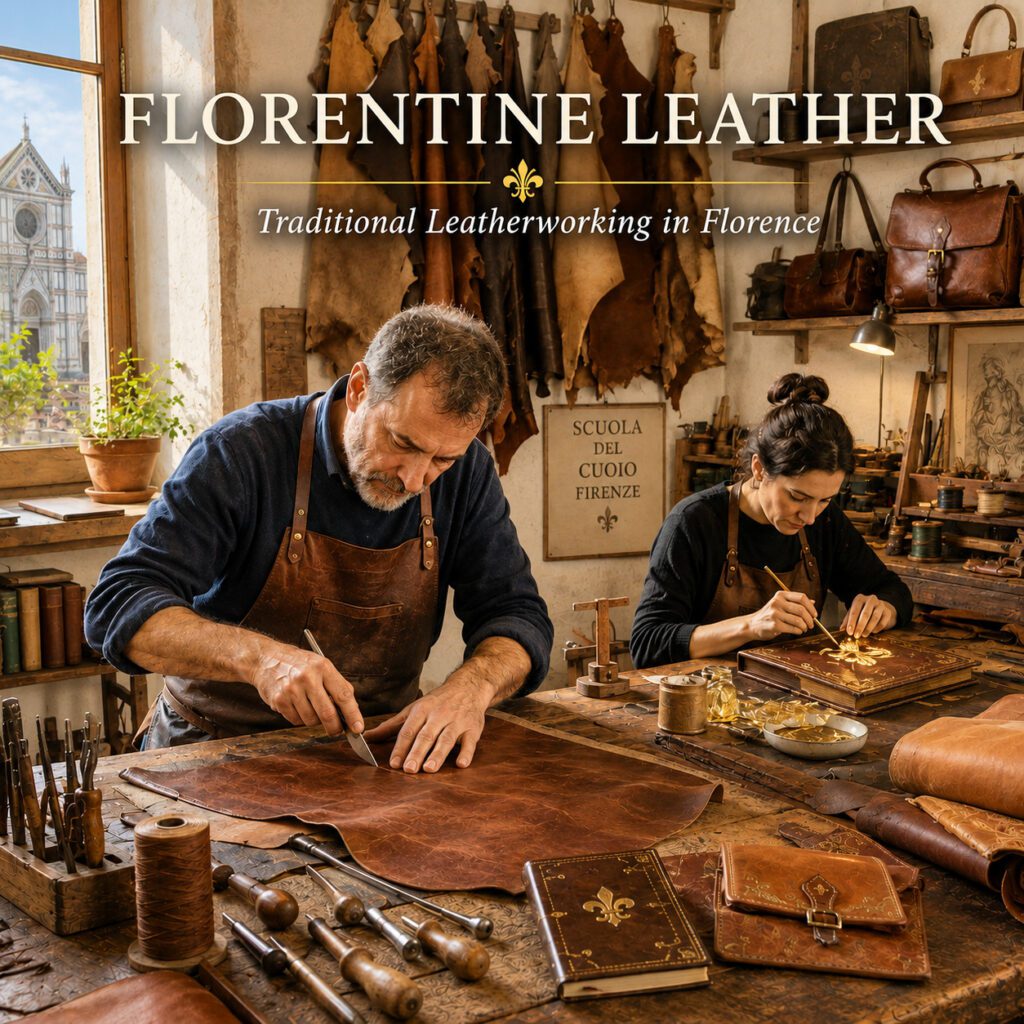
Florentine leather is one of the best-known craft traditions of Florence. Its roots reach back to the medieval city, while artisan workshops continue the tradition today. Bags, gloves, belts, wallets and finely bound objects have made leather almost inseparable from the modern image of Florentine craftsmanship.
Yet behind the elegant shop windows lies a much older story of tanners, guilds and demanding manual skills. Leather was once essential for shoes, clothing, book covers, saddles and countless everyday objects. Over time, practical leatherworking developed into a sophisticated craft that helped Florence gain an international reputation for refined leather goods.
👜 At a Glance
Tradition: Medieval origins with a continuing artisan culture
Historic areas: Santa Croce, Oltrarno and San Lorenzo
Typical products: Bags, gloves, belts, wallets and bookbindings
Traditional skills: Cutting, stitching, moulding, embossing and gilding
Where to see the craft: Scuola del Cuoio and selected artisan workshops
Buying advice: Always distinguish between leather sold in Florence and leather actually made by local or Italian craftspeople
The Origins of Leatherworking in Florence
Leatherworking has a long history in Florence. During the Middle Ages, the growing city created constant demand for durable materials. At the same time, its commercial networks provided access to raw materials and markets beyond Tuscany.
Different specialists participated in the process, from preparing hides to cutting, sewing and decorating finished leather. The early stages were particularly demanding because untreated animal hides required several processes before they became durable and workable.
Tanning also required water and produced strong odours. Therefore, it was not a craft suited to prestigious streets or densely occupied residential quarters. Instead, these activities developed in areas where water was readily available.
Why Tanners Worked Near the Arno
Traditional tanning required substantial quantities of water. This helps explain why activities connected with processing hides developed close to the Arno and other waterways.
The historic connection between leatherworking and the area around Santa Croce still survives in Florentine place names. Via dei Conciatori, for example, recalls the tanners and leatherworkers who once worked in this part of Florence. The Italian word concia refers to tanning.
Today, visitors encounter restaurants, apartments, shops and cultural attractions rather than medieval tanning yards. Nevertheless, the streets still preserve traces of the working city that existed behind Florence’s famous monuments.
🔎 Look at the Street Names
Florence often preserves its craft history in its streets. Names connected with old professions can reveal where particular trades once operated, even when the workshops disappeared centuries ago.
From Raw Hide to Finished Leather
Transforming an animal hide into usable leather is a complex process. Without treatment, hide decomposes. Tanning stabilises its structure and creates a durable material that artisans can cut, shape and use for many different purposes.
Historically, vegetable tanning relied on tannins derived from plant materials such as bark and wood. Craftspeople cleaned and prepared the hides before tanning, drying and finishing them. Depending on the intended use, they could then soften, colour or polish the leather.
The process required patience and considerable practical knowledge. Craftspeople needed to understand how different hides reacted during treatment and how the finished material would behave when cut, folded, stitched or decorated.
The Guild Tradition and Florentine Leather
Like many crafts in medieval and Renaissance Florence, leatherworking belonged to a highly organised economic world. Guilds and professional associations regulated trades, protected commercial interests and established standards within the city’s manufacturing economy.
Different stages of leather production involved different specialists. Tanning raw hides was quite different from making shoes, saddles, bags or other finished objects. This division of labour encouraged a high degree of technical knowledge.
Therefore, the history of Florentine leather cannot be reduced to the modern leather shop. What visitors see today represents only the final stage of a much larger historical network of materials, labour and specialist skills.
🏛 Historical Context
Renaissance Florence depended on specialised workshops. A finished luxury object could represent the work of several craftspeople, each responsible for a particular material, process or decorative technique.
How Florentine Leather Became a Luxury Craft
Leather was valuable because it was versatile. However, skilled craftspeople could transform it far beyond its practical function. Precise stitching, carefully finished edges and decorative details turned everyday objects into expressions of status and refinement.
Florence provided an ideal environment for this development. Wealthy merchants and aristocratic households created demand for finely made objects, while the city already possessed a strong culture of design and specialist craftsmanship.
Later, international travellers also became important customers. As a result, bags, cases, gloves and writing accessories helped establish the reputation for leather craftsmanship that Florence still enjoys today.
Traditional Techniques of Florentine Leatherworking
The character of a handmade leather object depends on many small decisions. First, the artisan chooses leather with the appropriate thickness, texture and flexibility. The individual pieces are then carefully positioned, cut and assembled.
Edges require precise finishing, while seams must provide both strength and visual balance. Depending on the object, artisans may also mould, emboss, stamp, gild or decorate the leather by hand.
These details explain why two objects made from apparently similar material can differ greatly in quality. Good leather matters, but craftsmanship determines how successfully the artisan uses its natural properties.
👀 What to Look For
Examine the edges, stitching, lining and transitions between different pieces of leather. Careful finishing in less visible areas often tells you more about craftsmanship than a prominent logo.
Leather and the Art of Bookbinding
Traditional bookbinding provides one of the most beautiful connections between leather and Florentine craftsmanship. Leather protected valuable books, while its surface also offered numerous possibilities for decoration.
Craftspeople could tool bindings with geometric patterns, borders, floral motifs or lettering. Gold leaf added another level of refinement and transformed a functional cover into a decorative object.
The finished book therefore brought several crafts together, including paper production, binding and leather decoration. This overlap is characteristic of Florentine craftsmanship, where practical objects frequently acquired an artistic dimension.
Florentine Leather and the Oltrarno
The Oltrarno remains one of the most rewarding areas for visitors interested in traditional craftsmanship. Streets around Santo Spirito and San Frediano have long had connections with small workshops, and artisans continue to work here today.
However, the Oltrarno should not be treated as an open-air craft museum. Its appeal comes precisely from the mixture of residential life, historic workshops, restaurants, cafés and contemporary creative businesses.
Walking slowly through the neighbourhood provides opportunities to discover small-scale production that visitors can easily miss on the main tourist routes. Workshop windows, tools and unfinished objects often reveal more about craftsmanship than polished retail displays.
🚶 Firenze Casa Tip
Explore the streets between Santo Spirito and San Frediano without a rigid route. Some of Florence’s most interesting artisan spaces occupy modest premises that are easy to pass without noticing.
The Scuola del Cuoio at Santa Croce
One of the best-known places to encounter Florentine leather craftsmanship is the Scuola del Cuoio within the historic complex of Santa Croce. Founded in the 20th century, it is much younger than Florence’s medieval leather tradition. Nevertheless, it has become an important centre for specialist leatherworking skills.
Visitors can observe artisans working with leather and gain a clearer understanding of the techniques behind finely crafted objects. Particularly fascinating is the traditional decoration of leather with gold leaf, which creates ornamental details, initials and other designs.
Watching artisans cut, stitch, finish and decorate leather makes the difference between genuine craftsmanship and industrial production much easier to understand.
✨ Firenze Casa Tip
If you want to see Florentine leatherworking rather than simply shop for leather, the Scuola del Cuoio is particularly interesting. Look for artisans decorating leather with gold leaf, one of the most beautiful traditional techniques practised there.
San Lorenzo and Florence’s Leather Markets
For many visitors, their first encounter with Florentine leather occurs around San Lorenzo. Stalls and shops offer bags, belts, jackets and countless other leather goods.
However, a product sold in Florence was not necessarily made in Florence. The enormous demand for inexpensive souvenirs means that locally crafted objects coexist with industrially manufactured and imported products.
This does not make San Lorenzo uninteresting. Yet visitors should distinguish between a leather market and an artisan workshop. The two offer very different experiences and should not automatically be treated as evidence of the same manufacturing tradition.
👜 Buying Tip
“Leather sold in Florence” and “leather made in Florence” are not the same thing. If local craftsmanship matters to you, ask where the object was produced and which stages artisans completed by hand.
How to Recognise Quality Florentine Leather
No single test proves that an object represents genuine Florentine craftsmanship. Instead, consider the material, construction and transparency of the artisan or seller together.
Good leather generally has natural character rather than the perfectly uniform appearance of a synthetic surface. Stitching should be controlled and appropriate to the object. In addition, handles, closures, stress points, linings and internal finishing deserve careful attention.
Most importantly, a genuine craftsperson should be able to discuss the object. Ask about the type and origin of the leather, how the piece was constructed and which work took place locally. Specific answers are far more useful than vague claims about “Italian tradition”.
Vegetable-Tanned Leather and Tuscany
Tuscany has a particularly strong association with vegetable-tanned leather. This traditional method uses tannins of plant origin and produces leather that can develop a distinctive patina through handling, light and time.
Today, the tanning industry is no longer concentrated in Florence’s historic centre. Important production takes place elsewhere in Tuscany, particularly in specialised districts with the infrastructure required for modern tanning.
This distinction helps explain contemporary Florentine leather production. An artisan may create an object in Florence while working with leather tanned elsewhere in Tuscany. Therefore, regional material production and local craftsmanship can form different stages of the same finished object.
🌿 Did You Know?
High-quality vegetable-tanned leather often becomes more individual with use. Its surface can gradually develop a deeper colour and distinctive patina rather than remaining visually unchanged.
Florentine Leather Today
Leatherworking in Florence now exists on several very different levels. International luxury brands, established businesses, small artisan workshops and souvenir retailers all contribute to the enormous visibility of leather in the city.
For traditional craftspeople, survival can be challenging. Handmade production requires time, skilled labour and suitable workshop space, while mass-produced goods cost much less. However, growing interest in provenance, repairability and durable objects has also created renewed appreciation for genuine craftsmanship.
The strongest contemporary workshops do not necessarily reproduce historical objects exactly. Instead, many combine inherited skills with modern forms and practical needs. This ability to adapt helps traditional leatherworking remain a living part of Florence.
Leatherworking and Florence’s Other Historic Crafts
Leather is only one part of Florence’s extraordinary artisan heritage. Silk weaving, woodcarving, gilding, stonework and art restoration all developed through highly specialised workshops and knowledge passed between generations.
The historic Antico Setificio Fiorentino, for example, preserves traditional silk weaving through old looms, patterns and specialist craftsmanship. Although silk and leather require completely different techniques, both traditions demonstrate the importance Florence has long placed on materials, precision and skilled manual work.
Together, these crafts reveal a side of Florence that can easily disappear behind the fame of Renaissance painting and sculpture. Many of the city’s celebrated interiors depended on anonymous artisans as much as on famous artists.
Where to Explore Leatherworking in Florence
Visitors interested in Florentine leather can approach the subject from several directions. Santa Croce provides historical context and the Scuola del Cuoio, while the Oltrarno offers opportunities to discover smaller artisan workshops.
San Lorenzo illustrates the modern commercial popularity of leather. However, shoppers should pay close attention to provenance and quality.
Rather than searching only for a single “best leather shop”, compare different environments. Observe how artisans display their objects, whether production takes place on site and how confidently they explain materials and techniques.
This approach turns shopping into part of the cultural experience. Even without buying anything, understanding the difference between industrial merchandise and skilled hand production offers a richer perspective on one of Florence’s most famous traditions.
Why Florentine Leather Is Worth Discovering
The story of Florentine leather reaches far beyond handbags and souvenir markets. It begins with a material essential to medieval life and continues through guild organisation, specialist workshops, luxury production and modern artisan businesses.
It also demonstrates an important characteristic of Florence itself. The city has repeatedly blurred the boundary between practical craft and artistic design. A well-made object had to function properly, but skilled workmanship could also make it beautiful.
That principle remains at the heart of genuine Florentine leather craftsmanship today. The most interesting pieces are not valuable simply because someone bought them in Florence. Their significance lies in the material, the knowledge of the artisan and the careful work required to create an object designed to last.
Frequently Asked Questions About Florentine Leather
Why is Florence famous for leather?
Florence has a long history of tanning and leatherworking that reaches back to the medieval city. Over time, specialist craftsmanship and luxury production gave Florentine leather an international reputation.
Is all leather sold in Florence made in Florence?
No. Locally made artisan goods are sold alongside industrial and imported products. Therefore, ask specifically about origin and production if local craftsmanship matters to you.
Where can you see leather craftsmanship in Florence?
The Scuola del Cuoio at Santa Croce is one of the best-known places to observe traditional leatherworking. Small artisan workshops also survive in parts of the Oltrarno.
Is San Lorenzo a good place to buy Florentine leather?
San Lorenzo offers an enormous selection, but quality and provenance vary considerably. Distinguish carefully between products sold in Florence and objects genuinely produced by Italian or Florentine craftspeople.
What is vegetable-tanned leather?
Vegetable tanning uses tannins derived from plant materials to stabilise hides. Tuscany has a strong tradition of this method, and the resulting leather can develop a distinctive patina over time.
What should I look for when buying handmade leather in Florence?
Examine the stitching, edges, linings and overall construction. In addition, ask where the leather came from and which stages of production took place locally.
Where is Florence’s traditional leatherworking district?
Historically, tanning had strong connections with the Santa Croce area, while the Oltrarno remains particularly associated with small artisan workshops. Today, however, leather businesses are spread across several parts of Florence.
Further Reading on Firenze Casa
- Florentine Crafts – Complete Guide
- Antico Setificio Fiorentino – Historic Silk Weaving in Florence
- Goldsmiths of Florence – Jewellery and the Ponte Vecchio
- Pietra Dura in Florence – The Art of Stone Inlay
- Florentine Paper – Marbling and Traditional Bookbinding
- Florentine Perfume – From Renaissance Apothecaries to Today
References
- Comune di Firenze – historical information on Florentine crafts, guilds and artisan districts
- Scuola del Cuoio, Florence – history and traditions of Florentine leather craftsmanship
- Consorzio Vera Pelle Italiana Conciata al Vegetale – Tuscan vegetable tanning and traditional production methods
- Treccani – historical information on tanning, leatherworking and Florentine guilds
- Museo Horne, Florence – decorative arts and objects illustrating Florentine craftsmanship
- Touring Club Italiano – Florence, Santa Croce, San Lorenzo and the Oltrarno

