
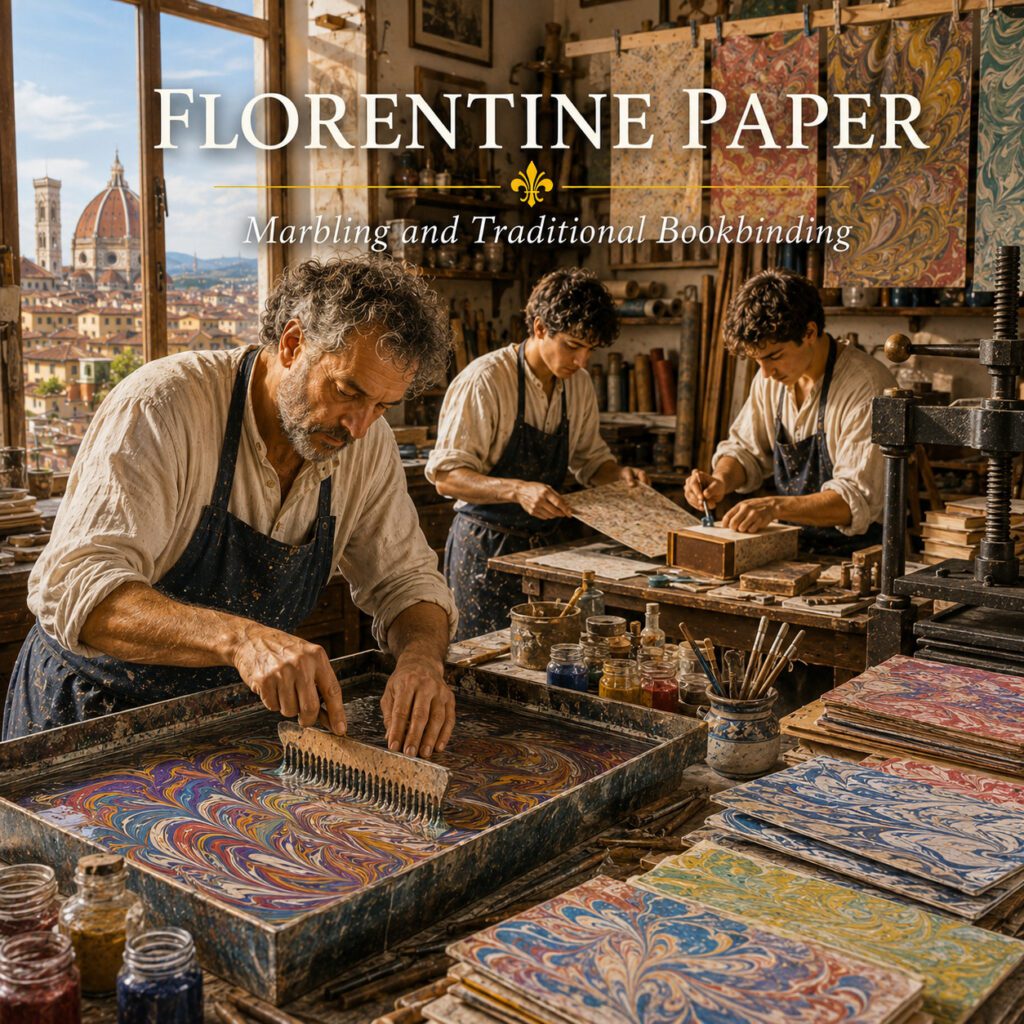
Florentine paper is one of Florence’s most colourful craft traditions. Swirling marbled patterns, decorative motifs and traditional bookbinding transform a simple material into notebooks, albums, boxes and other beautiful objects. Yet behind these familiar Florentine souvenirs lies considerable manual skill.
Traditional paper decoration combines colour, movement and precise handwork. In marbling, pigments float on a prepared liquid surface before the artisan manipulates them into patterns and transfers the design to paper. Bookbinders then use decorated sheets for covers, endpapers and other elements. Together, these techniques form an important part of the wider tradition explored in our Florentine Crafts – Complete Guide.
📚 At a Glance
Tradition: Decorative paper and traditional bookbinding
Known for: Marbled paper and Renaissance-inspired printed patterns
Techniques: Marbling, hand sewing, binding and gold tooling
Typical objects: Notebooks, albums, boxes, folders and stationery
Historic connection: Florence’s long tradition of books, manuscripts and artisan workshops
Today: Specialist paper and bookbinding workshops still continue the craft
Florence and the Art of Decorative Paper
Paper has played an essential role in Florence for centuries. Merchants needed it for correspondence and accounts, scholars filled it with manuscripts, artists used it for drawings, and printers transformed it into books. As literacy and publishing expanded, crafts connected with paper became increasingly important.
Decorative paper belonged to this wider world. Patterned sheets could line books, cover bindings and boxes or decorate everyday objects. Their purpose was practical as well as aesthetic because colour and pattern could transform an otherwise ordinary surface.
However, the term “Florentine paper” describes several decorative traditions rather than a single historic technique. Marbled papers are particularly distinctive because artisans create their patterns with floating colour. Other Florentine papers use printed motifs inspired by Renaissance ornament, textiles and botanical designs.
💡 Good to Know
Not every sheet described as Florentine paper is marbled. Florence is associated with both hand-marbled sheets and decorative papers printed with elaborate repeating designs.
What Is Paper Marbling?
Paper marbling creates patterns by floating colour on a prepared liquid bath. Rather than painting directly onto paper, the artisan first creates the entire design on the liquid surface.
Drops of colour spread across the bath and can then be manipulated with styluses and combs. Depending on the movements, patterns may resemble stone, feathers, waves or elaborate repeating forms.
Once the design is complete, the artisan carefully places a sheet of paper onto the surface. The paper picks up the floating colours almost immediately. After lifting and drying the sheet, a temporary pattern that existed only on liquid has become permanent.
Preparing the Marbling Bath
A successful marbled sheet begins before the first colour reaches the surface. The artisan prepares a shallow tray containing a liquid thick enough to allow pigments to float rather than sink or mix uncontrollably.
The consistency of the bath, pigments and working conditions all influence how the colours behave. The paper itself may also require preparation so that the pigments adhere correctly.
Therefore, what appears to be a spontaneous process actually depends on careful control of materials. Experience allows the artisan to predict how colours will spread and interact while still leaving room for subtle variation.
🎨 The Artisan’s Skill
Marbling means controlling substances that naturally want to move. The artisan must understand how pigments spread and how one colour reacts when another appears beside it.
Combs, Styluses and Traditional Patterns
The tools used for marbling are surprisingly simple. Fine points, sticks and combs allow artisans to manipulate colour across the surface of the bath.
A stylus drawn through concentric circles creates elongated forms. Repeating the movement can produce feather-like effects, while a comb establishes regular lines and waves. Further movements can transform these patterns again.
Although the results appear fluid and spontaneous, traditional designs depend on sequences learned through practice. Experienced marblers know which movements create particular families of patterns.
👀 Watch the Hands
If you see paper being marbled in Florence, watch the sequence of movements rather than only the finished sheet. A few controlled strokes can completely transform the floating colours.
Why Every Hand-Marbled Sheet Is Different
Marbling combines controlled technique with a degree of unpredictability. Pigments expand slightly differently, small currents move across the bath and the artisan’s hand never repeats a gesture with mechanical precision.
This variation is not a flaw. Instead, it is one of the clearest signs of genuine hand production. Small differences in lines, colours and movement reveal the physical process behind each sheet.
Industrial printing can reproduce the appearance of marbling very accurately. However, a printed design repeats. Traditional marbling creates the pattern anew for every sheet.
🛍 Buying Tip
Compare several sheets with the same general design. If every swirl and line appears in exactly the same position, the pattern is probably printed rather than individually marbled by hand.
Marbled Paper and Traditional Bookbinding
Decorative paper has a natural relationship with bookbinding. Marbled sheets are especially attractive as endpapers, the decorated leaves that connect the book block with its covers. Artisans may also use them externally, often together with leather or cloth.
A traditionally bound book brings several materials and skills together. Paper, board, thread and sometimes leather and gold decoration become a single object designed to protect its pages for many years.
This close relationship also connects paper craft naturally with traditional Florentine leatherworking. Both traditions demonstrate how practical materials can acquire artistic value through skilled handwork.
Inside a Traditional Bookbinder’s Workshop
A traditional bookbinding workshop looks very different from a modern printing business. Sheets, boards, leather, decorative papers, thread and hand tools fill the workbench, while presses help shape and secure the developing book.
The binder folds individual sections of pages and assembles them in the correct order before sewing them together. The spine must remain strong while allowing the finished book to open comfortably.
Boards provide structure for the covers. Depending on the binding, artisans cover them with leather, cloth or decorative paper before carefully finishing the edges, corners and other details.
🧵 Craftsmanship Detail
A handmade book is constructed rather than simply decorated. Sewing, spine preparation, cover boards and hinges determine whether it will remain functional after years of use.
Sewing a Book by Hand
Traditional binding joins folded groups of pages, known as sections or gatherings, with thread. The exact sewing structure varies, but its purpose is to create a flexible and durable book block.
This construction differs fundamentally from inexpensive books whose individual pages may simply be glued at the spine. A properly sewn binding withstands repeated opening and is also easier to repair.
Accuracy matters throughout the process. If sections are folded or sewn unevenly, even small errors can affect how the finished book sits inside its covers.
Leather, Paper and Gold
Traditional Florentine bookbinding often brings several of the city’s crafts together. Leather can provide a durable spine or cover, while Florentine paper introduces colour and pattern. Gold tooling can then add titles, borders and ornamental details.
A single book may therefore combine the knowledge of paper decorators, leatherworkers and craftspeople skilled in decorative finishing. This overlap is characteristic of Florence, where individual trades rarely existed in complete isolation.
The result also demonstrates why the boundary between functional object and decorative art can be difficult to draw. A book exists to be read, yet its binding may simultaneously become an object of considerable beauty.
Gold Tooling on Traditional Bindings
One of the most refined forms of book decoration involves applying gold to leather bindings. Heated tools carrying letters, lines or ornamental motifs create precise impressions and attach extremely thin gold leaf to the surface.
The technique requires careful control of pressure, temperature and positioning. Titles must remain aligned, while repeated decorative elements need to form coherent borders or patterns.
The same emphasis on precision appears in the goldsmith tradition of Florence. Although the materials and techniques differ, both crafts depend on controlled handwork and meticulous decorative finishing.
✨ Did You Know?
A traditionally bound book can combine several crafts: decorated paper, hand sewing, leatherwork and gold tooling may all contribute to a single finished object.
Printed Florentine Paper
Not all decorative Florentine paper is produced through marbling. Florence is also strongly associated with printed papers carrying elaborate repeated motifs, often inspired by Renaissance ornament, flowers, foliage and textiles.
These papers can be equally striking, but their production differs from marbling. Artisans and contemporary workshops use them for notebooks, boxes, picture frames and stationery.
Distinguishing between marbled and printed Florentine paper makes the tradition more interesting rather than less. Each technique has its own visual language and production process.
Florentine Paper and Renaissance Textile Patterns
Many decorative papers sold in Florence feature dense floral and geometric motifs reminiscent of Renaissance textiles. This connection is particularly interesting in a city with such a strong history of luxury silk production.
Pomegranates, scrolling foliage, stylised flowers and symmetrical patterns can evoke brocades and damasks without reproducing a particular fabric. Metallic details sometimes heighten the impression of textile richness.
For comparison, the Antico Setificio Fiorentino preserves Florence’s historic silk-weaving tradition through old looms, patterns and specialist craftsmanship. Together, textiles and decorative papers reveal the importance of repeated ornament within Florentine design.
From Books to Boxes and Stationery
Decorative paper extends far beyond bookbinding. Artisan workshops use patterned sheets for boxes, folders, albums, desk accessories and picture frames. Smaller pieces can become bookmarks, cards or decorative details.
This makes paper one of Florence’s more accessible traditional crafts. A handmade notebook or small box can preserve artisan techniques without the cost associated with jewellery, leather goods or elaborate Florentine pietra dura.
Such objects also retain a practical purpose. They are designed to be handled and used rather than simply displayed, continuing Florence’s long tradition of combining usefulness with decoration.
📖 Firenze Casa Tip
A small hand-bound notebook or genuinely marbled sheet makes an unusually authentic Florence souvenir: lightweight, useful and directly connected with the city’s artisan traditions.
Where to Discover Florentine Paper in Florence
Traditional stationery shops and artisan workshops remain scattered through Florence’s historic centre and the Oltrarno. Some concentrate on decorative paper and stationery, while others combine bookbinding, restoration and the production of notebooks, albums or boxes.
The most rewarding places are those where the process remains visible. Stacks of individual sheets, bookbinding tools, presses and unfinished objects suggest that a shop is connected with actual craft production rather than simply selling souvenirs.
When possible, ask whether marbling or binding takes place in the workshop. Artisans who practise the techniques themselves can usually explain their materials and methods in detail.
Historic Florentine Paper and Bookbinding Workshops
Several Florentine businesses have helped keep decorative paper and traditional bookbinding visible in the modern city. Il Papiro, established in Florence in the 20th century, became internationally known for marbled paper, stationery and decorated objects.
Florence also preserves specialist bookbinding traditions through historic artisan businesses such as Giulio Giannini e Figlio. Such workshops demonstrate how decorative paper, leather and hand-bound books belong to the same craft environment.
For travellers, these businesses provide an accessible introduction to Florentine paper. However, anyone particularly interested in hand production should still ask which technique was used for a specific sheet or object.
🔎 Look for the Process
The most interesting workshops often contain unfinished work. A book in a press, folded sections waiting to be sewn or freshly decorated sheets reveal much more about the craft than shelves filled only with finished products.
How to Recognise Handmade Marbled Paper
Begin by looking for variation. Genuine hand marbling produces individual sheets, so identical patterns should not repeat mechanically. Lines may follow the same general structure while differing subtly in position and movement.
Next, examine the fluidity of the design. Hand-marbled patterns reflect pigments manipulated on a bath rather than mechanically repeated details.
Most importantly, ask how the paper was produced. A genuine artisan should be able to explain the marbling bath, pigments and tools and may even demonstrate part of the process.
Choosing a Hand-Bound Book
When examining a handmade notebook or book, open it gently and observe how it moves. The pages should sit comfortably within the covers, while the spine should allow the book to open without excessive resistance.
Look carefully at corners and edges, where imprecise work is often easiest to identify. Decorative paper should be applied cleanly, and transitions between paper, cloth or leather should appear deliberate.
A handmade object does not need to look industrially perfect. Small variations can reveal the maker’s hand, but construction should remain controlled and functional.
🛍 Buying Tip
Do not judge a handmade notebook only by its cover. Open it, examine the spine and corners, and look at how the pages have been assembled. Good bookbinding is structural craftsmanship as much as decoration.
Florentine Paper Today
Like many traditional crafts, paper marbling and hand bookbinding exist alongside inexpensive industrial alternatives. Printed imitations reproduce historical patterns quickly, while mass-produced notebooks cost much less than objects assembled by hand.
However, renewed interest in handmade stationery, calligraphy and traditional materials has helped preserve a market for genuine craftsmanship. Many visitors now want to know how an object was made and who created it rather than simply buying a souvenir labelled “Florence”.
Contemporary artisans can therefore preserve historic techniques without restricting themselves to old designs. New colours and modern formats allow the craft to evolve while retaining its essential manual processes.
Paper as Part of the Florentine Crafts Tradition
Florentine paper occupies an interesting place among the city’s traditional crafts. Unlike gold or rare stones, its basic material is relatively modest. Its value comes primarily from what skilled hands do with it.
This connects marbling and bookbinding with Florence’s other artisan traditions. Silk weavers transform threads into textiles, leatherworkers shape hides, goldsmiths manipulate precious metals and pietra dura artisans turn fragments of stone into pictures.
Together, these traditions form the wider world of Florentine craftsmanship. They remind us that the city’s artistic identity was built not only in famous studios but also at countless workbenches where generations learned to understand materials through their hands.
Why Florentine Paper Still Matters
The appeal of Florentine paper lies partly in its immediacy. Watching colour spread across a marbling bath and then seeing the complete pattern transferred to paper within moments can feel almost magical.
Yet the apparent simplicity hides considerable experience. The artisan must understand pigments, movement and timing, while the bookbinder transforms fragile sheets into durable objects through careful construction.
In an age of identical mass-produced goods, the small differences between handmade sheets have acquired new significance. Each one records a particular moment of movement and the decisions of its maker. That individuality is precisely what makes traditional Florentine paper worth preserving.
Frequently Asked Questions About Florentine Paper
What is Florentine paper?
Florentine paper generally refers to decorative papers associated with Florence, including hand-marbled sheets and papers printed with elaborate floral, geometric and Renaissance-inspired patterns.
How is marbled paper made?
Colours float on a prepared liquid bath and are manipulated with tools such as styluses and combs. The artisan then places paper onto the surface to transfer the finished pattern.
Is every sheet of Florentine paper handmade?
No. Many decorative papers sold in Florence are mechanically printed. Genuine hand-marbled sheets are individually produced and therefore show natural variations.
Why is marbled paper used in bookbinding?
Marbled paper is decorative, lightweight and versatile. Bookbinders traditionally use it for endpapers, covers and other elements, often together with leather or cloth.
Can you still see traditional bookbinding in Florence?
Yes. Florence still has specialist bookbinders and artisan businesses working with decorative paper, leather and traditional binding techniques.
How can I recognise handmade marbled paper?
Compare several sheets and look for natural variations in the pattern. Exact repetition usually indicates a printed design rather than individual hand marbling.
What makes a good Florentine paper souvenir?
A genuinely hand-marbled sheet, hand-bound notebook, album or small paper-covered box can be an excellent choice. Ask where and how the object was made before buying.
Further Reading on Firenze Casa
- Florentine Crafts – Complete Guide
- Antico Setificio Fiorentino – Historic Silk Weaving in Florence
- Florentine Leather – Traditional Leatherworking in Florence
- Goldsmiths of Florence – Jewellery and the Ponte Vecchio
- Pietra Dura in Florence – The Art of Stone Inlay
- Florentine Perfume – From Renaissance Apothecaries to Today
References
- Biblioteca Nazionale Centrale di Firenze – history of books, paper and book culture in Florence
- Biblioteca Medicea Laurenziana – manuscripts and the Florentine book tradition
- Il Papiro, Florence – traditional decorative paper and marbling techniques
- Giulio Giannini e Figlio, Florence – traditional Florentine bookbinding and decorative paper
- Treccani – history of paper, bookbinding and decorative arts in Italy
- Victoria and Albert Museum – marbled papers, bookbinding and European decorative arts
- Metropolitan Museum of Art – historic bookbinding and decorative paper traditions

