
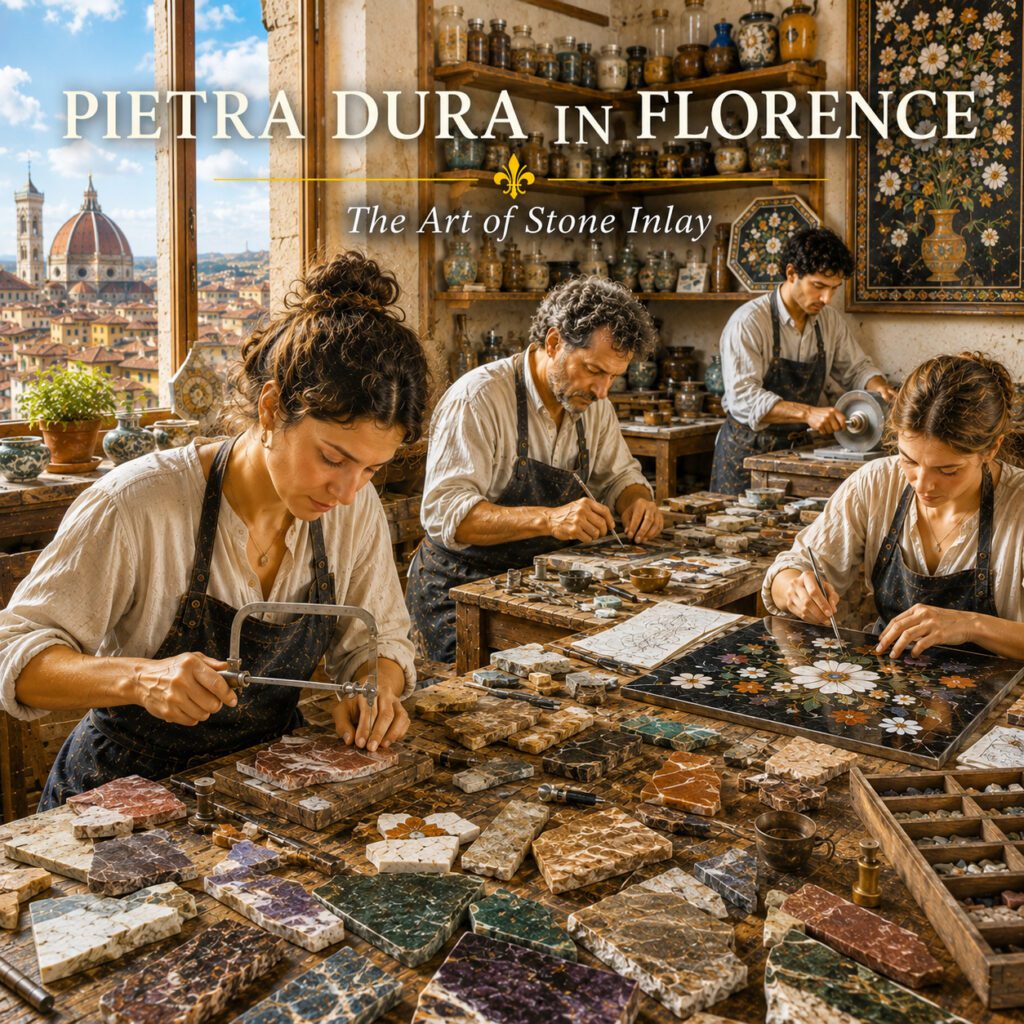
Pietra Dura in Florence is one of the city’s most extraordinary decorative traditions. Carefully selected pieces of coloured stone become intricate pictures, patterns and luxurious objects. Perfected under Medici patronage, the technique became a speciality of the Florentine court and produced flowers, birds and landscapes that can initially look like paintings.
The Italian expression pietre dure means “hard stones”, while the technique is commonly known internationally as pietra dura. Its beauty comes from the artisan’s ability to recognise colours and natural markings within stone, cut individual pieces with great precision and assemble them so closely that the joins almost disappear. It is one of the most distinctive traditions explored in our Complete Guide to Florentine crafts.
🪨 At a Glance
Tradition: Florentine hard-stone inlay
Golden age: Medici grand-ducal Florence
Historic workshop: Galleria dei Lavori, founded in 1588
Materials: Jasper, agate, chalcedony, lapis lazuli and other coloured stones
Highlights: Museo dell’Opificio delle Pietre Dure and Cappella dei Principi
Known for: Flowers, birds, landscapes, tabletops and luxury decorative objects
What Is Pietra Dura?
Pietra dura is a decorative technique in which artisans shape pieces of coloured stone individually and fit them together to create images or ornamental designs. Materials can include jasper, agate, chalcedony, lapis lazuli and many other stones chosen for their distinctive colours, veins and natural patterns.
The principle sounds simple, but the execution can be extraordinarily demanding. Each section of a design requires a suitable piece of stone, and every element must fit precisely against its neighbours. A flower petal, feather or fold of fabric may consist of several carefully selected fragments whose natural variations create highlights and shadows.
Finally, artisans polish the surface until the pieces visually merge into a unified composition. In the finest examples, viewers need to approach closely before realising that the “painting” contains no conventional paint at all.
🔎 Look Closely
A vein in the stone might become the edge of a cloud, the markings of an animal or the shadow on a flower petal. In fine pietra dura, natural variations become part of the design.
Florence and the Medici Passion for Precious Stones
The development of Pietra Dura in Florence is closely connected with Medici court culture. The grand dukes collected precious and unusual materials and encouraged workshops capable of transforming them into sophisticated works of art.
In the late 16th century, Grand Duke Ferdinando I de’ Medici established a court workshop dedicated to hard-stone work. This brought highly skilled craftspeople together and allowed techniques to develop within an environment supported by one of Europe’s most influential ruling families.
Medici commissions demanded exceptional workmanship. Decorative panels, tabletops, cabinets and architectural elements demonstrated both wealth and technical sophistication. Precious stones arrived from distant regions, while Florentine artisans transformed them into objects for palaces, churches and diplomatic gifts.
The Founding of the Grand-Ducal Workshop
In 1588, Ferdinando I established the Galleria dei Lavori, which became the institutional centre of Florentine hard-stone craftsmanship. Its artisans worked for the Medici court on ambitious projects that could require years of specialised labour.
The workshop brought together knowledge of stone, drawing, cutting, polishing and composition. Artists could provide designs, but translating them into stone required craftspeople who understood the colours and patterns hidden within natural materials.
This combination of artistic design and technical mastery became characteristic of the Florentine tradition. The workshop eventually developed into the institution known today as the Opificio delle Pietre Dure.
🏛 Historical Context
The Medici did more than collect pietra dura. Their patronage created an organised centre of specialist craftsmanship whose legacy survives in Florence more than four centuries later.
How a Pietra Dura Picture Begins
Before cutting begins, the artisan needs a design. Historical compositions could depict flowers, birds, fruit, landscapes, architecture or elaborate ornamental patterns. The drawing provides the structure, but the choice of stone determines much of the finished work’s character.
This stage requires a particular kind of imagination. The artisan examines slabs and fragments for markings that correspond to elements within the design. A reddish vein may suggest a petal, while a cloudy area can become part of a sky. Contrasting bands might create the impression of folds in fabric.
Unlike paint, stone cannot simply be mixed to produce the exact colour required. The craftsperson must find the colour in nature. Therefore, material selection becomes one of the most creative stages of the entire process.
Cutting and Fitting the Stone by Hand
Once the artisan selects a suitable stone, the individual element must be cut. Traditional Florentine craftspeople used remarkably simple-looking tools for work that demanded enormous precision.
A characteristic cutting tool consisted of a bow fitted with a metal wire. Combined with abrasive material and controlled by hand, it gradually worked through hard stone. The process was slow, especially when creating small curves and complex shapes.
Each piece then required careful refinement until it fitted closely against the surrounding elements. Even a slight mismatch could create a visible line. Consequently, fitting the stones demanded patience and exceptional manual control.
🛠 The Artisan’s Skill
Traditional pietra dura is not created by breaking stones into approximate shapes. Artisans carefully cut and adjust individual pieces so that complex curves and tiny details fit together with remarkable accuracy.
From Individual Stones to a Complete Image
As the separate elements are completed, the artisan assembles them according to the original design. Colour, pattern and shape must work together because a technically perfect fit alone does not guarantee a convincing image.
After assembly, careful finishing and polishing reveal the depth and brilliance of the stones. At the same time, the process helps the composition appear visually continuous.
This explains why the technique became known outside Italy as “Florentine mosaic”. However, conventional mosaic generally uses many smaller tesserae. Florentine pietra dura instead relies on individually shaped pieces selected specifically for each part of the design.
Painting with Stone
The phrase “painting in stone” captures the most fascinating quality of Pietra Dura in Florence. Skilled artisans learned to use natural stone to imitate many visual effects normally associated with painting.
Different shades within a single piece can suggest modelling and depth. Translucent stones create luminous effects, while veins and irregularities provide movement. Against a dark background, brightly coloured flowers or birds can appear almost three-dimensional.
Yet the artisan does not need to paint these effects onto the stone. The illusion depends on finding the right fragment and positioning it intelligently within the composition.
🎨 Did You Know?
The colours of pietra dura belong to the stones themselves. Therefore, historic works can retain remarkable brilliance when properly preserved.
Flowers, Birds and Landscapes
Floral compositions became one of the most recognisable subjects of Florentine stone inlay. Tulips, lilies, roses and other flowers could be recreated from brilliantly coloured stones and arranged against dark backgrounds.
Natural variations within agate, jasper and other materials imitate the subtle changes of colour found in petals and leaves. Moreover, polished surfaces give these compositions an extraordinary richness and depth.
Birds and animals offered different opportunities. Craftspeople used natural markings for feathers, fur and changing textures. Landscape scenes demanded even greater ingenuity, as veined stones could suggest mountains, clouds or distant horizons.
These works demonstrate that pietra dura developed far beyond simple ornamentation. At its most sophisticated, it became a genuine pictorial art capable of representing complex scenes.
Pietra Dura and the Medici Chapels
The most spectacular architectural expression of Florence’s passion for coloured stone can be seen in the Medici Chapels at San Lorenzo. The vast Cappella dei Principi was conceived as a grand dynastic mausoleum and decorated with an extraordinary range of coloured and precious stones.
Here the technique expands from intimate objects to monumental architecture. Walls, coats of arms and decorative surfaces create an environment in which stone itself becomes the dominant source of colour.
The project required enormous resources and prolonged work by the grand-ducal workshops. As a result, it remains one of the clearest demonstrations of the relationship between Medici political ambition and specialist Florentine craftsmanship.
💡 Firenze Casa Tip
Combine the Museo dell’Opificio delle Pietre Dure with the Cappella dei Principi at San Lorenzo. Together, they show how Florentine stonework ranged from tiny pictorial details to monumental architecture.
Tables, Cabinets and Luxury Objects
Not every masterpiece of Florentine stonework was architectural. Tabletops became impressive showcases for the technique because their broad surfaces allowed elaborate compositions to unfold like paintings.
Cabinets, boxes and smaller decorative objects also incorporated hard-stone panels. Such pieces became highly desirable at European courts, where Florentine workmanship was associated with sophistication and princely collecting.
These objects became portable ambassadors for Medici Florence. When rulers received them as diplomatic gifts or acquired them for their collections, they carried the reputation of Florentine craftsmanship far beyond Tuscany.
The Opificio delle Pietre Dure
The historic grand-ducal workshop eventually developed into the Opificio delle Pietre Dure, one of Florence’s most remarkable cultural institutions. Its name preserves the connection with hard-stone craftsmanship, although its modern role extends far beyond decorative stonework.
Today, the Opificio is internationally renowned for conservation and restoration. Specialists work on paintings, sculpture, mosaics, textiles and other works of art. They combine scientific research with highly developed practical expertise.
This evolution is particularly fitting. The same culture of precision, material knowledge and patient manual work that characterised historic pietra dura also lies at the heart of modern conservation.
The Museo dell’Opificio delle Pietre Dure
For anyone interested in Pietra Dura in Florence, the Museo dell’Opificio delle Pietre Dure is one of the most important places to visit. Its collection provides a concentrated introduction to the materials, history and extraordinary technical sophistication of Florentine stone inlay.
Visitors can see finished works while also gaining a clearer understanding of how artisans transformed raw stone into detailed compositions. Seeing the materials and techniques alongside completed objects makes the enormous amount of labour much easier to appreciate.
The museum is less famous than Florence’s major galleries. Therefore, it is particularly rewarding for travellers interested in discovering the city beyond its most obvious masterpieces.
📍 Practical Info
The Museo dell’Opificio delle Pietre Dure is located on Via degli Alfani in central Florence, only a short walk from the Duomo. Check current opening hours and access information before visiting.
From Court Workshop to Conservation Institute
The transformation of the Opificio from a grand-ducal workshop into a conservation institute shows how traditional expertise can acquire new purposes. Knowledge of materials remains fundamental, but specialists now use it primarily to understand, preserve and restore works of art.
Modern conservation combines craftsmanship with chemistry, physics, imaging and historical research. Before treating an object, specialists need to understand its materials, construction and changes over time.
In this sense, the institution preserves something deeper than a single decorative technique. It maintains the Florentine tradition of treating material knowledge as an essential part of artistic culture.
Can You Still Find Pietra Dura Artisans in Florence?
Pietra dura has not disappeared from Florence. Although the great Medici court workshops belong to history, specialist artisans continue to practise stone inlay on a smaller scale. They preserve traditional techniques while creating both historic designs and contemporary compositions.
As with other Florentine crafts, visitors should distinguish between genuinely handmade work and inexpensive industrial objects. Authentic stone inlay requires time, skill and individual selection of materials. Its price inevitably reflects that labour.
This same distinction between genuine craftsmanship and mass-produced goods also matters when exploring traditional Florentine leatherworking or the city’s historic jewellery tradition.
🛍 Buying Tip
Ask whether artisans cut and fitted the individual stones by hand and where they produced the piece. Fine pietra dura should reveal precise joins and thoughtful use of the natural markings within each stone.
How to Recognise Fine Pietra Dura
Begin by looking at the joins between individual pieces. In high-quality work, they should follow complicated curves without distracting gaps. The surface should appear visually unified rather than like a collection of unrelated fragments.
Next, examine the choice of stones. Fine craftsmanship uses natural markings deliberately. A skilled artisan does not merely choose a red stone for a flower. Instead, variations within that particular fragment contribute to the light, shape and depth of the petal.
Finally, step back from the object. The finest pietra dura works on two levels. From a distance it forms a convincing picture, while close examination reveals the extraordinary puzzle of natural materials from which that image emerged.
Pietra Dura and Florence’s Wider Craft Tradition
Stone inlay belongs to the same culture of specialist workmanship as historic Florentine silk weaving, leatherworking and the goldsmith tradition of Florence. These crafts use very different materials, yet all depend on precision, design and knowledge accumulated through generations.
They also challenge the modern distinction between “art” and “craft”. A masterfully cut flower made from fragments of jasper and chalcedony requires both technical expertise and artistic judgement. Neither element can succeed without the other.
This is one reason Florence remains so compelling for anyone interested in craftsmanship. Famous museums preserve the masterpieces, while workshops and specialist collections reveal the materials and skills behind the city’s artistic culture.
Why Pietra Dura in Florence Still Matters
Pietra Dura in Florence represents one of the purest expressions of the city’s fascination with materials. The artisan does not impose colour on a blank surface. Instead, the required colour, texture and pattern must first be discovered within nature.
The Medici transformed this skill into a prestigious court art and established workshops whose influence spread throughout Europe. Their legacy survives in the Cappella dei Principi, historic collections and the extraordinary institution that became today’s Opificio delle Pietre Dure.
Above all, the technique rewards close observation. What initially appears to be a painted flower, bird or landscape gradually reveals itself as an intricate assembly of stone. That moment of discovery is perhaps the best introduction to the patience and ingenuity behind Florentine craftsmanship.
Frequently Asked Questions About Pietra Dura in Florence
What is pietra dura?
Pietra dura is a decorative technique in which artisans cut and fit coloured hard stones together to create pictures, patterns and ornamental designs.
Why is Florence famous for pietra dura?
The Medici supported specialist hard-stone workshops in Florence, and Ferdinando I established the Galleria dei Lavori in 1588. Florentine artisans subsequently became internationally renowned for sophisticated stone inlay.
Is pietra dura the same as mosaic?
No. Traditional mosaic generally builds images from many small tesserae, while Florentine pietra dura typically uses individually shaped pieces selected for specific elements of a design.
Where can I see pietra dura in Florence?
The Museo dell’Opificio delle Pietre Dure has the most specialised collection. The Cappella dei Principi in the Medici Chapels shows coloured and precious stone on a monumental architectural scale.
What stones are used in Florentine pietra dura?
Artisans use materials such as jasper, agate, chalcedony and lapis lazuli. They choose stones for their colour as well as their natural veins, patterns and texture.
Is pietra dura still made in Florence?
Yes. Specialist artisans continue to practise traditional stone inlay in Florence, although production is much smaller than during the era of the Medici court workshops.
How can I recognise high-quality pietra dura?
Look for extremely precise joins and intelligent use of the stone’s natural markings. Fine work should form a convincing image from a distance while revealing remarkable detail at close range.
Further Reading on Firenze Casa
- Florentine Crafts – Complete Guide
- Antico Setificio Fiorentino – Historic Silk Weaving in Florence
- Florentine Leather – Traditional Leatherworking in Florence
- Goldsmiths of Florence – Jewellery and the Ponte Vecchio
- Florentine Paper – Marbling and Traditional Bookbinding
- Florentine Perfume – From Renaissance Apothecaries to Today
- Museo dell’Opificio delle Pietre Dure
References
- Opificio delle Pietre Dure – history of the institution, hard-stone craftsmanship and conservation
- Museo dell’Opificio delle Pietre Dure – collections and history of Florentine pietra dura
- Musei del Bargello – Medici Chapels and the Cappella dei Principi
- Treccani – pietre dure, Medici patronage and Florentine decorative arts
- Gallerie degli Uffizi – Medici collections and Florentine court art
- Victoria and Albert Museum – Florentine hard-stone inlay and European decorative arts
- Metropolitan Museum of Art – Italian pietra dura and Renaissance decorative arts

