
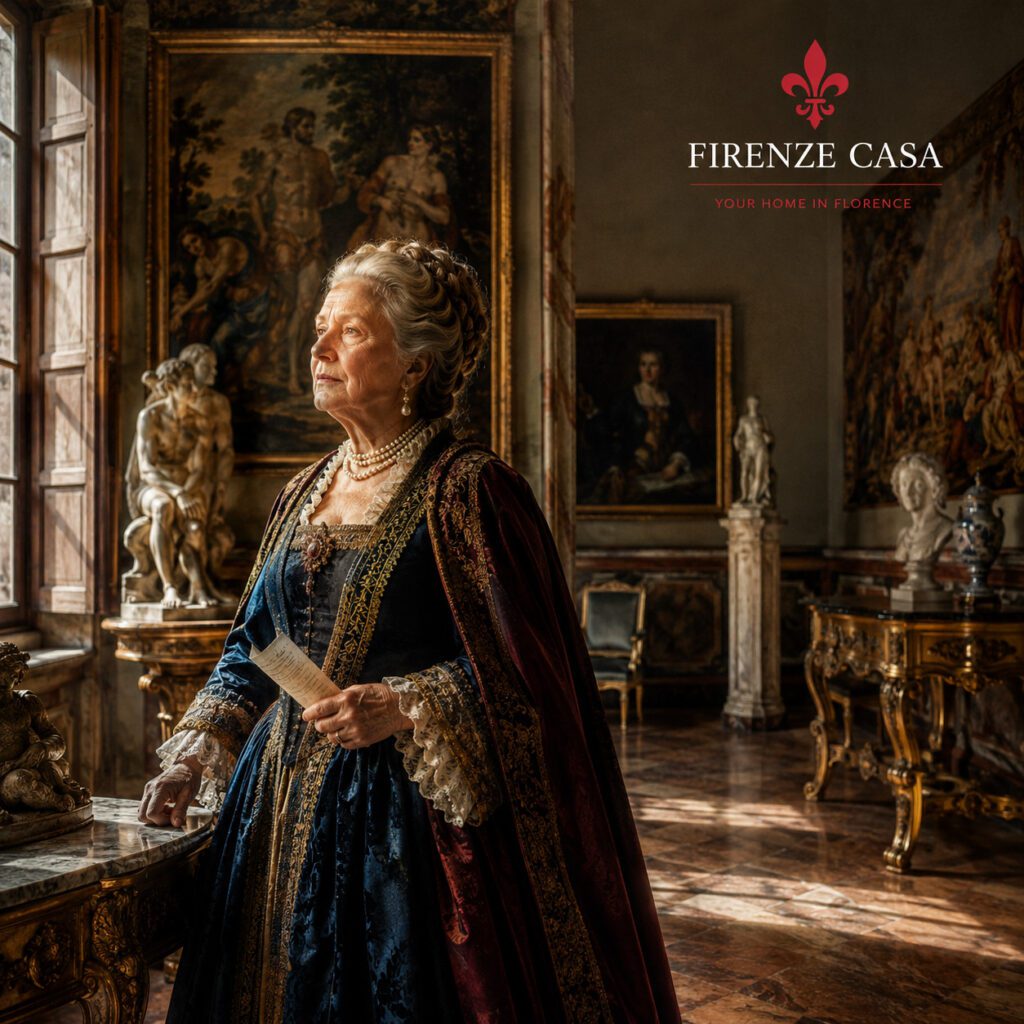
Anna Maria Luisa de’ Medici holds a unique place in the history of Florence. She did not rule the city, command armies or commission the great monuments normally associated with Medici power. Instead, her greatest contribution came at the end of the dynasty, when she helped ensure that generations of Medici collections remained in Tuscany rather than being dispersed across Europe.
Her famous agreement with the new rulers of Tuscany became known as the Family Pact. It protected an extraordinary cultural inheritance that included paintings, sculptures, precious objects, libraries and other collections accumulated during centuries of Medici patronage. The consequences remain visible today in the Uffizi, Palazzo Pitti and the Medici Chapels.
Born: 11 August 1667, Florence
Father: Cosimo III de’ Medici
Title: Electress Palatine
Husband: Johann Wilhelm II, Elector Palatine
Returned to Florence: After 1716
End of Medici rule: 1737
Key achievement: Family Pact
Died: 18 February 1743
Why she matters: She helped ensure that the Medici artistic inheritance remained connected with Tuscany
Anna Maria Luisa is one of the central personalities in our History of Florence – Important Florentine Figures and the final representative of the ruling line explored in our Medici Family – The Dynasty That Shaped Florence.
Who Was Anna Maria Luisa de’ Medici?
Anna Maria Luisa de’ Medici was born in Florence on 11 August 1667. She was the daughter of Grand Duke Cosimo III de’ Medici and Marguerite Louise d’Orléans and grew up inside a dynasty that had ruled Tuscany for generations.
Yet the political future of the family was becoming increasingly uncertain. Her brothers Ferdinando and Gian Gastone failed to produce surviving heirs, and over time it became clear that the principal Medici line would probably disappear.
This dynastic crisis would eventually determine not only the political future of Tuscany but also the fate of the enormous Medici cultural inheritance.
Anna Maria Luisa received the education expected of a European princess. Music, religion and the arts formed important parts of her world, while her position within one of Europe’s most celebrated ruling families exposed her to the traditions of Medici collecting and patronage from an early age.
The Medici created extraordinary collections over generations. Anna Maria Luisa became important at the moment when the dynasty itself was disappearing and the future of those collections became uncertain.
A Medici Princess in Düsseldorf
In 1691, Anna Maria Luisa married Johann Wilhelm II, Elector Palatine. The marriage took her from Florence to Düsseldorf, where she became known as the Electress Palatine.
Her husband maintained an important court and shared her interest in art and music. Together, they supported artists, musicians and cultural projects, while Düsseldorf developed into a significant centre of court culture.
Anna Maria Luisa therefore spent many years away from Tuscany while remaining closely connected to the sophisticated European world of collecting and patronage.
The marriage produced no children. When Johann Wilhelm died in 1716, Anna Maria Luisa eventually returned to Florence, where the question of Medici succession had become increasingly urgent.
Anna Maria Luisa is often called the “Electress Palatine” because of her marriage to Johann Wilhelm. In Italian sources she frequently appears as the Elettrice Palatina.
The End of the Medici Dynasty
The Medici had dominated Florentine politics since the fifteenth century and ruled Tuscany as grand dukes from the sixteenth century onward.
By the early eighteenth century, however, the dynasty faced a problem that wealth and political influence could not solve: there was no secure successor.
Anna Maria Luisa’s elder brother, Grand Prince Ferdinando, died in 1713 without surviving children. Her younger brother Gian Gastone became Grand Duke of Tuscany after the death of Cosimo III in 1723, but his marriage also remained childless.
European powers increasingly treated the Tuscan succession as part of the wider diplomatic balance of Europe. Consequently, the future of the grand duchy would be decided through international agreements rather than solely within Florence.
When Gian Gastone died on 9 July 1737, almost three centuries of Medici political dominance in Florence came to an end. Tuscany passed to Francis Stephen of Lorraine, who later became Holy Roman Emperor Francis I.
Anna Maria Luisa was now the last surviving member of the grand-ducal Medici line.
What Would Happen to the Medici Collections?
The extinction of a ruling dynasty raised an important practical question.
The Medici had accumulated enormous collections through centuries of patronage, purchase and inheritance. Paintings, sculptures, jewels, furniture, manuscripts, scientific objects and other treasures filled palaces, villas and institutions associated with the family.
Such collections did not automatically belong to a city in the modern sense. They were closely tied to the ruling house, and a dynastic succession could result in works being transferred to another court, divided among heirs or used as diplomatic gifts.
Florence therefore risked losing part of the cultural inheritance that had developed under the Medici.
Anna Maria Luisa recognised that these collections had significance far beyond their monetary value.
Today, we naturally associate the Uffizi and Palazzo Pitti with Florence. In the eighteenth century, however, great collections were often dynastic property, and a change of ruling family could also change where those collections were kept.
The Family Pact of 1737
The crucial agreement came in 1737.
Anna Maria Luisa de’ Medici and representatives of the new Habsburg-Lorraine dynasty concluded an arrangement commonly known as the Family Pact, or Patto di Famiglia.
The agreement transferred the Medici artistic and cultural inheritance to the new ruling dynasty while attaching an essential condition: the collections were to remain connected with the Tuscan state and were not to be removed from its territories.
The protected inheritance included an extraordinary range of objects accumulated by generations of Medici rulers.
This became Anna Maria Luisa’s defining contribution to Florence. She understood that the collections represented history, prestige and cultural identity rather than merely private dynastic wealth.
What Did Anna Maria Luisa Actually Preserve?
It is tempting to simplify the story by saying that Anna Maria Luisa “gave the Uffizi to Florence”. The historical reality is more complex.
The Uffizi already existed, while Medici collections were distributed across several palaces, villas, libraries and institutions.
Her achievement concerned the broader dynastic patrimony. Paintings, statues, libraries, jewels, furnishings and other precious possessions associated with the Medici were to remain within Tuscany.
Over time, many of these collections became central to the museums through which visitors encounter Medici Florence today.
Anna Maria Luisa did not create Florence’s museums in their modern form. Her importance lies in helping preserve the Medici collections as a territorial inheritance rather than allowing them to be dispersed with the change of dynasty.
The Uffizi and the Medici Legacy
The Uffizi provides perhaps the clearest example of why Anna Maria Luisa’s decision matters today.
Cosimo I de’ Medici originally commissioned Giorgio Vasari to construct the complex as administrative offices in the sixteenth century. Later generations of the family increasingly used parts of the building to display their collections.
Those holdings eventually included works by artists now inseparable from Florence, among them Botticelli, Leonardo da Vinci, Raphael and Titian.
The Family Pact helped keep this dynastic inheritance in Tuscany after Medici rule ended. During the following decades, the Uffizi continued its development towards the public museum visitors know today.
Palazzo Pitti and the Collections Across the Arno
Anna Maria Luisa’s legacy also reaches across the Arno to Palazzo Pitti.
The Medici acquired the palace in the sixteenth century and transformed it into their principal grand-ducal residence. Successive rulers filled its rooms with paintings, furniture and decorative objects.
Palazzo Pitti therefore contained another major part of the dynasty’s cultural inheritance.
The palace continued as a ruling residence under the new Habsburg-Lorraine dynasty, while its extraordinary collections remained in Tuscany.
Visitors walking through Palazzo Pitti today encounter several historical layers, yet the Medici foundation remains fundamental to the identity of the palace.
Anna Maria Luisa Returns to Florence
After her years in Düsseldorf, Anna Maria Luisa spent the final decades of her life in Florence.
She lived primarily at Palazzo Pitti and remained an important presence during the transition from Medici to Habsburg-Lorraine rule.
Her later life combined religious devotion with the management of her property and dynastic responsibilities. She also supported work connected with Medici religious and commemorative traditions, particularly at San Lorenzo.
By this stage, Anna Maria Luisa represented something unique. She was no longer simply a princess of a ruling house but the final living link to a dynasty that had shaped Florence for centuries.
San Lorenzo and the Medici Chapels
The Basilica of San Lorenzo had served as the principal dynastic church of the Medici since the Renaissance.
Its complex includes the famous Medici Chapels, where architecture, sculpture and dynastic memory come together on an extraordinary scale.
Anna Maria Luisa devoted attention and resources to projects associated with the family’s commemorative legacy.
The Cappella dei Principi, with its monumental decoration in coloured marble and semi-precious stone, embodied the grand-ducal dynasty’s desire to preserve its memory permanently.
San Lorenzo therefore provides one of the best places in Florence to understand Anna Maria Luisa. Her life belongs to the final chapter of the dynasty, while the complex surrounding her preserves the memory of generations that came before.
Combine the Medici Chapels with nearby Palazzo Medici Riccardi. Together, they reveal the remarkable journey of the Medici from Renaissance bankers to a grand-ducal dynasty whose final representative was Anna Maria Luisa.
The Death of the Last Medici
Anna Maria Luisa de’ Medici died in Florence on 18 February 1743 at the age of seventy-five.
With her death, the grand-ducal branch of the Medici dynasty became extinct.
Florence had changed enormously since Cosimo the Elder and Lorenzo the Magnificent established the family’s political and cultural influence during the Renaissance.
The Medici had become dukes and grand dukes, accumulated extraordinary collections, built palaces and villas and transformed Florence into one of Europe’s major centres of court culture.
The dynasty ended without a direct successor, but much of its artistic inheritance remained in Tuscany. That distinction explains why Anna Maria Luisa’s final contribution proved so important.
Where Is Anna Maria Luisa de’ Medici Buried?
Anna Maria Luisa rests in the Medici Chapels at the Basilica of San Lorenzo.
Her burial places her among the dynasty whose cultural inheritance she helped protect.
For visitors, the location has particular emotional resonance. The woman associated with preserving so much of the Medici heritage lies within the family’s great dynastic complex, only a short walk from many of the works and monuments connected with her ancestors.
Was Anna Maria Luisa Really the “Saviour of Florence’s Art”?
Modern descriptions sometimes portray Anna Maria Luisa as the woman who single-handedly saved Florence’s art.
The phrase captures an important truth, but it simplifies a much more complicated historical process. Florence’s collections developed over centuries, while later rulers, curators and museum administrators also played essential roles in preserving and presenting them.
Nevertheless, the Family Pact represented an exceptional act of cultural foresight.
At the moment when the Medici dynasty disappeared, Anna Maria Luisa attached its artistic inheritance to Tuscany and created a powerful safeguard against dispersal.
Her importance therefore does not depend on romantic legend. The agreement itself provides ample reason to regard her as one of the key figures in the preservation of Florence’s cultural heritage.
One of the Medici dynasty’s most important contributions to modern Florence came after its political power had effectively ended. Anna Maria Luisa’s legacy is preservation rather than rule.
Following Anna Maria Luisa Through Florence
A journey through Anna Maria Luisa’s Florence naturally begins with the Uffizi Gallery.
Its collections demonstrate the extraordinary artistic wealth accumulated during generations of Medici patronage. From there, cross Ponte Vecchio towards Palazzo Pitti, another major repository of the dynasty’s cultural inheritance.
Later, walk to San Lorenzo and visit the Medici Chapels. Together, these places connect the family’s collections, residence and dynastic memory.
This itinerary also reveals something unusual about Anna Maria Luisa’s legacy.
Unlike Cosimo I, she did not leave behind a new palace, monumental square or territorial state. Instead, her monument is effectively the survival of the collections themselves.
Cosimo I can be followed through buildings he commissioned. Anna Maria Luisa is encountered through what remained: collections, dynastic memory and the extraordinary concentration of Medici heritage still preserved in Florence.
Why Her Legacy Matters to Visitors Today
Florence attracts millions of visitors because extraordinary works of art remain concentrated within a relatively compact historic city.
Masterpieces appear not only in museums but also in palaces, churches, chapels and historic collections whose histories often reach back to the Medici.
Anna Maria Luisa understood that removing those collections from Tuscany would diminish more than the possessions of one family. Their connection to place mattered.
Art commissioned and collected in Florence formed part of the historical identity of both the city and the state surrounding it.
That principle feels remarkably modern. Cultural heritage gains much of its meaning from context, and Florence offers an exceptional example of a city where art, architecture and history remain closely connected.
The Family Pact helped protect that relationship.
The Legacy of Anna Maria Luisa de’ Medici
Anna Maria Luisa de’ Medici never possessed the political power of Cosimo I or the cultural fame of Lorenzo the Magnificent. Yet few members of the family have had a more direct influence on how visitors experience Florence today.
Her ancestors commissioned, purchased and inherited extraordinary works of art. At the end of the dynasty, she helped ensure that much of this accumulated heritage remained where it had been created and collected.
The Family Pact therefore transformed a dynastic inheritance into something closely tied to Tuscany itself.
Walk through the Uffizi, Palazzo Pitti or the Medici Chapels and her legacy becomes tangible. Florence remembers the Medici largely through the art and architecture they left behind.
Anna Maria Luisa helped make certain that much of that inheritance stayed in Florence.
Lorenzo helped create Florence’s cultural prestige, Cosimo I transformed Medici power into a territorial state and Anna Maria Luisa helped preserve the dynasty’s artistic inheritance after that political world had ended.
Further Reading on Firenze Casa
Continue exploring Anna Maria Luisa, the Medici dynasty and the collections that still shape Florence today:
- History of Florence – Important Florentine Figures
- The Medici Family – The Dynasty That Shaped Florence
- Lorenzo de’ Medici – The Magnificent Ruler of Renaissance Florence
- Cosimo I de’ Medici – The Duke Who Transformed Florence
- Uffizi Gallery – History and Medici Legacy
- Palazzo Pitti – Grand Ducal Palace of Florence
- Palazzo Medici Riccardi – Renaissance Palace in Florence
- History of Florence – Complete Guide
References
- Treccani – Dizionario Biografico degli Italiani: Anna Maria Luisa de’ Medici
- Gallerie degli Uffizi – Anna Maria Luisa de’ Medici and the Medici Collections
- Musei del Bargello – Cappelle Medicee and the Medici Dynasty
- Archivio di Stato di Firenze – Documentation Relating to the Medici and the Transition to Habsburg-Lorraine Rule
- Acton, Harold – The Last Medici
- Hibbert, Christopher – The House of Medici: Its Rise and Fall
- Young, G. F. – The Medici

