
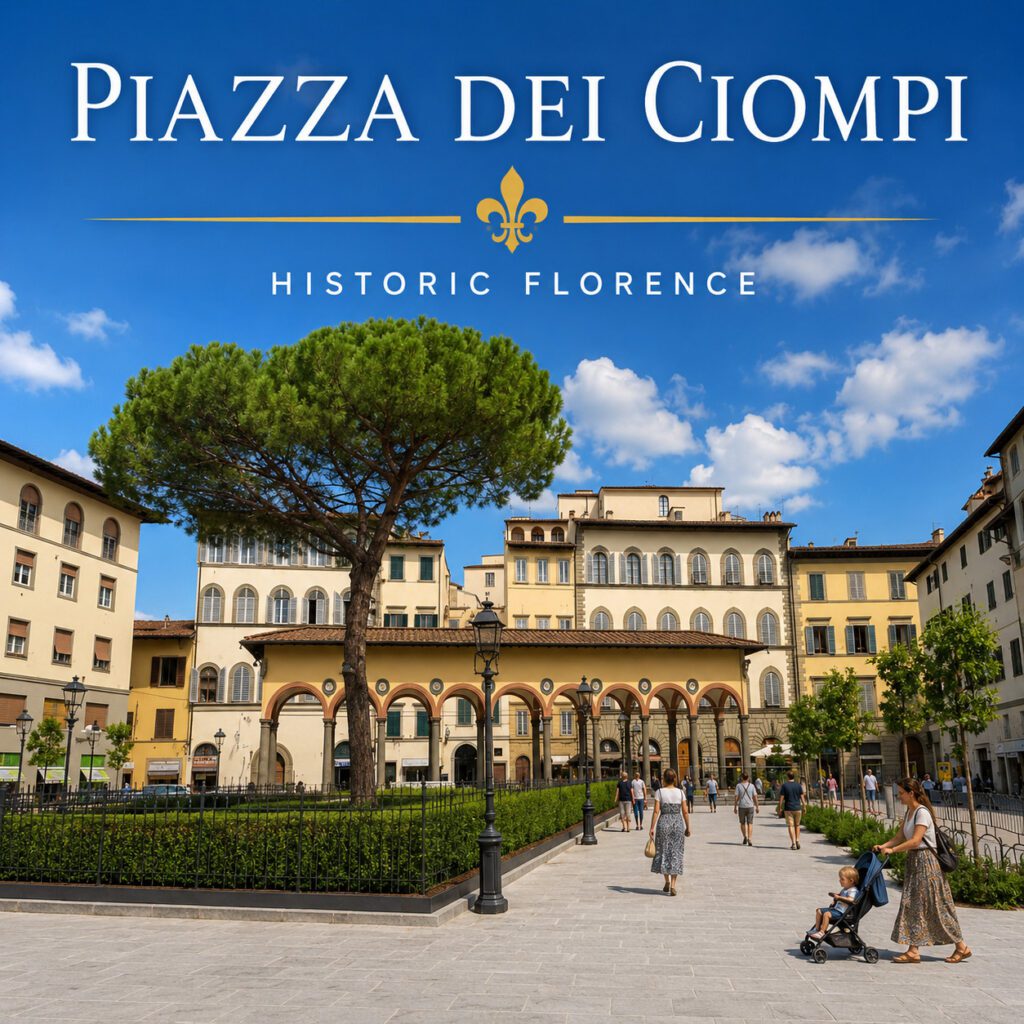
Piazza dei Ciompi is one of those Florentine squares whose importance is easy to underestimate. Located between the historic centre and the lively Sant’Ambrogio neighbourhood, it feels more local and informal than Florence’s monumental piazzas. Yet the square contains a remarkable piece of Renaissance architecture and preserves connections with several very different chapters of the city’s history.
At its heart stands the elegant Loggia del Pesce, designed by Giorgio Vasari for Cosimo I de’ Medici. Remarkably, however, the loggia was not originally built here. Its journey from the vanished Mercato Vecchio to Piazza dei Ciompi makes this quiet square an unexpected link between Renaissance Florence, nineteenth-century urban transformation and the everyday life of the modern city.
Where: Piazza dei Ciompi, eastern historic centre of Florence
Neighbourhood: Between Santa Croce and Sant’Ambrogio
Main landmark: Loggia del Pesce
Architect: Giorgio Vasari
Original loggia: 1568–1569
Reconstructed here: 1955
Why visit: Renaissance architecture, local atmosphere and a fascinating connection with Florence’s lost Mercato Vecchio
Where Is Piazza dei Ciompi?
Piazza dei Ciompi lies east of Florence’s most heavily visited streets, close to the Sant’Ambrogio district and within easy walking distance of Santa Croce. This position gives the square a particularly interesting character. It belongs unmistakably to the historic centre, yet everyday neighbourhood life remains much more visible here than around Piazza della Signoria or the Duomo.
The surrounding streets lead towards small shops, cafés, workshops and the Mercato di Sant’Ambrogio. Visitors exploring this part of Florence therefore encounter a city that feels less ceremonial and more residential.
Combine Piazza dei Ciompi with Sant’Ambrogio and Santa Croce rather than treating it as an isolated sight. This part of Florence is particularly rewarding for a slow walk through streets where historic monuments and everyday neighbourhood life exist side by side.
Why Is It Called Piazza dei Ciompi?
The name recalls the Ciompi, the poorly paid wool workers who occupied one of the lowest positions within Florence’s enormous textile economy. Unlike the powerful masters and merchants represented by the established guilds, these labourers had little political influence despite the importance of their work to Florentine prosperity.
Their name is inseparable from the famous Ciompi Revolt of 1378, one of the most dramatic social and political uprisings in medieval Florence. Workers and other groups excluded from political power challenged the established guild oligarchy and briefly secured greater representation.
The political experiment did not last, but the revolt remains one of the most remarkable episodes in Florence’s social history. The name Piazza dei Ciompi therefore recalls a Florence very different from the familiar image of wealthy bankers, Renaissance patrons and magnificent palaces: the Florence of labourers and artisans whose work helped create the city’s prosperity.
Florence’s extraordinary wealth depended heavily on textile production, especially wool. The Ciompi remind us that behind the great merchant families and artistic commissions stood thousands of workers whose lives rarely appear in the monumental architecture of Renaissance Florence.
The Loggia del Pesce – A Renaissance Monument in an Unexpected Place
The architectural centrepiece of Piazza dei Ciompi is the Loggia del Pesce. Its elegant arches, pietra serena columns and decorative details seem perfectly at home in the square, but this is not where the building originally stood.
The loggia was commissioned by Cosimo I de’ Medici and designed by Giorgio Vasari in the sixteenth century. Its purpose was practical rather than ceremonial: it provided a covered space for Florence’s fish sellers.
This combination of elegant architecture and everyday commerce is characteristically Florentine. Markets were not peripheral to the historic city. They occupied important urban spaces and formed an essential part of Florence’s social and economic life.
Why Did Florence Need a New Fish Market?
The story begins near Ponte Vecchio. Fish sellers had traditionally operated close to the bridge and the Arno. During the reign of Cosimo I, however, this area underwent an extraordinary transformation.
In 1565, Vasari constructed the elevated corridor connecting Palazzo Vecchio with Palazzo Pitti. The route passed through the Uffizi and above Ponte Vecchio, creating what we now know as the Vasari Corridor. The reorganisation of this prestigious Medici route displaced some of the traditional food trades around the bridge.
The fish sellers were moved to the Mercato Vecchio, the ancient market at the centre of Florence. Vasari designed the Loggia del Pesce there in 1568, creating a permanent architectural setting for their trade.
The elegant Loggia del Pesce ultimately owes its existence to the transformation of the area around Ponte Vecchio under Cosimo I. A project associated with Medici power therefore indirectly created a building intended for one of the most ordinary activities of urban life: selling fish.
From Mercato Vecchio to Piazza dei Ciompi
For centuries, the Loggia del Pesce stood in the Mercato Vecchio, close to the geographical heart of Florence. That historic district was a dense mixture of market stalls, houses, workshops, churches, narrow streets and small squares layered over the ancient centre of Roman Florentia.
Everything changed during the enormous urban redevelopment of central Florence in the late nineteenth century. Much of the old market district was demolished during the controversial Risanamento. The medieval urban fabric disappeared and was replaced by the broad streets and monumental buildings surrounding today’s Piazza della Repubblica.
The Loggia del Pesce was dismantled during this transformation. Architectural elements and decorations were preserved, but the structure itself disappeared from the cityscape for decades. The story forms part of the much larger transformation explored in our guide to the lost Mercato Vecchio of Florence.
The Reconstruction of the Loggia del Pesce
In the twentieth century, Florence decided to bring the loggia back into the urban landscape. It could no longer return to its original setting because the Mercato Vecchio had vanished beneath the redesigned centre.
Instead, the Loggia del Pesce was reconstructed in Piazza dei Ciompi in 1955, incorporating surviving historic elements into the rebuilt structure. The result is therefore both Renaissance and modern: a sixteenth-century architectural idea reconstructed in a twentieth-century location.
This makes the loggia particularly interesting. It is not simply a Renaissance monument but also a monument to the way Florence has preserved, moved, reconstructed and reinterpreted fragments of its own past.
The Loggia del Pesce is decorated with Medici and civic imagery as well as references to fishing and the sea. These details make its original function much easier to understand once you know that the elegant structure began life as part of Florence’s food market.
Piazza dei Ciompi and Florence’s Market History
Piazza dei Ciompi is especially interesting when seen as part of the wider history of the historic food markets of Florence. Markets once occupied many open spaces throughout the city, with individual streets and squares often associated with particular products and trades.
The Mercato Vecchio was the great historic market at the centre of Florence. During the nineteenth century, modern covered markets such as Mercato Centrale and Sant’Ambrogio became part of a new approach to food distribution and urban planning.
The Loggia del Pesce creates a physical connection between these different worlds. It began as a Renaissance market structure, survived the destruction of the old centre and eventually found a new home only a short walk from the still-active Sant’Ambrogio market.
The Flea Market and a More Recent Chapter
For many Florentines and long-time visitors, Piazza dei Ciompi is also remembered for its flea market. For decades, stalls and small dealers selling antiques, vintage objects, books, furniture and curiosities gave the square a distinctive atmosphere.
The permanent market was eventually reorganised and relocated, changing the appearance of the piazza. Yet the memory of second-hand trading remains strongly associated with Piazza dei Ciompi.
This more recent layer fits surprisingly well with the square’s deeper history. Markets change location, buildings move and neighbourhoods evolve, but commerce has repeatedly shaped this part of Florence.
A Square Between Sant’Ambrogio and Santa Croce
One of the pleasures of Piazza dei Ciompi is its location. Walk east and you quickly enter the Sant’Ambrogio area, one of the best places to experience the everyday rhythm of central Florence. Its historic market continues a commercial tradition that stretches back to the nineteenth century.
Walk south instead and the monumental world of Santa Croce soon comes into view. The basilica is one of the most important churches in Florence, filled with art, tombs and centuries of Florentine history.
Piazza dei Ciompi sits between these different experiences. It is neither a grand ceremonial square nor simply a residential space. Its appeal comes precisely from this mixture of architecture, history and neighbourhood life.
A rewarding route begins at Santa Croce, continues through the streets towards Piazza dei Ciompi and then leads on to Mercato di Sant’Ambrogio. It is a short walk, but it moves from monumental Florence into a much more local part of the historic centre.
A Link to Giorgio Vasari’s Florence
The Loggia del Pesce also makes Piazza dei Ciompi an interesting stop for anyone following Giorgio Vasari through Florence. His better-known works are monumental: the Uffizi, the Vasari Corridor and the vast decorative projects inside Palazzo Vecchio.
Here we encounter a different Vasari. The loggia was architecture for commerce and daily life rather than a ducal palace or government complex. Nevertheless, its history is still directly connected with Cosimo I and the transformation of sixteenth-century Florence.
Seen together, these projects demonstrate how extensively the Medici period reshaped the city. Political power, infrastructure, commerce and architecture were closely intertwined.
A Fragment of Florence’s Lost City
Perhaps the most fascinating way to understand Piazza dei Ciompi is to see the Loggia del Pesce as a surviving fragment of a Florence that no longer exists.
The old Mercato Vecchio disappeared almost completely. Visitors standing in Piazza della Repubblica today encounter an elegant nineteenth-century urban space, but the dense medieval neighbourhood that once occupied the site is difficult to imagine.
The reconstructed loggia gives that lost city a physical presence. It allows us to see something that once belonged to another square, another neighbourhood and another pattern of everyday life.
This is one reason Piazza dei Ciompi belongs naturally among the hidden stories of Florence. The square teaches us that the city’s history does not always survive where it originally happened. Sometimes Florence’s past has literally been moved across town.
Florence is often admired because so much of its past survives. Piazza dei Ciompi tells the opposite story just as beautifully: historic buildings can disappear, move and return in new settings. Understanding these transformations reveals a city that has never stopped changing.
Is Piazza dei Ciompi Worth Visiting?
Yes, particularly if you have already seen Florence’s major monuments and want to understand the city beyond its most famous sights. Piazza dei Ciompi does not require a long visit, and that is part of its appeal.
Come for the Loggia del Pesce, but spend a few minutes looking at the surrounding streets and thinking about the different histories that meet here. The Ciompi recall medieval workers and social conflict. Vasari’s loggia represents Medici Florence. Its relocation tells the story of the nineteenth-century destruction of Mercato Vecchio, while the surrounding neighbourhood preserves the atmosphere of everyday Florence.
Few small squares contain so many layers of the city’s history.
Why Piazza dei Ciompi Is Worth Discovering
Piazza dei Ciompi is not one of Florence’s monumental showpieces. It does something more subtle. It connects the history of workers, markets, Renaissance architecture, nineteenth-century urban transformation and modern neighbourhood life within a single small space.
The Loggia del Pesce is the key to reading the square. Designed by Vasari for Cosimo I, dismantled when the old centre was destroyed and reconstructed here centuries later, it embodies Florence’s complicated relationship with its own architectural past.
Visit Piazza dei Ciompi on the way between Santa Croce and Sant’Ambrogio and you discover something that the grander piazzas cannot always provide: a sense of Florence as a city that has been continuously lived in, altered and reinvented.
Further Reading on Firenze Casa
Continue exploring the markets, neighbourhoods, artists and hidden histories connected with Piazza dei Ciompi:
- Mercato Vecchio Florence – The Lost Old Market
- Historic Food Markets of Florence – Complete Guide
- Mercato di Sant’Ambrogio – Florence’s Authentic Food Market
- Giorgio Vasari – Artist, Architect and Chronicler of Florence
- Cosimo I de’ Medici – The Duke Who Transformed Florence
- The History of Ponte Vecchio – Florence’s Most Famous Bridge
- Hidden Stories of Florence – Complete Guide
References
- Comune di Firenze – historical and cultural documentation on Piazza dei Ciompi and the transformation of central Florence.
- Comune di Firenze, Cultura – historical documentation on Piazza della Repubblica and the former Mercato Vecchio.
- FeelFlorence – archaeological and historical resources on Florence and the Loggia del Pesce.
- Archivio Storico del Comune di Firenze – historical documentation on the nineteenth-century transformation of Florence.
- Najemy, John M. – A History of Florence 1200–1575.
- Hibbert, Christopher – Florence: The Biography of a City.
- Fanelli, Giovanni – studies on the architecture and urban history of Florence.
- Vasari, Giorgio – Lives of the Most Excellent Painters, Sculptors, and Architects.

