
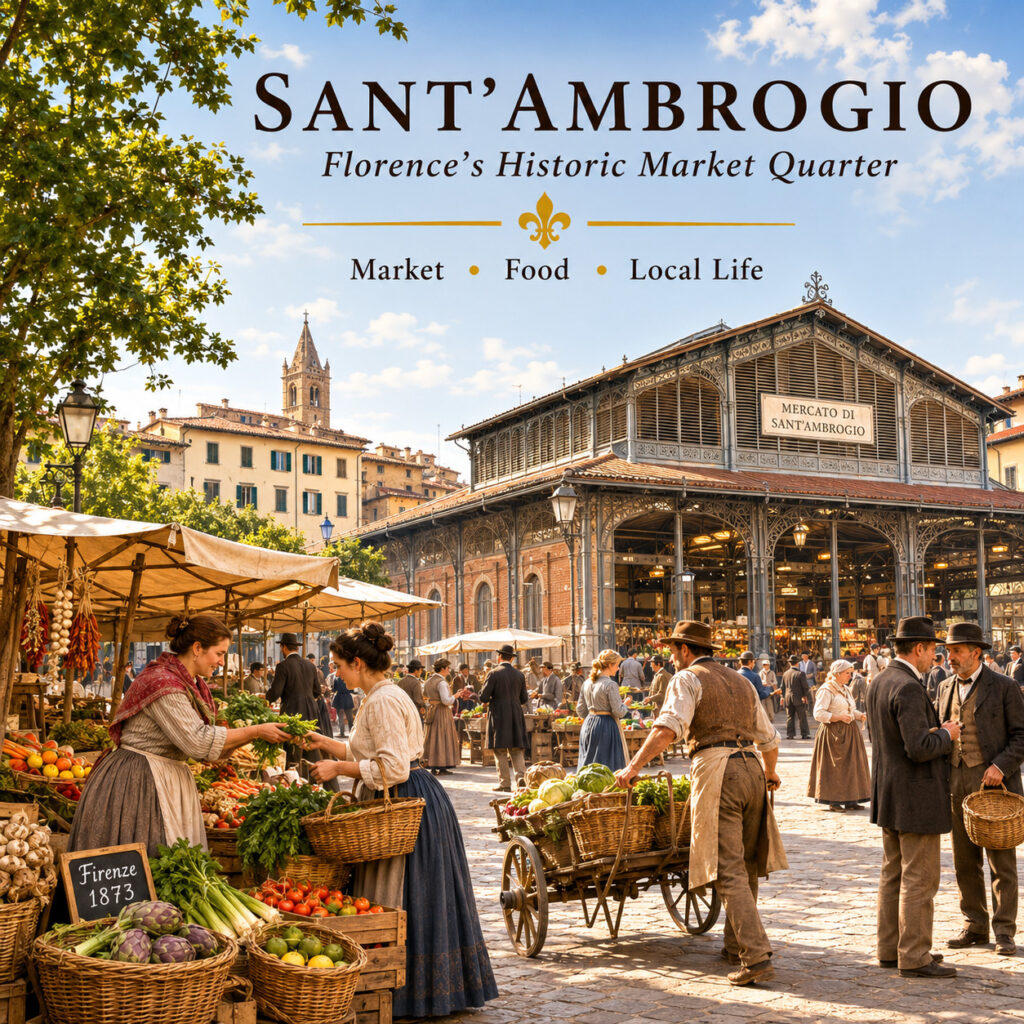
Sant’Ambrogio in Florence is one of the historic centre’s most distinctive local neighbourhoods. Its story began long before the famous market that now defines the area. An ancient church, medieval expansion, religious communities and centuries of everyday life shaped this eastern part of Florence before nineteenth-century urban planning transformed it again.
Today, Sant’Ambrogio offers a different atmosphere from the monumental streets around the Duomo and Piazza della Signoria. Residents still shop at the market, small food businesses animate the surrounding streets and cafés fill with neighbourhood life. This combination of history, food and daily routines makes Sant’Ambrogio one of the best places to experience Florence as a living city.
Location: Eastern historic centre, immediately beyond Santa Croce
Historic landmark: Church of Sant’Ambrogio
Market: Mercato di Sant’Ambrogio
Character: Food, markets, residential streets and local life
Historic transformation: Firenze Capitale in the nineteenth century
Nearby areas: Santa Croce, Piazza dei Ciompi and the Mattonaia
Best time to explore: Morning
How Sant’Ambrogio Became a Florentine Neighbourhood
The origins of Sant’Ambrogio reach back to a time when this area stood outside the main urban centre. The Church of Sant’Ambrogio appears in documentary sources by the end of the tenth century, although tradition gives the site considerably older origins. At that time, open countryside surrounded much of the eastern approach to Florence.
The neighbourhood takes its name from Saint Ambrose of Milan, who according to tradition stayed in this area during a visit to Florence in the fourth century. A religious community subsequently developed around the site, and the church became the geographical anchor for the surrounding district.
Florence expanded dramatically during the Middle Ages. Houses and streets spread eastwards, while the construction of the last great circuit of medieval city walls eventually brought Sant’Ambrogio within urban Florence. What had once stood near open countryside became part of the growing city.
This gradual transformation is characteristic of many areas explored in our Neighbourhoods of Florence – Complete Guide, where churches, gates, markets and major routes often became focal points around which distinctive local identities developed.
Sant’Ambrogio was once outside the walls of Florence. Only as the medieval city expanded did the area become fully incorporated into the urban fabric, giving the neighbourhood an interesting history as a former edge of the city.
The Ancient Church of Sant’Ambrogio
The Church of Sant’Ambrogio gave the neighbourhood both its name and its earliest focal point. Although less famous than the great basilicas of Santa Croce or Santa Maria Novella, it belongs to the oldest religious sites associated with Florence. For centuries, the church served a community surrounded by modest homes, religious institutions and, beyond the developing city, agricultural land.
The church also became associated with an important medieval religious tradition. In 1230, an event interpreted as a Eucharistic miracle reportedly occurred here. The story increased the religious importance of Sant’Ambrogio and attracted devotion beyond the immediate neighbourhood.
The Church of Sant’Ambrogio rarely receives the attention given to Florence’s monumental basilicas. Yet its long history provides an important clue to understanding how the eastern part of the medieval city developed.
From Countryside to City Streets
Sant’Ambrogio retained traces of its semi-rural origins for centuries. Gardens and cultivated land survived remarkably close to the historic centre, particularly towards the eastern walls, while residential development gradually intensified. Streets connected the area with Santa Croce, the city gates and routes leading towards eastern Tuscany.
Borgo la Croce became one of these important approaches, helping create a neighbourhood shaped by movement between Florence and the countryside beyond its walls. Unlike districts dominated by a single great palace or powerful dynasty, Sant’Ambrogio developed through many smaller layers of religious, residential and commercial activity.
Sant’Ambrogio and Santa Croce
Sant’Ambrogio and Santa Croce – Florence’s Historic Artisan Quarter are closely connected, and their boundaries are not always obvious to visitors. Historically, the wider area belonged to the Santa Croce quarter. In everyday modern usage, however, Sant’Ambrogio has developed a strong identity of its own.
The transition becomes noticeable when walking east from Piazza Santa Croce. Monumental buildings and visitor-oriented businesses gradually give way to residential streets, food shops and the activity surrounding the market. The change happens naturally rather than at a precise dividing line.
This overlap is important when exploring Florence’s neighbourhoods. Historic quarters, modern neighbourhood names and everyday local identities do not always follow perfectly defined boundaries.
Sant’Ambrogio forms part of the wider historic Santa Croce area, but Florentines commonly recognise it as a neighbourhood with its own character. The market, church and surrounding streets have created a particularly strong local identity.
Firenze Capitale Changes Sant’Ambrogio
The nineteenth century brought the most dramatic transformation since the medieval expansion of Florence. When the city became capital of the Kingdom of Italy in 1865, planners launched an ambitious programme of modernisation. New boulevards, residential districts and public infrastructure changed Florence on a scale rarely seen before.
Food distribution formed part of this transformation. The authorities planned new covered markets to replace older forms of urban commerce, with major projects in both Sant’Ambrogio and San Lorenzo. Open land and gardens near Sant’Ambrogio allowed planners to establish a market close to the old city walls, giving Piazza Ghiberti and its surroundings a completely new role.
The Birth of the Mercato di Sant’Ambrogio
Architect Giuseppe Mengoni designed the Mercato di Sant’Ambrogio, which opened in 1873. Mengoni also designed the larger Mercato Centrale at San Lorenzo. Both markets reflected a new approach to urban food distribution based on covered halls, iron structures and organised spaces for traders.
The Sant’Ambrogio market remained deliberately smaller, and its scale suited the surrounding neighbourhood. Food sellers operated inside the hall while additional stalls occupied the outdoor areas, creating a market closely connected with local residents.
The project changed the neighbourhood profoundly. Land that had included gardens and relatively open spaces became one of Florence’s important centres for everyday food shopping. More than 150 years later, that role remains central to Sant’Ambrogio’s identity.
The Mercato di Sant’Ambrogio opened in 1873, about a year before the Mercato Centrale at San Lorenzo. Both markets formed part of Florence’s nineteenth-century transformation into a modern European city.
The Market as the Heart of the Neighbourhood
The Mercato di Sant’Ambrogio is more than an architectural landmark. Every morning, food shopping gives Piazza Ghiberti and the surrounding streets their characteristic rhythm. Fruit and vegetables, meat, cheese, bread and other everyday products keep the market closely connected with local life, while outdoor stalls extend the activity beyond the covered hall.
This distinguishes Sant’Ambrogio from many heavily visited parts of central Florence. Travellers certainly come here, but tourism does not completely determine the market’s purpose. Residents still arrive primarily for groceries, lunch and familiar neighbourhood businesses.
The market belongs to Florence’s wider tradition of historic food trading, which developed differently across neighbourhoods such as Sant’Ambrogio and San Lorenzo.
Visit Sant’Ambrogio in the morning rather than late in the day. The market is at its liveliest when residents are shopping and the surrounding food businesses are preparing for lunch.
Food and Everyday Florentine Life
Food has become inseparable from the modern identity of Sant’Ambrogio. Traditional ingredients, small restaurants and neighbourhood shops make the area particularly attractive to anyone interested in Tuscan food culture. Yet its appeal comes less from individual destinations than from the concentration of everyday activity.
Morning is the defining time of day. Deliveries arrive, stalls open and residents complete their shopping before lunch. By early afternoon, the rhythm changes considerably as the market closes and the surrounding streets become quieter. Instead of following museum opening hours, much of Sant’Ambrogio still follows the timetable of a traditional food market.
Piazza dei Ciompi and the Artisan Tradition
Nearby Piazza dei Ciompi adds another dimension to the neighbourhood. Its name recalls the Ciompi, the wool workers who famously revolted against Florence’s political establishment in 1378. Although the modern piazza developed much later, the name evokes the world of workers and artisans that formed an essential part of medieval Florentine society.
The square also became associated with antiques and second-hand goods, reinforcing the area’s reputation as a place for browsing and trading away from Florence’s grand shopping streets. Together with the food market, these traditions contribute to Sant’Ambrogio’s informal character and connect it with the broader history of Florentine crafts and working life.
The Mattonaia and a Changing Nineteenth-Century Florence
The area north and east of Sant’Ambrogio changed considerably during the nineteenth century. The development known as the Mattonaia created new streets and residential buildings as Florence expanded and modernised, a process accelerated during the years of Firenze Capitale.
One particularly important development involved Florence’s Jewish community. After legal restrictions on residence ended in the nineteenth century, Jewish families increasingly moved away from the former ghetto in the old centre, and many settled in the developing Mattonaia area.
The monumental Synagogue of Florence later became the most visible expression of this new presence. Its great green dome rises above the eastern cityscape and adds another cultural and architectural layer to the wider Sant’Ambrogio area.
Sant’Ambrogio is not defined by a single period. Medieval religious history, nineteenth-century urban planning, market culture and the development of the nearby Jewish quarter all contributed to the identity of eastern central Florence.
Sant’Ambrogio and Florence’s Jewish History
The Jewish history of this part of Florence deserves particular attention. For centuries, the city’s Jewish population faced restrictions that included compulsory residence within the ghetto near the Mercato Vecchio. The nineteenth century brought emancipation and greater freedom to choose where to live.
More prosperous Jewish families began moving towards the newly developing Mattonaia area. Construction of the Great Synagogue between 1874 and 1882 gave the community a magnificent new religious centre, whose Moorish-inspired architecture deliberately differs from the medieval and Renaissance churches nearby.
Although the synagogue stands slightly north of the traditional core of Sant’Ambrogio, its history belongs to the wider transformation of eastern Florence. Market construction, residential expansion and religious diversity were all part of the changing nineteenth-century city.
A Neighbourhood Without Monumental Pretensions
Sant’Ambrogio has never depended on a single world-famous monument, and this is precisely part of its attraction. Small streets, ordinary apartment buildings, food shops and cafés create much of its atmosphere, while historic churches and cultural sites appear within this everyday setting without completely dominating it.
The result feels unusually balanced for such a central location. Sant’Ambrogio remains unmistakably historic, but it also feels inhabited and useful. Florence is not simply preserved here; people continue to live their daily lives within it.
What Is Sant’Ambrogio Like Today?
Modern Sant’Ambrogio has become increasingly popular with visitors, students and younger Florentines. Restaurants, cafés and bars have added new energy, particularly around the market and neighbouring streets, but local commerce remains highly visible.
Morning and evening reveal different personalities. The morning belongs largely to the market, shopping and food, while later in the day cafés and restaurants become more prominent. Like many central neighbourhoods, Sant’Ambrogio must balance tourism and changing lifestyles with the needs of residents, but it retains a recognisable local identity that distinguishes it from Florence’s busiest visitor areas.
How to Explore Sant’Ambrogio
Begin at the Church of Sant’Ambrogio to understand where the neighbourhood started, then walk towards Piazza Lorenzo Ghiberti and the Mercato di Sant’Ambrogio. The short distance between the ancient church and nineteenth-century market reveals almost a thousand years of urban development.
After exploring the market, continue through the surrounding streets towards Piazza dei Ciompi. Another route leads north towards the Mattonaia and the Synagogue, revealing how Florence expanded and diversified during the nineteenth century. Finally, walk west towards Santa Croce to experience the gradual transition between two closely connected neighbourhoods.
Church of Sant’Ambrogio → Mercato di Sant’Ambrogio → Piazza dei Ciompi → Mattonaia → Santa Croce makes an excellent neighbourhood walk. It connects medieval Florence, market life and the nineteenth-century transformation of the city.
Why Sant’Ambrogio Is Worth Exploring
Sant’Ambrogio is worth exploring because it reveals a side of Florence that monumental sightseeing can easily hide. Its ancient church recalls the city’s expansion beyond its earliest boundaries, while the market tells the story of nineteenth-century modernisation. Food shops, cafés and residential streets show how those historical layers continue to support everyday life.
The neighbourhood also provides an important contrast with nearby Santa Croce. Only a short walk separates the great basilica and monumental piazza from a district whose strongest attraction is simply the rhythm of the city itself. For travellers who want to understand how Florence lives as well as how Florence looks, Sant’Ambrogio is particularly rewarding.
Frequently Asked Questions About Sant’Ambrogio
Is Sant’Ambrogio a neighbourhood of Florence?
Yes. Sant’Ambrogio is commonly recognised as a distinct neighbourhood in the eastern historic centre, although historically it forms part of the wider Santa Croce quarter.
Why is Sant’Ambrogio famous?
The neighbourhood is best known for the Mercato di Sant’Ambrogio. Its ancient church, local food culture and residential streets also contribute to its distinctive character.
How old is the Sant’Ambrogio neighbourhood?
The Church of Sant’Ambrogio appears in medieval records, while traditions associated with the site reach further back. The surrounding area gradually became part of urban Florence as the city expanded.
When was the Mercato di Sant’Ambrogio built?
The market opened in 1873. Giuseppe Mengoni designed it during the major transformation of Florence associated with the period of Firenze Capitale.
Is Sant’Ambrogio part of Santa Croce?
Historically, it belongs to the wider Santa Croce quarter. In modern usage, however, Sant’Ambrogio has developed a strong identity around its church, market and surrounding streets.
Is Sant’Ambrogio touristy?
Visitors increasingly explore the area, but the market, food shops and residential streets still serve a substantial local population and preserve an everyday atmosphere.
What is the best time to visit Sant’Ambrogio?
Morning is the best time to experience the neighbourhood, when the market and surrounding streets are at their most active.
Which neighbourhood is closest to Sant’Ambrogio?
Santa Croce lies immediately to the west and is closely connected historically with Sant’Ambrogio. Both are included in our Neighbourhoods of Florence – Complete Guide.
Further Reading on Firenze Casa
- Neighbourhoods of Florence – Complete Guide
- Santa Croce – Florence’s Historic Artisan Quarter
- San Lorenzo – Florence’s Medici and Market Quarter
- Medieval City Walls of Florence
- Florentine Crafts – Complete Guide
- History of Florence
References
- Comune di Firenze – historical information on Florence’s historic markets and Mercato di Sant’Ambrogio
- FeelFlorence – Mercato di Sant’Ambrogio and the markets of Florence
- Comune di Firenze – historical information on the Sant’Ambrogio area and Firenze Capitale
- FeelFlorence – Jewish Florence and the development of the Mattonaia area
- Mercato di Sant’Ambrogio – history and traditions of the market
- Historical documentation concerning the Church of Sant’Ambrogio and the eastern expansion of medieval Florence

