
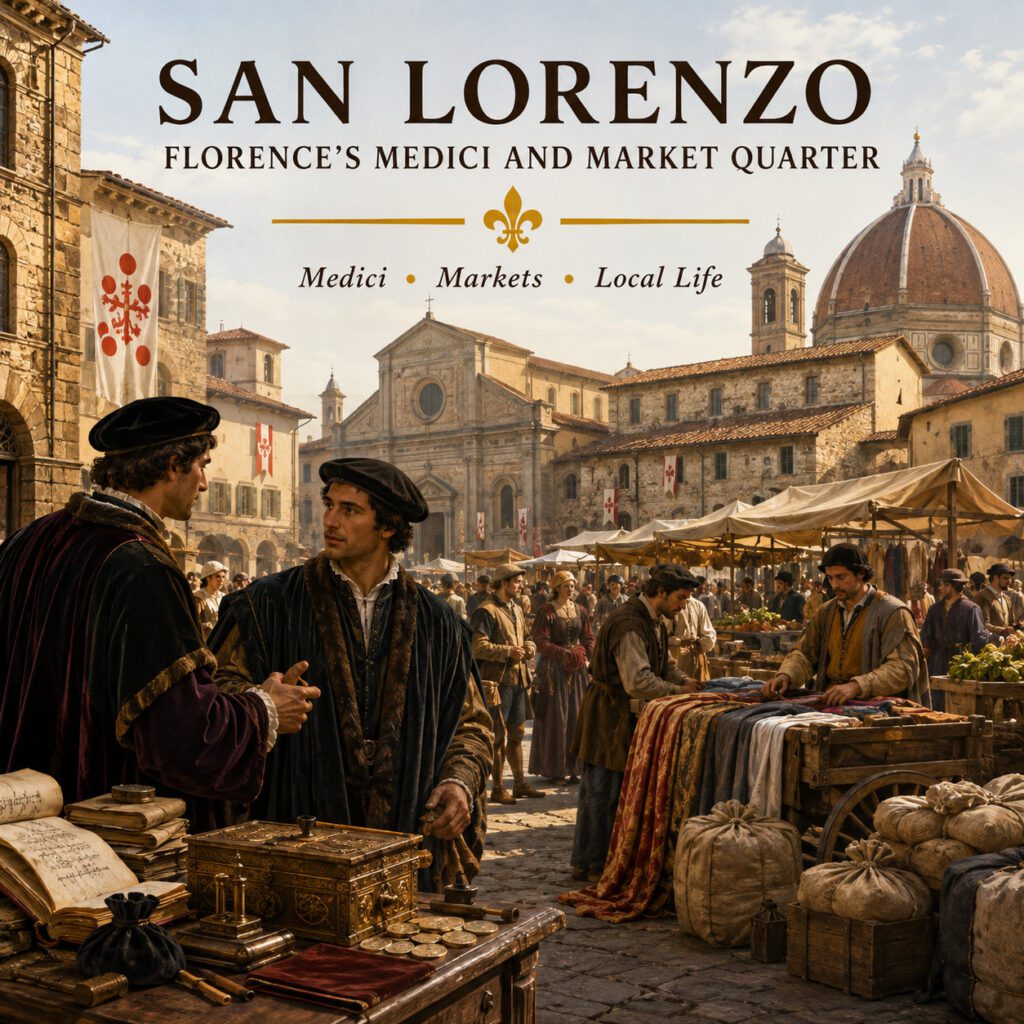
San Lorenzo in Florence brings together religion, power and trade. Its ancient basilica gave the area its name long before the Renaissance. Later, the Medici turned San Lorenzo into one of the most important centres of political and artistic life in Florence, while the nineteenth-century Mercato Centrale added another identity that remains visible today.
These different layers make San Lorenzo much more than the streets between the Duomo and the railway station. Around the basilica, Medici palaces and chapels recall the rise of Florence’s most famous dynasty, while only a few minutes away market stalls, food shops and busy streets continue the area’s commercial tradition. Few neighbourhoods bring monumental and everyday Florence together quite so closely.
Location: Historic centre, immediately north of the Duomo
Historic centre: Basilica di San Lorenzo
Famous family: Medici
Major landmark: Medici Chapels
Market: Mercato Centrale
Character: Renaissance monuments, markets and busy everyday city life
Best explored: On foot
How San Lorenzo Became a Florentine Neighbourhood
The origins of San Lorenzo reach much further back than Renaissance Florence. Saint Ambrose consecrated the church of San Lorenzo in 393, and tradition regards it as one of the city’s oldest churches. At the time, the area stood beyond the limits of ancient Roman Florence, but the city gradually expanded around this early religious centre.
During the eleventh century, Florentines rebuilt the church in Romanesque form, while houses, religious institutions and streets developed around it. Long before the Medici made San Lorenzo famous, the basilica already provided the area with a religious and geographical centre. Eventually, its name came to identify the surrounding neighbourhood as well as the church itself.
San Lorenzo is one of several historic districts explored in our Neighbourhoods of Florence – Complete Guide, which shows how churches, markets, powerful families and changing patterns of urban life gave different parts of Florence their distinctive identities.
San Lorenzo’s history predates the Renaissance by more than a thousand years. Saint Ambrose consecrated the church in AD 393, making the origins of the neighbourhood considerably older than the Florence most visitors recognise today.
The Medici Changed San Lorenzo
The Medici brought the decisive transformation. During the fifteenth century, the family strengthened its presence in the neighbourhood and turned San Lorenzo into the geographical heart of its growing influence. Giovanni di Bicci de’ Medici supported the rebuilding of the basilica, while Filippo Brunelleschi helped give the church its celebrated Renaissance character.
Cosimo de’ Medici reinforced this connection when he commissioned Michelozzo to create the family’s great urban residence nearby. Palazzo Medici stood only a short distance from San Lorenzo, projecting wealth and authority without the fortress-like appearance of some earlier Florentine palaces. From this part of the city, the Medici developed networks of banking, politics and patronage that shaped Florence for centuries.
San Lorenzo consequently became inseparable from the Medici family and its rise to power. Residence, family church, burial places and artistic patronage were concentrated within a remarkably small area, permanently changing both the architecture and reputation of the neighbourhood.
The Medici did not create San Lorenzo, but they transformed its identity. Their patronage turned an ancient religious neighbourhood into one of the principal settings for the family’s rise from wealthy bankers to rulers of Florence.
San Lorenzo as the Medici Family Church
The Basilica di San Lorenzo became inseparable from the Medici dynasty. Brunelleschi’s architecture and the Old Sacristy created a landmark of early Renaissance design, while Michelangelo later added the New Sacristy. Generations of Medici burials strengthened the relationship between the church and the family.
The monumental Medici Chapels made this dynastic connection even more visible. With its enormous dome and lavish decoration, the Cappella dei Principi became the mausoleum of the Medici grand dukes. The chapel’s extraordinary hard-stone decoration also became one of the great expressions of the Florentine tradition of pietra dura.
Yet San Lorenzo never functioned only as a ceremonial district. Markets, shops, workshops and ordinary homes continued to surround these extraordinary buildings, and that contrast still defines much of the neighbourhood’s character.
A Neighbourhood of Merchants and Everyday Life
The Medici dominate the historical story, but powerful families represented only one part of San Lorenzo. Its central location encouraged commerce, crafts and street trading, while merchants and artisans worked in streets connecting major religious buildings with the commercial heart of Florence.
This everyday dimension remains essential to understanding the neighbourhood. Monumental history and ordinary urban life grew side by side. Even today, visitors can walk within minutes from Michelangelo’s architecture and Medici tombs to food stalls, leather sellers and local shops.
San Lorenzo offers one of the clearest examples of Florence’s ability to mix extraordinary art with ordinary city life. Renaissance masterpieces have always shared these streets with residents, merchants and traders.
Firenze Capitale Transformed San Lorenzo Again
A second major transformation came during the nineteenth century. Florence served as capital of the Kingdom of Italy from 1865 to 1871, and the new role triggered an ambitious programme of urban development. Roads, squares and public buildings changed large parts of the city as planners attempted to transform Florence into a modern European capital.
Reorganisation of the city’s food markets formed part of this modernisation. New covered markets were planned for San Lorenzo and Sant’Ambrogio, creating new commercial centres in two very different Florentine neighbourhoods. In San Lorenzo, the project permanently changed the area around the basilica and added another architectural layer to a district already shaped by antiquity and the Renaissance.
The Mercato Centrale – A New Heart for San Lorenzo
Architect Giuseppe Mengoni designed the Mercato Centrale during this period of change. Using iron, cast iron and glass, he created a building that looked strikingly modern beside the stone churches and palaces of old Florence. The market opened in 1874 and quickly became a new focal point for the neighbourhood.
Food sellers gathered beneath its vast roof while commercial activity spread through the surrounding streets. Rather than replacing San Lorenzo’s older tradition of trade, the new building organised it on a much larger scale. Traditional food sellers still operate on the ground floor today, offering fruit, vegetables, meat, fish, bread and Tuscan products, while the upper level has developed into a contemporary food hall.
The market therefore reflects San Lorenzo itself: a historic neighbourhood that continually adapts to new ways of using the city.
The Mercato Centrale opened in 1874, only a few years after Florence’s period as capital of Italy. Its iron-and-glass architecture represented the city’s ambition to combine historic Florence with modern urban life.
The Streets Around the Market
The streets around the Mercato Centrale give San Lorenzo much of its contemporary energy. Via dell’Ariento, Via Sant’Antonino, Via Panicale and smaller lanes form a dense network between the market, basilica and railway station. Outdoor stalls add another layer of activity to this busy commercial area.
Leather goods, clothing and souvenirs now dominate some streets, and tourism has changed parts of the neighbourhood considerably. Nevertheless, the covered food market and established businesses ensure that San Lorenzo remains more than an open-air shopping area for visitors.
The contrasts can be striking. A crowded market street may lead moments later to a Renaissance palace, a centuries-old church or a quieter residential lane. These rapid changes of scale and atmosphere are an essential part of San Lorenzo’s identity.
San Lorenzo in Florentine Literature
The streets around San Lorenzo also entered Florence’s twentieth-century cultural memory. Writer Vasco Pratolini knew the popular districts of central Florence intimately, and his work captured their communities, political tensions and everyday relationships during periods of profound social change.
Life around the market was never merely picturesque. Workers and traders filled the area, while political conflict and wartime hardship also left their mark. San Lorenzo therefore belongs not only to Renaissance Florence but also to the social history represented in the city’s modern literature.
The Feast of San Lorenzo
The traditional Feast of San Lorenzo on 10 August provides another expression of neighbourhood identity. San Lorenzo is a co-patron saint of Florence, and celebrations around the basilica have long combined religious observance with popular traditions. The event connects the church, neighbourhood and wider city.
After the Medici strengthened their presence here in the fifteenth century, the feast gained further importance in local life. Over time, religious ceremonies and communal gatherings became closely connected, preserving the relationship between the district and its patron saint.
The Feast of San Lorenzo on 10 August has long brought religious tradition and neighbourhood life together. It remains one of the occasions that recalls the district’s deep connection with its ancient basilica.
San Lorenzo and Its Neighbouring Areas
San Lorenzo occupies an unusually central position in Florence. The Duomo lies immediately to the south, while Santa Maria Novella begins towards the west. Streets leading towards Via Faenza and the railway station create a gradual transition between these historic areas, and walking through them often reveals the boundaries more clearly than a modern map can.
The relationship with Santa Maria Novella is particularly interesting. Both neighbourhoods grew around important religious institutions, but later history gave them different identities. Travellers and eventually the railway increasingly shaped Santa Maria Novella, while the Medici and the market became defining features of San Lorenzo.
A walk between the two areas demonstrates why neighbourhoods provide such a useful way to understand Florence. The architecture remains unmistakably Florentine, yet the rhythm and historical associations of the streets gradually change.
What Is San Lorenzo Like Today?
San Lorenzo ranks among the busiest neighbourhoods in central Florence. Its location near the Duomo, railway station, Mercato Centrale and major Medici monuments attracts a constant flow of visitors, while the outdoor market adds even more movement during the day.
Tourism has inevitably changed the neighbourhood, particularly along its main shopping routes. Even so, traditional food sellers, local businesses and residents remain part of daily life. An ancient church, a Renaissance dynasty, a nineteenth-century market and modern tourism therefore continue to coexist within the same compact part of Florence.
How to Explore San Lorenzo
Begin at Piazza San Lorenzo rather than at the market. First look at the unfinished façade of the basilica and the buildings around the square, then walk towards Palazzo Medici Riccardi. The remarkably short distance between the Medici residence and the family church helps explain how strongly the dynasty was connected with this neighbourhood.
Return towards the streets behind the basilica and continue to the Mercato Centrale. Within only a few minutes, the surroundings change from Renaissance monuments to a busy market district. Pay attention to this transition rather than focusing only on individual sights, because it tells the story of San Lorenzo particularly well.
Visit San Lorenzo in the morning, when the market district is fully awake. Explore the basilica and Medici surroundings first, then continue towards the Mercato Centrale to experience the neighbourhood’s historic and commercial identities during the same walk.
Why San Lorenzo Is Worth Exploring
San Lorenzo is worth exploring because few neighbourhoods explain the development of Florence so clearly. An ancient religious centre gained a new identity through the Medici during the Renaissance, while the Mercato Centrale transformed the area again in the nineteenth century. Each period added another layer without completely erasing what came before.
The neighbourhood also demonstrates why visitors should look beyond individual monuments. The Basilica di San Lorenzo, Medici Chapels, Palazzo Medici and Mercato Centrale all belong to the same urban story. Together, they reveal a district where religion, political power, commerce and everyday life have interacted for centuries.
Frequently Asked Questions About San Lorenzo
Is San Lorenzo a neighbourhood of Florence?
Yes. San Lorenzo is a historic district in central Florence named after the ancient Basilica di San Lorenzo and closely associated with the Medici family and Mercato Centrale.
Why is San Lorenzo associated with the Medici?
The Medici lived nearby, supported the basilica and chose the church complex as an important family burial place. Their patronage transformed the neighbourhood during the Renaissance.
How old is the Basilica di San Lorenzo?
The church has very ancient origins and was consecrated by Saint Ambrose in AD 393. Later rebuilding culminated in the celebrated Renaissance complex associated with Brunelleschi and the Medici.
When did the Mercato Centrale open?
The Mercato Centrale opened in 1874 during a period of major urban transformation following Florence’s years as capital of Italy.
Is San Lorenzo mainly a tourist neighbourhood today?
Tourism is very visible around the monuments and outdoor market, but food sellers, local businesses and residents still contribute to everyday neighbourhood life.
What is the best way to explore San Lorenzo?
Explore it on foot, beginning around the basilica and Palazzo Medici Riccardi before continuing towards the Mercato Centrale. The short walk reveals the neighbourhood’s transition from Medici Florence to its commercial heart.
Which neighbourhoods are close to San Lorenzo?
Santa Maria Novella lies immediately to the west, while the Duomo area begins to the south. Our Neighbourhoods of Florence – Complete Guide places San Lorenzo within the wider historic city.
Further Reading on Firenze Casa
- Neighbourhoods of Florence – Complete Guide
- Santa Maria Novella – Florence’s Historic Gateway
- Sant’Ambrogio – Florence’s Historic Market Quarter
- The Medici Family: The Dynasty That Shaped Florence
- Pietra Dura in Florence – The Art of Stone Inlay
- History of Florence
References
- Comune di Firenze – historical information on San Lorenzo and the Mercato Centrale
- FeelFlorence – Basilica di San Lorenzo
- FeelFlorence – Piazza San Lorenzo
- FeelFlorence – San Lorenzo Market and Mercato Centrale
- Mercato Centrale Firenze – history of the market building
- Opera Medicea Laurenziana – Basilica di San Lorenzo and the Medici complex
- Giuseppe Richa – Notizie istoriche delle chiese fiorentine

