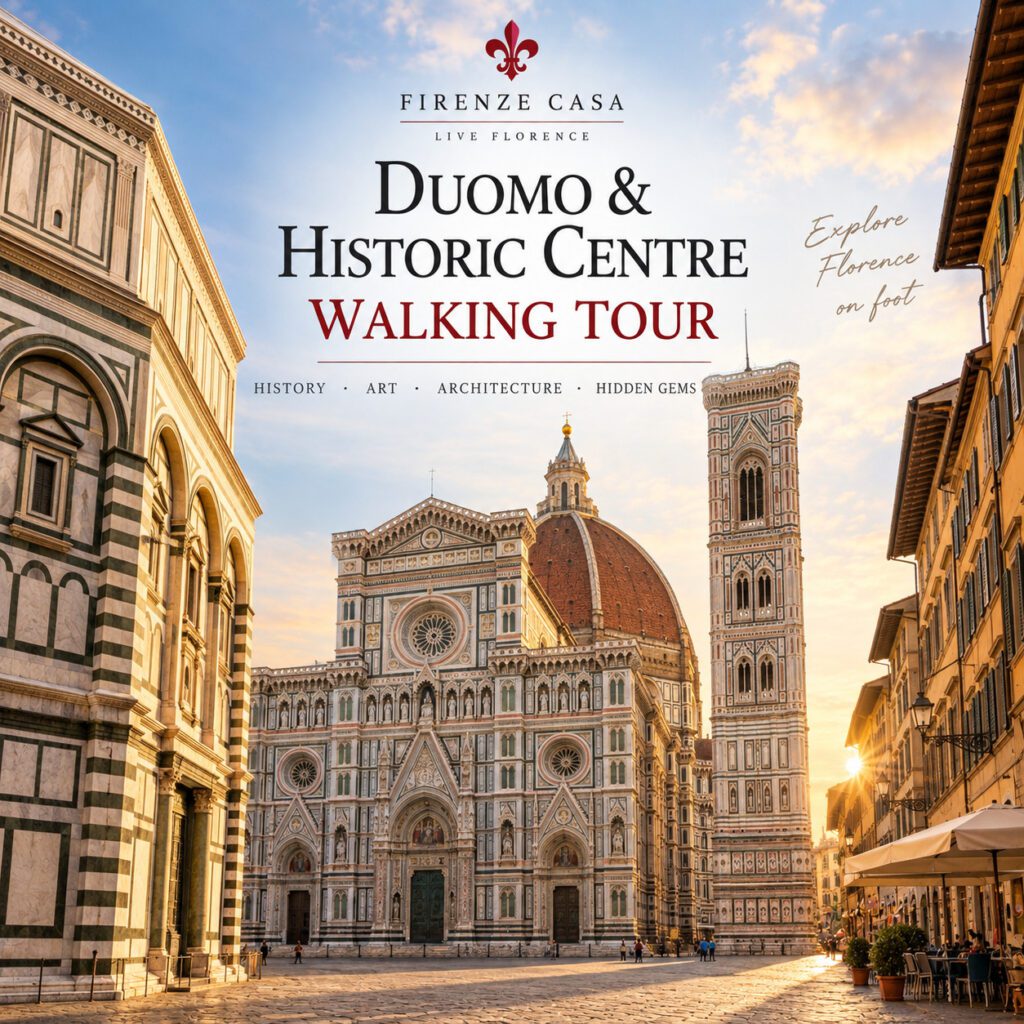
Explore the heart of Florence on this Duomo Walking Tour, beginning among the extraordinary monuments of Piazza del Duomo and continuing through streets shaped by Roman, medieval and Renaissance history. Within a remarkably compact area, the route connects religious landmarks, ancient streets, guild history, political power and the banks of the Arno.
This is the Florence many visitors imagine before arriving, yet walking slowly reveals much more than a collection of famous sights. Roman Florentia survives beneath modern streets, medieval towers stand close to Renaissance monuments, and civic institutions tell the story of a city shaped by merchants, guilds and political rivalry.
Distance:
Walking time:
Recommended time:
Start:
Finish:
Character: Cathedral · Medieval streets · Civic Florence · Renaissance art · Arno
Difficulty:
Walking Route Map
The map will show the final route through the Duomo district and Florence’s historic centre, together with the numbered stops described below.
[WP Go Maps route will be added here]
The Walking Tour
1. Piazza del Duomo
Begin in Piazza del Duomo, where several centuries of Florentine ambition are concentrated within a single extraordinary urban space. The cathedral, Baptistery and Campanile form one of Europe’s most recognisable architectural ensembles.
Before focusing on individual monuments, walk around the square. Changing position reveals how differently the buildings relate to one another. It also helps explain why the piazza became both the religious centre of Florence and one of the great stages of its civic identity.
Do not experience Piazza del Duomo from a single viewpoint. Walk around the cathedral and look back towards the Baptistery, Campanile and dome. The architecture changes constantly as you move through the square.
2. Baptistery of San Giovanni
The Baptistery introduces a Florence older than Brunelleschi’s dome. Its octagonal form and geometric marble decoration made it one of the city’s most important religious buildings long before the cathedral reached its present appearance.
Generations of Florentines were baptised here, including many of the people who later shaped the city’s history. The famous bronze doors also connect the building with the artistic competition and experimentation that helped define the early Renaissance.
3. Cathedral of Santa Maria del Fiore
Florence Cathedral expresses the enormous ambitions of the medieval city. Construction began long before the Renaissance, yet its most famous feature eventually became Filippo Brunelleschi’s revolutionary dome.
Stand close to the cathedral and notice the complexity of its marble decoration. Then move farther away whenever the surrounding streets allow it. Only from a greater distance does the extraordinary scale of the dome become fully apparent.
The cathedral is not the product of a single moment. Medieval Gothic ambition and Renaissance engineering coexist in the same building, making Santa Maria del Fiore a remarkable visual summary of Florence’s transformation.
4. Giotto’s Campanile
Beside the cathedral rises Giotto’s Campanile, one of Florence’s most elegant vertical landmarks. Its coloured marble connects visually with both the cathedral and Baptistery, while sculptural decoration turns the lower levels into a complex account of human work, knowledge and civilisation.
The tower also provides a useful reminder that Florence’s great monuments were collaborative achievements. Giotto initiated the project, but later architects continued and modified his work after his death.
5. Via dei Calzaiuoli
From Piazza del Duomo, enter Via dei Calzaiuoli. Today it is one of central Florence’s busiest pedestrian streets, but its importance reaches deep into the commercial and civic history of the city.
Rather than treating it simply as the quickest route to Piazza della Signoria, look into the side streets and above the modern shopfronts. The walk begins to shift here from monumental religious Florence towards the dense commercial and political world of the medieval city.
6. Orsanmichele
Orsanmichele is one of the best buildings in Florence for understanding how commerce, religion and guild power became intertwined. The building began as a grain market before developing into a church closely associated with the city’s powerful guilds.
Walk around the exterior rather than looking only at the entrance. The niches and sculptures demonstrate how guild organisations used art to express religious devotion, professional identity and civic status.
Orsanmichele explains something essential about Florence: art, religion and economic power were rarely separate worlds. The same guilds that organised trades and workshops also commissioned some of the city’s greatest public sculpture.
7. Piazza della Repubblica
Take a short detour towards Piazza della Repubblica to encounter a completely different layer of Florence. The area corresponds approximately to the centre of Roman Florentia and later became the site of the Mercato Vecchio and the Jewish ghetto.
Much of that dense historic neighbourhood disappeared during the nineteenth-century redevelopment of Florence. The spacious piazza seen today therefore tells a story not only of what survives, but also of what the modern city chose to remove.
Piazza della Repubblica is one of the best places to imagine Florence in layers. Roman streets, the medieval market, the former Jewish ghetto and nineteenth-century redevelopment all occupy essentially the same urban space.
8. Medieval Florence around Dante’s Quarter
Return towards the narrower streets between the Duomo and Piazza della Signoria. Here the scale changes dramatically. Stone façades, small piazzas and surviving towers evoke the Florence of powerful medieval families and neighbourhood rivalries.
The area traditionally associated with Dante is particularly rewarding when explored slowly. Rather than searching for one definitive monument, look at the urban fabric itself. These streets help visitors imagine Florence before monumental Renaissance architecture transformed the city’s appearance.
9. Piazza San Firenze and the Bargello
Continue towards Piazza San Firenze, where several periods of Florentine history meet within a very small area. The monumental Baroque presence of San Firenze contrasts with the severe medieval architecture nearby.
The Bargello was originally associated with civic authority, justice and government before becoming one of Florence’s great sculpture museums. Its fortress-like appearance provides a powerful introduction to the political character of medieval Florence.
10. Piazza della Signoria
Piazza della Signoria is the great civic stage of Florence. Political decisions, public ceremonies, conflict and punishment all formed part of the history of this extraordinary square.
Take time to look at the piazza as an urban space rather than moving immediately towards its individual monuments. Palazzo Vecchio dominates one side, while the Loggia dei Lanzi and surrounding sculptures turn the square into an open-air display of political symbolism and artistic power.
Piazza del Duomo and Piazza della Signoria represent two different centres of historic Florence. One expresses religious and civic ambition through the cathedral complex; the other reveals the political life of the Florentine Republic and later Medici rule.
11. Palazzo Vecchio
Palazzo Vecchio rises above Piazza della Signoria as one of the clearest symbols of Florentine political authority. Originally built for the city’s republican government, the palace later became closely associated with Medici rule.
Its architecture still communicates security and power. The crenellations, massive stonework and tower belong to a civic world very different from the elegant Renaissance palaces encountered elsewhere in Florence.
12. Loggia dei Lanzi
The Loggia dei Lanzi transforms one side of Piazza della Signoria into an extraordinary open-air sculpture gallery. Originally designed for public ceremonies, it later became a setting for works that carried strong political as well as artistic meanings.
Pause here before continuing. The relationship between sculpture, architecture and public space is especially clear when the loggia is viewed together with Palazzo Vecchio and the statues positioned around the piazza.
13. Uffizi Courtyard
Walk between the long wings of the Uffizi towards the Arno. Giorgio Vasari designed the complex in the sixteenth century for administrative offices, creating an architectural corridor that visually connects Piazza della Signoria with the river.
The experience is particularly effective on foot. As you move south, the narrow perspective suddenly opens towards the light above the Arno. It is one of the most carefully orchestrated urban views in central Florence.
Walk towards the river and then turn around. The view back through the Uffizi courtyard towards Palazzo Vecchio reveals how deliberately architecture and urban perspective were connected.
14. The Arno and Lungarno
Emerging from the Uffizi brings a sudden change of atmosphere. The dense streets and stone façades of the historic centre give way to the open space, reflections and changing light of the Arno.
The river shaped Florence long before the monuments surrounding it were built. It supported trade and manufacturing, connected the city with wider commercial networks and repeatedly threatened Florence through destructive floods.
15. Ponte Vecchio
Finish at Ponte Vecchio, where commerce, architecture and Medici history meet above the Arno. Shops have occupied the bridge for centuries, while the Vasari Corridor crosses above them on its route between Palazzo Vecchio, the Uffizi and the former Medici residence at Palazzo Pitti.
Before crossing, look at the bridge from the Lungarno. Then walk onto it and notice how quickly the experience changes. From a distance Ponte Vecchio is an architectural landmark; from within, it feels almost like a narrow commercial street suspended above the river.
Optional Detours
Museo Casa di Dante
Visitors interested in medieval Florence can spend more time in the streets traditionally associated with Dante. The Museo Casa di Dante provides historical context for the poet and the political world in which he lived, while the surrounding lanes and towers are just as important to the atmosphere of the area.
Palazzo Strozzi
From Piazza della Repubblica, a short detour leads to Palazzo Strozzi. Walking around the entire exterior is worthwhile even without visiting an exhibition. Its monumental rusticated façades demonstrate how Renaissance palace architecture could communicate wealth and family ambition.
Ponte Santa Trinita
If you want one of the classic views of Ponte Vecchio, continue along the river to Ponte Santa Trinita. Looking back from the bridge provides a broader perspective on Ponte Vecchio, the Arno and the historic buildings along the riverbanks.
Where to Pause Along the Way
Piazza della Repubblica provides a natural break roughly within the central part of the walk. Its cafés and open space offer a strong contrast with the narrow medieval streets nearby.
Piazza della Signoria deserves another pause even if you do not enter Palazzo Vecchio or the Uffizi. Find a position from which you can see the palace, Loggia dei Lanzi and surrounding sculpture together. Near the end of the walk, the Arno offers a quieter visual break from the dense historic centre.
Make This Walk Your Own
For a shorter architectural walk, concentrate on Piazza del Duomo, Via dei Calzaiuoli, Orsanmichele, Piazza della Signoria and the Uffizi. This version connects some of Florence’s most important religious, commercial and civic buildings without requiring museum visits.
History enthusiasts can spend more time around Piazza della Repubblica and the medieval streets near Dante’s quarter. These places reveal layers of Roman, medieval and nineteenth-century Florence that are less immediately visible than the great Renaissance monuments.
Art lovers can make the Uffizi the principal destination, while visitors interested in civic history may prefer to devote more time to Palazzo Vecchio, the Bargello and Piazza della Signoria.
This route works particularly well because it does not belong to a single historical period. Roman Florentia, medieval guilds, Renaissance architecture, Medici power and nineteenth-century redevelopment appear within streets only minutes apart.
Why This Walk Is Worth It
The Duomo & Historic Centre Walking Tour connects many of Florence’s most famous landmarks, but its real value lies in what happens between them. Moving on foot reveals how closely the cathedral, markets, guild buildings, government palace and river belong to the same urban story.
It also demonstrates that Florence cannot be understood as simply a Renaissance city. Medieval streets survive around monuments created by Renaissance masters, Roman history remains embedded beneath later piazzas, and nineteenth-century redevelopment altered places that had existed for centuries.
Walking from the Duomo to the Arno therefore becomes more than a route between attractions. It is a compact journey through the changing religious, commercial, political and artistic heart of Florence.
Further Reading on Firenze Casa
Internal links to related Firenze Casa articles will be added here after completion of the Walking Tours cluster.
References
- Opera di Santa Maria del Fiore – historical and architectural information on Florence Cathedral, the Baptistery and Giotto’s Campanile.
- Comune di Firenze – historical resources on Florence’s historic centre and principal civic spaces.
- Musei del Bargello – historical information on the Bargello and Florentine sculpture.
- Musei Civici Fiorentini – historical information on Palazzo Vecchio and Piazza della Signoria.
- Gallerie degli Uffizi – historical and architectural information on the Uffizi complex and Vasari Corridor.
- UNESCO – Florence Historic Centre cultural and historical documentation.