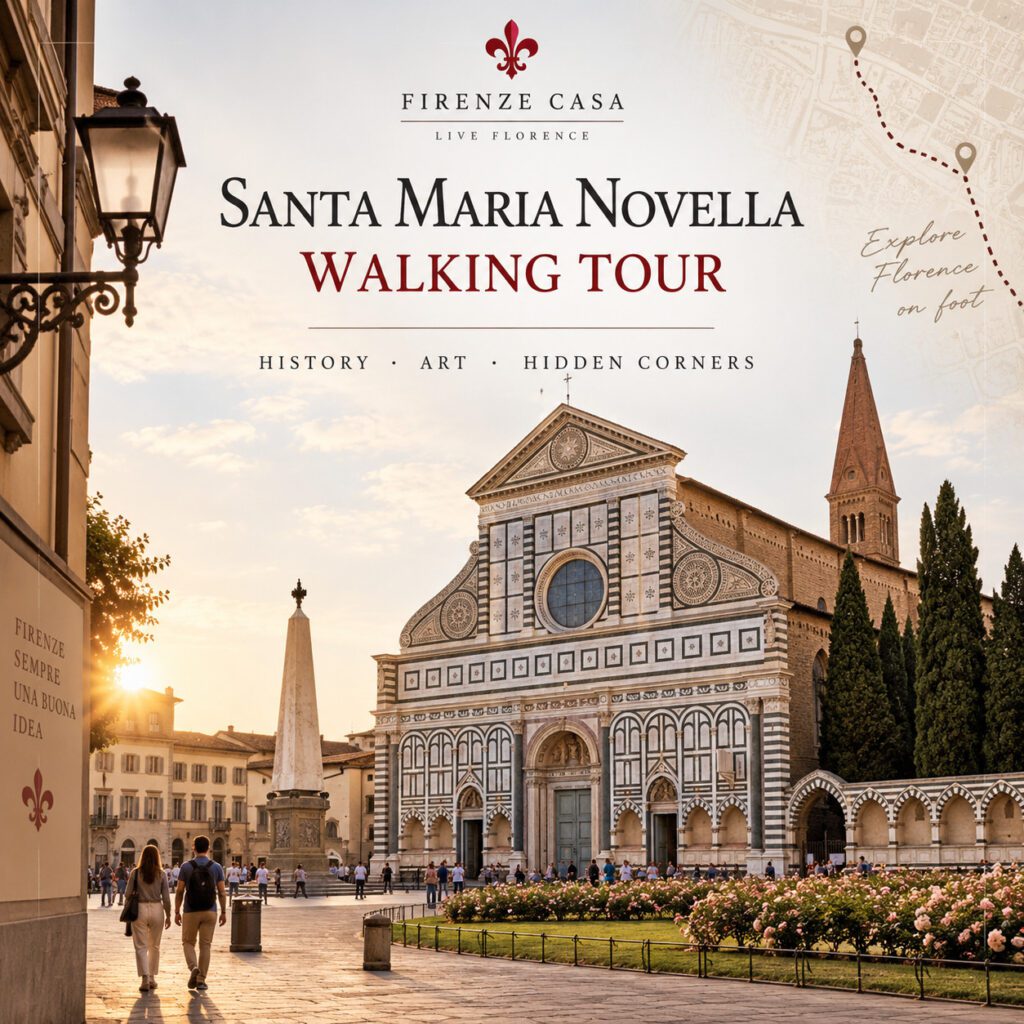
Discover one of Florence’s most varied historic neighbourhoods on this Santa Maria Novella Walking Tour. The route begins around the celebrated piazza and Dominican basilica before leading through streets shaped by religion, Renaissance patronage, craftsmanship and centuries of everyday Florentine life.
Rather than treating Santa Maria Novella simply as the area around Florence’s main railway station, this walk reveals a neighbourhood with its own distinct identity. Historic churches, a centuries-old apothecary tradition, elegant architecture and quieter streets towards Ognissanti and the Arno make it an ideal area to explore on foot. It forms part of our Walking Tours of Florence: The Complete Guide.
Distance:
Walking time:
Recommended time:
Start:
Finish:
Character: Renaissance art · Religious history · Historic streets · Local life
Difficulty:
Walking Route Map
The map below will show the complete route and numbered stops for this Santa Maria Novella walk.
[WP Go Maps route will be added here]
The Walking Tour
1. Piazza Santa Maria Novella
Begin by experiencing Piazza Santa Maria Novella as a space in its own right rather than simply approaching the basilica entrance. The broad piazza provides enough distance to appreciate the architecture surrounding it and immediately sets this neighbourhood apart from Florence’s narrower medieval streets.
Walk towards the opposite side of the square and look back at the church. From here, the proportions and coloured marble of the façade become much easier to understand as a complete composition.
Do not hurry across the piazza towards the church entrance. Santa Maria Novella is one of those Florentine monuments that becomes more impressive when you first step away from it and see the façade in relation to the surrounding urban space.
2. Basilica of Santa Maria Novella
The Basilica of Santa Maria Novella is the historical and artistic heart of the neighbourhood. The Dominican complex connects medieval Florence with the Renaissance through architecture, religious life and works by artists including Giotto, Masaccio and Domenico Ghirlandaio.
For this walking tour, pay particular attention to Leon Battista Alberti’s façade. Giovanni Rucellai financed its completion, turning the church into one of the clearest examples of how wealthy Florentine families used patronage to shape the appearance of the city.
The Rucellai name and family symbols are incorporated into the façade. They are a reminder that some of Florence’s most celebrated public monuments are also records of private family ambition and patronage.
3. Museo Novecento
On the same piazza, Museo Novecento introduces an entirely different period of Florentine culture. Its focus on twentieth-century and contemporary art creates an intriguing contrast with the medieval and Renaissance masterpieces only steps away.
You do not necessarily need to visit the museum during the walk. Its presence is nevertheless worth noticing because it demonstrates how the historic neighbourhood continues to accommodate new cultural uses rather than existing only as a preserved Renaissance setting.
4. Officina Profumo-Farmaceutica di Santa Maria Novella
The route now connects the Dominican complex with another remarkable Florentine tradition. The historic Officina Profumo-Farmaceutica di Santa Maria Novella on Via della Scala developed from the medicinal and aromatic preparations associated with the Dominican friars.
Its decorated historic rooms make this far more than an ordinary shop. The setting provides a tangible connection with Florence’s long history of pharmacy, medicinal plants, fragrance and specialised craftsmanship, explored more fully in our guide to Historic Pharmacies & Perfume in Florence.
Even if you are not planning to buy perfume, step inside for the historic setting. The rooms help explain why fragrance in Florence belongs as much to the history of pharmacy, botany and craftsmanship as it does to luxury shopping.
5. Via della Scala and the Quieter Side of Santa Maria Novella
Continue through Via della Scala and the surrounding streets to experience a different side of the neighbourhood. The monumental piazza quickly gives way to a more varied urban landscape of historic buildings, small businesses and streets that many visitors bypass on their way between the railway station and Florence’s major attractions.
This transition is one of the reasons the wider Santa Maria Novella neighbourhood deserves to be explored independently. Within a relatively compact area, Florence changes from international gateway to Renaissance monument and then to quieter residential streets.
6. Borgo Ognissanti and San Giovanni di Dio
As the walk moves towards Ognissanti, the history of the neighbourhood broadens beyond churches and artistic patronage. The former San Giovanni di Dio complex recalls Florence’s long traditions of charity and medical care and also connects this part of the city with the Vespucci family.
Borgo Ognissanti is particularly useful for understanding how major Florentine families left traces that extend beyond famous palaces. Religious institutions, hospitals and charitable foundations were also part of the social landscape of the city.
7. Chiesa di Ognissanti
The Chiesa di Ognissanti is one of the most rewarding stops on the western side of the walk. Its history connects the medieval Umiliati order with Florence’s textile economy, while its art brings the visitor into the world of Botticelli and Ghirlandaio.
The Vespucci family also had strong connections with the church and neighbourhood, while Sandro Botticelli was buried here. These overlapping stories make Ognissanti an excellent example of what this walking tour is designed to reveal: art, families, commerce and religious life were rarely separate worlds in historic Florence.
Ognissanti connects two famous Florentines whose lives seem to belong to completely different stories: Sandro Botticelli and the Vespucci family. Looking at the neighbourhood through these connections reveals how closely art, commerce and family identity overlapped in Renaissance Florence.
8. Piazza Ognissanti and the Arno
From the church, the walk reaches the riverfront and opens onto a very different view of Florence. The dense streets of Santa Maria Novella give way to the broad landscape of the Arno, where palaces, bridges and the Lungarni reveal how the river shaped the western side of the historic centre.
This is a natural place to slow down and look back at the route. The walk has moved from a monumental Renaissance piazza through monastic and charitable history towards the river without entering the busiest parts of the historic centre.
9. Ponte alla Carraia
The Ponte alla Carraia provides a fitting final perspective on the neighbourhood. The crossing has medieval origins and for centuries formed part of the practical movement of people and goods through Florence.
From the bridge, look east along the Arno towards Ponte Santa Trinita and Ponte Vecchio. The view places the Santa Maria Novella area within the wider geography of Florence and provides a natural transition towards the Oltrarno for anyone who wants to continue exploring.
Optional Detours
Palazzo Rucellai
If Renaissance architecture is one of your main interests, consider extending the walk towards Palazzo Rucellai. Its celebrated façade provides another opportunity to explore the relationship between Leon Battista Alberti and the Rucellai family already encountered at Santa Maria Novella.
Palazzo Strozzi
Another possible extension leads towards Palazzo Strozzi. Walking around its monumental exterior reveals how architecture became an expression of wealth and family ambition in Renaissance Florence.
Where to Pause Along the Way
Piazza Santa Maria Novella itself is an excellent place to pause before beginning the walk. Farther west, Piazza Ognissanti and the Arno provide a completely different atmosphere and allow the neighbourhood to be experienced away from the busiest sightseeing routes.
The riverfront is particularly suitable for a final pause. Rather than immediately moving on to another monument, take a moment to look along the sequence of bridges and consider how the Arno connects the neighbourhood with the rest of Florence.
Make This Walk Your Own
The Santa Maria Novella Walking Tour can easily be adapted according to your interests. Art lovers may spend more time inside the basilica and Museo Novecento, while visitors interested in Florentine craftsmanship can focus on the historic pharmacy and the streets leading towards Ognissanti.
For a stronger Renaissance architecture theme, add Palazzo Rucellai and Palazzo Strozzi. If you prefer to continue walking rather than visiting interiors, reach the Arno and follow the river towards Ponte Santa Trinita or cross Ponte alla Carraia into the Oltrarno.
Crossing Ponte alla Carraia provides a natural transition from Santa Maria Novella into the western Oltrarno. From there, the character of Florence changes again as the streets lead towards San Frediano and Santo Spirito.
Why This Walk Is Worth It
Santa Maria Novella is often the first neighbourhood travellers encounter in Florence, yet it is also one of the easiest to overlook. Visitors arriving by train frequently move directly towards the Duomo without discovering the remarkable concentration of art, architecture and social history immediately around them.
Walking slowly from the basilica towards Ognissanti and the Arno reveals a more layered Florence. Dominican history, Renaissance patronage, perfume traditions, charitable institutions, Botticelli, the Vespucci family and the river all become parts of one neighbourhood story. The result is not simply a route between monuments, but a way of understanding how different aspects of Florentine life developed side by side.
Further Reading on Firenze Casa
- Walking Tours of Florence: The Complete Guide
- Santa Maria Novella Florence – Historic Neighbourhood
- Basilica of Santa Maria Novella – Art and Architecture in Florence
- Chiesa di Ognissanti – Botticelli’s Church in Florence
- Historic Pharmacies & Perfume in Florence
- Palazzo Rucellai – Alberti’s Renaissance Palace
- Ponte alla Carraia – Historic Bridge in Florence
References
- Comune di Firenze – historical and cultural information on Florence and the Santa Maria Novella district.
- Basilica di Santa Maria Novella – historical information on the Dominican complex and its artistic heritage.
- Officina Profumo-Farmaceutica di Santa Maria Novella – history of the historic pharmacy and Dominican tradition.
- Museo Novecento Firenze – information on the museum, collections and historic building.
- Treccani – biographical and historical reference material on Florentine artists, families and institutions.