Palazzo San Firenze reveals a side of Florence that is often overshadowed by the Renaissance. Dominating one side of Piazza San Firenze, only a few steps from Palazzo Vecchio and the Bargello, this monumental complex belongs primarily to the seventeenth and eighteenth centuries and to the history of the Oratorians of Saint Philip Neri.
Its grand façade can easily be mistaken for that of an aristocratic palace. In reality, the Complesso di San Firenze was conceived as a religious ensemble combining a church, an oratory and living quarters for the Oratorian Fathers. Over the centuries it became a government building and courthouse before beginning yet another life as a centre for culture and the performing arts.
Historic name: Complesso di San Firenze
Location: Piazza San Firenze, Florence
Origins: 17th-century Oratorian complex
Main architects: Pier Francesco Silvani, Ferdinando Ruggieri and Zanobi del Rosso
Original purpose: Church, oratory and residence of the Oratorians
Later use: Government offices and Florence courthouse
Today: Cultural complex including the Franco Zeffirelli collection and foundation
Architectural importance: One of the major expressions of Baroque architecture in central Florence
A Baroque Landmark in Renaissance Florence
Florence is so closely identified with Renaissance architecture that later periods are easily overlooked. Yet Palazzo San Firenze demonstrates that architectural ambition did not end with Brunelleschi, Michelozzo or Alberti.
The complex belongs to the broader story explored in our Historic Palaces of Florence – Complete Guide. It is an unusual member of that collection because it was not created as the residence of a wealthy Florentine dynasty. Instead, its monumental appearance grew from the religious and institutional ambitions of the Oratorians.
This distinction makes San Firenze particularly valuable. Alongside buildings such as Palazzo Corsini al Parione, it demonstrates how Florentine architecture developed a richer and more theatrical language during the Baroque period.
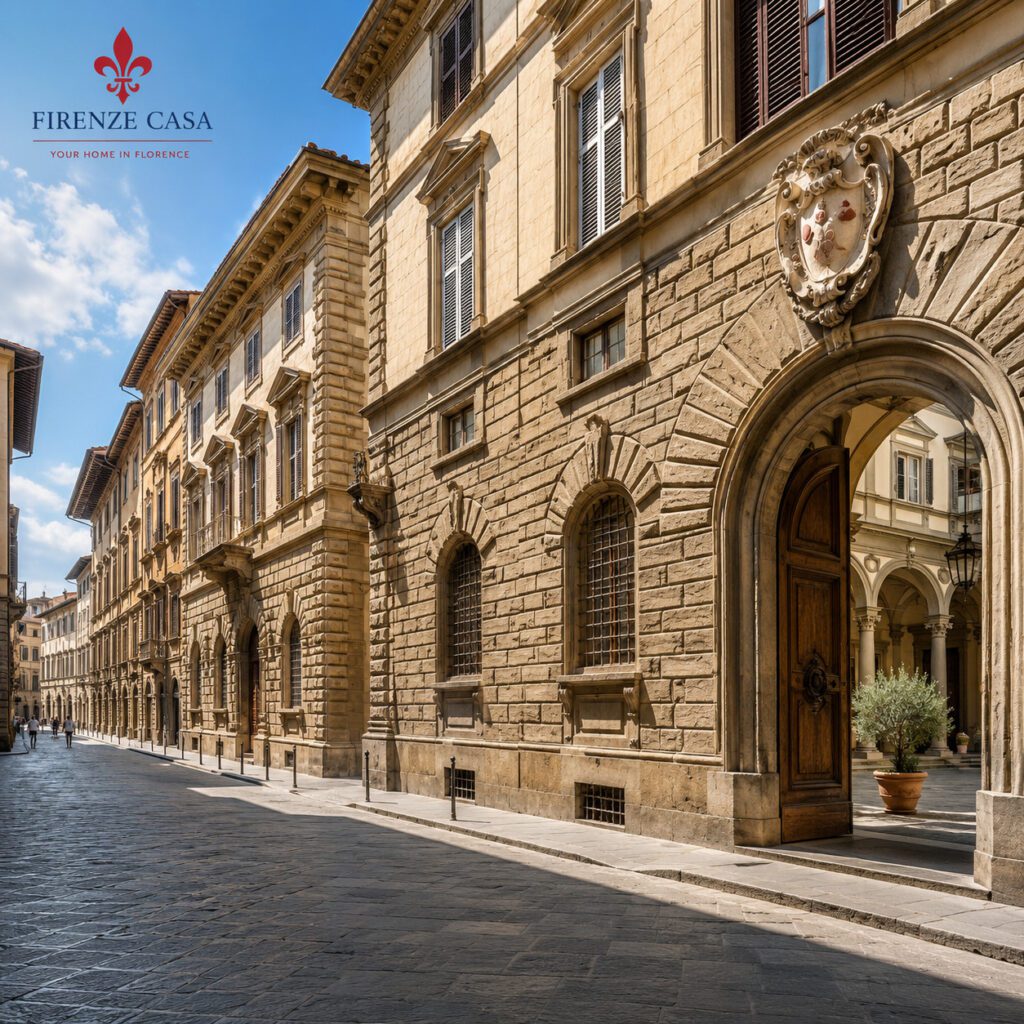
Stand back in Piazza San Firenze and look at the entire composition rather than at a single entrance. The long façade was designed to unite several different functions into what appears to be one monumental architectural statement.
The Oratorians Arrive in Florence
The history of the complex is inseparable from the Congregation of the Oratory of Saint Philip Neri. The Oratorians established themselves in Florence during the seventeenth century, bringing with them a religious tradition that had developed in Rome around the charismatic Florentine priest Filippo Neri.
Saint Philip Neri had been born in Florence in 1515 but spent most of his religious life in Rome. His approach emphasised prayer, preaching, music, charitable activity and a more personal form of spiritual community. He founded the Congregation of the Oratory, whose members became commonly known in Italy as the Filippini.
After Neri’s canonisation in 1622, devotion to the Florentine saint grew further. Establishing a major Oratorian centre in his native city therefore carried considerable symbolic importance.
Although Saint Philip Neri is most strongly associated with Rome, he was Florentine by birth. The great Oratorian complex at San Firenze therefore brought the religious movement he founded back to the city in which his life had begun.
What Was Here Before Palazzo San Firenze?
The Oratorians did not arrive on an empty site. A much older church dedicated to San Firenze – or San Fiorenzo – already stood in this part of the city and is documented from the Middle Ages.
The surrounding urban fabric consisted of houses, towers and smaller buildings typical of the dense medieval centre. The Oratorians gradually acquired and reorganised properties to create the much larger complex they envisioned.
This process is characteristic of Florence. Monumental buildings that appear unified today often grew through the absorption and transformation of much older structures.
San Firenze therefore represents not only Baroque architecture but also another stage in the continuous rebuilding of medieval Florence.
An Ambitious Project by Pietro da Cortona
The Oratorians initially looked beyond Florence for an architect capable of giving their new complex appropriate grandeur. In the 1640s, Pietro da Cortona, one of the leading architects and painters of Roman Baroque, became involved in the project.
His ideas were ambitious. The proposed architecture would have introduced a monumental Roman Baroque language into a city whose architectural traditions were generally more restrained.
The scale of the project, however, proved difficult to realise. Financial considerations and the challenge of adapting such an ambitious design to Florentine circumstances eventually led to a different approach.
The surviving complex is therefore not simply the execution of one architect’s original vision. It emerged through a succession of designs, compromises and building campaigns extending across more than a century.
Baroque architecture developed most spectacularly in Rome. San Firenze is fascinating partly because it shows how those ideas were adapted to Florence, a city with an exceptionally strong Renaissance architectural identity.
Pier Francesco Silvani and the New San Firenze
The decisive figure in shaping the complex was the Florentine architect Pier Francesco Silvani. During the 1660s, he reworked the earlier plans and eventually developed a substantially different project incorporating the church, oratory and residence of the Oratorian Fathers.
Silvani belonged to an important Florentine architectural family. His father, Gherardo Silvani, was one of the leading architects working in seventeenth-century Florence and contributed to several aristocratic and religious buildings.
At San Firenze, Pier Francesco Silvani had to reconcile the Oratorians’ ambitions with the realities of the site and available resources. The result helped establish the architectural framework from which the later complex developed.
Rather than importing Roman Baroque unchanged, San Firenze gradually acquired a distinctly Florentine interpretation of the style.
The Church of San Filippo Neri
The church forms one of the principal elements of the San Firenze complex. Its interior reveals a world very different from the restrained spaces commonly associated with early Renaissance Florence.
Architecture, sculpture, painting and decorative elements work together to create a richer visual environment. The Oratorians understood art and music as important components of religious experience, making the setting particularly appropriate for their spiritual tradition.
The church also reflects the changing artistic culture of Florence during the seventeenth century. The city remained profoundly attached to its Renaissance heritage, but patrons and religious institutions continued to commission ambitious new works in contemporary styles.
San Firenze is therefore an important reminder that Florence did not become an architectural museum after the sixteenth century.
Ferdinando Ruggieri and the Monumental Façade
After Pier Francesco Silvani’s death, work on the complex continued. One of the most important later contributions came from Ferdinando Ruggieri, who worked on the monumental façade during the early eighteenth century.
The façade gives San Firenze much of the imposing appearance visitors recognise today. Strong architectural divisions, sculptural decoration and carefully organised openings create a much more animated surface than the austere stone fronts of Florence’s fifteenth-century merchant palaces.
Yet the building never becomes extravagantly Roman. Its Baroque character remains filtered through Florentine traditions of proportion and architectural discipline.
This balance between theatricality and restraint is one of the reasons the façade is so interesting.
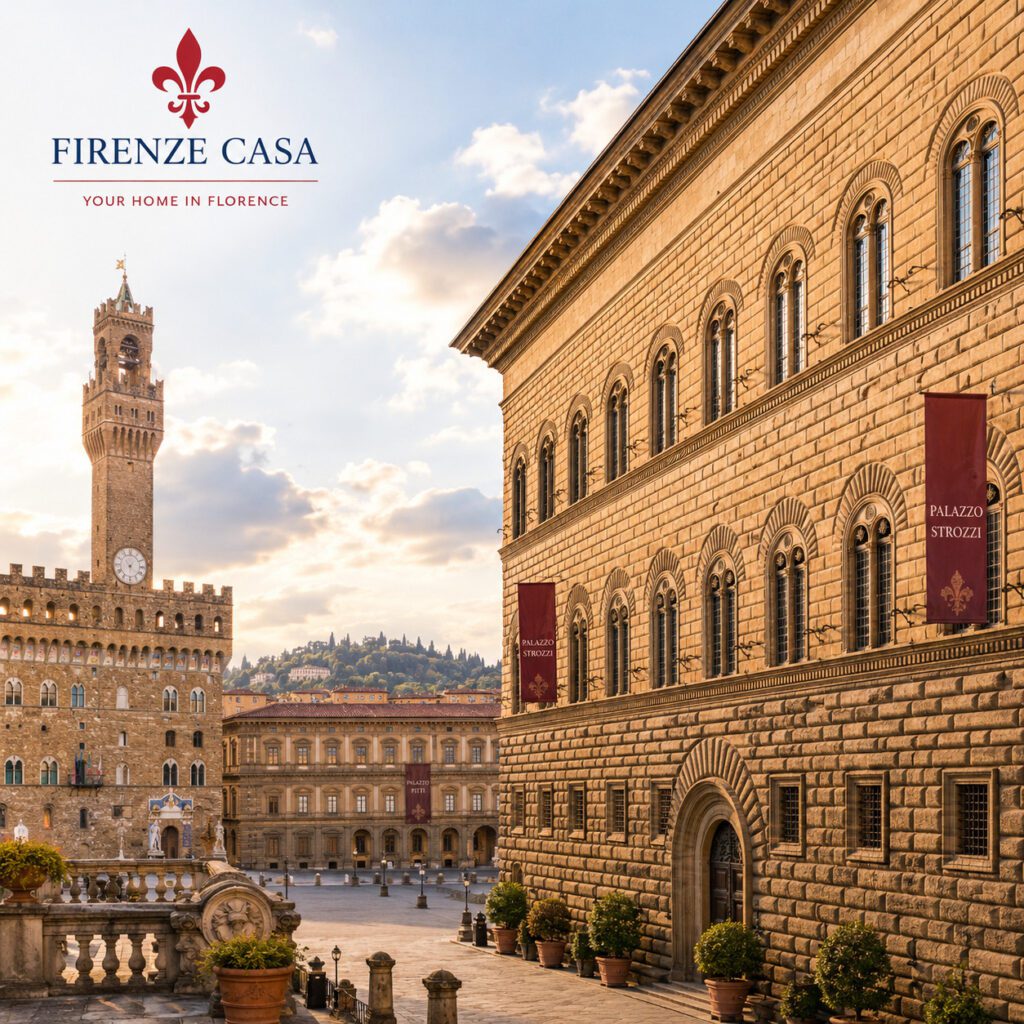
Compare San Firenze with Palazzo Strozzi or Palazzo Medici Riccardi. The Baroque façade uses greater movement, ornament and sculptural emphasis, revealing how dramatically architectural language had changed since the fifteenth century.
Church, Residence and Oratory
Understanding San Firenze becomes easier once you realise that the monumental façade conceals several different functions.
The Oratorians required not only a church but also their own residential and communal spaces and a separate oratory. The complex therefore developed almost like a small religious city contained within a single urban block.
The central conventual section was developed during the eighteenth century, helping connect the different parts into a more coherent whole.
The distinction between church and oratory was important within Oratorian life. The oratory provided a setting for religious exercises, preaching and devotional activities that complemented formal worship in the church.
Zanobi del Rosso and the New Oratory
The appearance of the complex continued to evolve during the eighteenth century. The older oratory was eventually replaced by a new building designed under Zanobi del Rosso during the 1770s.
The new oratory was carefully integrated into the existing composition. Its façade echoed the architectural language of the church, strengthening the impression of symmetry across Piazza San Firenze.
This is one of the most successful aspects of the complex. What developed through different architects and construction campaigns appears from the square as a remarkably coherent monumental ensemble.
The apparent symmetry of San Firenze is deceptive. The complex was not created all at once. Church, residence and oratory emerged through different building campaigns extending across generations.
Piazza San Firenze – Between Bargello and Palazzo Vecchio
The location of Palazzo San Firenze is exceptional. The piazza lies between two of the most important centres of civic power in historic Florence.
Immediately nearby stands the Bargello, the medieval Palazzo del Podestà associated for centuries with justice, policing and imprisonment. A few minutes in the opposite direction brings you to Palazzo Vecchio, the great political palace of the Florentine Republic.
San Firenze introduces yet another layer. Its Baroque façade represents seventeenth- and eighteenth-century religious and institutional Florence within an urban landscape still dominated by medieval and Renaissance monuments.
Standing in the piazza therefore allows visitors to read several centuries of Florentine history within an exceptionally small area.
Approach Piazza San Firenze from the Bargello and then continue towards Piazza della Signoria. In only a few minutes, the walk connects medieval civic architecture, Florentine Baroque and the political heart of the city.
Suppression of the Oratorians and a New Civic Role
The religious history of San Firenze was disrupted by the political transformations that swept across Tuscany and Europe during the late eighteenth and early nineteenth centuries.
Religious communities were suppressed and restored during different periods, and the Oratorians were affected by these changes. Eventually, the vast complex acquired increasingly secular and administrative functions.
This transition was part of a much wider transformation of Florence. Former convents, monasteries and religious institutions throughout the city were adapted into schools, offices, military buildings, hospitals and government institutions.
San Firenze survived partly because its size and central location made it exceptionally useful for new purposes.
Palazzo San Firenze and the Courts of Florence
One of the most important later chapters in the building’s history was its association with the Tribunale di Firenze. For generations of modern Florentines, San Firenze was therefore known not primarily as an Oratorian complex but as a courthouse.
This produced an intriguing historical transformation. Rooms created for a religious community became part of the machinery of the modern Italian state.
The judicial function also creates an interesting connection with the nearby Bargello. The Bargello represents the administration of justice in medieval and early modern Florence, while San Firenze became associated with the courts of a much later city.
The relocation of the principal judicial offices to the new Palazzo di Giustizia in Novoli eventually ended this long phase of San Firenze’s history.
The Bargello and San Firenze stand remarkably close together. Their histories allow visitors to follow the changing architecture of Florentine justice from a fortified medieval civic palace to a former religious complex adapted for modern courts.
From Courthouse to Cultural Palace
After the courts left San Firenze, the question became how such an enormous historic building could be returned to the cultural life of the city.
The Comune di Firenze developed plans to transform significant parts of the complex into a centre devoted to arts and performance. This new role is remarkably appropriate for a building created by the Oratorians, whose religious culture had itself placed considerable emphasis on music, performance and communication.
Instead of becoming a static monument, Palazzo San Firenze therefore continues its long history of adaptation.
Religious complex, administrative building, courthouse and cultural institution are not separate histories. Together they explain why the building has remained relevant to Florence for centuries.
Franco Zeffirelli at San Firenze
The most prominent contemporary cultural association is with Franco Zeffirelli, the Florentine director, designer and filmmaker whose career extended across theatre, opera and cinema.
The Fondazione Franco Zeffirelli established its cultural centre within the San Firenze complex, bringing together materials documenting decades of theatrical and cinematic creativity.
Drawings, designs, costumes, models, photographs and archival material reveal the enormous amount of visual planning behind Zeffirelli’s productions.
The location creates an appealing continuity. A building created by an order that valued music and religious performance now houses the legacy of one of Florence’s internationally renowned twentieth-century figures in theatre and opera.
San Firenze’s modern association with theatre and performance is surprisingly appropriate. Music and communal religious exercises were central to the Oratorian tradition long before the complex became connected with Franco Zeffirelli.
Why Baroque Florence Is Easy to Miss
Visitors often arrive in Florence looking primarily for the Middle Ages and Renaissance. Brunelleschi’s dome, Botticelli, Michelangelo and the Medici understandably dominate the city’s international image.
As a result, seventeenth-century Florence can almost disappear between the Renaissance and the Grand Tour.
Yet buildings such as San Firenze and Palazzo Corsini al Parione, together with spaces such as the Cappella Niccolini in Santa Croce, demonstrate that Baroque Florence deserves considerably more attention.
The city’s version of the Baroque is often less overwhelming than Rome’s, but precisely for that reason it reveals how new artistic ideas were adapted to a strong local architectural tradition.
How to Read the Façade of Palazzo San Firenze
The best way to appreciate Palazzo San Firenze is to resist concentrating on individual decorative details at first. Instead, cross the piazza and look at the entire façade.
Notice how horizontal and vertical architectural elements organise its considerable length. Then examine the entrances, windows, pilasters, sculptural decoration and changes corresponding to the different parts of the complex.
The façade succeeds because it makes separate functions appear unified. Only after understanding the building’s history does its apparent symmetry reveal the complicated sequence of construction behind it.
It is architecture designed not merely to occupy one side of a square but to shape the square itself.
San Firenze becomes much more interesting once you stop asking whether it is a church or a palace. It is an urban complex in which religious, residential, administrative and cultural architecture have overlapped for centuries.
Palazzo San Firenze and the Changing City
Few buildings demonstrate Florence’s ability to reuse its historic architecture more clearly than Palazzo San Firenze.
The Oratorians created the complex for a particular form of seventeenth-century religious life. Political change later removed much of that original function. The state and city adapted the building for administration and justice, and modern Florence has once again transformed significant parts of it for cultural purposes.
At every stage, the architecture survived because it could accommodate new forms of urban life.
This continuing adaptation is one of the great characteristics of Florence. Historic buildings are not always frozen at the moment of their creation. Many remain alive precisely because successive generations find new purposes for them.
Why Palazzo San Firenze Is Worth Discovering
Palazzo San Firenze deserves attention because it expands the familiar story of Florentine architecture beyond the Renaissance. Its history begins with the Oratorians and Saint Philip Neri, passes through some of the leading architects of Florentine Baroque and continues through government offices, courts and contemporary cultural life.
Architecturally, it demonstrates how Baroque ideas were adapted to Florence rather than simply copied from Rome. Historically, it reveals how a major religious complex could be repeatedly transformed without disappearing from the life of the city.
Its location makes the contrast even more compelling. The medieval Bargello, Renaissance and civic world of Palazzo Vecchio, and Baroque San Firenze stand within minutes of one another.
That concentration of different periods is one of the reasons walking through Florence is so rewarding. The city is not only Renaissance Florence. At Piazza San Firenze, several centuries of architecture and history meet within a single view.
Palazzo San Firenze broadens our collection of historic Florentine palaces beyond aristocratic residences. It represents religious ambition, Baroque architecture, civic reuse and the remarkable ability of Florence’s historic buildings to acquire new lives.
Further Reading on Firenze Casa
Continue exploring Florence’s historic palaces, Baroque architecture and the monuments surrounding Piazza San Firenze:
- Historic Palaces of Florence – Complete Guide
- Palazzo Vecchio – Florence’s Historic Government Palace
- Palazzo Corsini al Parione – Baroque Palace in Florence
- Cappella Niccolini in Santa Croce – Florence’s Baroque Gem
- Florence Museums – The Complete Guide
References
- Comune di Firenze – historical and architectural documentation on the Complesso di San Firenze.
- Comune di Firenze – Palazzo delle Arti e dello Spettacolo, San Firenze.
- Historical and architectural studies on the Oratorians of Saint Philip Neri in Florence.
- Studies on Pietro da Cortona and the early designs for San Firenze.
- Studies on Pier Francesco Silvani and seventeenth-century Florentine architecture.
- Historical documentation on Ferdinando Ruggieri and the façade of San Firenze.
- Historical documentation on Zanobi del Rosso and the eighteenth-century Oratory.
- Fondazione Franco Zeffirelli – historical and institutional documentation.