

The Renaissance in Florence – Complete Guide
Few periods in history changed the world as profoundly as the Renaissance. It transformed art, architecture, literature, science and political thought, laying the foundations for modern Europe. Although its influence eventually spread across the continent, the Renaissance was born in one remarkable city: Florence. Walking through its streets today means walking through the birthplace of a cultural revolution that continues to inspire visitors more than five hundred years later.
Introduction
Florence is often described as the Cradle of the Renaissance, but what does that actually mean? Why did this extraordinary movement begin here rather than in Rome, Venice or Paris? And why do millions of visitors continue to admire Renaissance masterpieces centuries after they were created?
The Renaissance was far more than a new artistic style. It represented a completely different way of thinking about humanity, knowledge and the world. Artists sought to understand nature instead of merely copying earlier traditions. Architects rediscovered the harmony of ancient Rome. Scholars studied classical texts with fresh curiosity, while scientists began observing and questioning the natural world in ways that transformed human understanding.
Florence became the perfect environment for this cultural revolution. Wealth generated through banking and international trade allowed powerful families to invest in artists, architects and scholars. Competition between influential citizens encouraged innovation, while the city’s republican traditions created an atmosphere in which new ideas could flourish.
This guide explains not only what the Renaissance was, but also why it began in Florence, who made it possible and, perhaps most importantly, how you can still recognise its influence today. By the end of your visit, you will see Florence with completely new eyes.
📅 Historical Timeline
| Period | Development |
|---|---|
| 1300s | Early humanist scholars such as Petrarch encourage a renewed interest in classical learning. |
| 1401 | The famous competition for the Baptistery doors marks the beginning of a new artistic age. |
| 1420 | Filippo Brunelleschi begins constructing the revolutionary dome of Florence Cathedral. |
| Mid-1400s | Cosimo de’ Medici establishes Florence as Europe’s leading cultural centre through patronage. |
| Late 1400s | The age of Lorenzo il Magnifico sees the flourishing of Botticelli, Leonardo da Vinci and young Michelangelo. |
| 1500s | The High Renaissance spreads from Florence throughout Italy and the rest of Europe. |
| Today | Florence remains one of the world’s most important cities for Renaissance art, architecture and culture. |
What Does “Renaissance” Mean?
The word Renaissance comes from the French term meaning rebirth. It describes the renewed interest in the ideas, art and knowledge of ancient Greece and Rome that emerged in Italy during the fourteenth and fifteenth centuries.
For medieval Europeans, religion shaped nearly every aspect of life. Art primarily served devotional purposes, education focused on theology and society remained organised according to long-established traditions. Renaissance thinkers did not reject religion, but they expanded their view of the world by placing greater emphasis on human potential, observation, learning and creativity.
This intellectual transformation became known as Humanism. Scholars believed that studying classical philosophy, literature, history and science could help people understand both themselves and the world more deeply. Artists began depicting real human emotions, architects rediscovered mathematical harmony and writers explored subjects far beyond purely religious themes.
The Renaissance was therefore not simply a return to antiquity. It combined ancient knowledge with new ideas, leading to innovations that transformed painting, sculpture, architecture, engineering, politics, literature and science.
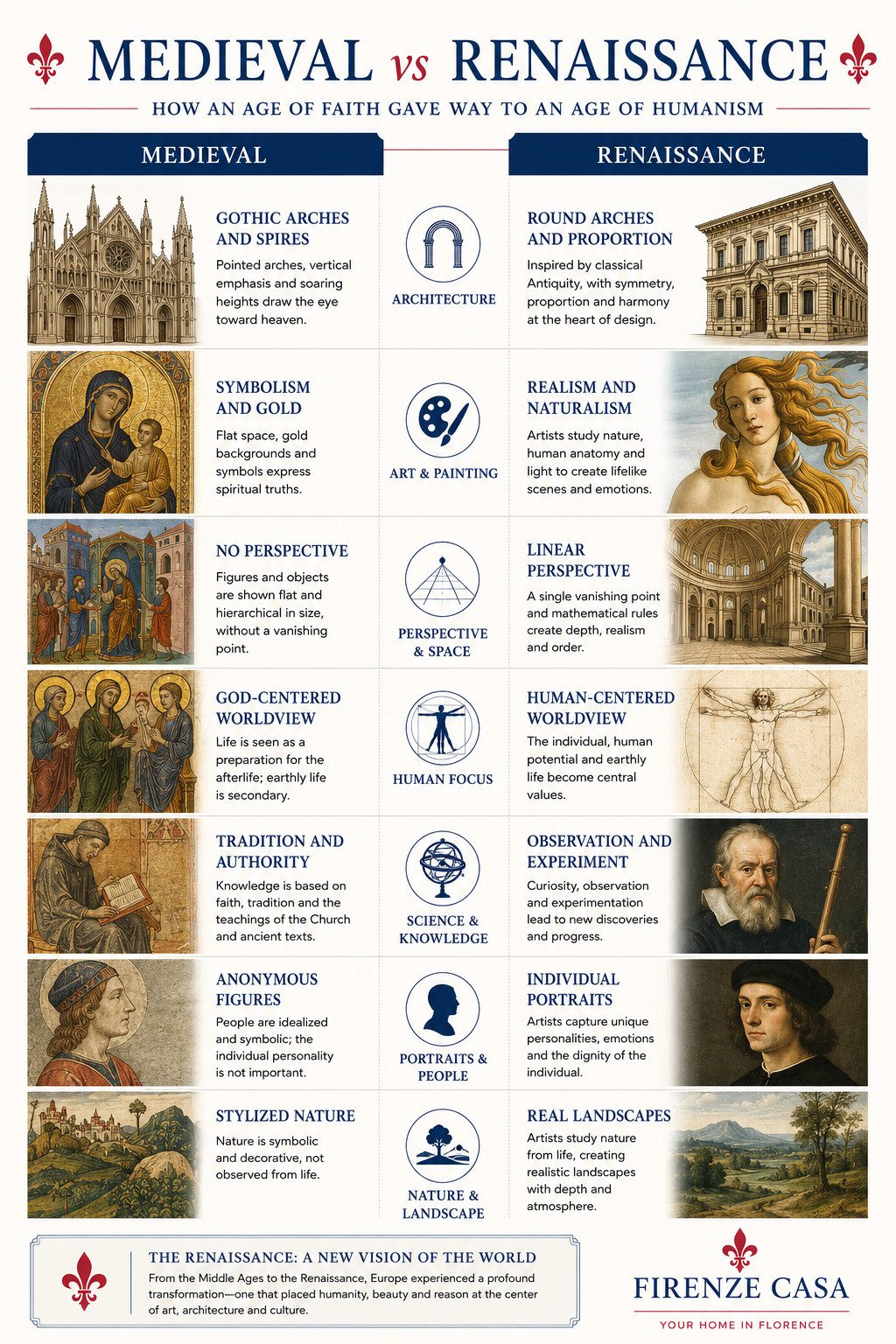
🔍 Click to view the infographic in full size
Why Did the Renaissance Begin in Florence?
Many Italian cities were wealthy during the late Middle Ages, yet Florence possessed a unique combination of economic prosperity, political independence and cultural ambition that allowed the Renaissance to flourish.
International banking families accumulated enormous wealth through trade, finance and textile production. Rather than investing only in military power, many Florentine citizens competed to finance churches, libraries, public buildings and works of art that enhanced both their reputation and the prestige of the city itself.
Florence also benefited from an unusually educated population. Merchants required mathematical knowledge, literacy and foreign languages to conduct business across Europe and the Mediterranean. This practical culture encouraged curiosity, innovation and intellectual exchange.
Equally important was the city’s political structure. Although power often rested in the hands of influential families, Florence remained a republic for much of the Renaissance. Competition between ambitious citizens stimulated architectural projects, artistic commissions and scholarly achievements unlike anywhere else in Europe.
By the early fifteenth century, Florence had become an environment where artists, architects, philosophers and scientists could experiment, collaborate and challenge established traditions. It was here that the Renaissance truly took shape before spreading throughout Italy and eventually across Europe.
The Medici – The Great Patrons of the Renaissance
No family is more closely associated with the Renaissance than the Medici. Originally successful bankers, they understood that wealth alone did not guarantee lasting influence. By supporting artists, architects, scholars and scientists, they transformed Florence into Europe’s leading cultural capital.
Cosimo de’ Medici believed that investing in knowledge and beauty strengthened both the city and his family’s reputation. He financed churches, libraries and public buildings while encouraging some of the greatest creative minds of his generation. His grandson, Lorenzo de’ Medici, known as Lorenzo il Magnifico, expanded this vision even further.
Under Lorenzo’s patronage, young artists such as Michelangelo received education, financial support and access to remarkable collections of ancient sculpture. Botticelli created some of the Renaissance’s most celebrated paintings, while scholars translated classical texts and debated new philosophical ideas.
The Medici did not simply purchase works of art. They created an environment in which extraordinary talent could develop. Their patronage encouraged innovation across painting, sculpture, architecture, literature and science, making Florence the intellectual centre of Renaissance Europe.
Our dedicated article on The Medici Family explores how several generations of this remarkable dynasty shaped the political, cultural and artistic history of Florence.
Humanism – A New Way of Thinking
The Renaissance was not only an artistic revolution; it was also an intellectual one. At its heart stood Humanism, a movement that encouraged people to study humanity itself through history, literature, philosophy and the achievements of classical antiquity.
Humanist scholars believed that education should extend beyond theology. They rediscovered the writings of ancient Greek and Roman thinkers such as Plato, Aristotle and Cicero, seeing them not as relics of the past but as valuable guides for understanding human nature and society.
This new approach transformed education throughout Florence. Libraries expanded, manuscripts were collected and translated, and scholars gathered in academies supported by influential patrons such as the Medici. The focus shifted from simply preserving knowledge to questioning, analysing and creating new ideas.
Humanism also profoundly influenced artists. Painters no longer portrayed anonymous symbolic figures but individual people with recognisable emotions and personalities. Architects sought mathematical harmony, while sculptors studied anatomy to represent the human body with unprecedented realism.
The Renaissance therefore placed human curiosity at the centre of intellectual life. Rather than asking only what had always been believed, Renaissance thinkers increasingly asked what could be observed, measured and understood.
How to Recognise Renaissance Architecture
One of the easiest ways to recognise the Renaissance in Florence is through its architecture. Medieval buildings often appear tall, defensive and irregular, reflecting centuries when security was more important than beauty. Renaissance architects introduced an entirely different vision inspired by the balance and harmony of ancient Rome.
Instead of creating buildings that impressed through size alone, architects sought perfect proportions. Every façade, window, column and courtyard was carefully designed according to mathematical principles that created a sense of order and elegance.
When walking through Florence, look for these characteristic Renaissance features:
- Symmetrical façades with balanced proportions.
- Round arches instead of pointed Gothic arches.
- Classical columns and pilasters inspired by ancient Rome.
- Large interior courtyards bringing light into the building.
- Clear horizontal divisions between different storeys.
- Domes that combine engineering innovation with architectural beauty.
- Simple geometric forms rather than excessive decoration.
Some of the finest examples include Brunelleschi’s Cathedral Dome, Palazzo Medici Riccardi, Palazzo Rucellai, San Lorenzo and the elegant façade of Santa Maria Novella designed by Leon Battista Alberti.
Our detailed guides to these buildings explain how Renaissance architects transformed both Florence and European architecture forever.

How to Recognise Renaissance Painting
Perhaps nowhere is the Renaissance more immediately visible than in painting. Comparing a medieval painting with a Renaissance masterpiece reveals how dramatically artists changed their understanding of the world.
Medieval paintings often emphasised symbolism over realism. Figures appeared flat, backgrounds were frequently covered in gold leaf and perspective was largely absent. The goal was spiritual meaning rather than visual accuracy.
Renaissance painters introduced entirely new techniques that created lifelike scenes filled with depth, movement and emotion.
| Medieval Art | Renaissance Art |
|---|---|
| Flat figures | Natural human proportions |
| Gold backgrounds | Real landscapes and architecture |
| Limited perspective | Scientific linear perspective |
| Symbolic poses | Natural movement and emotion |
| Stylised faces | Individual personalities |
| Little attention to anatomy | Detailed anatomical accuracy |
Artists such as Masaccio pioneered perspective, Fra Angelico combined spirituality with realism, Botticelli celebrated beauty and mythology, Leonardo da Vinci perfected observation and Michelangelo elevated the human figure to an unprecedented level of artistic achievement.
When visiting the Uffizi Gallery, these characteristics become immediately recognisable, allowing visitors to appreciate Renaissance painting far more deeply.
How to Recognise Renaissance Sculpture
Florence also revolutionised sculpture. Medieval statues often appeared formal and symbolic, whereas Renaissance sculptors studied the human body with remarkable precision. Inspired by surviving Roman sculptures, they sought to recreate natural movement, realistic anatomy and emotional expression.
Donatello was among the first artists to revive the classical free-standing statue, while Verrocchio and Michelangelo brought Renaissance sculpture to extraordinary heights.
Key characteristics include:
- Accurate human anatomy.
- Natural standing poses (contrapposto).
- Realistic facial expressions.
- Movement captured in marble or bronze.
- Classical influences from ancient Greece and Rome.
Michelangelo’s David perfectly illustrates these ideals. More than a biblical hero, the statue embodies confidence, intelligence and the Renaissance belief in human potential.
How the Renaissance Changed Literature
The Renaissance transformed literature just as profoundly as it changed art. Writers became increasingly interested in the individual, human emotions, politics and everyday life rather than focusing exclusively on religious subjects.
Several remarkable Florentine and Tuscan authors shaped this new literary world.
| Writer | Contribution |
|---|---|
| Dante Alighieri | Bridged the medieval world and early Renaissance thought through the Divine Comedy. |
| Francesco Petrarch | Often called the Father of Humanism. |
| Giovanni Boccaccio | The Decameron introduced realistic storytelling centred on human experience. |
| Niccolò Machiavelli | Revolutionised political thought through The Prince. |
These writers encouraged readers to think critically about politics, ethics, society and human behaviour. Their influence extended far beyond Italy and continues to shape literature and political philosophy today.
The Renaissance and the Birth of Modern Science
The Renaissance encouraged people to observe the world rather than simply accept traditional explanations. This spirit of curiosity became the foundation of modern science.
Artists studied anatomy to paint the human body accurately. Architects applied geometry to achieve harmonious buildings. Engineers experimented with new construction techniques, while astronomers questioned humanity’s place in the universe.
Although Galileo belongs slightly later than the High Renaissance, his work reflects the intellectual curiosity that developed in Florence during this remarkable period. Careful observation, experimentation and mathematical reasoning gradually replaced unquestioned authority.
Many visitors are surprised to discover that Florence’s Renaissance influenced not only painters and sculptors but also medicine, engineering, astronomy and the scientific method itself.
How the Renaissance Changed Politics
The Renaissance did not only transform art and science; it also reshaped politics. Florence was one of the most influential republics of its time, governed not by kings but by wealthy citizens, merchant families and elected officials. Although political power was often concentrated among a few leading families, the city developed a dynamic political culture that encouraged debate, diplomacy and innovation.
No Renaissance thinker influenced political philosophy more than Niccolò Machiavelli. Having served the Florentine Republic as a diplomat, he observed how rulers gained, maintained and lost power. His famous work The Prince remains one of the most influential political books ever written.
Rather than describing how rulers ought to behave according to moral ideals, Machiavelli analysed how politics actually worked. His practical observations marked a turning point in political thought and continue to be discussed more than five centuries later.
The Renaissance therefore transformed not only artistic expression but also the understanding of government, diplomacy and leadership.
How the Renaissance Changed Everyday Life
The Renaissance affected ordinary Florentines as much as famous artists. Prosperity brought new opportunities for education, trade and craftsmanship, while growing international connections introduced fresh ideas, luxury goods and cultural influences.
Florence became famous for its textile industry, banking houses, workshops and artisan traditions. Apprentices learned their professions in highly specialised workshops, where painters, sculptors, goldsmiths and architects passed their knowledge from one generation to the next.
Fashion also became increasingly important. Wealthy citizens commissioned luxurious clothing made from silk, velvet and fine wool, while jewellery and elaborate accessories reflected social status. Public festivals, religious celebrations and civic ceremonies transformed Florence into a vibrant stage where art and everyday life merged.
Education expanded rapidly, and literacy became increasingly valuable for merchants and professionals. The Renaissance encouraged curiosity, travel and the exchange of ideas, creating a society that looked beyond local traditions towards a wider European world.
Where You Can Still Experience the Renaissance in Florence
One of Florence’s greatest attractions is that the Renaissance is not confined to museums. The city itself remains one of the world’s best-preserved Renaissance landscapes, allowing visitors to experience the movement where it originally developed.
| Place | What You Can Discover |
|---|---|
| Cathedral of Santa Maria del Fiore | Brunelleschi’s revolutionary dome and Renaissance engineering. |
| Uffizi Gallery | Botticelli, Leonardo, Michelangelo and the greatest Renaissance paintings. |
| Accademia Gallery | Michelangelo’s David. |
| Palazzo Vecchio | The political centre of Renaissance Florence. |
| Palazzo Medici Riccardi | The rise of the Medici family and early Renaissance architecture. |
| San Lorenzo | Brunelleschi’s architecture and the Medici Chapels. |
| Santa Maria Novella | Perspective, geometry and Renaissance painting. |
| Bargello Museum | Masterpieces by Donatello, Verrocchio and Michelangelo. |
Together, these monuments form an extraordinary open-air museum where visitors can trace the development of Renaissance architecture, sculpture, painting and political history simply by walking through the historic centre.
Can You Recognise the Renaissance Today?
After exploring Florence, you will begin to notice that Renaissance ideas appear everywhere. Once you know what to look for, the city becomes much easier to understand.
Ask yourself these simple questions as you explore:
- Does the building have balanced proportions and symmetry?
- Can you see classical columns or rounded arches?
- Does the painting create realistic depth through perspective?
- Do the figures display natural anatomy and human emotion?
- Does the sculpture appear alive and capable of movement?
- Does the building draw inspiration from ancient Rome?
- Is mathematics or geometry visible in the design?
- Does the artwork celebrate human achievement as well as religious faith?
If the answer is yes to several of these questions, you are almost certainly looking at a masterpiece of the Renaissance.
Visitor Information
Visitor Information
📍 Main Renaissance Sites
Cathedral of Santa Maria del Fiore (Duomo)
Uffizi Gallery
Accademia Gallery
Palazzo Vecchio
Palazzo Medici Riccardi
San Lorenzo
Santa Maria Novella
Bargello Museum
📌 Location
The principal Renaissance monuments are concentrated within Florence’s UNESCO-listed historic centre and can easily be explored on foot.
⏱ Suggested Visit
Allow at least two to three days to experience Florence’s most important Renaissance sites. Visitors interested in art and history could easily spend a week exploring the city.
🌐 Official Websites
Consult the official websites of the Uffizi Galleries, Opera di Santa Maria del Fiore and the Florentine Civic Museums for current visitor information.
🗺 View on Google Maps
Create a walking route linking the Duomo, Piazza della Signoria, the Uffizi, Palazzo Medici Riccardi, San Lorenzo and Santa Maria Novella.
Interesting Facts
- The word Renaissance was introduced centuries after the period itself had ended.
- Brunelleschi’s dome remained the world’s largest masonry dome for hundreds of years.
- The Medici never officially became kings of Florence, yet they shaped the city’s history more than any ruling dynasty.
- Michelangelo was only twenty-six years old when he completed David.
- Linear perspective, one of the defining features of Renaissance painting, was first developed in Florence.
- Many Renaissance masterpieces remain in the buildings for which they were originally created.
- Florence’s historic centre is a UNESCO World Heritage Site because of its exceptional Renaissance heritage.
- The Renaissance influenced not only Europe but eventually the entire Western world.
Frequently Asked Questions
What was the Renaissance?
The Renaissance was a cultural movement that began in Florence during the fourteenth and fifteenth centuries, transforming art, architecture, literature, science and political thought.
Why did the Renaissance begin in Florence?
Florence combined economic prosperity, political independence, educated citizens and influential patrons such as the Medici family, creating ideal conditions for innovation.
Who financed the Renaissance?
Wealthy merchant families, especially the Medici, supported artists, architects, writers and scholars through generous patronage.
Who were the most important Renaissance artists?
Brunelleschi, Donatello, Botticelli, Leonardo da Vinci, Michelangelo, Fra Angelico and Masaccio were among the movement’s most influential figures.
How can I recognise Renaissance architecture?
Look for symmetry, classical columns, rounded arches, domes, harmonious proportions and inspiration drawn from ancient Roman architecture.
Which Florence museums best explain the Renaissance?
The Uffizi Gallery, Accademia Gallery, Bargello Museum, Museo dell’Opera del Duomo and Palazzo Vecchio provide outstanding introductions.
Why is Florence called the Cradle of the Renaissance?
Because many of the movement’s defining ideas, artistic innovations and influential personalities first emerged there before spreading across Europe.
Can visitors still experience the Renaissance today?
Absolutely. Florence remains one of the world’s best-preserved Renaissance cities, with churches, palaces, museums and public squares that continue to reflect the ideals of this remarkable period.
Further Reading from Firenze Casa
- Florence Museums: The Complete Guide
- The Most Beautiful Churches in Florence
- The Most Beautiful Palaces in Florence
- The Most Beautiful Squares in Florence
- The Great Families of Florence
- The Medici Family (Coming Soon)
- Brunelleschi’s Dome (Coming Soon)
- Humanism in Florence (Coming Soon)
- Renaissance Art in Florence (Coming Soon)
References
- UNESCO World Heritage Centre – Historic Centre of Florence.
- Opera di Santa Maria del Fiore – Official historical resources.
- Gallerie degli Uffizi – Renaissance collections and historical information.
- Musei del Bargello – Sculpture and Renaissance art.
- Museo Galileo – Renaissance science and scientific instruments.
- Comune di Firenze – Cultural heritage resources.
- Academic publications on Renaissance history, Humanism and Florentine art.
- Standard works on the Medici family and the Italian Renaissance.
Conclusion
The Renaissance was far more than an artistic style. It was a new way of thinking that transformed how people understood themselves, their society and the world around them. In Florence, wealth, education, political ambition and visionary patronage came together to create an environment unlike any other in Europe.
The achievements of Brunelleschi, Donatello, Botticelli, Leonardo da Vinci, Michelangelo and countless others were not isolated miracles. They emerged from a city that encouraged creativity, rewarded innovation and believed that knowledge could improve both individuals and society.
Today, Florence remains the world’s greatest classroom for understanding the Renaissance. Every church, palace, museum and public square tells part of this extraordinary story. Once you learn how to recognise its architecture, paintings, sculptures and ideas, the city reveals itself not simply as a collection of beautiful monuments, but as the place where the modern world began.

