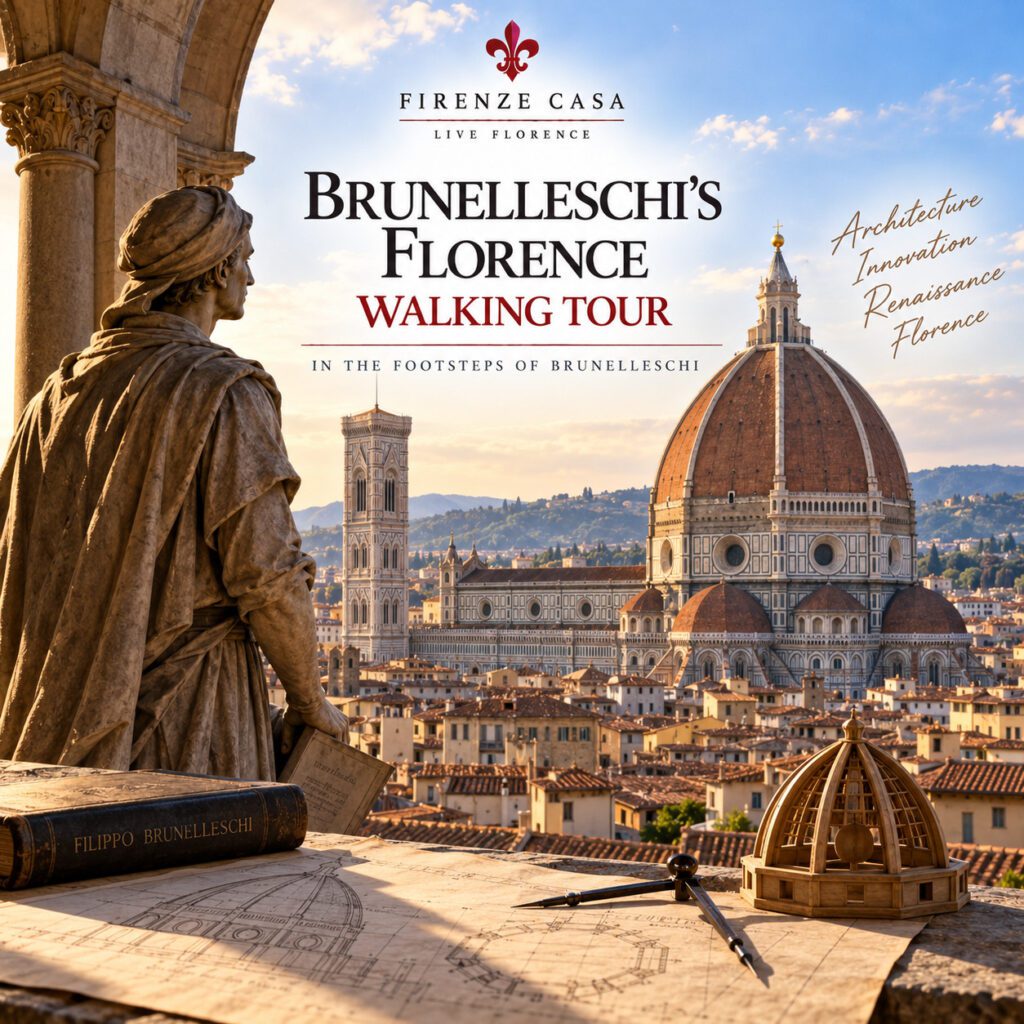
Follow Filippo Brunelleschi through Florence on this Brunelleschi Florence Walking Tour, connecting the buildings, spaces and ideas that transformed him from a goldsmith and sculptor into one of the most influential architects of the Renaissance.
Brunelleschi’s Florence is remarkably compact. His revolutionary dome dominates the skyline, while the Ospedale degli Innocenti, San Lorenzo and Santo Spirito reveal how his ideas about proportion, geometry and classical architecture changed the appearance of the city itself. This walk forms part of our Walking Tours of Florence: The Complete Guide.
🚶 At a Glance
Distance:
Walking time:
Recommended time:
Start:
Finish:
Character: Brunelleschi · Renaissance architecture · Engineering · Perspective · Churches · Florence
Difficulty:
Walking Route Map
The map will show the final route through Brunelleschi’s Florence, connecting the principal buildings and places associated with his architecture, engineering and experiments with perspective.
🗺️ Walking Route Map
[WP Go Maps route will be added here]
The Walking Tour
1. Piazza del Duomo – Brunelleschi’s Florence Begins Here
Begin in Piazza del Duomo beneath the building that made Filippo Brunelleschi famous. When construction of Florence Cathedral began in 1296, nobody yet knew exactly how its enormous crossing would eventually be covered. The octagonal space was simply too wide for conventional medieval building methods.
Brunelleschi transformed that problem into one of the defining achievements of Renaissance architecture. Standing in the piazza before beginning the walk makes the scale of his challenge immediately understandable.
👀 Firenze Casa Tip
Before looking at individual details, step back and study the entire cathedral. Brunelleschi’s dome is not simply a roof above the building – its scale transformed the skyline of Florence.
2. Brunelleschi’s Dome – An Engineering Revolution
The dome of Santa Maria del Fiore was Brunelleschi’s greatest engineering achievement. Construction began in 1420, and the enormous structure rose without the massive traditional wooden centring that would normally have supported a masonry dome during construction.
Brunelleschi developed an ingenious combination of a double-shell structure, carefully organised masonry, horizontal reinforcement and specially designed construction techniques. The famous herringbone arrangement of bricks helped control the masonry as the dome rose above the city.
The result was both technical and visual. The dome solved a construction problem that had challenged Florence for decades while creating the architectural landmark that still defines the city from almost every surrounding hill.
🏗️ Engineering Before Architecture
Brunelleschi’s achievement cannot be understood purely as a question of style. He had to invent construction methods, lifting equipment and organisational solutions capable of turning an unprecedented architectural idea into a physical structure.
3. Baptistery of San Giovanni – The Competition That Changed Art History
Cross Piazza del Duomo to the Baptistery of San Giovanni. Here Brunelleschi’s career intersects with one of the most famous artistic competitions of the early Renaissance.
In 1401, Brunelleschi and Lorenzo Ghiberti were among the artists who submitted designs for a new set of bronze doors for the Baptistery. Their surviving competition panels depicting the Sacrifice of Isaac reveal strikingly different approaches to composition, movement and bronze casting.
Ghiberti won the commission. Brunelleschi increasingly turned his attention towards architecture, engineering and the study of ancient buildings – a change of direction that would profoundly affect Florence.
4. Brunelleschi and the Discovery of Perspective
The area around the Baptistery is also traditionally associated with Brunelleschi’s celebrated experiments in linear perspective. Using a painted view of the Baptistery and an ingenious arrangement involving a mirror, he demonstrated how three-dimensional space could be represented according to a coherent geometric system.
The original panel has not survived, but the principle became fundamental to Renaissance visual culture. Architecture, painting and the mathematical understanding of space became increasingly interconnected.
📐 Look at Florence Differently
Brunelleschi’s importance extends beyond individual buildings. His experiments with perspective helped change the way artists understood and represented space – one of the central intellectual developments of the Renaissance.
5. Ospedale degli Innocenti – A New Architectural Language
Continue to Piazza della Santissima Annunziata and the Ospedale degli Innocenti. Designed by Brunelleschi from 1419, its elegant loggia is among the clearest early statements of Renaissance architecture in Florence.
Rounded arches rest on slender columns, while repeated geometric relationships organise the façade into a calm and comprehensible rhythm. Compared with the vertical complexity and richly articulated surfaces of much medieval architecture, Brunelleschi’s design appears remarkably controlled.
The building demonstrates an important principle that will recur throughout this walk: Brunelleschi created architectural harmony through proportion rather than through excessive decoration.
📏 Architecture to Notice
Stand across Piazza Santissima Annunziata and follow the repeated arches of the loggia. The relationship between column height, arch width and the spaces between them makes Brunelleschi’s architecture unusually easy to read.
6. Basilica of San Lorenzo – Brunelleschi and the Medici
Walk west towards the Basilica of San Lorenzo, one of the most important places for understanding Brunelleschi’s architectural language and his relationship with Medici patronage.
Inside, grey pietra serena architectural elements stand clearly against pale wall surfaces. Columns, arches and entablatures organise the interior through a system of measured proportions, creating a sense of order very different from the spatial complexity of a Gothic church.
San Lorenzo also places Brunelleschi within the wider story of the Medici family. Their patronage helped transform this ancient Florentine church into one of the key architectural complexes of the Renaissance.
7. The Old Sacristy – Geometry Made Visible
The Old Sacristy of San Lorenzo is one of Brunelleschi’s most concentrated architectural statements. Commissioned by Giovanni di Bicci de’ Medici, it combines a square principal space with a dome and carefully coordinated geometric forms.
Here Brunelleschi’s architecture can almost be read as a mathematical diagram. Circles, squares, arches and proportional relationships organise the room, while pietra serena makes the underlying architectural structure visually explicit.
Donatello’s sculptural decoration adds another layer to the space, bringing together two of the most innovative figures of early fifteenth-century Florence.
⚜️ Brunelleschi and the Medici
The Old Sacristy demonstrates how architectural innovation and private patronage were closely connected in Renaissance Florence. The Medici gained a prestigious family space while Brunelleschi received an opportunity to develop a radically new architectural vocabulary.
8. Palazzo di Parte Guelfa – Brunelleschi and Civic Florence
Continue towards the historic centre to the Palazzo di Parte Guelfa. Brunelleschi was involved in work on the building during the fifteenth century, making it an interesting reminder that his career extended beyond the great churches with which he is most commonly associated.
The palace belonged to Florence’s complex political and institutional world. Its connection with Brunelleschi places his architectural activity within the civic fabric of the republic rather than presenting him simply as a designer of religious buildings.
9. Piazza della Signoria – Brunelleschi’s Perspective and the Renaissance City
Continue to Piazza della Signoria. Brunelleschi did not design the medieval Palazzo Vecchio, but the square provides an ideal place to consider the broader transformation in visual thinking that occurred during his lifetime.
Perspective offered artists a systematic way of organising buildings, streets and figures within convincing spatial environments. Standing in one of Florence’s great civic spaces makes it easier to understand why the representation of architecture became such an important subject for Renaissance painters and sculptors.
The square also connects Brunelleschi’s generation with the wider artistic development explored on our Renaissance Masters of Florence walk.
10. Ponte Vecchio – Crossing into the Oltrarno
Walk towards the Arno and cross the Ponte Vecchio. Brunelleschi’s architectural story now moves into the Oltrarno, where two important churches reveal different aspects of his work.
The crossing also changes the character of the walk. The monumental civic centre gives way to the narrower streets and neighbourhood atmosphere south of the river.
11. Santa Felicita and the Barbadori Chapel
Just beyond Ponte Vecchio stands Santa Felicita. Within the church, the Barbadori Chapel – later known as the Capponi Chapel – is associated with Brunelleschi and represents another important stage in his development of centrally organised architectural spaces.
The chapel was subsequently transformed and is now especially famous for Pontormo’s extraordinary Deposition. Its history therefore brings different generations of Florentine art together within a remarkably compact interior.
12. Basilica of Santo Spirito – Brunelleschi’s Mature Architecture
Finish at the Basilica of Santo Spirito, one of the clearest expressions of Brunelleschi’s mature architectural thinking. The church stands at the heart of the Santo Spirito neighbourhood and provides an ideal conclusion to the walk.
The interior develops many of the principles already encountered at San Lorenzo but with an even stronger sense of spatial unity. Repeated columns and rounded arches organise the nave and aisles, while the sequence of chapels creates a continuous architectural rhythm around the church.
Comparing San Lorenzo and Santo Spirito is one of the most rewarding parts of this tour. They demonstrate that Brunelleschi was not applying a fixed Renaissance formula. He continued to refine his ideas about proportion, geometry, movement and space.
👀 Firenze Casa Tip
After entering Santo Spirito, look back towards the entrance and then slowly turn towards the crossing. Notice how repeated columns and arches make the entire interior feel connected. This is architecture designed to be understood through movement.
Brunelleschi Beyond the Architect
It is tempting to remember Brunelleschi simply as the architect of Florence Cathedral’s dome, but his career was much broader. He trained as a goldsmith, participated in the Baptistery competition, worked with sculpture, developed machines and construction techniques, studied ancient architecture and became closely associated with the development of linear perspective.
These activities were not separate interests. They reveal a mind fascinated by how things were constructed, how geometry could organise space and how observation could be transformed into practical solutions.
💡 Renaissance Innovation
Brunelleschi is a particularly good example of why modern categories can be misleading when exploring Renaissance Florence. Architecture, engineering, mathematics, craftsmanship and artistic experimentation were closely interconnected.
How to Read Brunelleschi’s Architecture
You do not need specialist architectural knowledge to recognise Brunelleschi’s ideas. Look for repeated rounded arches, classical columns, clearly defined geometric units and the characteristic contrast between grey pietra serena and pale wall surfaces.
More importantly, notice relationships. A column is rarely an isolated decorative element: its height may determine the width of an arch or the dimensions of the space beside it. Brunelleschi’s buildings become easier to understand when viewed as systems of connected proportions.
Walking between his buildings makes these recurring principles particularly visible. The individual monuments differ, but the underlying concern with geometry, clarity and controlled space remains remarkably consistent.
Optional Detours
Palazzo Medici Riccardi
Palazzo Medici Riccardi was designed by Michelozzo rather than Brunelleschi, but it provides useful context for understanding the architectural world created by Medici patronage. It can easily be added while visiting San Lorenzo.
Medici Chapels and Laurentian Library
The later additions to the San Lorenzo complex provide a fascinating comparison with Brunelleschi. Michelangelo’s New Sacristy and Laurentian Library demonstrate how a later generation could take the architectural vocabulary of the early Renaissance and deliberately make it more dynamic and unconventional.
Brancacci Chapel
Visitors interested in the wider artistic revolution of Brunelleschi’s generation can continue into San Frediano to the Brancacci Chapel. Masaccio’s use of perspective, light and convincingly solid human figures demonstrates how rapidly new approaches to pictorial space developed during the early fifteenth century.
Where to Pause Along the Way
Piazza della Santissima Annunziata is one of the best places to pause. Sit opposite the Ospedale degli Innocenti and study how Brunelleschi’s loggia establishes a rhythm that later architecture around the square continued.
San Lorenzo deserves another slower stop, particularly if you visit the Old Sacristy. The difference between experiencing Brunelleschi’s architecture from outside and standing within one of his geometrically organised interiors is considerable.
At the end of the walk, Piazza Santo Spirito provides a natural place to rest after visiting the basilica and to experience the everyday neighbourhood that surrounds one of Brunelleschi’s greatest buildings.
Make This Walk Your Own
For an architecture-focused walk, concentrate on the Dome, Ospedale degli Innocenti, San Lorenzo and Santo Spirito. These four sites alone provide an excellent introduction to Brunelleschi’s development as an architect.
If engineering interests you most, spend more time at the cathedral and consider visiting the Museo dell’Opera del Duomo separately to understand the construction of the dome in greater depth.
For a broader Renaissance perspective, pay particular attention to the Baptistery competition, Brunelleschi’s experiments with perspective and the relationship between his architecture and contemporary sculpture and painting. The Renaissance in Florence – Complete Guide places these developments within the wider transformation of the city.
Why Brunelleschi’s Florence Is Worth Exploring
Few architects have shaped the identity of a city as profoundly as Filippo Brunelleschi shaped Florence. His dome created the city’s most recognisable silhouette, but the walk reveals that his influence reaches much further than one extraordinary engineering achievement.
At the Ospedale degli Innocenti, San Lorenzo and Santo Spirito, architectural space becomes clear, measured and harmonious. At the Baptistery, the story of the competition with Ghiberti recalls Brunelleschi’s beginnings as a sculptor, while his perspective experiments reveal an intellectual curiosity that extended far beyond conventional architectural practice.
Most importantly, these places remain part of the living city. Walking between them shows how closely the birth of Renaissance architecture was connected with Florence itself – its churches, patrons, civic institutions, craftsmen and streets.
Further Reading on Firenze Casa
- Walking Tours of Florence: The Complete Guide
- Renaissance Masters of Florence
- Medici Florence
- Florence Cathedral
- Basilica of San Lorenzo
- Basilica of Santo Spirito
- The Renaissance in Florence – Complete Guide
References
- Opera di Santa Maria del Fiore – historical and architectural information on Brunelleschi’s Dome and the cathedral complex.
- Ospedale degli Innocenti – historical information on Brunelleschi’s architecture and the institution.
- Basilica di San Lorenzo – historical information on Brunelleschi, the Old Sacristy and the Medici.
- Basilica di Santo Spirito – historical and architectural information on Brunelleschi’s church.
- Musei del Bargello – historical information on Brunelleschi, Ghiberti and the 1401 Baptistery competition.
- Encyclopaedia Britannica – biographical information on Filippo Brunelleschi.