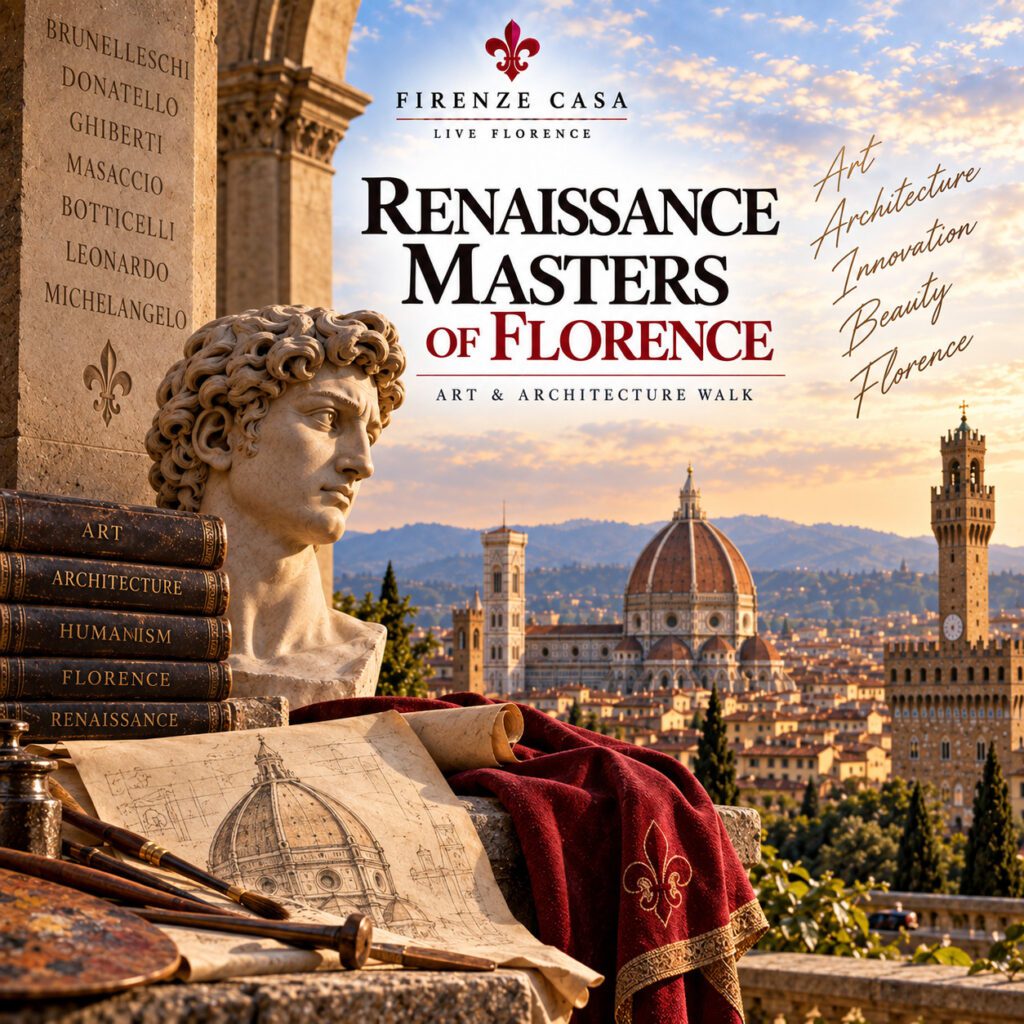
Walk through the city that changed the history of art on this Renaissance Masters Florence Walking Tour, connecting the churches, squares, palaces and museums associated with Brunelleschi, Donatello, Ghiberti, Masaccio, Botticelli, Leonardo da Vinci, Michelangelo and other masters of the Florentine Renaissance.
Rather than following the biography of a single artist, this walk reveals how generations of painters, sculptors and architects transformed Florence into an extraordinary laboratory of artistic innovation. Perspective, monumental sculpture, classical architecture and a new understanding of the human figure developed here within a remarkably compact urban landscape. It forms part of our Walking Tours of Florence: The Complete Guide.
Distance:
Walking time:
Recommended time:
Start:
Finish:
Character: Renaissance art · Architecture · Sculpture · Painting · Florentine masters
Difficulty:
Walking Route Map
The map will show the final route through Renaissance Florence, connecting buildings, sculptures and artistic landmarks associated with some of the greatest masters of the fifteenth and sixteenth centuries.
[WP Go Maps route will be added here]
The Walking Tour
1. Piazza del Duomo – The Renaissance Takes Shape
Begin in Piazza del Duomo, where several of the innovations that defined the Florentine Renaissance can be encountered within a few steps. The cathedral complex brings together architecture, sculpture, engineering and artistic competition on an extraordinary scale.
Florence Cathedral itself predates the Renaissance, but the fifteenth-century transformation of the complex demonstrates how a medieval city became the centre of a new artistic age. Brunelleschi, Ghiberti, Donatello and Luca della Robbia all contributed to this remarkable environment. The wider historic centre can be explored on the Duomo & Historic Centre Walking Tour.
Before concentrating on individual monuments, turn slowly around Piazza del Duomo. Few places allow you to compare so many generations of Florentine architecture and sculpture within one urban space.
2. Brunelleschi’s Dome – Architecture Reinvented
Look upwards to Filippo Brunelleschi’s enormous dome above Santa Maria del Fiore. Constructed during the first half of the fifteenth century, it solved an engineering problem that had challenged Florence for generations.
Brunelleschi developed an ingenious system that allowed the vast octagonal dome to rise without the enormous temporary wooden centring traditionally required for such construction. Its double-shell structure, carefully organised masonry and innovative building techniques made the project one of the defining achievements of Renaissance engineering.
The dome was more than a technical triumph. Its enormous silhouette transformed the identity of Florence and became a visible statement of the city’s confidence and ambition. Brunelleschi’s work across the city can be followed in greater depth on Brunelleschi’s Florence.
Brunelleschi did not simply imitate antiquity. His importance lies in combining the study of classical architecture with extraordinary technical experimentation to solve new problems.
3. Baptistery of San Giovanni – Ghiberti and the Gates of Paradise
Cross to the Baptistery and examine the doors associated with Lorenzo Ghiberti. His famous east doors, later celebrated as the Gates of Paradise, became one of the masterpieces of Renaissance bronze sculpture.
The reliefs demonstrate sophisticated perspective, carefully constructed architectural settings and an increasingly convincing representation of space. Figures in the foreground project strongly from the surface while distant scenes recede into shallow relief.
Ghiberti’s career was closely connected with the celebrated competition of 1401 for another set of Baptistery doors, in which his design competed with Brunelleschi’s. The episode has become one of the symbolic starting points of the Florentine Renaissance.
4. Museo dell’Opera del Duomo – Donatello, Ghiberti and Luca della Robbia
The Museo dell’Opera del Duomo preserves original works created for the cathedral complex and is one of the most important places for understanding early Renaissance sculpture.
Donatello’s extraordinary Penitent Magdalene reveals a dramatically different conception of the human figure from idealised classical beauty. The emaciated body and intensely expressive face transform the biblical figure into an image of suffering and spiritual devotion.
Works associated with Ghiberti and Luca della Robbia demonstrate other directions taken by Florentine sculpture, from sophisticated bronze relief to the harmonious figures and glazed terracotta for which the della Robbia workshop became famous.
5. Ospedale degli Innocenti – Brunelleschi and the Renaissance Façade
Continue to Piazza Santissima Annunziata, where Brunelleschi’s Ospedale degli Innocenti introduced a new architectural language to Florence. Its elegant loggia is organised through clear proportions, rounded arches and classical columns.
The building demonstrates how Renaissance architecture could create harmony through mathematical relationships and repeated geometric forms. Compared with the vertical complexity of medieval architecture, Brunelleschi’s design feels remarkably calm and rational.
The famous glazed terracotta medallions of infants were added by Andrea della Robbia, connecting the building with another important Florentine artistic dynasty.
Stand opposite the Ospedale and follow the rhythm of columns and arches. Renaissance architecture often becomes easier to understand when you look for repeated geometric relationships rather than decorative details.
6. San Marco – Fra Angelico
At the San Marco Museum, Renaissance art becomes quieter and more contemplative. Fra Angelico created frescoes for the monastery that combine religious devotion with the developing spatial language of fifteenth-century painting.
His celebrated Annunciation uses architecture, light and restrained perspective to create an image of extraordinary serenity. Throughout the convent, frescoes were designed not primarily for public display but for the spiritual life of the Dominican community.
San Marco therefore provides an important counterpoint to Florence’s monumental civic art. Renaissance innovation could serve private contemplation just as powerfully as public prestige.
7. Palazzo Medici Riccardi – Art and Patronage
Walk towards Palazzo Medici Riccardi, where architecture, politics and artistic patronage come together. Designed by Michelozzo for Cosimo de’ Medici, the palace became a model for the Renaissance urban residence.
Its massive rusticated ground floor gradually gives way to more refined masonry above, creating a carefully controlled impression of strength and elegance. The building expressed Medici status without taking the form of a royal palace.
Inside, Benozzo Gozzoli’s magnificent Journey of the Magi transforms the private chapel into a brilliant procession of richly dressed figures, landscapes and portraits associated with the Medici world. The dynasty’s wider influence on the city can be followed on Medici Florence.
The Renaissance was not created by artists alone. Wealthy families, guilds, religious institutions and civic authorities financed works that expressed devotion, prestige, political ambition and Florentine identity.
8. San Lorenzo – Brunelleschi and Donatello
The Basilica of San Lorenzo brings two foundational Renaissance masters together. Brunelleschi reshaped important parts of the church and created architectural spaces based on proportion, classical vocabulary and geometric clarity.
Donatello’s presence is equally important. His works for San Lorenzo include bronze pulpits created late in his career, while his close connection with the Medici and with Brunelleschi places him at the centre of the artistic world represented by the complex.
The contrast between Brunelleschi’s controlled architectural order and Donatello’s emotionally powerful sculpture demonstrates how varied the Florentine Renaissance could be.
9. Piazza della Repubblica – Florence and the Workshop City
As you move towards the civic centre, remember that Renaissance Florence was not simply a collection of isolated geniuses. Artists worked within a dense network of workshops, guilds, patrons and collaborators.
Painters and sculptors trained as apprentices, exchanged techniques and competed for prestigious commissions. Successful workshops could involve masters, assistants and specialised craftsmen working together on complex projects.
This collaborative environment helps explain why artistic innovation developed so rapidly in Florence during the fifteenth century. The broader culture of skilled workshops survives as an important part of the city’s identity and is explored in our Florentine Crafts – Complete Guide.
10. Orsanmichele – Sculpture in the Streets
Orsanmichele is one of the best places to understand the relationship between Renaissance art and Florence’s guilds. The exterior niches were commissioned by powerful professional organisations and decorated with statues of their patron saints.
Donatello’s Saint George became one of the defining works of early Renaissance sculpture, combining physical confidence with psychological alertness. Ghiberti, Verrocchio and other leading sculptors also contributed to the extraordinary programme.
The original sculptures are now protected in museums, with replicas occupying many exterior niches, but the building still demonstrates how major works of art once formed part of everyday urban life.
Orsanmichele rewards a complete circuit of the building. Each niche belonged to a guild, turning the exterior into a remarkable public gallery of Florentine sculpture.
11. Bargello – Donatello, Verrocchio and Michelangelo
The Bargello contains one of the world’s greatest collections of Renaissance sculpture. For this walk, it provides an extraordinary opportunity to compare several generations of Florentine masters within a single museum.
Donatello’s bronze David is revolutionary in both form and meaning. The youthful nude draws upon classical sculpture while creating something unmistakably new for fifteenth-century Florence.
Works by Verrocchio and Michelangelo reveal how subsequent generations continued to explore the human body, movement and the possibilities of bronze and marble. The museum turns the development of Renaissance sculpture into an almost visible conversation between artists.
12. Piazza della Signoria – The Renaissance as Public Art
Enter Piazza della Signoria, where sculpture became inseparable from political life. The square in front of Palazzo Vecchio functioned as Florence’s civic stage, and the works placed here acquired meanings extending far beyond artistic beauty.
Michelangelo’s David originally stood beside the entrance to Palazzo Vecchio, transforming the biblical hero into a symbol of republican strength. Donatello’s Judith and Holofernes also acquired political associations in this setting.
The sculptures visible outdoors today include originals and replicas from different periods, but the square still demonstrates the Florentine idea that monumental art belonged within the political heart of the city.
13. Palazzo Vecchio – Leonardo and Michelangelo in Competition
Inside Palazzo Vecchio lies the setting for one of the most famous artistic rivalries of the Renaissance. Leonardo da Vinci and Michelangelo were commissioned to create monumental battle scenes for the Salone dei Cinquecento.
Leonardo worked on the Battle of Anghiari, while Michelangelo prepared the Battle of Cascina. Neither survives as a completed mural, yet their designs became legendary and were studied by generations of artists.
The episode brings two towering figures of the High Renaissance into direct competition and demonstrates Florence’s continuing ability to attract extraordinary artistic ambition. Michelangelo’s wider Florentine career can be followed on Michelangelo’s Florence.
Had both projects been completed, one vast Florentine hall would have confronted visitors with monumental compositions by Leonardo on one wall and Michelangelo on another.
14. Loggia dei Lanzi – Sculpture in Public Space
The Loggia dei Lanzi extends the sculptural experience of Piazza della Signoria. Originally created for civic ceremonies, it later became an extraordinary open-air setting for monumental sculpture.
Benvenuto Cellini’s bronze Perseus with the Head of Medusa belongs to a later phase of the Renaissance and demonstrates how Florentine sculpture evolved towards the elegant complexity associated with Mannerism.
Its prominent public position continues the Florentine tradition of using sculpture to communicate power, culture and political meaning.
15. Uffizi – Botticelli and the Florentine Renaissance
The Uffizi provides the richest concentration of Renaissance painting on the walk. Although its collections extend far beyond Florence, the museum contains masterpieces that make it possible to follow the development of Florentine painting across generations.
Sandro Botticelli’s Birth of Venus and Primavera have become icons of Renaissance Florence. Their graceful figures, mythological subjects and sophisticated cultural references reflect the humanist environment associated with Medici patronage.
Works by Leonardo da Vinci, Filippo Lippi and other masters demonstrate different approaches to landscape, anatomy, perspective, expression and the representation of sacred and secular subjects.
Botticelli’s mythological paintings remind us that Renaissance culture did not simply revive ancient forms. Classical mythology was reinterpreted within the intellectual and artistic world of fifteenth-century Florence.
16. Ponte Vecchio – Art, Craft and the Renaissance City
Continue towards Ponte Vecchio. The bridge is not a single Renaissance masterpiece in the way Brunelleschi’s architecture or Donatello’s sculpture is, but it helps reconnect great art with the culture of skilled craftsmanship from which Florentine artists emerged.
Goldsmithing, metalworking, stone carving, textile production and other crafts required exceptional technical knowledge. The distinction between artist and artisan was far less rigid than modern visitors sometimes imagine.
Many Renaissance masters began their careers in workshops where drawing, metalwork, carving and practical problem-solving were inseparable. Visitors especially interested in this world can continue with the Florence Artisan Walk.
17. Santa Maria del Carmine – Masaccio and the Brancacci Chapel
Cross the Arno and continue to Santa Maria del Carmine, where the Brancacci Chapel contains one of the decisive achievements of early Renaissance painting.
Masaccio’s frescoes introduced an extraordinary sense of physical presence, emotional realism and coherent space. His figures possess weight and volume, while the use of perspective creates a convincing world in which the biblical scenes unfold.
Generations of artists studied these frescoes. Michelangelo was among those who learned from the figures in the chapel, making Santa Maria del Carmine one of the true classrooms of Renaissance art.
The Brancacci Chapel was not only admired by visitors. Young Florentine artists studied Masaccio’s figures and compositions, helping his innovations influence generations that followed.
18. Santo Spirito – Brunelleschi’s Architectural Harmony
Finish the main walk at the Basilica of Santo Spirito, one of the clearest expressions of Brunelleschi’s architectural ideas. Inside, repeated columns and rounded arches create a harmonious interior based on rhythm, geometry and proportion.
The church also connects with the young Michelangelo, who studied anatomy in association with the complex and created a wooden crucifix traditionally linked with his time here.
Santo Spirito therefore provides a fitting conclusion. Brunelleschi’s architecture belongs to the generation that helped establish the Renaissance, while Michelangelo points towards the extraordinary artistic developments that followed. The surrounding Oltrarno can be explored on the Santo Spirito & San Frediano Walking Tour.
From Brunelleschi to Michelangelo, the Renaissance was not one moment but a chain of innovations. Each generation studied what came before, then pushed Florentine art in a new direction.
Why Florence Became the Cradle of the Renaissance
No single explanation accounts for Florence’s extraordinary artistic concentration. Wealth generated through banking, commerce and textile production provided resources for ambitious commissions, while guilds, religious institutions, wealthy families and civic authorities competed to embellish the city.
Florence also possessed a strong culture of workshops and technical craftsmanship. Artists learned by working with materials, studying established masters and solving practical problems. Competition for major commissions encouraged experimentation and made artistic reputation enormously valuable.
Humanist interest in classical antiquity added another dimension. Ancient literature, philosophy, sculpture and architecture provided inspiration, but Florentine artists did not simply reproduce the past. They transformed it into a new visual language. For a broader overview of this transformation, see The Renaissance in Florence – Complete Guide.
The Masters Behind the Renaissance
Brunelleschi revolutionised architecture and engineering. Donatello transformed sculpture and the representation of the human figure. Ghiberti developed extraordinarily sophisticated bronze relief, while Masaccio helped redefine space and physical presence in painting.
Fra Angelico combined new artistic methods with spiritual intensity. Botticelli created some of the most recognisable images of Florentine humanism, while Verrocchio operated a workshop that helped train the young Leonardo da Vinci.
Leonardo and Michelangelo then carried Florentine experimentation into the High Renaissance, transforming the study of nature, anatomy, movement and monumental composition.
These artists did not work in isolation. Their achievements overlapped, competed and influenced one another, making Renaissance Florence a network of ideas rather than simply a collection of famous names.
The modern idea of the solitary artistic genius can be misleading. Renaissance Florence depended on workshops filled with assistants, apprentices and specialised craftsmen, even when one celebrated master received the lasting fame.
How to Look at Renaissance Art
Instead of trying to identify every artist and date, look for a few recurring ideas. Notice how painters create believable depth, how sculptors give bodies weight and movement, and how architects organise buildings through proportion and geometry.
Then compare generations. Masaccio’s figures differ dramatically from earlier medieval painting, while Michelangelo’s bodies push physical expression much further. Brunelleschi’s measured architecture establishes principles that later architects deliberately modify and challenge.
Renaissance art becomes most interesting when seen as a continuing experiment rather than a fixed style.
Optional Detours
Galleria dell’Accademia
Visitors who want to place Michelangelo at the centre of the walk can add the Accademia Gallery. His David and unfinished Prisoners provide an extraordinary demonstration of the possibilities of monumental marble sculpture.
Medici Chapels and Laurentian Library
These sites expand the architectural story into the sixteenth century. Michelangelo’s New Sacristy and Laurentian Library show how the balanced vocabulary of early Renaissance architecture could be manipulated into something more dramatic and unconventional.
Santa Maria Novella
Santa Maria Novella contains several works essential to the development of Renaissance art, including Masaccio’s Trinity. The fresco’s convincing architectural perspective makes it one of the landmark experiments of fifteenth-century painting. The church and surrounding district can be explored on the Santa Maria Novella Walking Tour.
Brancacci Chapel as a Separate Visit
If opening times or reservations make the full route difficult, the Brancacci Chapel is important enough to visit separately. Its significance to later Florentine artists makes it far more than an optional decorative interior.
Where to Pause Along the Way
Piazza Santissima Annunziata is an excellent place to pause and study Renaissance urban space. Brunelleschi’s loggia helped establish the architectural rhythm that later buildings continued around the square.
Piazza della Signoria deserves another deliberate stop. Here sculpture, architecture and politics interact so closely that the square functions almost like an open-air lesson in Florentine civic culture.
After crossing the Arno, the quieter streets of the Oltrarno provide a useful change of pace before the final encounters with Masaccio and Brunelleschi.
Make This Walk Your Own
For an architecture-focused route, concentrate on Brunelleschi’s Dome, the Ospedale degli Innocenti, San Lorenzo and Santo Spirito, adding Palazzo Medici Riccardi for Michelozzo’s contribution to the Renaissance palace.
Sculpture lovers should prioritise the Museo dell’Opera del Duomo, Orsanmichele, Bargello and Piazza della Signoria. Together they reveal the extraordinary transformation from early fifteenth-century sculpture to Michelangelo and the later Renaissance.
For painting, spend more time at San Marco, the Uffizi and the Brancacci Chapel. These three sites alone reveal radically different approaches to religious imagery, classical mythology, perspective and the human figure.
Do not try to visit every museum interior in a single day. The walk works equally well as a framework for several days, allowing you to return to selected museums and churches without losing the geographical connection between them.
Why This Walk Is Worth It
The Renaissance can seem like an abstract chapter in art history until you walk through Florence. Here, the distance between Brunelleschi’s architecture, Donatello’s sculpture, Masaccio’s frescoes and Michelangelo’s civic masterpieces is often measured in minutes.
The route reveals that Florence’s artistic transformation was not produced by one extraordinary individual. Generations of artists observed, competed with and learned from one another, supported by patrons and institutions willing to invest enormous resources in art and architecture.
It also reconnects famous masterpieces with the places for which they were created. Sculptures regain their civic meaning, churches become experiments in architecture and paintings can be understood within the religious and political environments that produced them.
By the end of the walk, Renaissance Florence emerges not simply as a city containing great art, but as the extraordinary urban laboratory in which many of the ideas that transformed European art were developed.
Further Reading on Firenze Casa
- Walking Tours of Florence: The Complete Guide
- Brunelleschi’s Florence
- Michelangelo’s Florence
- Medici Florence
- The Renaissance in Florence – Complete Guide
- Florentine Crafts – Complete Guide
- Accademia Gallery
References
- Gallerie degli Uffizi – collections and historical information on Florentine Renaissance painting.
- Musei del Bargello – Renaissance sculpture, Donatello, Verrocchio and Michelangelo.
- Opera di Santa Maria del Fiore – Brunelleschi’s Dome and the artistic heritage of the cathedral complex.
- Galleria dell’Accademia di Firenze – Michelangelo and Florentine Renaissance sculpture.
- Museo di San Marco – Fra Angelico and Renaissance Florence.
- Musei Civici Fiorentini – Palazzo Vecchio and Florence’s civic artistic heritage.
- Brancacci Chapel – Masaccio, Masolino and the development of Renaissance painting.