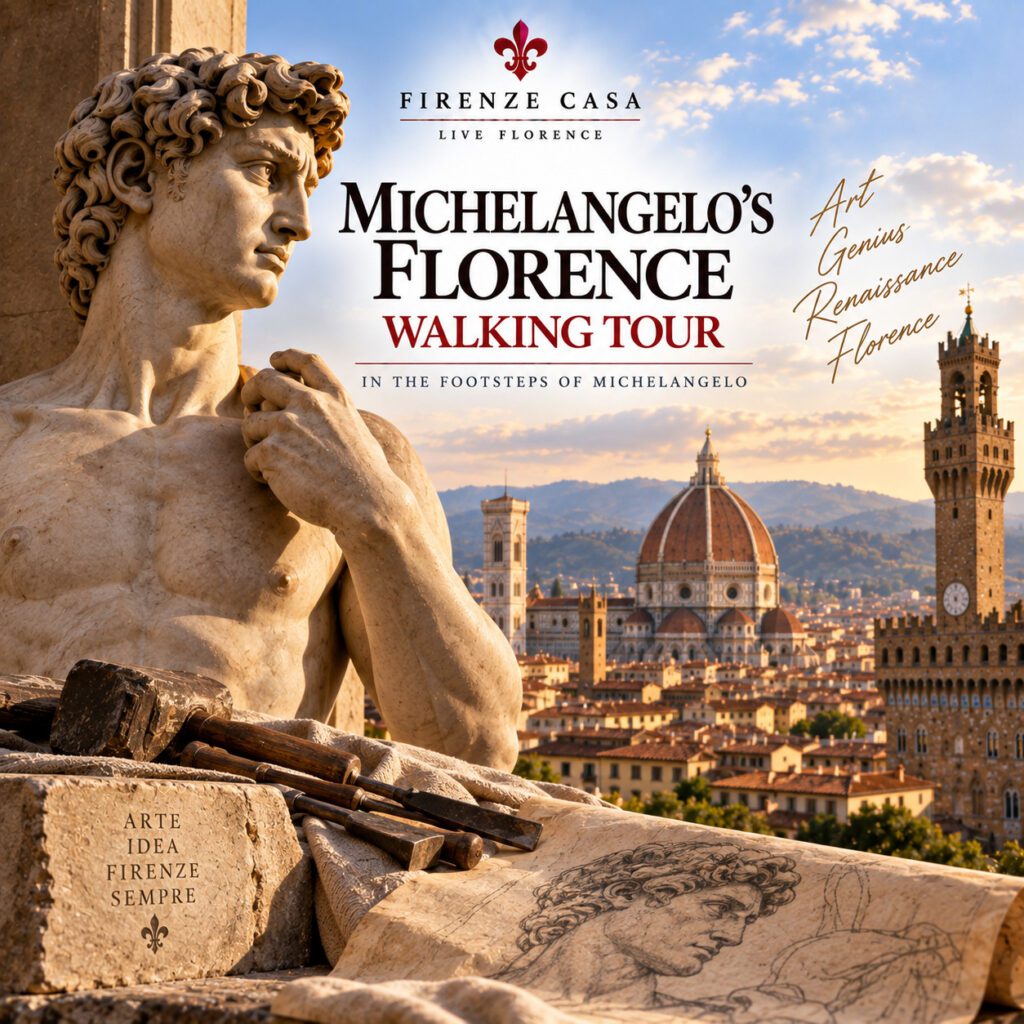
Follow one of history’s greatest artists on this Michelangelo Florence Walking Tour, tracing Michelangelo Buonarroti through the streets, churches, palaces and museums of the city that shaped his extraordinary career. Florence preserves not only some of his greatest masterpieces, but also places connected with his youth, his relationship with the Medici and his development as sculptor, painter and architect.
This walk follows Michelangelo from the Medici world around San Lorenzo to the monumental David, the political heart of Florence, Casa Buonarroti and finally Santa Croce, where the artist is buried. Along the way, it reveals a Florence that remained central to Michelangelo’s identity even though much of his later career unfolded in Rome. It forms part of our Walking Tours of Florence: The Complete Guide.
🚶 At a Glance
Distance:
Walking time:
Recommended time:
Start:
Finish:
Character: Michelangelo · Renaissance sculpture · Architecture · Medici · David · Florentine history
Difficulty:
Walking Route Map
The map will show the final route through Michelangelo’s Florence, connecting the principal places associated with his life, work and extraordinary artistic legacy.
🗺️ Walking Route Map
[WP Go Maps route will be added here]
The Walking Tour
1. Piazza San Lorenzo – Michelangelo and the Medici
Begin in Piazza San Lorenzo, where Michelangelo’s relationship with the Medici becomes visible in architecture, sculpture and family history. The young artist entered the cultural world surrounding Lorenzo de’ Medici and encountered the classical sculpture, humanist ideas and influential patrons that helped shape his artistic development.
San Lorenzo later became one of the most important centres of Michelangelo’s architectural career in Florence. Several major projects here reveal how his relationship with the Medici continued long after his youth. The district and its monuments can be explored more broadly on the San Lorenzo & Northern San Giovanni Walking Tour.
👀 Firenze Casa Tip
San Lorenzo is the best place to begin because it connects several phases of Michelangelo’s life at once: his early relationship with the Medici, his mature sculpture and his revolutionary architecture.
2. Basilica of San Lorenzo – The Unfinished Façade
Stand in front of the rough brick façade of the Basilica of San Lorenzo and imagine an entirely different building. In the early sixteenth century, Michelangelo was commissioned to design a monumental marble façade for the church.
The project was never realised. Michelangelo developed drawings and models and invested considerable effort in the commission before it was abandoned. The unfinished façade therefore represents one of Florence’s most fascinating examples of architecture that exists primarily through plans and imagination.
🏛️ The Florence That Never Was
Michelangelo’s proposed façade would have dramatically changed Piazza San Lorenzo. The bare surface visible today makes the unrealised project unusually easy to imagine.
3. Medici Chapels – The New Sacristy
The New Sacristy is one of the essential stops on any Michelangelo route. Here Michelangelo worked simultaneously as architect and sculptor, designing a funerary space for members of the Medici family in which architecture, tombs and monumental figures form a unified composition.
The celebrated figures of Day, Night, Dawn and Dusk accompany the Medici tombs. Their powerful bodies seem both perfectly suited to marble and almost too alive to remain confined within it.
The New Sacristy demonstrates Michelangelo’s ability to treat an entire room as a work of art. Walls, windows, architectural details and sculpture interact in ways that would profoundly influence later architecture. Its dynastic context becomes even clearer when followed through the wider Medici Florence route.
🗿 Look Beyond the Statues
Do not concentrate only on the famous sculptures. Michelangelo designed the architectural setting as well, deliberately manipulating familiar Renaissance forms to create tension, movement and monumentality.
4. Laurentian Library
Michelangelo’s architectural experimentation continues at the Laurentian Library, commissioned by the Medici to house their important collection of manuscripts. The vestibule is among the most remarkable interiors of sixteenth-century Florence.
The staircase seems almost to flow into the room, while columns appear embedded within the walls and conventional architectural rules are deliberately unsettled. Michelangelo uses the vocabulary of classical architecture but refuses to treat it conventionally.
The contrast with the calm reading room beyond makes the experience even more striking. Together, the spaces reveal Michelangelo as an architect of extraordinary originality.
5. Palazzo Medici Riccardi – The World of Lorenzo the Magnificent
Continue to Palazzo Medici Riccardi, the family palace of the Medici and a key location for understanding Michelangelo’s youth. Lorenzo the Magnificent recognised the young artist’s talent and brought him into the intellectual and artistic environment surrounding the Medici household.
This connection gave Michelangelo access to classical sculpture and to some of the leading humanists and artists of Florence. His fascination with the human body and ancient art developed within this extraordinary cultural atmosphere. The wider history of the dynasty is explored in our guide to the Medici Family.
📖 Michelangelo and Lorenzo
Michelangelo’s relationship with Lorenzo de’ Medici was decisive for his early development. The Medici world gave the young sculptor access not only to patronage but also to classical art and Florentine humanist culture.
6. Galleria dell’Accademia – David
The Accademia Gallery contains Michelangelo’s most famous Florentine sculpture: David. Carved from a huge block of marble between 1501 and 1504, the figure transformed a difficult piece of stone abandoned by earlier sculptors into one of the defining works of Renaissance art.
David is represented before his confrontation with Goliath, alert and intensely concentrated. The colossal figure came to symbolise the determination and independence of the Florentine Republic.
The sculpture originally stood outside Palazzo Vecchio in Piazza della Signoria. It was moved indoors in the nineteenth century to protect it from weathering, while a replica now marks its historic position.
👀 Firenze Casa Tip
Walk around David rather than viewing it only from the front. The changing proportions, enormous hands and subtle shifts in posture reveal how carefully Michelangelo designed the figure to be experienced in space.
7. The Prisoners
The Accademia also preserves Michelangelo’s unfinished Prisoners or Slaves, originally intended for the enormous tomb of Pope Julius II. These figures provide a rare opportunity to study Michelangelo’s working process.
Bodies seem to emerge gradually from rough blocks of marble. Finished surfaces exist beside areas where the stone still bears the marks of tools, creating the extraordinary impression that the figures are struggling to free themselves from the material.
Whether or not Michelangelo intended these particular works to remain unfinished, they offer one of the most powerful demonstrations of sculpture as a process of revealing form within stone.
8. Piazza del Duomo – Michelangelo and Brunelleschi
Continue towards Piazza del Duomo. Michelangelo did not create Florence Cathedral or its great dome, but Brunelleschi’s achievement belonged to the architectural world he inherited and admired.
The cathedral complex also connects with one of Michelangelo’s later Florentine sculptures, the Florentine Pietà, today preserved in the Museo dell’Opera del Duomo. The work was created much later in his life and may originally have been associated with his own funerary intentions. Visitors interested in Brunelleschi’s architectural Florence can follow Brunelleschi’s Florence.
9. Museo dell’Opera del Duomo – The Florentine Pietà
The Florentine Pietà, also known as the Bandini Pietà, presents a very different Michelangelo from the triumphant creator of David. Created when the artist was elderly, the sculpture depicts the dead Christ supported by the Virgin Mary, Mary Magdalene and Nicodemus.
The figure of Nicodemus has traditionally been understood as bearing Michelangelo’s own features, giving the work an intensely personal dimension. The sculpture was damaged and abandoned by Michelangelo before being subsequently restored and completed in part by another hand.
Its unfinished and altered state makes it one of the most moving works on this route – a meditation on death, faith and the limits of artistic creation.
🗿 A Different Michelangelo
Compare the Florentine Pietà with David. One belongs to the confidence of Michelangelo’s youth; the other to an ageing artist confronting mortality and spiritual questions.
10. Piazza della Signoria – David’s Original Setting
Walk to Piazza della Signoria and stand before the entrance to Palazzo Vecchio. This was the original public setting of Michelangelo’s David from 1504.
The location changes the meaning of the sculpture. At the Accademia, David is encountered as an artistic masterpiece; here, beside the seat of Florentine government, its political significance becomes much clearer.
The young biblical hero facing a stronger enemy became an extraordinarily appropriate symbol for a republic determined to defend its independence.
11. Palazzo Vecchio – The Battle That Never Happened
Palazzo Vecchio is connected with one of the greatest unrealised confrontations in Renaissance art. Michelangelo and Leonardo da Vinci were commissioned to create enormous battle scenes for the Salone dei Cinquecento.
Michelangelo prepared the Battle of Cascina, while Leonardo worked on the Battle of Anghiari. Neither composition survives in its intended form, yet contemporary artists studied their preparatory work intensely.
The episode captures an extraordinary moment when two of the greatest artists of the Renaissance were effectively placed in artistic competition within the same Florentine civic space. Their broader artistic world is explored on the Renaissance Masters of Florence route.
🎨 Michelangelo versus Leonardo
Imagine the Salone dei Cinquecento decorated by monumental battle scenes from Leonardo on one side and Michelangelo on the other. It would have been one of the most extraordinary artistic confrontations in history.
12. Bargello – The Young Sculptor
The Bargello adds another important chapter to Michelangelo’s Florentine career. Its collection includes works that demonstrate his early mastery of marble and his fascination with the classical male body.
The Bacchus is particularly revealing. Michelangelo gives the pagan god an unstable posture and sensuous physical presence, demonstrating both his knowledge of ancient sculpture and his determination to move beyond simple imitation.
The Bargello therefore complements the monumental David by revealing the experimental young sculptor developing the language that would make him famous.
13. Casa Buonarroti
Continue to Casa Buonarroti in Via Ghibellina. Despite its name, the museum should not be understood simply as Michelangelo’s preserved personal home. The building became a place where later generations of the Buonarroti family celebrated and preserved his legacy.
For anyone following Michelangelo through Florence, however, it is an essential stop. The collection contains important works, drawings, documents and material connected with the artist and his family.
Most importantly, Casa Buonarroti preserves two celebrated works from Michelangelo’s youth: the Madonna of the Stairs and the Battle of the Centaurs. They allow visitors to encounter the artist before David, the Sistine Chapel and the monumental works that later defined his reputation.
🏠 Historical Context
Casa Buonarroti is a museum and family memorial rather than a perfectly preserved Renaissance artist’s house. Its importance lies in the works, drawings and documents preserved by Michelangelo’s descendants.
14. Madonna of the Stairs
The Madonna of the Stairs is one of Michelangelo’s earliest surviving sculptures. Created when he was still remarkably young, the shallow marble relief already demonstrates his close study of Donatello and his unusual ability to suggest monumental form within a restricted depth.
Knowing the later Michelangelo makes this small work especially fascinating. Many of the concerns that would dominate his career – the human body, compressed movement and the expressive potential of marble – are already present.
15. Battle of the Centaurs
The Battle of the Centaurs reveals another side of the young Michelangelo. A dense mass of muscular bodies twists across the marble surface, reflecting his intense engagement with classical sculpture and the human figure.
The work feels astonishingly ambitious for such a young artist. Rather than arranging figures calmly within space, Michelangelo creates a turbulent field of bodies, movement and physical struggle.
🔎 Look Closely
The two early reliefs at Casa Buonarroti are small compared with David, but they are among the most revealing works on the walk. Here you can see Michelangelo’s artistic language beginning to form.
16. Basilica of Santa Croce – Michelangelo’s Tomb
Finish at Santa Croce, where Michelangelo is buried. He died in Rome in 1564, but his remains were brought back to Florence, the city with which his identity remained inseparably connected.
His monumental tomb was designed by Giorgio Vasari. Allegorical figures representing Painting, Sculpture and Architecture mourn the artist, appropriately acknowledging the extraordinary range of his achievements.
Ending here completes the biographical arc of the walk. From the young sculptor shaped by Medici Florence to the celebrated master whose remains returned to the city after his death, Michelangelo’s relationship with Florence lasted far beyond the years he physically lived there. The surrounding district can be explored further on the Santa Croce & Sant’Ambrogio Walking Tour.
⚜️ The Final Return
Michelangelo spent much of his later life in Rome and died there, but Florence became his final resting place. His tomb in Santa Croce turned the artist himself into part of the city’s monumental history.
Michelangelo and the Medici
The relationship between Michelangelo and the Medici runs through much of this walk. Lorenzo the Magnificent helped introduce the young sculptor to a remarkable cultural world of classical art, poetry, philosophy and humanist learning.
Later Medici patrons commissioned some of Michelangelo’s most ambitious Florentine projects, including work at San Lorenzo, the New Sacristy and the Laurentian Library. Yet the relationship was never simply one of artist and patron.
Michelangelo lived through periods of intense Florentine political conflict and the repeated rise, fall and restoration of Medici power. His own republican sympathies complicated his relationship with the dynasty, making the story considerably more interesting than a simple history of patronage. The political evolution of the family can be followed in more detail through Medici Florence.
Michelangelo the Sculptor, Painter and Architect
Michelangelo famously thought of himself primarily as a sculptor, yet Florence demonstrates the extraordinary breadth of his abilities. David and the works in the Bargello and Casa Buonarroti reveal his mastery of marble, while San Lorenzo demonstrates his radical architectural imagination.
His approach to architecture often seems sculptural. Walls appear compressed, architectural elements project and retreat, and spaces acquire a physical tension comparable to the bodies of his statues.
This ability to move between disciplines helps explain Michelangelo’s enormous influence. He did not merely produce individual masterpieces; he changed the possibilities of sculpture, painting and architecture for generations of artists who followed. His place within this wider artistic transformation is explored in The Renaissance in Florence – Complete Guide.
🎨 More Than David
One of the pleasures of this walk is discovering Michelangelo beyond his most famous sculpture. Architecture, unfinished works, drawings and early reliefs reveal an artist whose experimentation continued throughout his life.
Optional Detours
Santo Spirito
Santo Spirito is one of the most rewarding extensions to the main route. As a young man, Michelangelo was permitted to study human anatomy in connection with the religious complex, an experience that contributed to his extraordinary understanding of the human body.
A wooden crucifix traditionally attributed to the young Michelangelo is preserved at the Basilica of Santo Spirito, making the church especially relevant for visitors interested in his earliest Florentine years. The surrounding Oltrarno can be explored on the Santo Spirito & San Frediano Walking Tour.
Porta Romana
Visitors interested in Michelangelo’s role in the defence of the Florentine Republic can extend the walk towards the fortifications south of the Arno. Michelangelo was appointed to work on Florence’s defensive preparations during the final republican struggle against Medici restoration.
San Miniato al Monte
The hillside around San Miniato al Monte provides additional context for Michelangelo’s military work and offers a view over the city whose architecture shaped his youth. It is best treated as a separate extension rather than part of the compact central route. The ascent can be followed on the Piazzale Michelangelo & San Miniato Walking Tour.
Where to Pause Along the Way
Piazza San Lorenzo deserves time at the beginning of the walk. Several Michelangelo stories overlap here, from the unrealised façade to the Medici tombs and Laurentian Library.
Piazza della Signoria is the best place to pause after seeing David at the Accademia. Standing at its original location restores the political meaning that can easily be lost when the sculpture is encountered only inside a museum.
Casa Buonarroti offers a quieter and more intimate encounter with Michelangelo before the final walk to Santa Croce. Its early works provide a useful counterpoint to the monumental masterpieces seen earlier.
Make This Walk Your Own
For a compact Michelangelo route, concentrate on the Medici Chapels, Accademia, Piazza della Signoria, Casa Buonarroti and Santa Croce. These stops provide a strong overview of his Florentine life from youth to posthumous commemoration.
Sculpture lovers should add the Bargello and Museo dell’Opera del Duomo, allowing the young Bacchus, monumental David and late Florentine Pietà to reveal very different stages of Michelangelo’s career.
Visitors particularly interested in architecture should spend more time at San Lorenzo, the New Sacristy and Laurentian Library. Here Michelangelo’s treatment of space and classical architectural language can be experienced directly.
⚜️ Firenze Casa Perspective
Do not follow Michelangelo only from masterpiece to masterpiece. The most interesting route connects the young artist, the ambitious sculptor, the experimental architect, the politically involved Florentine and finally the ageing master whose legacy returned to Florence after his death.
Why This Walk Is Worth It
Michelangelo’s Florence is not confined to a single museum. His presence stretches across the city, from the Medici district where his talent developed to the civic square where David became a political symbol and the family museum where his earliest works survive.
The route also reveals an artist far more complex than the creator of a handful of famous masterpieces. Michelangelo was a sculptor, architect, draughtsman and poet whose career intersected with Medici patronage, republican politics and some of the defining conflicts of Renaissance Florence.
Most importantly, walking between these places restores geography to his biography. San Lorenzo, the Accademia, Piazza della Signoria, Casa Buonarroti and Santa Croce become chapters in one story rather than isolated monuments.
By the time the route reaches Michelangelo’s tomb, Florence itself has become part of the portrait: the city that educated him, challenged him, commissioned him and ultimately claimed him as one of its greatest sons.
Further Reading on Firenze Casa
- Walking Tours of Florence: The Complete Guide
- Medici Florence
- Brunelleschi’s Florence
- Renaissance Masters of Florence
- Accademia Gallery
- Casa Buonarroti
- The Renaissance in Florence – Complete Guide
References
- Casa Buonarroti – collections and historical documentation relating to Michelangelo and the Buonarroti family.
- Galleria dell’Accademia di Firenze – Michelangelo’s David and Prisoners.
- Musei del Bargello – Michelangelo’s sculpture and the Medici Chapels.
- Opera di Santa Maria del Fiore – Michelangelo’s Florentine Pietà and the cathedral complex.
- Biblioteca Medicea Laurenziana – Michelangelo’s architectural work at the Laurentian Library.
- Opera di Santa Croce – Michelangelo’s tomb and his connection with the basilica.