
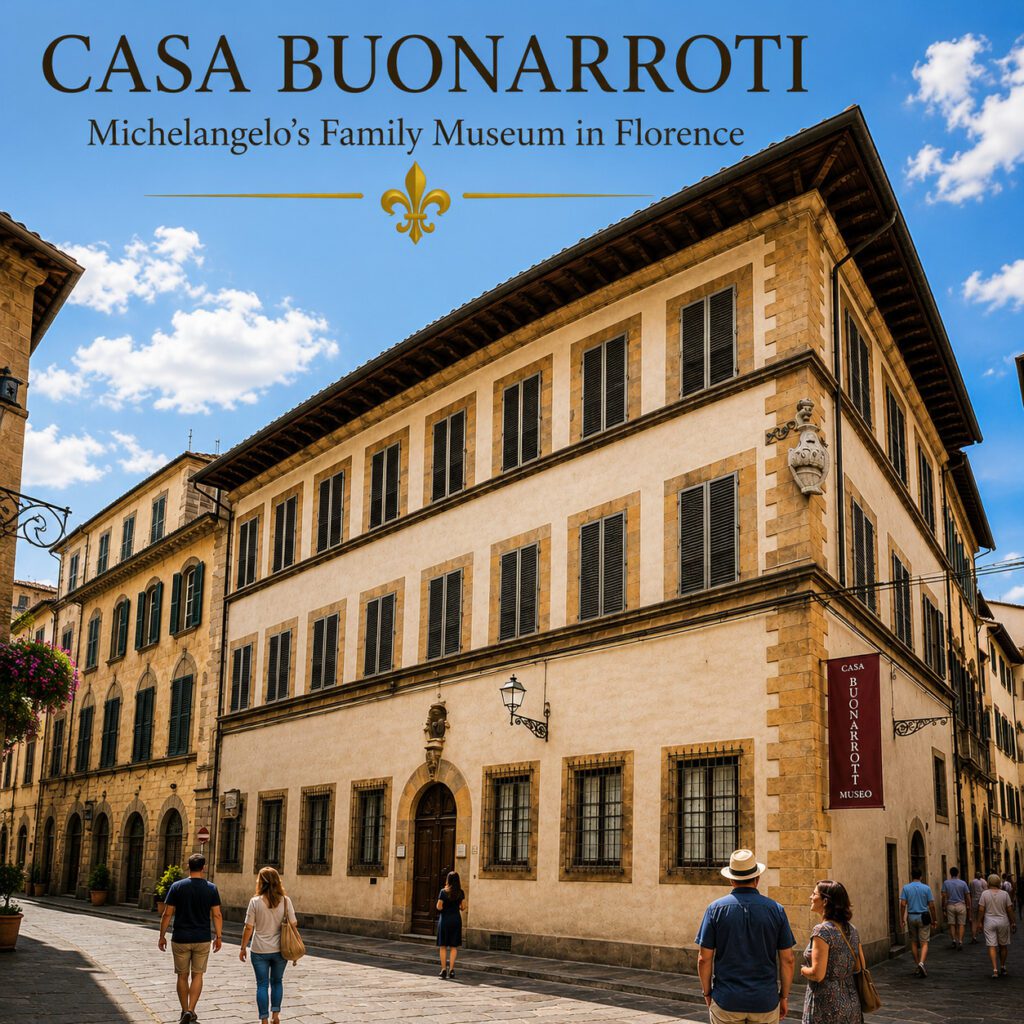
Casa Buonarroti Florence is one of the city’s most rewarding museums for anyone interested in Michelangelo beyond his most famous masterpieces. Located at Via Ghibellina 70, a short walk from Santa Croce, the museum preserves two extraordinary works from the artist’s youth together with drawings, family collections and richly decorated rooms celebrating his life and reputation.
Despite its name, Casa Buonarroti should not simply be understood as Michelangelo’s preserved private home. Its history is more interesting than that: Michelangelo acquired property here, lived for a time in one of the earlier houses on the site and invested heavily in creating security and status for his family. The palace visitors see today was largely shaped by his descendants, who eventually transformed the family residence into a monument to their extraordinary ancestor.
Museum: Casa Buonarroti
Address: Via Ghibellina 70, Florence
Area: Santa Croce
Famous for: Michelangelo’s early works and the Buonarroti family collections
Highlights: Madonna della Scala and Battle of the Centaurs
Also worth seeing: Michelangelo drawings, historic rooms and family collections
Best for: Michelangelo enthusiasts, Renaissance art and Florentine family history
Character: Small, specialised and considerably quieter than Florence’s major museums
What Is Casa Buonarroti?
Casa Buonarroti occupies a fascinating position among Florence’s museums. It is simultaneously an art museum, a historic family residence and a monument to the reputation of Michelangelo Buonarroti.
Michelangelo acquired properties in Via Ghibellina during the early sixteenth century. However, the building visitors encounter today should not be imagined as a perfectly preserved house in which the artist spent his Florentine life. The properties developed over generations, and the present museum owes much of its appearance and decoration to Michelangelo’s descendants.
The most important figure in this transformation was his great-nephew Michelangelo Buonarroti the Younger, who lived from 1568 to 1647. A writer and cultivated member of Florentine society, he commissioned an ambitious decorative programme celebrating the achievements of his famous great-uncle.
Casa Buonarroti therefore tells two interconnected stories: the development of the young Michelangelo and the way his family preserved, celebrated and helped shape his legacy. It forms a particularly personal complement to the larger institutions in our complete guide to Florence museums.
Casa Buonarroti is not a conventional artist’s house preserved exactly as Michelangelo knew it. He owned property here and lived for a period in one of the earlier houses, but the residence visible today was substantially developed by later generations of the Buonarroti family.
Michelangelo, His Father and the Buonarroti Family
Behind Casa Buonarroti lies a surprisingly personal story about money, family ambition and Michelangelo’s relationship with his father, Lodovico di Leonardo Buonarroti Simoni.
The Buonarroti considered themselves members of an old and respectable Florentine family, but by the time Michelangelo was born in 1475 their financial position did not fully correspond to those social ambitions. Lodovico held occasional public offices – he was serving as podestà of Caprese when Michelangelo was born – yet the family did not possess the great commercial fortune of Florence’s leading banking and merchant dynasties.
Michelangelo’s decision to become an artist initially caused tension. For a family conscious of its social standing, manual artistic work did not necessarily represent the career Lodovico imagined for his son. Ironically, however, Michelangelo’s extraordinary success would eventually provide much of the financial security the family desired.
As his career developed, Michelangelo repeatedly sent money to relatives, dealt with property purchases and became deeply involved in family finances. His surviving correspondence reveals a man concerned not only with marble, architecture and papal commissions but also with land, houses, expenses and the behaviour of his relatives.
His investments in Via Ghibellina formed part of this broader concern. Michelangelo wanted the Buonarroti to possess property appropriate to the social position he believed the family should occupy.
Michelangelo’s letters reveal something rarely visible when standing before David or the Sistine Chapel: the celebrated artist spent decades worrying about his family’s finances, buying property and helping support relatives. His artistic success became an important foundation for the renewed prosperity and status of the Buonarroti family.
Did Michelangelo Live at Casa Buonarroti?
The answer requires an important distinction. Michelangelo did live for a period in one of the houses associated with the Via Ghibellina property, particularly during the years when he was again working extensively in Florence. However, he did not live in Casa Buonarroti as visitors see it today.
Michelangelo spent large parts of his career elsewhere, particularly in Rome. The transformation of the properties into the more unified and prestigious family residence occurred gradually and continued after his death in 1564.
Consequently, describing Casa Buonarroti simply as “Michelangelo’s house” creates the wrong impression. It is better understood as the Buonarroti family home built around Michelangelo’s legacy.
That distinction actually makes the museum more interesting. Instead of presenting a frozen reconstruction of an artist’s domestic life, Casa Buonarroti reveals how Michelangelo’s success changed the fortunes and identity of an entire Florentine family.
The Buonarroti Family in Via Ghibellina
Michelangelo began acquiring property in Via Ghibellina in the early sixteenth century. Over time, the houses became associated with his determination to provide the family with a permanent and respectable Florentine base.
Later generations continued to live here and developed both the residence and its collections. Paintings, sculptures, ceramics, archaeological objects, documents and works connected with Michelangelo accumulated within the family over several centuries.
The building therefore became much more than a container for famous artworks. It embodied the transformation of the Buonarroti family’s fortunes and their determination to preserve their connection with Michelangelo.
This continuity gives Casa Buonarroti a character quite different from Florence’s larger public galleries and helps explain why it belongs naturally among our small museums in Florence worth discovering.
Michelangelo Buonarroti the Younger
The person most responsible for the extraordinary interiors was Michelangelo Buonarroti the Younger. During the early seventeenth century, he transformed parts of the family residence into an elaborate celebration of his great-uncle’s achievements.
He commissioned leading Florentine artists to decorate rooms with paintings devoted to episodes from Michelangelo’s life, his virtues and his artistic fame. Among the artists represented in the decorative programme are Artemisia Gentileschi, Jacopo da Empoli, Passignano, Giovanni da San Giovanni, Matteo Rosselli and Francesco Furini.
The result is fascinating because visitors encounter not only Michelangelo’s art but also the beginnings of the cultural mythology surrounding him.
The seventeenth-century rooms of Casa Buonarroti were deliberately conceived as a celebration of Michelangelo. They show how firmly his reputation as an exceptional figure had become established within only a few generations of his death.
The Madonna della Scala
One of the greatest treasures of Casa Buonarroti Florence is Michelangelo’s Madonna della Scala, or Madonna of the Stairs. Usually dated to around 1490, it belongs to the earliest surviving phase of his career.
The marble relief depicts the Virgin seated in profile while the Christ Child rests against her. Its exceptionally shallow carving reflects Michelangelo’s engagement with the Florentine sculptural tradition, particularly the stiacciato relief technique associated with Donatello.
Yet even at this early age, Michelangelo was already developing an individual approach to monumental form. The restrained composition feels surprisingly powerful despite the limited depth of the carving.
Seeing the work at close range is one of the strongest reasons to visit Casa Buonarroti. Unlike Michelangelo’s enormous later sculptures, this is an intimate object that allows visitors to encounter the artist near the beginning of his development.
Visitors interested in Donatello and the sculptural tradition that preceded Michelangelo can continue this story at the Bargello Museum, whose collection offers one of the finest introductions to Florentine Renaissance sculpture.
The Battle of the Centaurs
The second great masterpiece is the Battle of the Centaurs, created around 1490–1492 when Michelangelo was still a teenager. The unfinished marble relief presents an extraordinary mass of intertwined bodies engaged in violent struggle.
The work belongs to the period when the young Michelangelo was connected with the cultural environment surrounding Lorenzo de’ Medici and exposed to humanist scholarship and ancient sculpture. According to the early biographical tradition, the subject was suggested by the humanist Agnolo Poliziano.
This early Medici connection places Michelangelo within the much wider story of the Medici family and Renaissance Florence. Lorenzo’s circle brought artists, writers and humanist scholars together and provided an extraordinary environment for the development of a young sculptor.
The relief already reveals one of the central themes of Michelangelo’s later career: the expressive possibilities of the human body. Figures twist, overlap and emerge from the marble with remarkable confidence.
Michelangelo himself appears to have continued to value the work later in life. For today’s visitor, it provides an extraordinary opportunity to see how early the artistic language associated with his mature sculpture began to emerge.
If you have already seen Michelangelo’s David at the Accademia, the Battle of the Centaurs is particularly fascinating. It allows you to move backwards in his career and discover how strongly his fascination with anatomy, movement and marble was already developed during his youth.
Two Young Works, One Extraordinary Beginning
Seeing the Madonna della Scala and the Battle of the Centaurs together is perhaps the most memorable experience at Casa Buonarroti. Although created within a relatively short period, the two works reveal strikingly different aspects of the young artist.
The Madonna is quiet, controlled and remarkably subtle. The Battle, by contrast, is filled with physical movement and compressed energy.
Together they demonstrate that Michelangelo’s development cannot be reduced to a simple progression towards the monumental works of his maturity. Even as a young artist, he was experimenting with radically different ways of giving life to marble.
From the Battle of the Centaurs to David
Casa Buonarroti becomes particularly meaningful when compared with the Accademia Gallery. Here, visitors encounter Michelangelo as an extraordinarily gifted teenager. At the Accademia, David reveals the artist little more than a decade later at a completely different level of ambition and public importance.
The contrast is remarkable. The Battle of the Centaurs compresses numerous intertwined bodies into a relatively small marble surface, while David stands independently at monumental scale.
Yet the fascination with anatomy, tension and the expressive potential of the human body connects both works. Seeing them during the same stay in Florence creates one of the best ways to understand Michelangelo’s rapid artistic development.
Michelangelo’s Drawings
Casa Buonarroti also preserves an important collection of drawings by Michelangelo. Because works on paper are sensitive to light, the exact selection visible to visitors may vary for conservation reasons.
These drawings offer another perspective on Michelangelo’s creative process. Studies of figures, architectural ideas and preparatory sketches reveal an artist who repeatedly investigated form before translating ideas into painting, sculpture or architecture.
For visitors accustomed to seeing only finished masterpieces, drawings can make Michelangelo’s working methods feel unexpectedly immediate.
The Galleria – Creating the Myth of Michelangelo
One of the most interesting rooms is the Galleria created under Michelangelo Buonarroti the Younger. Its decorative programme was conceived as a pictorial biography and celebration of his famous great-uncle.
Paintings depict episodes associated with Michelangelo and powerful patrons, while other scenes and allegorical figures celebrate his artistic achievements and personal virtues.
The room can therefore be read almost like a seventeenth-century biography in images. It shows how Michelangelo’s descendants wanted later generations to remember him.
This makes the Galleria particularly valuable from a historical perspective. Visitors are not simply looking at representations of Michelangelo’s life; they are witnessing the deliberate construction of his posthumous reputation.
The Historic Rooms
The museum route continues through a sequence of richly decorated seventeenth-century rooms, including the Camera della Notte e del Dì, Camera degli Angioli and Studio.
The Camera degli Angioli later served as a family chapel and contains an elaborate decorative programme centred on religious themes. The Studio celebrates distinguished Tuscan writers, scientists, physicians, historians, philosophers and other intellectual figures.
These interiors broaden the museum beyond Michelangelo himself. They reveal the cultural ambitions of a prominent Florentine family and show how collecting, scholarship and family identity could become intertwined.
The Buonarroti Family Collections
Generations of the Buonarroti family collected works from different periods and artistic traditions. As a result, the museum contains paintings, sculpture, ceramics and archaeological material in addition to objects directly associated with Michelangelo.
The family also preserved an exceptional documentary archive. Michelangelo’s correspondence is particularly valuable because it illuminates not only his artistic career but also his complicated relationships with relatives, money and property.
These collections are sometimes overshadowed by the two famous marble reliefs, yet they are essential to understanding Casa Buonarroti as a historic family museum rather than simply a gallery devoted to one artist.
Michelangelo Beyond Sculpture
Another aspect of the museum concerns Michelangelo’s architectural projects in Florence. His career was never limited to sculpture and painting; architecture occupied an increasingly important position in his work.
Casa Buonarroti preserves material connected with his architectural ideas and projects, including work associated with San Lorenzo. These objects provide useful context for visitors who later explore the Medici Chapels and Laurentian Library.
Together, these different aspects of the collection reveal Michelangelo as a sculptor, draughtsman and architect whose creative interests extended far beyond the works for which he is most immediately famous.
Casa Buonarroti is particularly rewarding if you want to understand Michelangelo as more than the creator of David. Drawings and architectural material reveal the extraordinary breadth of his creative interests.
Three Michelangelos in Three Florence Museums
One of the most rewarding ways to understand Michelangelo in Florence is to compare three very different stages of his career.
At Casa Buonarroti, the Madonna della Scala and Battle of the Centaurs reveal the astonishingly talented teenager. At the Accademia Gallery, David represents the confidence and monumental ambition of the young master.
Then, at the Museo dell’Opera del Duomo, the unfinished Pietà Bandini introduces an elderly Michelangelo confronting themes of death, faith and his own mortality.
Few artists can be followed through one city with such extraordinary clarity. Together, these three museums allow visitors to encounter the beginning, triumph and final decades of Michelangelo’s exceptionally long career.
Casa Buonarroti → Accademia Gallery → Museo dell’Opera del Duomo creates an exceptional Michelangelo itinerary. You move from his teenage experiments to David and finally to the deeply personal Pietà Bandini of his later years.
Casa Buonarroti and Santa Croce
The location of Casa Buonarroti near Santa Croce creates one of the most meaningful Michelangelo walks in Florence. The museum preserves masterpieces from the beginning of his career, while the Basilica of Santa Croce contains his monumental tomb.
Michelangelo died in Rome in 1564. His body was subsequently brought back to Florence, where he was buried in Santa Croce. His tomb, designed by Giorgio Vasari, became another important place in the cultivation of his memory.
Visiting Casa Buonarroti and Santa Croce on the same day therefore creates an unusual chronological journey: from the experimental works of Michelangelo’s adolescence to the monument created after his death.
Michelangelo and Donatello – Two Generations of Florentine Sculpture
Michelangelo’s early work did not emerge from nowhere. Florence already possessed an extraordinary sculptural tradition, and Donatello had transformed the possibilities of marble and bronze during the previous century.
The shallow relief of the Madonna della Scala demonstrates Michelangelo’s engagement with techniques associated with Donatello, while his later work would push the Florentine fascination with the human body in dramatically new directions.
A visit to the Bargello Museum therefore makes an excellent companion to Casa Buonarroti. Donatello’s David, Saint George and other works provide the artistic background against which the young Michelangelo began his remarkable career.
Is Casa Buonarroti Worth Visiting?
Yes, particularly if you already know some of Florence’s major museums. Casa Buonarroti cannot compete with the Uffizi or Accademia in scale, nor does it attempt to. Its appeal lies precisely in being smaller, more focused and more personal.
For a first visit of only one or two days, the Uffizi, Accademia and Florence’s principal monuments will understandably take priority. However, visitors spending more time in the city – or anyone with a particular interest in Michelangelo – should seriously consider Casa Buonarroti.
The two youthful marble reliefs alone justify the visit for many art lovers. The historic interiors, drawings, documents and family collections then add another layer that makes the museum much richer than its modest size might suggest.
It is also generally a more contemplative experience than Florence’s busiest museums. That makes it particularly suitable for visitors who enjoy looking carefully rather than moving through enormous collections under time pressure.
How Much Time Should You Allow?
For most visitors, approximately one hour provides enough time to appreciate the principal rooms and works without rushing. Visitors with a strong interest in Michelangelo, drawings or Florentine family history may want to stay longer.
Because Casa Buonarroti is relatively compact, it combines easily with Santa Croce and other sights in the eastern part of Florence’s historic centre.
Combine Casa Buonarroti with Santa Croce. Begin with Michelangelo’s youthful works in Via Ghibellina and then walk to the basilica to see his tomb. Few short walks in Florence connect the beginning and end of an artist’s story so effectively.
What to Combine with Casa Buonarroti
Santa Croce
This is the natural companion visit. Casa Buonarroti preserves some of Michelangelo’s earliest surviving works, while Santa Croce contains the monumental tomb created after his death.
Accademia Gallery
The Accademia Gallery provides the essential next chapter in Michelangelo’s artistic development. Comparing the youthful reliefs with David demonstrates just how rapidly his art evolved.
Bargello Museum
The nearby Bargello Museum places Michelangelo within the wider history of Florentine sculpture and allows visitors to compare his early Bacchus with major works by Donatello and Verrocchio.
Museo dell’Opera del Duomo
The Museo dell’Opera del Duomo completes the chronological story with Michelangelo’s late Pietà Bandini.
Practical Information
Casa Buonarroti
Via Ghibellina 70
50122 Florence, Italy
The museum is within easy walking distance of Piazza Santa Croce and the historic centre. Opening hours, ticket prices, temporary exhibitions and possible changes to individual displays should always be checked with Casa Buonarroti before visiting.
Because drawings and other light-sensitive works may be rotated for conservation, visitors should not assume that every work on paper in the collection will be displayed during every visit.
Casa Buonarroti at a Glance
| Category | Information |
|---|---|
| Museum | Casa Buonarroti |
| Address | Via Ghibellina 70, Florence |
| Main focus | Michelangelo and the Buonarroti family legacy |
| Major works | Madonna della Scala and Battle of the Centaurs |
| Also important | Drawings, documents, family collections and seventeenth-century interiors |
| Best for | Michelangelo enthusiasts and Renaissance sculpture |
| Suggested visit | About 1 hour |
| Nearby | Santa Croce and Bargello Museum |
Frequently Asked Questions About Casa Buonarroti
Was Casa Buonarroti Michelangelo’s home?
Michelangelo lived for a period in one of the earlier houses associated with the Via Ghibellina property, but not in the Casa Buonarroti visitors see today. The present family residence was substantially developed by later generations after Michelangelo had spent much of his career elsewhere.
Did Michelangelo buy the house for his father?
It is more accurate to say that Michelangelo acquired property in Via Ghibellina as part of his wider effort to provide security and status for the Buonarroti family. The present palace developed from these properties over subsequent generations rather than being a single finished house purchased for Lodovico.
Did Michelangelo financially support his family?
Yes. His correspondence documents repeated involvement in family finances, property and the support of relatives. As Michelangelo became successful, his earnings played an important role in improving the family’s financial security and social position.
What are the most important works in Casa Buonarroti?
The principal masterpieces are Michelangelo’s youthful marble reliefs Madonna della Scala and Battle of the Centaurs. The museum also preserves drawings, documents and material connected with his artistic and architectural work.
How old was Michelangelo when he created the Battle of the Centaurs?
The relief dates from around 1490–1492, when Michelangelo was still in his teens. Its sophisticated treatment of the human body makes it one of the most remarkable surviving works from his youth.
Why is the Madonna della Scala important?
The relief is among Michelangelo’s earliest surviving works and demonstrates his engagement with the Florentine sculptural tradition, particularly the shallow relief technique associated with Donatello.
Are Michelangelo’s drawings always on display?
Not necessarily. Works on paper are sensitive to prolonged exposure to light, so drawings may be rotated for conservation reasons. The works visible during a particular visit can therefore vary.
Is Casa Buonarroti worth visiting after the Accademia?
Yes. The two museums complement each other particularly well. The Accademia presents the monumental achievement of David, while Casa Buonarroti reveals Michelangelo’s astonishing development as a young sculptor and the family history behind his later reputation.
How long does a visit to Casa Buonarroti take?
About one hour is sufficient for most visitors, although those particularly interested in Michelangelo, the family archive or the historic interiors may wish to spend longer.
What else can you visit nearby?
Santa Croce is the most natural companion visit because Michelangelo is buried there. The Bargello Museum and several historic streets of medieval and Renaissance Florence are also within comfortable walking distance.
Why Casa Buonarroti Is Worth Visiting
Casa Buonarroti Florence reveals a Michelangelo who is easy to miss elsewhere. Instead of beginning with the established genius of David, the Sistine Chapel or the Medici tombs, the museum introduces an extraordinarily talented young artist still developing his visual language.
But the house also tells a more human story. Michelangelo’s success did not transform only his own life. It provided financial security for relatives, enabled investment in property and helped restore the social standing to which the Buonarroti family aspired.
After his death, his descendants continued that story. They preserved his works, collected his documents and transformed their residence into a sophisticated monument to his memory.
Casa Buonarroti therefore brings together three histories under one roof: the beginnings of Michelangelo the artist, the changing fortunes of the Buonarroti family and the creation of the Michelangelo legend.
For travellers who enjoy Florence beyond its most famous attractions, it is precisely the kind of museum worth discovering – and perhaps the best place in the city to begin following Michelangelo from his teenage experiments to the masterpieces of his maturity.
Further Reading on Firenze Casa
- Florence Museums – The Complete Guide
- Accademia Gallery – Home of Michelangelo’s David
- Bargello Museum – Renaissance Sculpture in Florence
- Museo dell’Opera del Duomo – Florence Cathedral Museum
- The Medici Family – The Dynasty That Shaped Florence
- Small Museums in Florence Worth Discovering
References
- Fondazione Casa Buonarroti – Museum history, collections, Michelangelo works, family archive and museum itinerary.
- Condivi, Ascanio. Vita di Michelagnolo Buonarroti.
- Vasari, Giorgio. Lives of the Most Excellent Painters, Sculptors, and Architects.
- Wallace, William E. Michelangelo: The Artist, the Man and His Times.
- Hibbard, Howard. Michelangelo.
- Symonds, John Addington. The Life of Michelangelo Buonarroti.
- Goldscheider, Ludwig. Michelangelo: Paintings, Sculpture, Architecture.

