
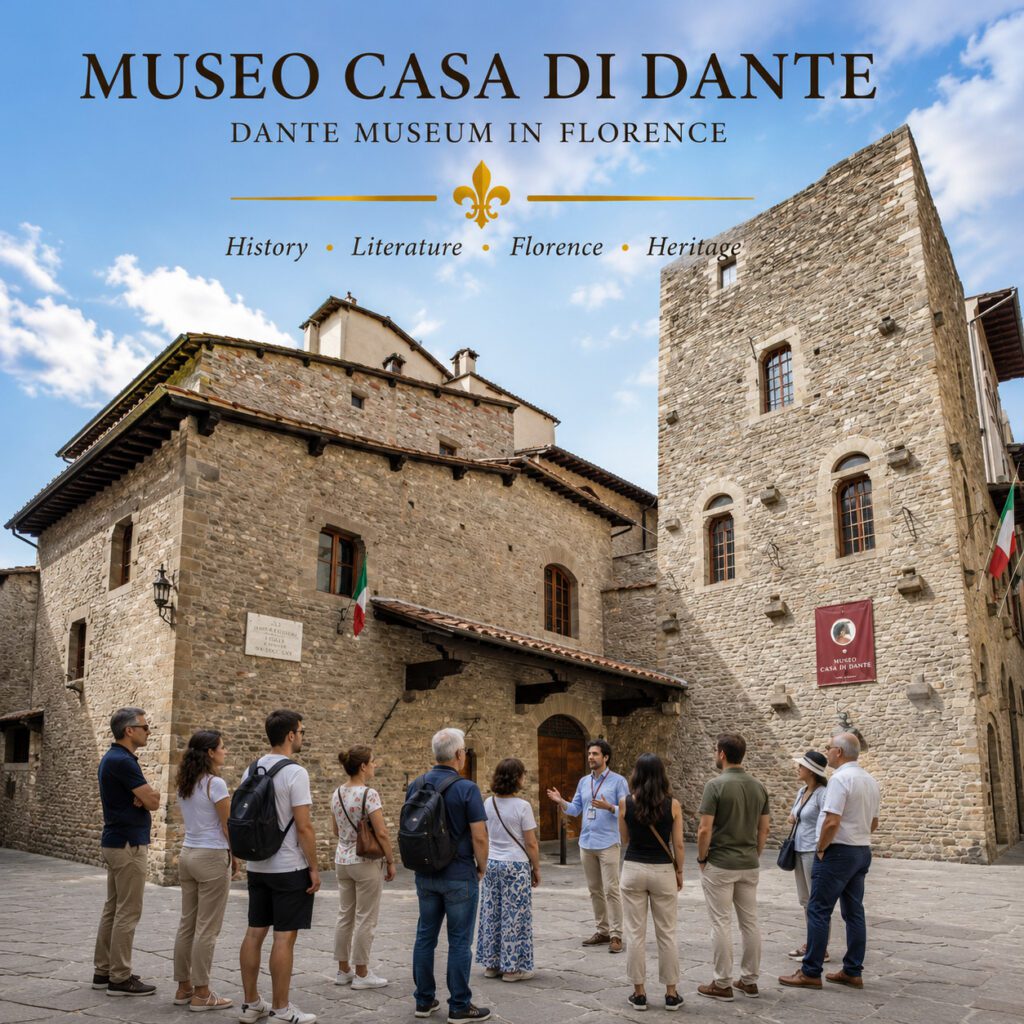
Museo Casa di Dante brings visitors into the world of Florence’s greatest poet. Located in the medieval heart of the city, the museum explores the life of Dante Alighieri, his political career, his exile and the Florence that helped shape the Divine Comedy.
The building itself requires a little explanation. Despite the popular English name “Dante’s House”, visitors should not expect Dante’s original medieval home. The present structure is a reconstruction created in the area traditionally associated with the Alighieri family.
Museum: Museo Casa di Dante
Dedicated to: Dante Alighieri and medieval Florence
Main themes: Dante’s life, politics, exile and the Divine Comedy
Historic setting: Area traditionally associated with the Alighieri family
Nearby: Santa Margherita dei Cerchi, Torre della Castagna, Duomo and Piazza della Signoria
Best for: Literature lovers, Dante enthusiasts and medieval history
Who Was Dante Alighieri?
Dante Alighieri was born in Florence in 1265 and became one of the most influential writers in European literature. His greatest work, the Divine Comedy, follows an imaginary journey through Hell, Purgatory and Paradise.
Yet Dante was much more than a poet. He lived during a turbulent period of Florentine history and participated actively in the political affairs of the republic.
His Florence was a city of merchants, guilds, towers and powerful families. Political rivalries frequently erupted into violence, while competing factions struggled to control the government. Our overview of the history of Florence places Dante within this wider transformation of the medieval city.
This environment profoundly influenced his life and writing. To understand Dante, it helps enormously to understand Florence.
Dante wrote the Divine Comedy after leaving Florence, but the city remained present throughout his work. Florentine personalities, political conflicts and memories appear repeatedly during his journey through the afterlife.
Is Museo Casa di Dante Really Dante’s House?
This is the most important question to answer before visiting.
The present Museo Casa di Dante is not a preserved medieval house in which historians can prove that Dante lived. Instead, it stands in the area where historical evidence places properties associated with the Alighieri family.
Florence reconstructed the present building in the early twentieth century. The project aimed to evoke the appearance of medieval Florence and create a place dedicated to the memory of Dante.
Therefore, the museum works best as an introduction to Dante and his world rather than as an authentic preserved domestic interior. Visitors interested specifically in historic Florentine houses can find a very different experience at Palazzo Davanzati, where the building itself helps illustrate domestic life in medieval and Renaissance Florence.
This distinction does not make the location of Museo Casa di Dante unimportant. Quite the opposite: the surrounding streets still form one of the most atmospheric medieval corners of central Florence.
The name “Casa di Dante” can easily create the impression that visitors enter Dante’s surviving birthplace. The museum instead occupies a reconstructed building in the historic neighbourhood traditionally connected with his family.
The Medieval Florence of Dante
The neighbourhood around Museo Casa di Dante looks very different from Florence’s grand Renaissance squares. Narrow streets, stone buildings and surviving medieval towers create a more intimate atmosphere.
During Dante’s lifetime, Florence contained many fortified family towers. Wealthy families used them both as residences and as symbols of political and social power. Family loyalties mattered enormously, as did membership in the city’s guilds and political factions.
Dante grew up within this complex urban world. The conflicts surrounding him later became inseparable from his personal fate and literary imagination.
Guelfs, Ghibellines and Political Conflict
Medieval Florence experienced long struggles between Guelfs and Ghibellines. Later, the victorious Guelf faction itself divided into the White and Black Guelfs.
Dante became associated with the White Guelfs and took an active role in Florentine politics. In 1300, he served as one of the city’s priors, among the highest offices of the republic.
Political circumstances soon turned against him. The Black Guelfs gained control of Florence while Dante was away from the city. In 1302, his opponents condemned him to exile.
Dante never returned to Florence.
What to See Inside Museo Casa di Dante
The museum uses several floors to introduce different aspects of Dante’s life and historical environment. Displays combine documents, reproductions, objects, models and explanatory material.
Rather than presenting a collection of famous Renaissance masterpieces, Museo Casa di Dante tells a story. Its strength lies in connecting the poet with the political and social world of medieval Florence.
This makes it quite different from many of the institutions in our complete guide to Florence museums. The principal attraction here is historical and literary context rather than a collection of original masterpieces.
Dante’s Early Life in Florence
One part of the museum explores Dante’s family background and the Florence of his childhood. Visitors gain an impression of the urban environment in which the young poet grew up.
The displays also introduce medieval social structures, family networks and the political divisions that shaped everyday life.
Politics and Exile
Dante’s political career occupies an essential place in the museum. His involvement in Florentine public life eventually led to one of the defining events of his biography: exile.
Leaving Florence changed Dante’s life permanently. He spent his remaining years moving between different courts and cities in Italy.
Nevertheless, Florence remained central to his identity. His anger, nostalgia and political judgement repeatedly emerge in his writing.
The Divine Comedy
The museum also explores Dante’s greatest literary achievement. The Divine Comedy describes a journey through three realms of the afterlife: Inferno, Purgatorio and Paradiso.
The poem combines theology, philosophy, politics, history and intensely personal experience. Dante encounters historical personalities, mythical figures and people he knew during his own lifetime.
Florence appears again and again. Even far from home, Dante remained intellectually and emotionally connected to the city that had expelled him.
Dante and Florence in Literature
Dante represents perhaps the most fundamental connection between Florence and literature. His work transformed personal experience, political conflict and memories of the city into poetry that would influence European culture for centuries.
Yet he is only the beginning of a much longer literary relationship with Florence. Later writers including Giovanni Boccaccio, Niccolò Machiavelli, E. M. Forster and numerous international authors would also use the city as a setting, inspiration or intellectual home.
Our Florence in Literature guide follows this wider relationship between the city and the writers who described, imagined and sometimes reinvented it.
Museo Casa di Dante belongs to the museum story of Florence, but it also opens the door to the city’s literary history. Dante transformed Florence from a physical city into a place that could live permanently inside literature.
Dante and the Italian Language
Dante’s importance extends far beyond Florence. His writing played a decisive role in the development of literary Italian.
Educated Europeans commonly used Latin for serious literature during the Middle Ages. Dante instead wrote the Divine Comedy in the Tuscan vernacular.
His extraordinary literary achievement helped give the Florentine form of Tuscan enormous prestige. Later writers, especially Petrarch and Boccaccio, strengthened this development.
Over the centuries, Tuscan became the principal foundation of standard Italian.
Dante did not simply write one of Europe’s greatest poems. His use of the Florentine vernacular helped shape the language that eventually developed into modern standard Italian.
Beatrice and Santa Margherita dei Cerchi
A visit to Museo Casa di Dante naturally leads to another famous part of the Dante story: Beatrice.
Dante describes Beatrice as the great spiritual and emotional figure of his life. Tradition identifies her with Beatrice Portinari, a Florentine woman whom Dante knew from a young age.
The small Church of Santa Margherita dei Cerchi stands only a few steps from the museum. Popular tradition strongly associates the church with Dante and Beatrice.
Visitors often leave letters for Beatrice there, especially messages concerning love and relationships. This modern custom has turned the tiny church into one of the most unusual literary pilgrimage sites in Florence.
However, visitors should distinguish romantic tradition from documented history. Not every detail commonly repeated about Dante and Beatrice can be established with certainty.
Dante’s Exile from Florence
Exile provides the emotional background to much of Dante’s later life.
After his political opponents took control of Florence, authorities accused Dante of financial wrongdoing and political offences. He refused to return under the conditions imposed on him.
As a result, he spent almost two decades away from his native city. He travelled through different parts of Italy and depended on the hospitality of patrons.
Dante eventually settled in Ravenna, where he died in 1321. His tomb remains there today.
Florence later celebrated the poet whom it had once expelled. This creates one of the great ironies of the city’s cultural history.
Florence condemned Dante to exile, yet later generations transformed him into one of the city’s greatest cultural symbols. His remains, however, stayed in Ravenna.
Dante and the Political Heart of Florence
Dante’s political career makes nearby Piazza della Signoria especially relevant to his story. The square later developed into the monumental political centre we recognise today, but the institutions of Florentine republican government grew from the same civic culture in which Dante participated.
The nearby Palazzo Vecchio became the great architectural symbol of Florentine government. Construction began shortly after Dante’s political career had collapsed and his exile had begun.
Walking from Casa di Dante towards Piazza della Signoria therefore creates an interesting historical transition: from the narrow streets of Dante’s medieval neighbourhood to the monumental civic centre of the Florentine Republic.
Exploring Dante’s Florence Around the Museum
Museo Casa di Dante becomes more interesting when you explore the surrounding streets before or after the visit. This small part of the historic centre preserves the scale of medieval Florence better than many of the city’s grander Renaissance spaces.
Nearby landmarks help place Dante within his urban environment. Santa Margherita dei Cerchi recalls the tradition of Beatrice, while medieval towers evoke the powerful families that dominated Florentine society.
The Duomo and Piazza della Signoria are also only a short walk away. Together, these places help visitors imagine the political and religious world that shaped Dante.
Look Beyond the Museum Building
The museum should therefore not be treated as an isolated attraction. The surrounding neighbourhood is part of the experience.
Walk slowly through the narrow streets and notice the stone façades, towers and irregular street pattern. They reveal a Florence very different from the monumental city created during the later Renaissance.
Combine Museo Casa di Dante with a short walk through the surrounding medieval streets. Santa Margherita dei Cerchi, the Torre della Castagna, Piazza della Signoria and the Duomo are all close enough to create a compact Dante-themed walk.
Is Museo Casa di Dante Worth Visiting?
Museo Casa di Dante is particularly worthwhile for visitors interested in literature, medieval history and the political world of Florence before the Renaissance.
It is less suitable for anyone expecting an untouched medieval house filled with Dante’s personal belongings. The museum does not offer that kind of experience.
Instead, it provides historical context. It helps explain how Florence shaped Dante and why exile from the city became such a decisive event in his life.
The relatively small scale also makes the museum easy to combine with other attractions in the historic centre. Visitors who enjoy intimate and specialised collections may also find more ideas in our guide to small museums in Florence worth discovering.
Practical Information for Visiting Museo Casa di Dante
Museo Casa di Dante stands in the historic centre of Florence, only a few minutes on foot from Piazza del Duomo and Piazza della Signoria.
Because opening hours, ticket prices and admission arrangements can change, visitors should check the museum’s current information before planning their visit.
| Visitor Information | Details |
|---|---|
| Museum | Museo Casa di Dante |
| Location | Historic centre of Florence, in the medieval area traditionally associated with the Alighieri family |
| Main themes | Dante’s life, medieval Florence, politics, exile and the Divine Comedy |
| Nearby | Santa Margherita dei Cerchi, Torre della Castagna, Piazza del Duomo and Piazza della Signoria |
| Best for | Literature lovers, Dante enthusiasts and visitors interested in medieval Florence |
Frequently Asked Questions About Museo Casa di Dante
Is Museo Casa di Dante Dante’s real house?
No. The present museum occupies a reconstructed building in the area traditionally associated with the Alighieri family. Visitors should not interpret it as Dante’s original house preserved unchanged since the Middle Ages.
Where is Museo Casa di Dante?
The museum stands in the medieval heart of Florence between the Duomo and Piazza della Signoria. It lies close to Santa Margherita dei Cerchi and several surviving medieval towers.
What can you see inside Museo Casa di Dante?
The museum presents Dante’s life and historical environment through displays about medieval Florence, politics, exile and the Divine Comedy.
Was Dante born in Florence?
Yes. Dante Alighieri was born in Florence in 1265 and spent much of his early life in the city before political conflict forced him into exile.
Did Dante ever return to Florence?
No. After his exile in 1302, Dante never returned permanently to Florence. He died in Ravenna in 1321.
Why is Beatrice connected with the area?
Tradition associates nearby Santa Margherita dei Cerchi with Dante and Beatrice Portinari. Today, visitors often leave letters there, although several details of the popular story remain matters of tradition rather than documented fact.
How long should I allow for the museum?
The museum is relatively compact. Most visitors can combine it easily with a walk through the surrounding medieval quarter and other nearby sights.
Why Museo Casa di Dante Is Worth Visiting
Museo Casa di Dante offers something different from Florence’s great Renaissance museums. Instead of concentrating primarily on masterpieces, it introduces the political, social and literary world of medieval Florence.
That context makes Dante easier to understand. His poetry grew from a city filled with political rivalries, powerful families, religious ideas and intense civic pride.
The museum also encourages visitors to look at Florence differently. The Renaissance city stands everywhere around us, but beneath it survives the medieval Florence that Dante knew.
The most rewarding way to visit is therefore to see the museum as the beginning rather than the end of the story. Step back outside, walk towards Santa Margherita dei Cerchi, continue through the medieval streets towards Piazza della Signoria and imagine the political city in which Dante once participated.
Museo Casa di Dante is ultimately not simply about where Dante may have lived. It is about the Florence that shaped the poet he became – and the poet whose writing helped shape the way the world remembers Florence.
Further Reading on Firenze Casa
- Florence Museums – The Complete Guide
- Florence in Literature
- History of Florence – From Roman Florentia to the Renaissance and Beyond
- Palazzo Vecchio – Inside the Political Heart of Florence
- Palazzo Davanzati – Life Inside a Medieval Florentine Home
- Small Museums in Florence Worth Discovering
References
- Museo Casa di Dante – Historical and visitor information.
- Società Dantesca Italiana – Studies and biographical material on Dante Alighieri.
- Dante Alighieri. Divina Commedia.
- Dante Alighieri. Vita Nuova.
- Treccani – Dante Alighieri, biographical and historical reference material.
- Encyclopaedia Britannica – Dante Alighieri, life and works.
- Comune di Firenze – Historical information on medieval Florence and the Dante quarter.

