
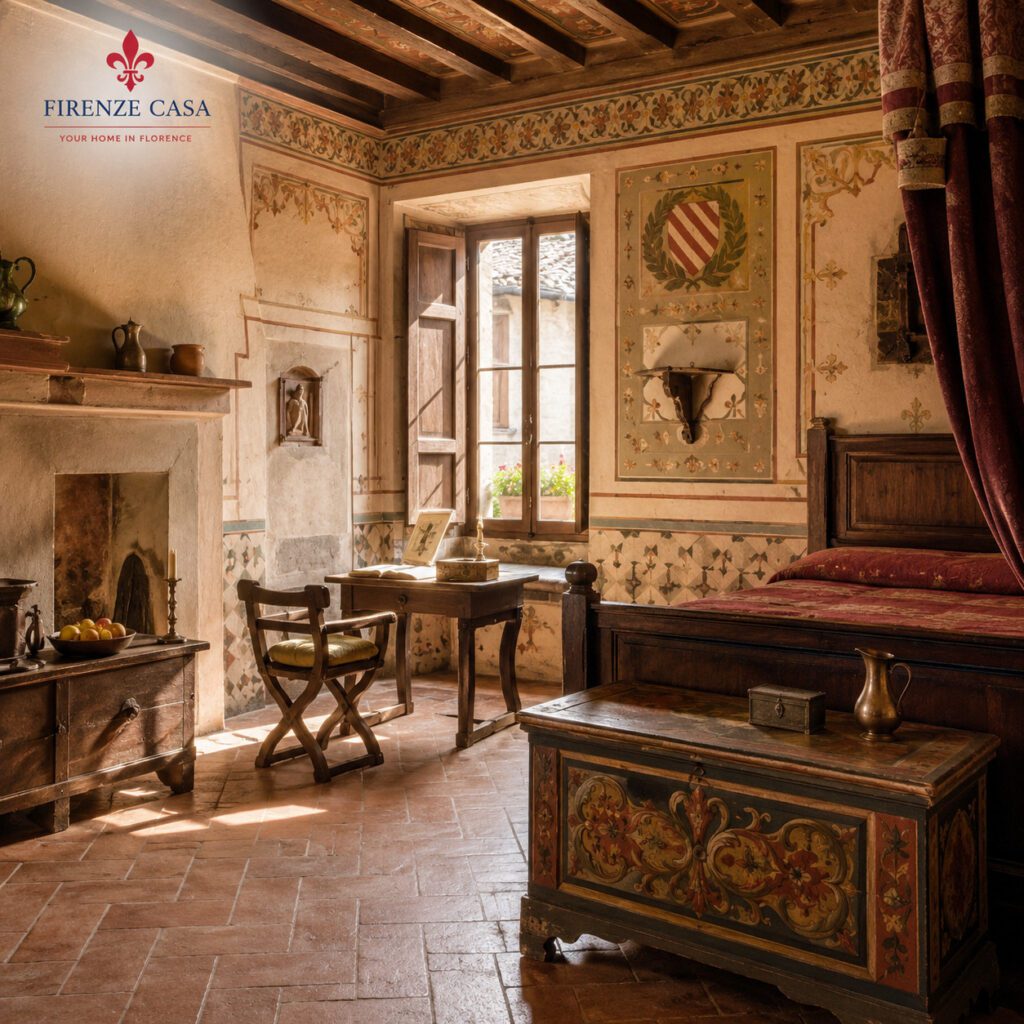
Palazzo Davanzati Florence offers something very different from the city’s famous galleries and Renaissance museums. Instead of standing before monumental masterpieces, visitors step inside a historic Florentine home and discover how a wealthy family lived centuries ago. Furnished rooms, painted walls, wooden ceilings and ingenious domestic details make this one of the most atmospheric museums in Florence.
Officially known as the Museo dell’Antica Casa Fiorentina, or Museum of the Old Florentine House, Palazzo Davanzati recreates the atmosphere of an affluent Florentine residence between the Middle Ages and the Renaissance. Rather than focusing on rulers or famous artists, it reveals bedrooms, reception rooms, household organisation and the practical realities of domestic life.
Official name: Museo dell’Antica Casa Fiorentina
Main attraction: Historic Florentine domestic interiors
Best for: Medieval Florence, historic homes and everyday life
Historic period: Primarily late medieval and Renaissance Florence
Suggested visit: About 1 hour
Location: Via Porta Rossa, historic centre of Florence
Nearby: Palazzo Strozzi, Piazza della Repubblica, Ponte Vecchio and Piazza della Signoria
Why Visit Palazzo Davanzati Florence?
Most of Florence’s major museums tell the story of artists, rulers, churches and powerful dynasties. Palazzo Davanzati tells a more personal story: the history of the home.
That makes it particularly valuable after visiting Florence’s monumental attractions. Here, surprisingly familiar questions come to mind. Where did people sleep? How did they heat their rooms? Where did they store their belongings? How were meals prepared and privacy organised?
At the same time, the palace demonstrates how closely domestic life was connected with social status. A prosperous merchant family’s home needed to provide security and comfort while displaying wealth and position, so architecture, furnishings and decoration all contributed to the impression made on visitors.
Because the museum is relatively compact, it fits easily into a day exploring the historic centre and belongs among the distinctive smaller institutions in our complete guide to Florence museums.
A Short History of Palazzo Davanzati
The palace dates largely from the fourteenth century and was originally associated with the Davizzi family, wealthy Florentine merchants and bankers. Its architecture reflects a period when successful commercial families were creating substantial residences within the densely built medieval city.
The building later passed through different owners. In the sixteenth century, it was acquired by the Davanzati family, whose name it still carries today.
Like many historic buildings, Palazzo Davanzati changed over the centuries. Its modern history as a place dedicated to historic Florentine domestic life developed much later, eventually leading to its establishment as the Museo dell’Antica Casa Fiorentina.
Today, the museum combines surviving architectural features with historic furniture, artworks and decorative objects to evoke the character of an old Florentine home.
Fourteenth-century Florence was already one of Europe’s great commercial centres. Successful merchants and bankers accumulated considerable wealth, but their homes still belonged to the architectural world of the medieval city. Palazzo Davanzati captures this fascinating moment between the fortified medieval residence and the elegant Renaissance palace.
From Medieval Tower Houses to Florentine Palaces
To understand Palazzo Davanzati, it helps to imagine medieval Florence before the harmonious Renaissance palaces transformed its streets. Powerful families had once lived in tall, defensive tower houses, and the skyline of medieval Florence looked dramatically different from the city visitors know today.
As political and social conditions changed, wealthy families increasingly developed larger and more comfortable urban residences. Palazzo Davanzati represents an important stage in this evolution.
Its exterior retains a strong, almost defensive character, while the interior reveals increasing attention to comfort, decoration and sophisticated domestic life. A few generations later, buildings such as Palazzo Medici Riccardi and Palazzo Strozzi would take the Florentine urban palace in a distinctly Renaissance direction.
The Courtyard – The Heart of Palazzo Davanzati
One of the first memorable spaces is the internal courtyard. Florentine palaces often organised movement around such central spaces, which brought light and air into buildings surrounded by dense urban development and provided access to different parts of the residence.
At Palazzo Davanzati, stone columns, arches and the vertical arrangement of the building immediately establish the atmosphere of a historic merchant’s home. Look upwards as well as around you: the height of the palace reveals how much domestic life was organised vertically, with different floors serving different purposes.
The courtyard is an excellent place to begin imagining the building not as a museum, but as a functioning household filled with family members, servants, visitors and commercial activity.
Inside a Wealthy Florentine Home
The rooms of Palazzo Davanzati Florence reveal a world very different from modern domestic life. Furniture was relatively sparse by today’s standards, and large wooden chests played an important role in storing clothing, textiles and valuables.
Walls provided another opportunity for display. Painted decoration could transform rooms with patterns, architectural illusions and narrative scenes, while textiles provided warmth and comfort and demonstrated wealth in a city whose economy was deeply connected with the production and trade of luxury cloth.
The result is neither the austerity of a medieval fortress nor the overwhelming ceremonial splendour of Palazzo Pitti. Palazzo Davanzati occupies a fascinating space between the two.
The Great Hall and Reception Rooms
A wealthy Florentine home was also a place for business and social interaction. Important rooms were used to receive guests, conduct conversations and demonstrate the standing of the family.
Architecture and decoration therefore communicated messages about prosperity and respectability. Large fireplaces remind visitors how essential fire was for heating during colder months, while wooden ceilings and painted walls create an atmosphere very different from the marble and gilding of later grand-ducal residences.
Look closely at the furniture rather than treating it simply as decoration. Chests, tables, seating and other objects reveal how rooms were used and how differently domestic space functioned before modern built-in storage and specialised furniture became commonplace.
The Painted Rooms of Palazzo Davanzati
Some of the most memorable interiors are decorated with wall paintings. These rooms demonstrate that wealthy medieval and early Renaissance homes could be remarkably colourful, making the familiar image of the Middle Ages as a world of bare grey stone highly misleading.
Decorative schemes included geometric patterns, imitation textiles, heraldic elements and narrative scenes. They created an environment that was both comfortable and visually sophisticated.
One of the pleasures of Palazzo Davanzati is therefore simply looking at the walls. Details that initially appear ornamental often reveal stories, symbols or clues about the cultural world of the people who inhabited such residences.
Take time to examine the painted walls rather than concentrating only on furniture. Their colours and decorative patterns challenge the familiar image of medieval interiors as dark and bare. Wealthy Florentine homes could be surprisingly colourful and visually sophisticated.
The Camera Castellana
Among the palace’s best-known interiors is the room traditionally called the Camera Castellana. Its painted decoration illustrates a medieval story of love, conflict and adventure, with narrative scenes unfolding around the walls.
Rooms such as this demonstrate how storytelling formed part of domestic decoration. Images were not restricted to churches and public buildings; secular stories could also surround people inside their homes.
The combination of painted walls, historic furniture and intimate scale makes these rooms particularly atmospheric. Rather than encountering individual works removed from their original setting, visitors experience decoration as part of an architectural space.
Bedrooms and Private Life
The bedrooms are among the most fascinating areas because they bring visitors unusually close to the private world of historic Florence. Beds could be substantial pieces of furniture, often surrounded by fabrics that provided warmth and privacy, while storage chests held clothing and valuable household possessions.
Bedrooms were not necessarily private in the modern sense. Domestic spaces could serve multiple purposes, and households included extended family members, servants and frequent visitors.
Marriage, inheritance and family alliances also played important roles in Florentine society. A wealthy household was both a private home and part of a broader economic and social network.
How Comfortable Was a Medieval Florentine Home?
By modern standards, life inside a medieval palace would still have been challenging. Heating depended largely on fireplaces, artificial lighting was limited and carrying water, preparing food and maintaining a large household required substantial labour.
Yet a residence such as Palazzo Davanzati offered levels of comfort unavailable to most inhabitants of medieval Florence. Thick walls provided protection and insulation, fireplaces heated important rooms and systems for managing water made daily life easier.
The palace therefore represents the lifestyle of a prosperous urban elite rather than the average Florentine.
A Surprisingly Sophisticated Medieval Bathroom
One of the details visitors often remember most is the evidence of sanitation and washing facilities. Medieval domestic life was more technologically varied than popular stereotypes suggest, and wealthy urban houses could incorporate systems for water and waste that offered considerably greater convenience than many people expect.
Palazzo Davanzati preserves features that help explain how such practical needs were integrated into a multi-storey residence. These details are important because they move the museum beyond paintings and furniture and reveal the engineering of everyday life.
How people obtained water, disposed of waste, stayed warm and maintained privacy tells us as much about a historic home as its most beautiful decorations.
One of the most surprising aspects of Palazzo Davanzati is the attention given to practical domestic needs. Water supply, sanitation and fireplaces were incorporated into the architecture, reminding visitors that an affluent medieval Florentine home could be far more sophisticated than the usual image of medieval life suggests.
The Kitchen and Household Organisation
The kitchen provides another glimpse into the practical organisation of the palace. Preparing meals for a large household required considerable work, and food storage, water, firewood and cooking equipment all had to be managed without modern refrigeration, plumbing or appliances.
Kitchens were often located strategically within large houses because fire presented a serious danger. Smoke, heat and the movement of servants also influenced how domestic spaces were arranged.
Household work would have remained largely invisible to important guests, yet it was essential to maintaining the lifestyle displayed in the more prestigious rooms. This contrast between representation and practical work is one of the most interesting themes to consider while exploring Palazzo Davanzati.
Furniture, Chests and Everyday Objects
Historic furniture gives the rooms much of their character. Among the most characteristic objects are large wooden chests, or cassoni, which could store textiles, clothing and valuable possessions and were sometimes associated with marriage and the transfer of goods between families.
Tables and chairs were very different from modern mass-produced furniture. Individual pieces represented valuable household possessions that could remain in families for generations.
Objects associated with spinning, weaving and other domestic activities also help reconstruct daily routines. Florence’s enormous textile industry makes these details particularly relevant because cloth stood at the centre of the city’s economy and contributed to the fortunes of many leading families.
Merchants, Bankers and the Wealth of Medieval Florence
Palazzo Davanzati makes more sense when placed within Florence’s economic history. Long before the city became synonymous with Renaissance art, Florentine merchants developed commercial networks extending across Europe and beyond. Banking, wool production, silk and international trade generated enormous fortunes.
Families invested part of this wealth in their homes. A palace demonstrated stability and social position while providing a base for family life and, in some cases, business activities.
The distinction between domestic and economic life was less rigid than it is today. The great Renaissance palaces that later appeared throughout Florence grew from this culture of wealthy urban families competing for influence and prestige.
The history of the Strozzi family, for example, shows how banking wealth, political ambition and monumental palace architecture could become closely intertwined. Palazzo Davanzati allows visitors to see an earlier stage of this development.
Palazzo Davanzati and the Role of Women
Domestic life also reveals aspects of Florentine history that monumental public buildings often leave in the background. Women played central roles in managing households, raising children and maintaining family networks.
Marriages between important families could strengthen political, social and economic alliances, while textiles, clothing, dowries and household possessions were closely connected with these relationships.
Life was nevertheless shaped by strict social expectations and legal structures very different from those of modern Florence. Exploring a historic residence makes these realities easier to imagine because the spaces themselves bring family life into focus.
Children and Family Life
Palazzo Davanzati was not simply an elegant residence occupied by adults. Houses of this kind were complex family environments in which several generations might interact alongside servants and visitors.
Children from prosperous families grew up within a world shaped by family expectations, religion and the economic interests of the household. Education differed according to gender, status and intended roles.
Sons of merchant families might eventually participate in business, while daughters’ futures were often closely connected with marriage arrangements or religious life. The home was therefore also a place where the next generation learned its position within Florentine society.
Servants Behind the Scenes
The comfort enjoyed by a wealthy family depended heavily on the work of others. Servants prepared food, maintained fires, carried water, cleaned rooms, cared for clothing and performed countless other tasks necessary to keep a large urban residence functioning.
Their presence is easy to overlook because the surviving decorative rooms naturally draw most of the visitor’s attention. Yet imagining the movement of servants through staircases, kitchens and service areas helps restore the palace as a living household.
The elegant rooms and painted walls tell only one side of the story. Daily life required constant labour behind the scenes.
What Palazzo Davanzati Tells Us About Medieval Florence
The museum reveals that medieval Florence was not simply a collection of churches, towers and narrow streets. It was a densely populated commercial city in which family, business and social status were closely interconnected.
Wealthy households functioned as private residences but also reflected the economic structures that made Florence powerful. The palace demonstrates how architecture responded to these needs: security remained important, yet comfort, decoration and representation became increasingly sophisticated.
This helps explain the transition towards the great Renaissance palaces that would soon reshape Florence. Palazzo Davanzati stands at an especially interesting point in that transformation.
From Palazzo Davanzati to Palazzo Strozzi
The geographical proximity of Palazzo Davanzati and Palazzo Strozzi makes an interesting historical comparison possible. Palazzo Davanzati retains important characteristics of a late medieval merchant residence, while Palazzo Strozzi, begun towards the end of the fifteenth century, represents the monumental confidence of Renaissance palace architecture.
Walking between them takes only a few minutes, yet architecturally they belong to different worlds. The comparison shows how rapidly the homes of Florence’s elite evolved as the city became wealthier and Renaissance architectural ideas matured.
The story behind the later palace is explored in our guide to the Strozzi family of Florence, whose immense banking wealth and rivalry with the Medici helped produce one of the city’s most imposing Renaissance residences.
After visiting Palazzo Davanzati, walk the few minutes to Palazzo Strozzi and compare the two buildings from outside. Palazzo Davanzati preserves the character of a medieval merchant’s residence, while Palazzo Strozzi represents the monumental Renaissance palace at its most confident. Seeing them together makes the architectural transformation of Florence remarkably clear.
Palazzo Davanzati and Museo Horne – Two Ways to Experience a Historic Home
Museo Horne provides one of the most interesting comparisons with Palazzo Davanzati. Both museums allow visitors to experience art, furniture and decorative objects within relatively intimate domestic interiors.
The important difference is historical. Palazzo Davanzati is fundamentally a surviving medieval and Renaissance Florentine palace whose rooms help reconstruct the domestic life of an affluent household.
Museo Horne occupies a historic palace but reflects the carefully researched vision of the early twentieth-century collector Herbert Horne, who assembled Renaissance objects to evoke an ideal Florentine interior.
Visiting both therefore reveals two complementary approaches: one begins with the historic house, while the other begins with the collector’s interpretation of Renaissance domestic culture.
Why Palazzo Davanzati Is One of Florence’s Hidden Gems
Palazzo Davanzati rarely receives the same attention as the Uffizi, Accademia or Palazzo Pitti, and that is part of its appeal.
The museum offers a more intimate encounter with Florence and focuses on a subject that the larger collections cannot easily reproduce. Instead of moving through galleries filled with visitors searching for famous masterpieces, you explore the rooms of a historic home.
For travellers spending several days in Florence, this change of perspective can be refreshing. After seeing how the Medici ruled, how Michelangelo sculpted and how Brunelleschi built, Palazzo Davanzati answers another question: what was it actually like to live here?
It therefore fits naturally into our guide to small museums in Florence worth discovering.
Highlights of Palazzo Davanzati Florence
- The internal courtyard – the architectural heart of the historic residence.
- The painted rooms – colourful evidence of sophisticated domestic decoration.
- The Camera Castellana – one of the palace’s most atmospheric narrative interiors.
- Historic bedrooms – offering insight into private and family life.
- Furniture and cassoni – objects that reveal how possessions were stored and displayed.
- Domestic facilities – practical features connected with water, sanitation and heating.
- The kitchen and household spaces – evidence of the labour required to maintain an affluent home.
How Long Do You Need at Palazzo Davanzati?
For most visitors, approximately one hour is a comfortable amount of time for Palazzo Davanzati Florence. This allows you to explore the principal rooms without rushing and pay attention to the smaller domestic details that make the museum interesting.
Visitors particularly interested in medieval history, architecture or historic interiors may want to stay longer. The palace rewards close observation rather than speed.
Because the museum is considerably smaller than the Uffizi or Palazzo Pitti, it is also easy to combine with other attractions on the same day.
When Is the Best Time to Visit?
Palazzo Davanzati can work well at almost any point during a day in the historic centre. Its indoor setting also makes it useful during very hot weather or on a rainy day.
The experience benefits from a relatively calm atmosphere because much of its appeal comes from observing small architectural and decorative details.
Opening arrangements can be more limited than those of Florence’s largest museums, and access to particular floors or rooms may occasionally vary. Check current official information before planning your visit rather than relying on older guidebooks or travel websites.
Where Is Palazzo Davanzati in Florence?
Palazzo Davanzati stands on Via Porta Rossa in the heart of Florence’s historic centre. Palazzo Strozzi is only a short walk away, while Piazza della Repubblica, Ponte Vecchio and Piazza della Signoria are all nearby.
The building is easy to pass without realising what lies inside because its façade blends naturally into the dense urban fabric of central Florence.
That is part of the experience. You step from one of the city’s busy streets through the entrance of an old palace and suddenly enter a very different Florence.
What to Combine with Palazzo Davanzati
Palazzo Strozzi
This is perhaps the most interesting architectural combination. Comparing the two palaces reveals the transition from medieval domestic architecture towards the monumental Renaissance residence. Our article on the Strozzi family provides the historical context behind the later palace.
Piazza della Repubblica
A short walk brings you to one of Florence’s busiest squares, whose present appearance reflects a much later period in the city’s history.
Ponte Vecchio
The famous bridge is nearby and provides a natural continuation towards the Oltrarno.
Palazzo Vecchio
Combining Palazzo Davanzati with Palazzo Vecchio creates a fascinating contrast between private domestic life and the public political world of medieval and Renaissance Florence.
Museo Horne
Museo Horne is the strongest thematic companion for visitors interested in Renaissance interiors, furniture and domestic culture.
Palazzo Davanzati or Palazzo Pitti?
The two palaces could hardly be more different, which makes comparing them particularly interesting. Palazzo Davanzati represents the home of a wealthy Florentine merchant family during the transition between the medieval and Renaissance worlds, and its relatively intimate scale keeps domestic life at the centre of the experience.
By contrast, Palazzo Pitti represents the world of rulers. The Medici Grand Dukes transformed it into an enormous dynastic residence filled with art, ceremonial spaces and courtly splendour.
Choose Palazzo Davanzati if you want to understand how a prosperous Florentine household lived. For the grandeur of the Medici court, choose Palazzo Pitti. Seeing both creates an extraordinary journey through the changing meaning of wealth and domestic life in Florence.
Palazzo Davanzati or Palazzo Vecchio?
Palazzo Vecchio tells the story of government, political power and the Medici transformation of Florence. Palazzo Davanzati tells the story of private life.
Inside Palazzo Vecchio, visitors encounter monumental halls, political symbolism and rooms associated with rulers and public administration. At Palazzo Davanzati, the focus shifts towards bedrooms, furniture, household organisation and family life.
The two museums therefore complement each other extremely well. If you are particularly interested in everyday history rather than monumental art, Palazzo Davanzati may be the more unusual experience.
Palazzo Davanzati at a Glance
| Category | Information |
|---|---|
| Official name | Museo dell’Antica Casa Fiorentina |
| Main attraction | Historic Florentine domestic interiors |
| Best for | Medieval Florence, historic homes and everyday life |
| Suggested visit | About 1 hour |
| Historic period | Primarily late medieval and Renaissance Florence |
| Location | Via Porta Rossa, historic centre of Florence |
| Nearby attractions | Palazzo Strozzi, Piazza della Repubblica, Ponte Vecchio, Piazza della Signoria |
| Ideal for | Visitors looking for a smaller and unusual Florence museum |
Interesting Facts About Palazzo Davanzati
- The palace dates largely from the fourteenth century.
- It was originally associated with the wealthy Florentine Davizzi family.
- The Davanzati family acquired the building later and gave the palace the name it carries today.
- Its official museum name is Museo dell’Antica Casa Fiorentina.
- The building represents an important stage between medieval tower houses and later Renaissance palaces.
- Painted walls show that affluent medieval interiors could be remarkably colourful.
- Large wooden chests played an important role in storing clothing, textiles and valuable possessions.
- The palace preserves evidence of practical domestic arrangements for water, sanitation and heating.
- Servants were essential to maintaining the lifestyle of wealthy Florentine households.
- Palazzo Strozzi stands only a short walk away, making it easy to compare medieval and Renaissance palace architecture.
Frequently Asked Questions About Palazzo Davanzati Florence
Is Palazzo Davanzati worth visiting?
Absolutely, especially if you are interested in medieval Florence, historic interiors or everyday life. The museum offers a very different experience from Florence’s large art collections.
What is Palazzo Davanzati famous for?
Palazzo Davanzati is famous for its reconstructed historic Florentine interiors, painted rooms, furniture and domestic features. Together, they illustrate how an affluent family lived centuries ago.
How old is Palazzo Davanzati?
The palace dates largely from the fourteenth century, although later owners altered parts of the building over the centuries.
Did the Medici live in Palazzo Davanzati?
No. Wealthy merchant families occupied Palazzo Davanzati rather than the Medici. For an impression of Medici court life, Palazzo Pitti provides a fascinating contrast.
How long should I spend at Palazzo Davanzati?
Around one hour is sufficient for most visitors. Those particularly interested in architecture and domestic history may want to spend longer examining the rooms and details.
Is Palazzo Davanzati a good museum for children?
For many children, it can be surprisingly interesting. Beds, kitchens, furniture and unusual domestic features often feel more accessible than large collections of paintings because they encourage questions about how people actually lived.
Is Palazzo Davanzati close to Palazzo Strozzi?
Yes. Palazzo Strozzi is only a short walk away. Visiting both makes it particularly easy to compare medieval and Renaissance palace architecture.
Is Palazzo Davanzati a medieval building?
Its origins lie in fourteenth-century Florence, although later owners modified the building. It still preserves important characteristics of a wealthy late medieval urban residence.
What is the difference between Palazzo Davanzati and Museo Horne?
Palazzo Davanzati focuses on a historic Florentine house and the reconstruction of domestic life, while Museo Horne reflects Herbert Horne’s early twentieth-century scholarly vision of a Renaissance interior assembled from historic art and furnishings.
Why Palazzo Davanzati Is Worth Visiting
Palazzo Davanzati Florence offers something increasingly rare in a city famous for monumental art: an intimate encounter with everyday history. Instead of concentrating on a single masterpiece or celebrated artist, the museum asks visitors to imagine the people who once lived behind the walls of a Florentine palace.
Bedrooms, painted walls, furniture, fireplaces and household facilities reveal a world shaped by family, commerce, status and constant domestic work. The palace also captures an important moment in Florence’s development, standing between the defensive world of medieval tower houses and the monumental Renaissance residences that later transformed the city.
That makes Palazzo Davanzati an excellent complement to Florence’s more famous museums. Palazzo Vecchio reveals how the city was governed, while Palazzo Pitti introduces the world of grand dukes and kings. Museo Horne recreates another vision of Renaissance domestic culture through the eyes of a twentieth-century collector.
Palazzo Davanzati answers a simpler but equally fascinating question: what was it like to live in Florence centuries ago?
For anyone curious about the people behind Florence’s famous façades, this small historic palace is one of the city’s most rewarding hidden gems.
Further Reading on Firenze Casa
- Florence Museums – The Complete Guide
- Museo Horne – A Renaissance Home Recreated
- The Strozzi Family – Florence’s Great Rivals of the Medici
- Palazzo Vecchio – Political Heart of Florence
- Palazzo Pitti – The World of the Medici
- Small Museums in Florence Worth Discovering
References
- Musei del Bargello – Official information on Museo di Palazzo Davanzati and its collections.
- Ministero della Cultura – Official information on Palazzo Davanzati and Italy’s national museum collections.
- Comune di Firenze – Historical and cultural information on Florence.
- UNESCO World Heritage Centre – Historic Centre of Florence.

