
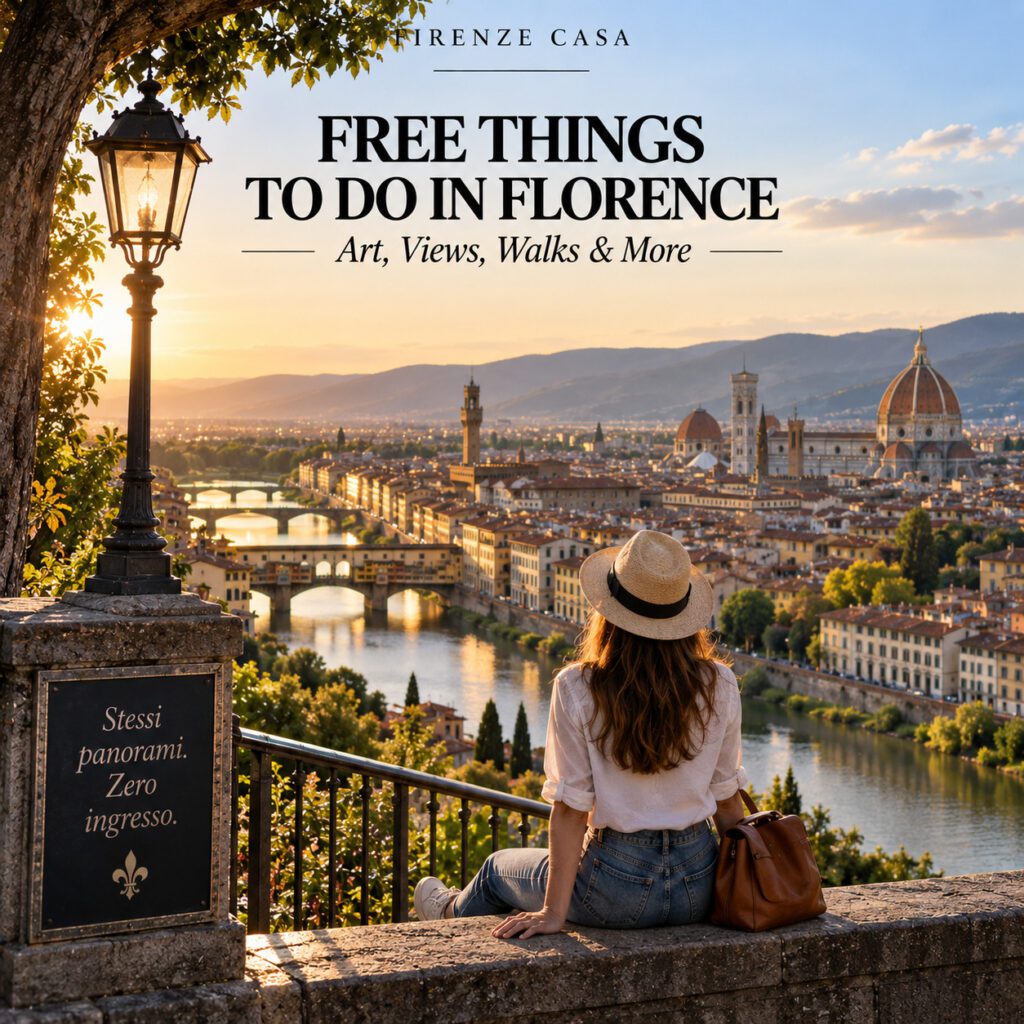
Some of the best free things to do in Florence are also among the city’s essential experiences. You can cross Ponte Vecchio, admire Piazza della Signoria, walk beside the Arno, explore historic neighbourhoods and look across the entire Renaissance skyline from Piazzale Michelangelo without buying a ticket.
This makes Florence surprisingly rewarding even on days when you do not want another museum reservation. The key is knowing which free experiences are genuinely worth your time. This guide focuses on places and walks we would recommend even if admission prices were irrelevant.
💶 Free Florence – At a Glance
Best panorama: Piazzale Michelangelo
Best historic square: Piazza della Signoria
Best bridge: Ponte Vecchio
Best free garden: Giardino delle Rose
Best experience: Exploring Florence on foot
Cost: €0 – although coffee, gelato and spontaneous discoveries may test your resolve
Is It Possible to Enjoy Florence for Free?
Very much so. Florence’s famous museums are important, and we would never suggest skipping the Uffizi or Accademia simply to save money. Yet much of what makes Florence extraordinary exists outside museum doors.
The historic centre itself is an architectural experience. Medieval streets lead into Renaissance piazzas, church façades appear unexpectedly between buildings, and the Arno provides a completely different perspective on the city.
Free activities are therefore useful for more than budget travel. They also provide balance between museums and ticketed monuments.
If this is your first visit, our First Time in Florence guide can help you combine these experiences with the attractions that really are worth booking.
💡 Firenze Casa Tip
Do not fill every day with paid attractions simply because Florence has so many famous museums. One major museum followed by several hours exploring the city on foot often creates a much better day.
1. Walk Around Piazza del Duomo
Few free experiences in Florence can compete with simply arriving in Piazza del Duomo for the first time.
Walk completely around Florence Cathedral rather than photographing the dome from one position and moving on. The exterior reveals the relationship between the cathedral, Giotto’s Bell Tower and the Baptistery far better when seen from different angles.
Look closely at the marble decoration, doors, sculpture and changing perspective of Brunelleschi’s dome as you move around the complex.
Ticketed parts of the Duomo complex offer much more, of course. But experiencing its monumental exterior and the surrounding piazza costs nothing.
2. Explore Piazza della Signoria
Piazza della Signoria is effectively an open-air lesson in Florentine history.
The fortress-like Palazzo Vecchio dominates the square, while monumental sculpture, historic façades and the entrance to the Uffizi surround you.
You do not need a museum ticket to understand why this became the political heart of Florence. Spend time looking at the architecture rather than simply crossing the piazza on your way to somewhere else.
The square is particularly atmospheric early in the morning and again in the evening, when the relationship between the buildings becomes easier to appreciate.
🏛️ Look Up
Florence rewards visitors who stop looking only at street level. Towers, coats of arms, rooflines, façades and architectural details turn an ordinary walk through the historic centre into a free introduction to the city’s history.
3. See the Sculptures of the Loggia dei Lanzi
On Piazza della Signoria, the Loggia dei Lanzi offers something remarkable: monumental sculpture in a historic open loggia that can be admired without entering a museum.
The setting itself is part of the experience. Sculpture, civic architecture and public space come together in the same square where Florentine political life unfolded for centuries.
Take a few minutes to look properly rather than treating the loggia as a backdrop for Palazzo Vecchio.
It is one of the clearest examples of why a day of free things to do in Florence does not have to feel like a compromise.
4. Cross Ponte Vecchio
Walking across Ponte Vecchio costs nothing and connects two sides of Florence that every visitor should experience.
The bridge dates mainly from the 14th century and is lined with the goldsmith and jewellery shops that became associated with it after the Medici period. Above them runs the Vasari Corridor.
During the middle of the day, the bridge can become extremely crowded. Visit early in the morning if you want to appreciate its structure and atmosphere more easily.
Then return later – but view it from somewhere else.
5. See Ponte Vecchio from Ponte Santa Trinita
One of the best free views in Florence is not from Ponte Vecchio but towards it.
Walk downstream to Ponte Santa Trinita and look back. From here, the complete medieval bridge appears across the Arno with its projecting shops and the historic city beyond.
Late afternoon can be particularly beautiful, but morning is often calmer.
If you enjoy the river, our Florence Along the Arno route turns the bridges into a longer free walk through the city.
6. Walk Along the Arno
The Arno offers one of the easiest ways to escape the intensity of the central shopping and sightseeing streets without actually leaving central Florence.
Walk along the Lungarni, cross different bridges and watch how the skyline changes from one bank to the other.
Ponte Vecchio may be the famous landmark, but the wider river landscape is just as important to Florence. Our Bridges of Florence: The Complete Guide explains the history of the individual crossings.
Early morning and the hour before sunset are especially rewarding times for a riverside walk.
7. Walk Up to Piazzale Michelangelo
Piazzale Michelangelo provides the classic panorama of Florence – and the view is free.
From the terrace, Brunelleschi’s dome, Palazzo Vecchio, Santa Croce, the Arno and the surrounding hills come together in one extraordinary cityscape.
Sunset is famous but also extremely busy. If you prefer a calmer experience, go earlier in the morning or during the afternoon.
Walking there from San Niccolò also makes the ascent part of the experience rather than simply transporting you to a viewpoint.
📷 Firenze Casa Tip
Piazzale Michelangelo is not only a sunset destination. Clear mornings can offer beautiful light, better visibility and far fewer people competing for the same viewpoint.
8. Continue to San Miniato al Monte
One of the most common mistakes at Piazzale Michelangelo is turning around immediately after taking the photograph.
Continue uphill to San Miniato al Monte. The Romanesque basilica stands above the piazzale and offers another superb perspective over Florence.
The church is one of the city’s great medieval monuments, with a striking geometric marble façade, atmospheric interior and centuries of history.
The terrace in front of the basilica is also generally quieter than Piazzale Michelangelo below.
As with all active churches, access can be affected by services and religious events. Respect worship and check current visitor arrangements if entering the basilica is important to your plans.
9. Visit the Rose Garden
Directly below Piazzale Michelangelo lies the Rose Garden – Giardino delle Rose, one of the loveliest genuinely free attractions in Florence.
The terraced garden combines roses, olive trees, sculptures by Jean-Michel Folon, a small Japanese garden and beautiful views across the historic centre.
Spring is particularly attractive when the roses are flowering, but the panorama makes the garden worthwhile beyond the main flowering season.
Instead of walking directly up and down the same route to Piazzale Michelangelo, use the garden as part of your ascent or descent.
🌹 An Excellent Free Half-Day
San Niccolò → Rose Garden → Piazzale Michelangelo → San Miniato al Monte. This is one of the best combinations of free walking, gardens, architecture and panoramic views in Florence.
10. Visit the Iris Garden in Spring
If you are in Florence during its short spring opening season, the Iris Garden – Giardino dell’Iris is another wonderful free experience.
The garden lies beside Piazzale Michelangelo and contains an extraordinary collection of irises growing among olive trees on the hillside.
It is normally accessible to casual visitors only for a few weeks around the main flowering season, traditionally from late April into May. Admission during the regular spring opening has traditionally been free.
Because dates and weather-related arrangements vary each year, check the current season before planning your visit specifically around the garden.
11. Explore San Niccolò
Before or after climbing to Piazzale Michelangelo, spend time in San Niccolò.
This small neighbourhood beneath the hillside provides a pleasant transition between the Arno and the panoramic routes above Florence.
Historic streets, remnants of the old city and a more intimate atmosphere make it rewarding even without entering a single attraction.
It also prevents Piazzale Michelangelo from becoming an isolated viewpoint reached only for a photograph.
12. Wander Through Santo Spirito
Cross the Arno and explore Santo Spirito without a fixed sightseeing list.
The Oltrarno neighbourhood offers historic streets, artisan traditions, local businesses and one of Florence’s most characteristic squares.
Piazza Santo Spirito is particularly good for simply stopping and watching neighbourhood life.
If you want a structured route without paying for a tour, follow our Santo Spirito & San Frediano Walking Tour on your own.
13. Discover San Frediano
Continue west into San Frediano, another part of the Oltrarno where the attraction lies largely in the neighbourhood itself.
Walking here provides a useful contrast to the monumental centre around the Duomo and Piazza della Signoria.
Look for workshops, modest historic façades, local streets and the everyday fabric of Florence rather than one famous object.
This is precisely the kind of experience that costs nothing but adds depth to a longer stay.
14. Explore Santa Croce and Sant’Ambrogio
You do not have to enter every monument to enjoy the eastern side of central Florence.
Begin in Piazza Santa Croce, admire the monumental façade of the basilica and then move into the surrounding Santa Croce neighbourhood.
Continue towards Sant’Ambrogio, where central Florence begins to feel more residential.
Our Santa Croce & Sant’Ambrogio Walking Tour provides a free self-guided route through both areas.
🏡 Staying with Firenze Casa
The Firenze Casa Florence apartment is near Piazza d’Azeglio, between Santa Croce and Sant’Ambrogio. From here, many of the city’s best free experiences – neighbourhood walks, the historic centre and the Arno – begin simply by stepping outside and walking.
15. Experience Florence’s Markets
You do not need to buy anything to enjoy the atmosphere of a traditional market.
Florence’s food markets reveal a practical side of the city that is easy to miss between museums and monuments. Go in the morning, observe what is in season and see how food remains connected with neighbourhood life.
Our guide to Historic Food Markets in Florence explains their history and character.
If you want to connect markets with the wider food culture of the city, follow the Florence Food & Market Walk. Looking is free; resisting the temptation to eat something is another matter.
16. Follow a Firenze Casa Walking Route
A self-guided walk is one of the most useful free things to do in Florence because it turns the city itself into the attraction.
Firenze Casa has routes through individual neighbourhoods as well as thematic walks following Dante, Michelangelo, Brunelleschi, the Medici, Renaissance masters, Jewish Florence, artisans and the Arno.
Each route is designed to connect places that genuinely belong together rather than simply producing a sequence of famous sights.
Start with our Florence Walking Routes or browse the complete collection in Walking Tours of Florence: The Complete Guide.
🚶 Free Self-Guided Tours
You do not need to complete an entire route. Use a Firenze Casa walking tour as the framework for a neighbourhood, then stop whenever a church, café, shop or quiet street catches your attention.
17. Follow Dante Through Medieval Florence
For a free walk with a clear theme, explore the streets associated with Dante.
The medieval centre around the Duomo, Via del Proconsolo and the narrow streets traditionally connected with Dante reveals a Florence older than the Renaissance city most visitors expect.
Our Dante’s Florence route connects the places with their historical and literary context.
Some individual museums or monuments along the route charge admission, but following the streets and understanding their relationship costs nothing.
18. Follow the Medici Through Florence
The Medici shaped Florence so extensively that much of their story can be traced simply by walking.
Start around San Lorenzo and Palazzo Medici Riccardi, continue towards Piazza della Signoria and the Uffizi, then follow the route towards Ponte Vecchio and the Oltrarno.
Our Medici Florence walk provides the sequence, while the Medici Family in Florence guide explains the dynasty behind it.
You can then decide which interiors deserve a paid visit rather than purchasing tickets simply because you happen to pass them.
19. Look for Florence’s Artisan Traditions
Florence’s craftsmanship is not confined to souvenir shops.
Walking through the Oltrarno reveals streets historically associated with workshops and trades that have shaped the city for centuries.
Our Florence Artisan Walk explores this tradition on foot.
Remember that workshops are working businesses rather than free museums. Observe respectfully, and never assume that every studio welcomes visitors simply because the door is open.
20. Watch Florence Change in the Evening
One of the simplest free experiences is returning to a place you saw earlier and discovering that it feels completely different.
Walk beside the Arno as daylight fades. Return to Piazza della Signoria after dinner. Cross Ponte Vecchio when the daytime crowds have thinned or sit somewhere with a view across the city.
Florence’s stone façades, river and narrow streets respond dramatically to changing light.
You do not need another attraction. Sometimes the best final hour of the day is simply a walk home.
Free Things to Do in Florence by Area
| Area | Free Experiences |
|---|---|
| Duomo | Piazza del Duomo · Cathedral exterior · Historic streets |
| Signoria | Piazza della Signoria · Loggia dei Lanzi · Uffizi courtyard area |
| Arno | Ponte Vecchio · Ponte Santa Trinita · Riverside walks |
| Oltrarno | Santo Spirito · San Frediano · Artisan streets |
| Southern hills | Rose Garden · Piazzale Michelangelo · San Miniato al Monte |
| Eastern centre | Santa Croce · Sant’Ambrogio · Neighbourhood streets and markets |
The Best Free Half-Day in Florence
If you want to combine several free attractions into one coherent route, the southern hills are difficult to beat.
Begin beside the Arno and walk into San Niccolò. Continue through the Rose Garden to Piazzale Michelangelo, then climb a little farther to San Miniato al Monte.
You will experience a historic neighbourhood, garden, monumental viewpoint, Romanesque architecture and some of the finest views in Florence without paying admission.
Our Piazzale Michelangelo & San Miniato Walking Tour provides the route.
A Free Evening Walk Through Florence
Another excellent route begins at Piazza del Duomo in the late afternoon.
Walk through the historic streets to Piazza della Signoria, continue towards the Uffizi and reach the Arno. Cross Ponte Vecchio into the Oltrarno and continue towards Santo Spirito.
The route contains some of Florence’s most famous places but requires no ticket.
Allow yourself to stop. The purpose is not to complete a checklist but to experience how Florence changes from monumental centre to river and neighbourhood.
Are Florence’s Churches Free?
Some are, while others charge admission to their monumental visitor complexes or particular areas. The situation is not uniform across Florence.
Do not assume that every church is free simply because it is an active place of worship. Santa Croce and Santa Maria Novella, for example, have ticketed visitor arrangements for their monumental complexes.
Other churches can normally be entered without a tourist admission fee, although donations may be welcomed and access can change during services.
Our Churches of Florence guide helps you decide which churches are worth including for their architecture, art and history. Always check current visitor arrangements if free admission is important to your plan.
⛪ Respect the Difference
A church that can be entered without an admission ticket is still a place of worship, not a free museum. Avoid sightseeing during services, dress appropriately and respect areas reserved for prayer.
Are Florence’s Museums Ever Free?
Free museum admission is a separate question from permanently free attractions.
Italian state museums can participate in national free-admission initiatives on specified dates, and individual institutions may announce additional special openings or free events.
These arrangements can change, so we would not build a Florence itinerary around an old list of free museum days found online.
If the Uffizi or Accademia is essential to your visit, plan and reserve it normally. Treat any applicable free initiative as a bonus rather than the foundation of your trip.
Our guide to What to Book in Advance in Florence explains which major attractions deserve advance planning.
Free Does Not Always Mean No Planning
A free attraction can still have opening hours.
The Rose Garden closes at different times during the year. The Iris Garden has an exceptionally short public season. Churches may restrict tourist access during services, while markets are best experienced during their operating hours.
Public squares, bridges and neighbourhood walks offer the greatest flexibility because they do not depend on a ticket window.
Before making a special journey for any garden, church or market, check current information.
Free Things to Do When It Rains
Rain changes the list considerably.
Walking along the Arno and climbing to Piazzale Michelangelo are less appealing in persistent bad weather, while free indoor possibilities are naturally more limited than outdoor ones.
Use churches appropriately, explore covered market areas and take advantage of breaks in the weather for the historic centre.
For a complete strategy, see Florence in the Rain – What to Do.
Free Things to Do on a Monday
Monday is actually an excellent day for free exploration because several major state museums are normally closed.
Rather than searching for substitute museums, make Monday your walking day. Explore Piazza del Duomo, Piazza della Signoria, the Arno, Oltrarno or the southern hills.
Our guide to Florence on a Monday – What Is Open? helps you combine free experiences with attractions that normally remain open.
How Much Can Free Activities Save?
A substantial amount, particularly for couples or families. But saving money should not be the only reason to include them.
A visitor who spends every day moving between paid monuments can easily miss the relationships between them. Florence makes more sense once you walk from the Duomo to Piazza della Signoria, follow the Arno and cross into the Oltrarno.
Free experiences provide the connective tissue between the famous interiors.
That is why we would include them even in an unlimited travel budget.
What Is Worth Paying For?
A guide to free things to do in Florence should not pretend that everything can be experienced equally well without tickets.
If Renaissance art matters to you, the Uffizi is worth paying for. Michelangelo’s David at the Accademia cannot be replaced by seeing a reproduction elsewhere. The interior experiences of major monuments also add layers that their façades cannot provide.
The better strategy is selective spending: pay for the places that genuinely matter to you and leave enough unscheduled time to experience Florence itself.
Our Florence Museums: The Complete Guide can help you decide which museums deserve your limited time and budget.
💶 Spend Selectively
Saving money in Florence should not mean avoiding the places you came to see. Choose a few important paid attractions and surround them with free walks, neighbourhoods, viewpoints and public spaces.
A Free Day in Florence
If you wanted to spend an entire day without buying an attraction ticket, this would be our route:
| Time | Free Florence Plan |
|---|---|
| Early morning | Piazza del Duomo before the largest crowds |
| Morning | Piazza della Signoria and Loggia dei Lanzi |
| Late morning | Arno, Ponte Vecchio and Ponte Santa Trinita |
| Afternoon | Santo Spirito and San Frediano |
| Late afternoon | San Niccolò and the Rose Garden |
| Evening | Piazzale Michelangelo and San Miniato al Monte |
The attractions cost nothing. Your coffee, lunch, gelato and dinner probably will – and that is a perfectly reasonable use of the money you saved.
Why the Best Free Things in Florence Matter
Florence is often presented as a collection of masterpieces behind ticket barriers. That is only part of the city.
The urban landscape that connects those masterpieces is itself extraordinary. The relationship between the Duomo and surrounding streets, Palazzo Vecchio and its square, Ponte Vecchio and the Arno, and the historic centre and surrounding hills cannot be understood from inside a museum.
Walking, looking and occasionally doing nothing are therefore not gaps between attractions.
They are part of visiting Florence.
🌿 In One Sentence
The best free things to do in Florence are not substitutes for paid attractions: they are some of the experiences that make Florence worth visiting in the first place.
Questions & Answers About Free Things to Do in Florence
What are the best free things to do in Florence?
Piazza della Signoria, Ponte Vecchio, the Arno, Piazzale Michelangelo, the Rose Garden and exploring the historic neighbourhoods on foot are among the best free experiences.
Is Piazzale Michelangelo free?
Yes. Access to the famous panoramic terrace is free, and you can walk there from the historic centre via San Niccolò.
Is the Rose Garden in Florence free?
Yes. Admission to the Giardino delle Rose below Piazzale Michelangelo is free. Opening hours vary seasonally.
Is Ponte Vecchio free?
Yes. You can walk across Ponte Vecchio freely. For the classic view of the bridge, continue to Ponte Santa Trinita.
Can you visit Florence Cathedral for free?
Access arrangements differ across the Duomo complex, and ticketed monuments require the appropriate pass. The cathedral exterior and Piazza del Duomo can always be enjoyed without a ticket; check current official arrangements for interior access.
Are churches in Florence free?
Some churches can normally be entered without a tourist admission fee, while major monumental complexes such as Santa Croce and Santa Maria Novella charge admission for visitor areas.
Are museums in Florence free?
Major museums normally charge admission, although national or special free-admission initiatives can apply on selected dates. Check the museum’s official information for your visit.
What can I do in Florence for free at night?
Walk through Piazza della Signoria, along the Arno or across Ponte Vecchio and explore the illuminated streets of the historic centre and Oltrarno.
Can I spend a whole day in Florence without paying for attractions?
Yes. A day combining the historic centre, Arno, Oltrarno, Rose Garden, Piazzale Michelangelo and San Miniato can be extremely rewarding without a single attraction ticket.
Is Florence good for budget travellers?
Yes, provided you choose paid attractions selectively. Many of Florence’s most memorable public spaces, neighbourhoods, walks and viewpoints can be experienced for free.
Further Reading on Firenze Casa
- First Time in Florence
- Florence Walking Routes
- The Rose Garden in Florence – Giardino delle Rose
- Piazzale Michelangelo Florence – The Best View
- Quiet Places in Florence: Gardens, Streets & Views
- Florence on a Monday – What Is Open?
- What to Book in Advance in Florence
References
- Comune di Firenze – official information on public gardens, monuments and cultural sites.
- FeelFlorence – official tourism information for Florence and current visitor information.
- Ministero della Cultura – information on Italian state museums and national admission initiatives.
- Opera di Santa Maria del Fiore – official visitor information for Florence Cathedral and the Duomo complex.
- Abbazia di San Miniato al Monte – visitor and religious information.
- Società Italiana dell’Iris – visitor information for the Giardino dell’Iris.

