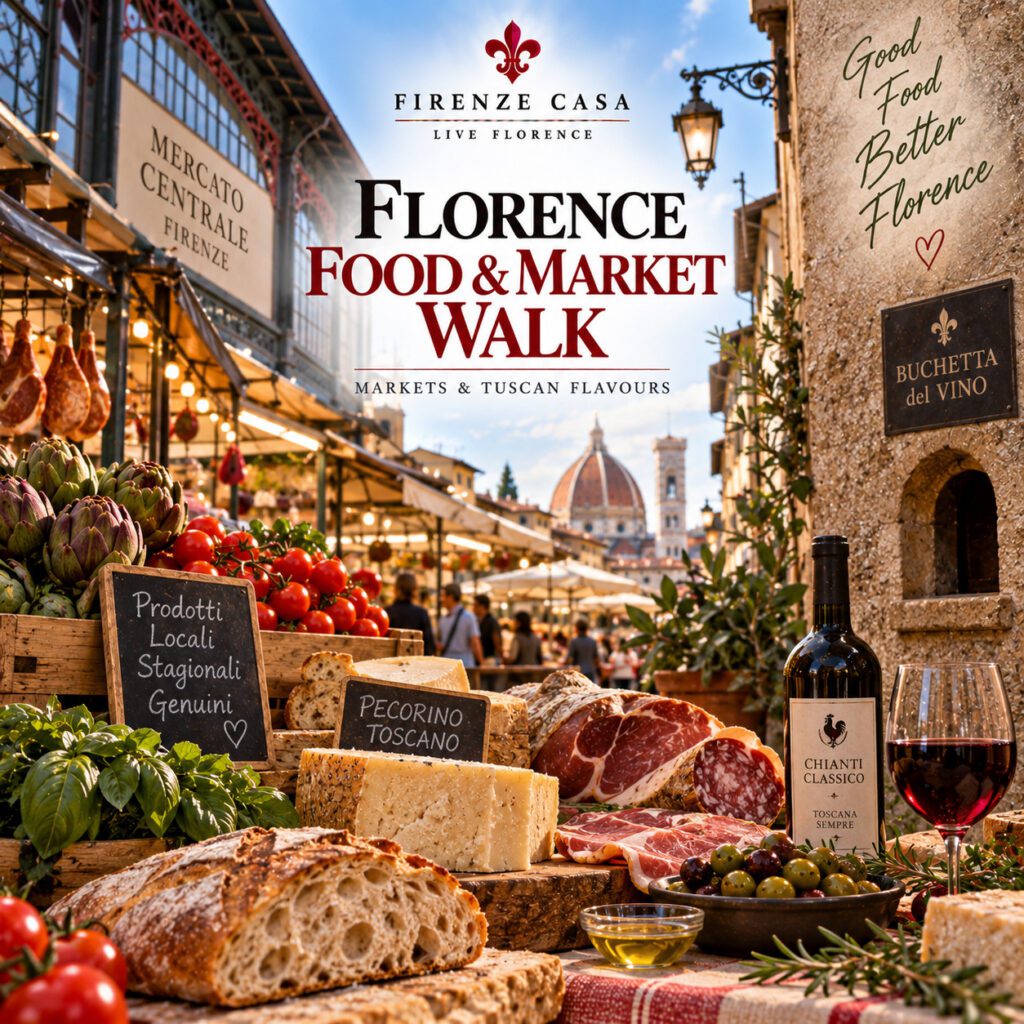
Discover the flavours behind the city on this Florence Food & Market Walk, connecting historic markets, traditional food streets and places that reveal how Florentines have bought, prepared and shared food for generations. Florence is famous for Renaissance art, but its culinary culture is equally rooted in history, neighbourhood life and remarkably simple ingredients.
This walk is not designed as a checklist of restaurants or fashionable food stops. Instead, it explores the foundations of Florentine and Tuscan cuisine – markets, bread, meat, cheese, vegetables, wine and the traditions of using ingredients carefully rather than extravagantly. Along the way, there are plenty of opportunities to taste Florence as well as understand it. It forms part of our Walking Tours of Florence: The Complete Guide.
🚶 At a Glance
Distance:
Walking time:
Recommended time:
Start:
Finish:
Character: Food markets · Tuscan cuisine · Traditional shops · Street food · Wine · Local ingredients
Difficulty:
Walking Route Map
The map will show the final route through Florence’s food culture, connecting historic markets, traditional shopping streets and neighbourhoods associated with Florentine cuisine.
🗺️ Walking Route Map
[WP Go Maps route will be added here]
The Walking Tour
1. Mercato Centrale – Start with the Ingredients
Begin at Mercato Centrale in San Lorenzo. The nineteenth-century market building is one of the best places to start understanding Florentine food because the story begins not with finished dishes but with ingredients.
Look for vegetables, fruit, meat, salumi, cheese, bread and other staples of Tuscan cooking. The exact stalls and products change, but the principle remains important: traditional Florentine cuisine developed from what was locally available, seasonal and practical.
The market also demonstrates how food shopping historically formed part of everyday urban life. Before supermarkets and refrigerators transformed household habits, markets and specialist shops were essential parts of the city’s daily rhythm. For a wider overview of Florence’s market tradition, see Historic Food Markets in Florence.
👀 Firenze Casa Tip
Visit food markets earlier in the day if you want to experience their traditional function. A market feels very different when residents are buying ingredients rather than when the focus shifts mainly towards visitors and prepared food.
2. San Lorenzo – Food, Trade and the Market District
Walk through the streets around San Lorenzo and consider why markets developed here. The district sits close to important routes through the historic centre and has long combined religious, commercial and everyday neighbourhood life.
Food markets were never isolated attractions. They belonged to larger networks of bakers, butchers, wine sellers, inns, street vendors and specialist shops supplying both households and travellers.
Even where individual businesses have changed, the concentration of commerce around San Lorenzo preserves this historical relationship between food and the city. The district itself can be explored more broadly on the San Lorenzo & Northern San Giovanni Walking Tour.
3. Bread – The Foundation of Tuscan Cooking
Florentine and Tuscan bread deserves attention because it appears in so many traditional dishes. Tuscan bread is famously made without salt, a characteristic surrounded by several historical explanations and legends.
Its relatively neutral flavour works particularly well with strongly seasoned foods, olive oil, cured meats and sauces. More importantly, bread was traditionally too valuable to waste.
Old or dry bread became an ingredient in its own right, contributing to dishes such as panzanella, ribollita and pappa al pomodoro. What may now appear as fashionable rustic cuisine often originated in practical household economy.
🍞 Nothing Wasted
Some of Tuscany’s most famous dishes reflect a simple principle: good food should not be thrown away. Stale bread could become the foundation of an entirely new meal.
4. Via dei Cerretani and the Historic Food City
Continue towards the centre through streets that have carried residents, merchants and travellers for centuries. Modern shopfronts make it easy to forget how dependent the historic city was on small specialist food businesses.
A household might buy bread from a baker, meat from a butcher, vegetables at the market and wine from a separate seller. Food shopping therefore created repeated journeys through the neighbourhood rather than one weekly visit to a single store.
This pattern helps explain why food remains closely connected with individual streets and districts in Italian cities.
5. Piazza della Repubblica – The Lost Mercato Vecchio
Piazza della Repubblica is one of the most important historical stops on this walk because the elegant modern square replaced a much older commercial landscape. For centuries, the area contained Florence’s Mercato Vecchio – the Old Market.
The neighbourhood was dense, crowded and filled with market activity. Food sellers, small shops and other trades occupied an urban environment dramatically different from the spacious piazza visible today.
During the late nineteenth-century redevelopment of central Florence, much of this district was demolished. The transformation created the present square but erased one of the city’s oldest market environments.
🏙️ The Market Beneath the Piazza
When you stand in Piazza della Repubblica, imagine narrow streets filled with stalls, food sellers and small shops. The polished square conceals centuries of everyday commercial history.
6. Orsanmichele – Grain at the Heart of Florence
Continue to Orsanmichele, where food history becomes monumental architecture. The site developed in close connection with Florence’s grain market, and the upper parts of the building were used for grain storage.
Grain was not merely another commodity. Bread was a fundamental food, and maintaining supplies was an important concern for medieval cities. Shortages could create severe hardship and political instability.
Orsanmichele therefore connects Florence’s artistic heritage with one of the most basic questions of urban life: how to feed a large population.
7. Via dei Calzaiuoli and the Commercial Centre
Walking south towards Piazza della Signoria takes you through one of the busiest commercial corridors in Florence. Although little of its historic food trade remains visible, the route helps connect the old market areas with the political centre.
Food regulation, grain supply, taxation and market organisation were matters of civic importance. The government of Florence could not separate politics from the practical necessity of feeding the city.
8. Piazza della Signoria – Food and Civic Florence
Piazza della Signoria is primarily associated with political history, but it provides useful context for understanding food as part of urban government. Markets required rules, weights and measures had to be controlled, and essential supplies affected the stability of the city.
Florence’s extraordinary artistic achievements depended on a functioning urban economy beneath them. Merchants, labourers, craftsmen and officials all had to eat, and an extensive food system connected the countryside with the city every day.
9. Via dei Neri – The Florentine Street-Food Tradition
As the walk turns east, Florence’s contemporary street-food culture becomes more visible. Sandwiches filled with cured meats, cheese and vegetables are now enormously popular with visitors, but eating simple prepared food in the street has much older roots.
Florentine food is often at its best when ingredients remain recognisable. Good bread, pecorino, cured meat or vegetables do not require elaborate preparation to create a satisfying meal.
Popularity, however, has transformed some central streets dramatically. Long queues do not necessarily indicate the only authentic place to eat; similar traditions can often be experienced more quietly elsewhere.
🥪 Firenze Casa Tip
Do not judge a Florentine food stop only by the length of its queue. Look at the ingredients, watch what local customers order and remember that excellent simple food is found throughout the city.
10. Lampredotto – Florence’s Most Distinctive Street Food
No exploration of traditional Florentine street food is complete without lampredotto. Made from the abomasum, one of the compartments of a cow’s stomach, it belongs to Florence’s long tradition of using inexpensive cuts and wasting as little as possible.
Lampredotto is generally cooked slowly in a seasoned broth and commonly served in a bread roll, often with sauces or seasoning. Its origins lie far from luxury cuisine.
For visitors unfamiliar with offal, it may require a little culinary courage. Yet few foods connect so directly with the working-class history of Florence.
🥘 What Is Lampredotto?
Lampredotto is not simply another word for tripe. It comes specifically from the cow’s fourth stomach compartment and developed as an inexpensive, filling food associated particularly closely with Florence.
11. Sant’Ambrogio – Enter a Neighbourhood Food District
Continue east towards Sant’Ambrogio. Moving away from the most heavily visited streets changes the character of the walk and brings you into a neighbourhood where food shopping remains closely connected with everyday life.
The surrounding streets contain a mixture of food shops, cafés, bakeries and restaurants. This is useful because a real food culture exists not only inside a market hall but throughout the neighbourhood around it. The district also forms part of the Santa Croce & Sant’Ambrogio Walking Tour.
12. Mercato di Sant’Ambrogio
Mercato di Sant’Ambrogio is one of the most rewarding stops for understanding how Florentines shop and eat. The market serves the surrounding neighbourhood as well as visitors and retains a strong connection with everyday food purchasing.
Look at what is in season. Vegetables and fruit provide a much better introduction to Tuscan cooking than a list of famous dishes because traditional recipes developed around ingredients available at particular times of year.
Cheese, meat and cured products add another layer to the market. Instead of trying to taste everything, choose a few ingredients and learn what distinguishes them.
🧺 Market Etiquette
Remember that traditional markets are workplaces. Avoid blocking counters for photographs, let regular customers shop and ask before handling produce or taking close-up pictures of vendors.
13. Seasonal Vegetables and Cucina Toscana
Tuscan cuisine gives vegetables an important role. Beans, leafy greens, tomatoes, onions and seasonal produce appear repeatedly in traditional dishes.
This helps explain classics such as ribollita, a substantial soup traditionally associated with bread, beans and vegetables. Recipes vary, and family versions may differ considerably.
The important idea is not one rigid list of ingredients but a cooking culture based on making full use of affordable seasonal food.
14. Pecorino and Tuscan Cheese
Cheese counters provide an opportunity to explore another Tuscan staple: pecorino, made from sheep’s milk. Different ageing periods produce dramatically different textures and flavours.
Younger pecorino can be relatively soft and mild, while mature examples become firmer and more intense. It may be eaten simply with bread or combined with accompaniments such as honey or preserves.
As with wine, tasting different stages side by side is often more informative than searching for a single “best” cheese.
15. Salumi and the Tradition of Preserving Meat
Cured meats reflect a food culture developed long before refrigeration. Salting, seasoning and ageing allowed meat to be preserved while creating distinctive flavours and textures.
Finocchiona, associated with fennel, is among the Tuscan products visitors frequently encounter. Other salumi reveal regional and local traditions of using different cuts and seasoning methods.
A market counter makes the diversity much clearer than the generic word “salami” suggests.
🧀 Taste Small, Learn More
A food walk is more enjoyable if you do not turn every stop into a full meal. Small tastings leave room to compare ingredients and traditions throughout the route.
16. Bistecca alla Fiorentina – More Than a Large Steak
Bistecca alla Fiorentina is probably the city’s most internationally famous meat dish. Traditionally, the thick steak is cooked over high heat and served very rare inside.
Its identity depends not simply on size but on the cut, quality of the meat and cooking method. A genuine bistecca is generally intended for sharing rather than ordered as an ordinary individual steak.
The dish also reflects the importance of cattle and meat traditions within Tuscan food culture, although its modern fame has made it one of the most heavily marketed foods in Florence. Our broader guide to Florentine & Tuscan Food places dishes such as bistecca within the wider regional culinary tradition.
17. Tuscan Wine and the Florentine Table
Food in Florence cannot be separated from the surrounding wine country. The Tuscan landscape beyond the city has produced wine for centuries, and Florence historically functioned as an important commercial centre for its distribution and consumption.
Wine traditionally belonged to everyday meals as well as celebrations. Modern visitors encounter a far more sophisticated commercial world of denominations, producers and vintages, but the connection between city and countryside remains fundamental.
Rather than treating wine as an isolated tasting experience, consider how acidity, structure and flavour interact with the simple, robust foods encountered along the walk.
18. The Buchette del Vino – Florence’s Wine Windows
Small openings known as buchette del vino survive in the walls of many historic Florentine buildings. These wine windows allowed wine to be sold directly from palaces and properties to customers in the street.
They offer a fascinating glimpse into the relationship between urban property owners, Tuscan agricultural estates and direct wine sales. Their small size makes them easy to overlook unless you know what to look for.
Some have been restored or returned to use, while others survive simply as architectural traces of an older commercial system.
🍷 Look at the Walls
Wine windows are scattered across Florence rather than concentrated in one street. Once you learn their characteristic small arched shape, you may begin noticing them throughout the historic centre.
Cucina Povera – The Intelligence of Simple Food
The expression cucina povera is often translated as “poor cooking”, but the phrase can be misleading. It describes a culinary tradition shaped by limited resources, seasonal ingredients and the need to avoid waste rather than food lacking flavour or sophistication.
Stale bread was reused. Inexpensive cuts of meat were cooked slowly. Beans and vegetables provided substance, while herbs, olive oil and careful preparation created flavour.
Dishes such as ribollita, pappa al pomodoro and panzanella demonstrate how this practical approach became an enduring culinary identity. Their modern popularity should not obscure the economic circumstances from which they developed.
⚜️ Firenze Casa Perspective
The strength of traditional Florentine cooking lies less in complexity than in judgement: choosing good ingredients, wasting little and knowing when not to interfere with their natural flavour.
From Countryside to City
Florence cannot be understood as a culinary island. Much of what appears on a Florentine table originates in the countryside surrounding the city and across Tuscany.
Olive oil, wine, vegetables, beans, meat and cheese moved between rural producers and urban markets. Florence provided a large population of consumers as well as merchants who distributed agricultural products more widely.
The food markets therefore represent meeting points between two landscapes: the densely built city and the farms, vineyards, olive groves and pastures beyond it.
How to Explore a Florentine Market
Start by looking rather than immediately buying. Notice which vegetables dominate the stalls, compare different cheeses and cured meats and watch what regular customers request.
Ask simple questions when vendors have time. Learning whether a cheese is young or mature, how a vegetable is traditionally cooked or what distinguishes one salume from another can be more rewarding than collecting dozens of tastings.
Most importantly, remember that markets change with the seasons. A genuine food market should not offer exactly the same experience every month of the year.
Florentine Dishes to Know
Ribollita, pappa al pomodoro and panzanella demonstrate the importance of bread and vegetables. Lampredotto represents the street-food tradition and the economical use of offal.
Bistecca alla Fiorentina belongs to the city’s celebrated meat culture, while crostini and simple combinations of bread, oil, cheese or cured meats show how little preparation good ingredients sometimes require.
These dishes should not be treated as boxes to tick. Understanding why they developed tells you far more about Florence than trying to eat all of them in one day.
Optional Detours
Oltrarno Food Traditions
Crossing the Arno extends the walk into Santo Spirito and San Frediano, neighbourhoods with their own markets, food shops and strong traditions of everyday Florentine cooking. This is particularly worthwhile if you want to continue beyond the heavily visited historic centre. The area can be explored further on the Santo Spirito & San Frediano Walking Tour.
Wine Windows
Visitors particularly interested in Florence’s wine history can build a separate route around surviving buchette del vino. Because they are scattered throughout the city, they work especially well as small discoveries incorporated into other walks.
Traditional Bakeries
A bakery provides an opportunity to compare Tuscan unsalted bread with focaccia-like schiacciata and seasonal baked products. What is available can change significantly throughout the year.
Historic Food Shops
Traditional specialist shops can add another dimension to the market experience. Long-established businesses sometimes preserve old interiors, counters and methods of displaying products, although their historical character should not automatically be confused with local production. Florence’s longer culinary continuity can also be explored through our guide to Historic Restaurants in Florence.
Where to Pause Along the Way
Mercato Centrale is the natural place for the first pause, particularly if you visit while the traditional food stalls are active. Spend time looking at ingredients before deciding what to taste.
Piazza della Repubblica requires a very different pause. Here the food history is largely invisible, and the challenge is to imagine the crowded Mercato Vecchio beneath the modern square.
Sant’Ambrogio is the ideal place to slow down towards the end of the route. The market and surrounding neighbourhood reveal food as part of ordinary Florentine life rather than simply an attraction for visitors.
Make This Walk Your Own
For a shorter route, concentrate on Mercato Centrale, the former Mercato Vecchio at Piazza della Repubblica, Orsanmichele and Mercato di Sant’Ambrogio. Together they tell the story of Florence through markets past and present.
For a tasting-focused walk, begin lightly. Try bread, cheese or salumi in small portions before considering lampredotto or a larger meal later in the route.
Visitors particularly interested in history should pay attention to the places where markets have disappeared. Piazza della Repubblica and Orsanmichele reveal how deeply food supply was embedded in the development of the city.
🍅 Firenze Casa Tip
Do this walk with curiosity rather than a fixed tasting checklist. The most interesting ingredient may simply be whatever is in season on the market stalls that morning.
Why This Walk Is Worth It
The Florence Food & Market Walk reveals the city through something far more ordinary than palaces and masterpieces: the daily need to buy, prepare and share food. Markets connect Florence with generations of residents whose lives unfolded far beyond the world of famous artists and rulers.
The route also explains why traditional Florentine cuisine is often so simple. Bread, vegetables, beans, inexpensive cuts of meat, cheese, olive oil and wine were transformed through experience and careful use rather than elaborate preparation.
Historic places such as Mercato Vecchio and Orsanmichele show that feeding Florence has always shaped the city itself. Modern markets such as Sant’Ambrogio continue that relationship between neighbourhoods, vendors and the Tuscan countryside.
By the end of the walk, Florentine food becomes more than a collection of famous dishes. It becomes another way of reading the city – through seasons, markets, street names, old wine windows and the enduring pleasure of making something memorable from good ingredients.
Further Reading on Firenze Casa
- Walking Tours of Florence: The Complete Guide
- Historic Food Markets in Florence
- Florentine & Tuscan Food
- Mercato Vecchio
- San Lorenzo & Northern San Giovanni Walking Tour
- Santa Croce & Sant’Ambrogio Walking Tour
- Santo Spirito & San Frediano Walking Tour
References
- Mercato Centrale Firenze – historical and visitor information on Florence’s central market.
- Comune di Firenze – historical information on Florence’s markets and the redevelopment of the historic centre.
- Regione Toscana – information on Tuscan food traditions and regional agricultural products.
- Accademia Italiana della Cucina – documentation of Italian and Tuscan culinary traditions.
- Associazione Buchette del Vino – historical documentation of Florence’s wine windows.
- Treccani – historical and cultural studies of Florentine and Tuscan food traditions.