
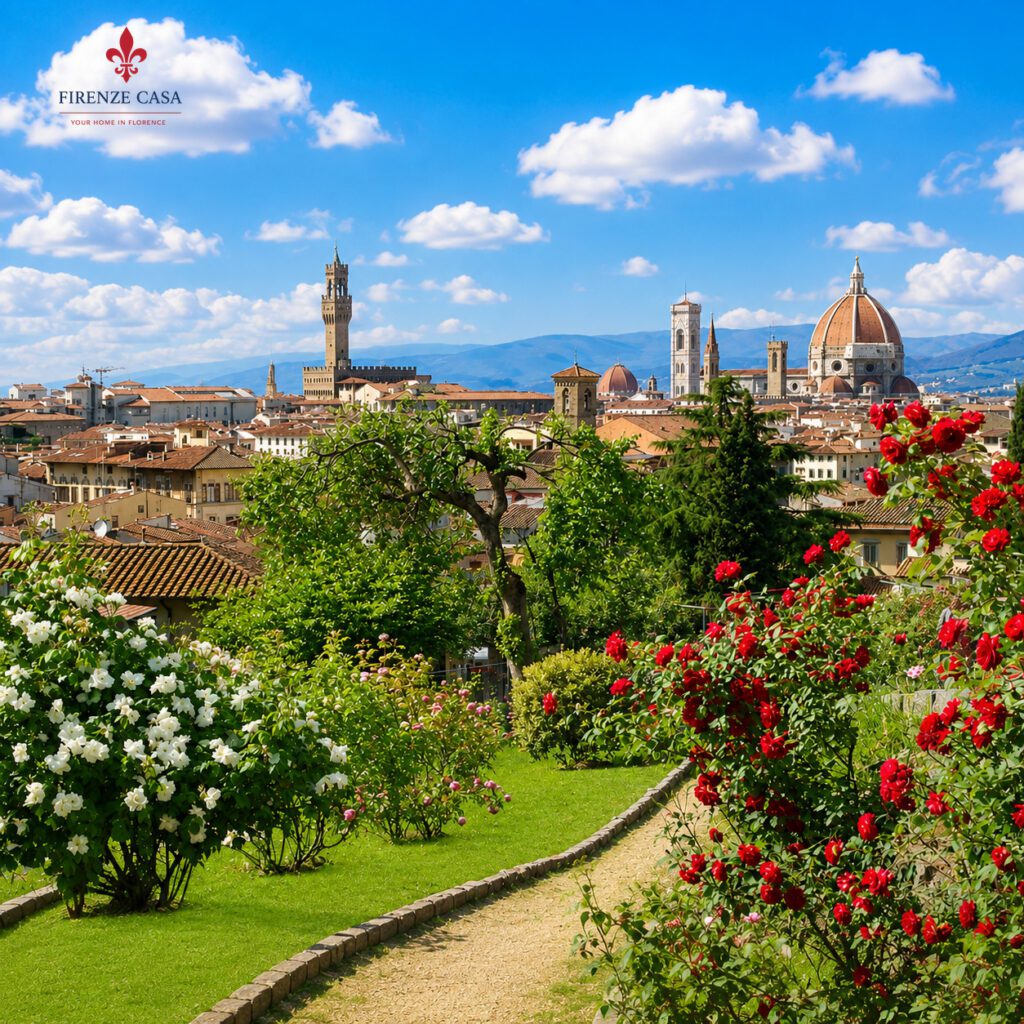
The Rose Garden Florence, known locally as the Giardino delle Rose, is one of the loveliest green spaces overlooking the historic centre. Located on the hillside directly below Piazzale Michelangelo, the garden combines hundreds of roses with sculptures, quiet paths and wonderful views across Florence.
Unlike the grand formal gardens attached to historic palaces, the Giardino delle Rose feels intimate and relaxed. It is one of the highlights in our Complete Guide to the most beautiful gardens in Florence and a particularly rewarding stop for visitors exploring the hills south of the Arno.
🌹 At a Glance
Location: Viale Giuseppe Poggi 2, below Piazzale Michelangelo
Admission: Free
Best known for: Roses, panoramic views, Folon sculptures and the Japanese garden
Best season: Spring, especially during the main rose flowering period
A Garden Above Florence
The Rose Garden occupies a terraced position on the slopes of the San Miniato hill. From its lawns and paths, Florence opens below you in an extraordinary panorama.
The dome of Santa Maria del Fiore dominates the skyline, while Palazzo Vecchio and the towers and rooftops of the historic centre stretch towards the surrounding Tuscan hills. The combination of flowers and city views makes this one of the most photogenic gardens in Florence.
Because the garden sits directly below Piazzale Michelangelo, many visitors pass close to it without realising what lies behind its gates. Yet a short detour offers a quieter way to enjoy essentially the same celebrated panorama.
📷 Firenze Casa Tip
Instead of leaving immediately after visiting Piazzale Michelangelo, walk down through the Rose Garden. The changing viewpoints along the hillside offer beautiful opportunities to photograph Florence away from the busiest part of the piazzale.
The Rose Garden and Giuseppe Poggi
The history of the garden is closely connected with the transformation of Florence during the nineteenth century. In 1865, Florence became the capital of the newly unified Kingdom of Italy, triggering major changes to the city and its surroundings.
Architect Giuseppe Poggi was entrusted with an ambitious programme of urban improvements. His plans included new boulevards around the historic centre, the Viale dei Colli and Piazzale Michelangelo, while the Giardino delle Rose formed part of the wider transformation of the hills south of the Arno.
Poggi designed the garden in 1865, taking advantage of its naturally sloping terrain and exceptional position above Florence. It later opened to the public in 1895, when horticultural and artistic events began to take place here during spring.
🏛 Did You Know?
The Rose Garden, Piazzale Michelangelo and the Viale dei Colli belong to the same remarkable nineteenth-century vision for Florence. Giuseppe Poggi transformed the hillside during the years of Firenze Capitale.
The Roses of the Giardino delle Rose
Roses remain the heart of the garden. Around a thousand rose plants representing hundreds of varieties grow across its terraces and slopes.
The collection includes both modern and historic varieties, giving the garden botanical as well as visual interest. During the main flowering season, the hillside becomes a mosaic of red, pink, white, yellow and delicate pastel colours.
Visitors who enjoy seasonal flowers can also combine the Rose Garden with the nearby Iris Garden. Together, the two gardens offer two very different but complementary spring experiences on the slopes around Piazzale Michelangelo.
When Is the Best Time to See the Roses?
For visitors interested primarily in the flowers, late April and May are generally the most rewarding period. Exact timing naturally depends on temperatures and weather conditions in each particular year.
Morning is especially pleasant. The light over Florence can be beautiful, temperatures are usually comfortable and the atmosphere tends to be quieter than later in the day.
🌹 Best Time to Visit
If roses are your priority, plan your visit for spring. If panoramic views are more important, the garden is worth visiting throughout the year. Clear winter days can offer exceptionally crisp views across Florence and the surrounding hills.
Jean-Michel Folon in the Rose Garden
One of the most distinctive features of the Rose Garden Florence has nothing to do with flowers. Sculptures by Belgian artist Jean-Michel Folon are distributed throughout the landscape.
Rather than occupying a conventional gallery, the works appear among lawns, paths and rose bushes, creating an unusual dialogue between contemporary art, nature and the Renaissance skyline beyond.
Among the best-known works is Partir, the large open suitcase through which visitors can look towards Florence. The city itself effectively becomes part of the sculpture. Other works include Je me souviens, with its contemplative figure seated on a bench, and Chat, Folon’s large cat resting among the greenery.
🎨 Look Through the Suitcase
Do not simply photograph Folon’s Partir from the outside. Look through the opening: the skyline of Florence becomes part of the artwork and creates one of the garden’s most memorable views.
A Little Piece of Japan in Florence
The garden contains another unexpected feature: a small Japanese garden known as the Shorai-teien.
Created in 1998, it was offered to Florence through the city’s relationship with Kyoto and the Kodai-ji Zen temple. Japanese architect Yasuo Kitayama selected the Giardino delle Rose for the project.
Water, stones, carefully arranged plants and architectural details introduce a very different garden tradition to the Florentine hillside. The peaceful Japanese section makes the Giardino delle Rose much more than simply a collection of flowers.
🌿 A Surprising Detail
Few first-time visitors expect to discover a Japanese garden beneath Piazzale Michelangelo. Its quiet atmosphere provides an unexpected contrast to the roses and panoramic terraces around it.
The View from the Rose Garden
The panorama alone would justify a visit. Because the garden descends along the hillside, the view changes continuously as you walk.
Brunelleschi’s dome remains the dominant landmark, but different paths also reveal Palazzo Vecchio, Santa Croce and the dense pattern of terracotta roofs that characterises central Florence.
The setting provides something Piazzale Michelangelo cannot offer in quite the same way: foreground. Roses, trees and sculptures frame the city, producing photographs that feel more intimate than the classic panorama from the square above.
A similarly close relationship between vegetation and skyline can be experienced at Bardini Garden, where terraces and the famous wisteria pergola frame some of Florence’s most beautiful views.
A Peaceful Alternative to Piazzale Michelangelo
Piazzale Michelangelo is understandably one of Florence’s most popular viewpoints, but at busy times the square can become extremely crowded.
The Rose Garden offers a very different atmosphere only a short distance away. Visitors can sit on the grass, wander among the flowers or simply find a quiet place to look across the city.
This contrast is part of the garden’s charm. One moment you are surrounded by crowds admiring Florence from the piazzale; a few minutes later, you can be walking between roses and sculptures on a peaceful hillside.
💡 Firenze Casa Tip
Combine the Rose Garden with Piazzale Michelangelo and San Miniato al Monte. In spring, adding the nearby Iris Garden creates an especially rewarding walk on the south side of the Arno.
How to Reach the Rose Garden
The main entrance is on Viale Giuseppe Poggi, immediately below Piazzale Michelangelo. Visitors approaching from the historic centre can walk uphill from the San Niccolò district or descend into the garden after visiting the piazzale.
The uphill route is beautiful but involves a noticeable climb. Another attractive option is to reach Piazzale Michelangelo first and then walk downhill through the garden towards the Arno, turning the visit into part of a scenic walk rather than a separate excursion.
Practical Information
📍 Giardino delle Rose
Address: Viale Giuseppe Poggi 2, Florence
Area: Below Piazzale Michelangelo
Admission: Free
Opening: Year-round, with seasonal closing times
Accessibility: Partially accessible; the hillside location includes slopes and changes in level
Opening hours vary during the year and may change. Visitors should therefore check current municipal information before planning their visit, especially outside the main tourist season.
What to Combine with the Rose Garden
Iris Garden
The Iris Garden lies nearby and is one of Florence’s most distinctive seasonal gardens. Its flowering period makes it an especially natural companion to the Rose Garden in spring.
Bardini Garden
The Bardini Garden offers another beautiful combination of flowers and panoramic views. Its Baroque staircase, woodland and wisteria pergola make it very different from the more informal Rose Garden.
Boboli Gardens
For a much grander landscape experience, visit the Boboli Gardens behind Palazzo Pitti. Boboli represents the monumental tradition of the Medici court, while the Rose Garden feels smaller, freer and more intimate.
Florence’s Other Historic Gardens
Visitors interested in exploring further can use our Complete Guide to the most beautiful gardens in Florence to compare formal gardens, romantic parks, seasonal flower gardens and quieter green spaces across the city.
Why the Rose Garden Is Worth Visiting
The Giardino delle Rose brings together several aspects of Florence that are usually experienced separately. It is simultaneously a botanical garden, a panoramic viewpoint, a small open-air sculpture collection and a reminder of the city’s nineteenth-century transformation.
Yet its greatest attraction may be its simplicity. There is no monumental entrance and no need to follow a fixed itinerary. Visitors can wander, sit on the grass, discover a sculpture or stop to watch the light change across the rooftops.
For travellers looking for a quieter side of Florence, the Rose Garden Florence is one of the easiest places to escape the intensity of the historic centre without actually leaving the city.
Frequently Asked Questions About the Rose Garden Florence
Is the Rose Garden in Florence free?
Yes. Admission to the Giardino delle Rose is free, making it an easy addition to a walk around Piazzale Michelangelo.
When is the best time to visit the Rose Garden?
Late April and May are usually the best months for the roses. The panoramic views, however, make the garden worthwhile throughout the year.
Where is the Rose Garden in Florence?
The garden lies on Viale Giuseppe Poggi, directly below Piazzale Michelangelo on the south side of the Arno.
How long do you need at the Rose Garden?
A relaxed visit usually takes around 30–60 minutes. Allow longer if you want to sit, photograph the views or explore the sculptures carefully.
Are there sculptures in the Rose Garden?
Yes. A group of works by Belgian artist Jean-Michel Folon is displayed throughout the garden, including the well-known sculpture Partir.
Is there a Japanese garden in the Giardino delle Rose?
Yes. The small Shorai-teien introduces a Japanese garden tradition to the hillside and reflects Florence’s cultural relationship with Kyoto.
Can you combine the Rose Garden with the Iris Garden?
Yes. The two gardens are close to each other and make an excellent spring itinerary, especially when both are in flower.
Is the Rose Garden a good alternative to Piazzale Michelangelo?
Yes. It offers similarly beautiful views of Florence in a greener and generally quieter setting directly below the famous piazzale.
Further Reading on Firenze Casa
- The Most Beautiful Gardens in Florence – Complete Guide
- Bardini Garden Florence – Wisteria & Panoramic Views
- The Iris Garden in Florence – Giardino dell’Iris
- Boboli Gardens – Florence’s Great Medici Garden
- Villa il Ventaglio Park – Romantic Garden in Florence
- Giardino Torrigiani – Florence’s Hidden Private Garden
- Parco delle Cascine Florence – The City’s Largest Park
- Mostra dei Fiori Florence – Historic Flower Show
References
- Comune di Firenze – Giardino delle Rose and municipal information on the Piazzale Michelangelo hillside
- FeelFlorence – Rose Garden (Giardino delle Rose)
- Comune di Firenze – Historical information on the Giardino delle Rose and Firenze Capitale
- Comune di Firenze – Giardino Giapponese and Florence–Kyoto cultural connections
- Comune di Firenze – Jean-Michel Folon sculptures in the Giardino delle Rose

