
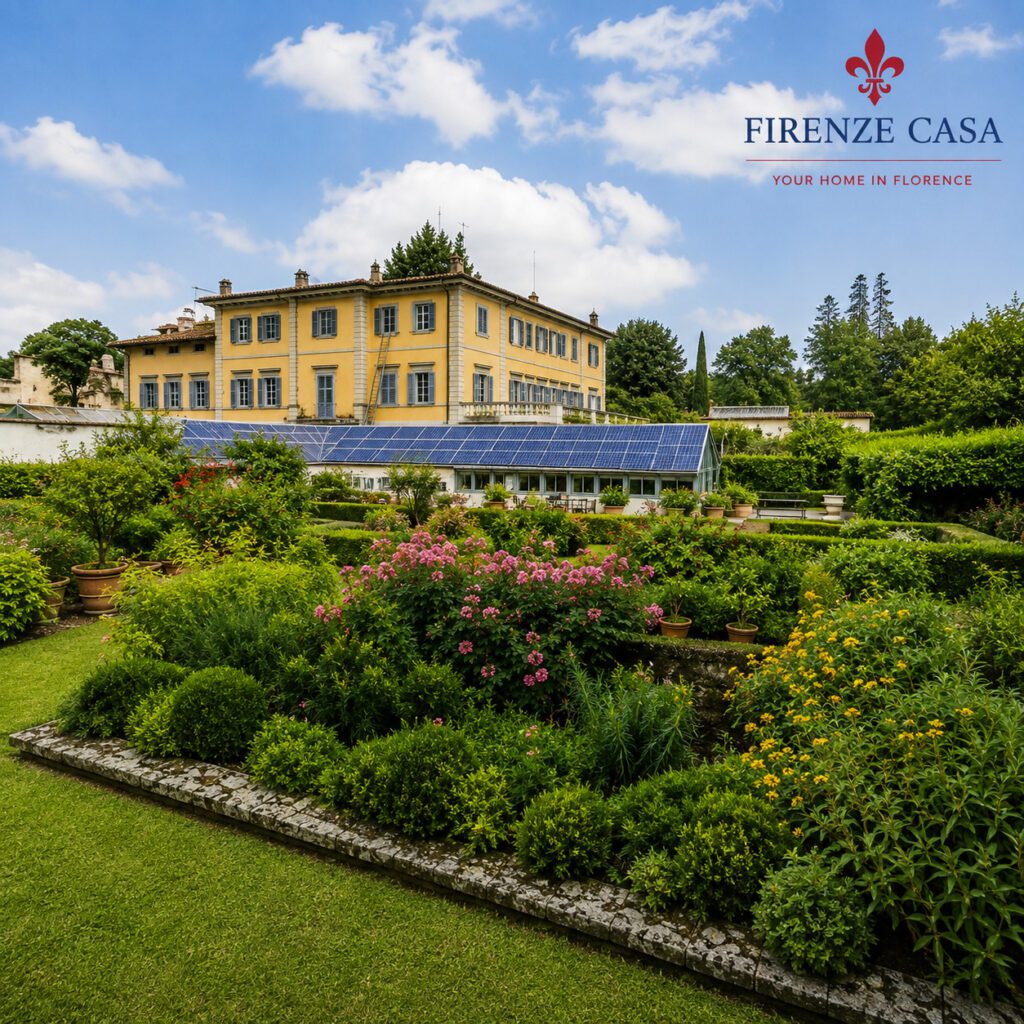
Hidden behind high walls in the Oltrarno, Giardino Torrigiani is one of Florence’s most remarkable private gardens. Almost seven hectares of historic landscape, monumental trees, mysterious symbols and Romantic architecture create a fascinating contrast to the city’s famous public gardens.
Unlike the nearby Boboli Gardens, Giardino Torrigiani Florence remains privately owned and does not function as a conventional public park. Therefore, visits require more planning. However, this seclusion is also part of its appeal. Among the places featured in our Complete Guide to the most beautiful gardens in Florence, Torrigiani offers perhaps the strongest sense of entering a hidden world.
🌿 At a Glance
Location: Oltrarno, Florence
Address: Via dei Serragli 144
Size: Almost 7 hectares
Style: 19th-century Romantic landscape garden
Highlights: Torrino, monumental trees, symbolic architecture and historic nursery
Access: Private garden; check current visiting arrangements in advance
A Secret Garden in the Heart of Florence
Florence is famous for its palaces, churches and museums. Yet some of its most intriguing places remain almost invisible from the street. Giardino Torrigiani is a perfect example.
High walls conceal an extensive landscape between Via dei Serragli and the area towards Porta Romana. From outside, however, little reveals the scale of the garden beyond them.
Today, Giardino Torrigiani covers almost seven hectares. After the Boboli Gardens, it ranks among the largest historic gardens within Florence’s old urban area. Moreover, it is one of the city’s most important surviving examples of a Romantic English-style landscape garden.
🌳 Did You Know?
Giardino Torrigiani is often described as one of the largest privately owned gardens within the historic walls of a European city. Its scale is particularly surprising because high walls hide almost the entire landscape from the surrounding streets.
From Botanical Garden to Romantic Landscape
The history of the site stretches back much further than its present appearance. Already in the 16th century, the garden had a reputation for its botanical character. This tradition remained important for centuries.
Its great transformation began in the early 19th century. Marquis Pietro Torrigiani enlarged the property by acquiring neighbouring land. He then decided to create an extensive Romantic landscape garden in the fashionable English style of the period.
In 1813, Torrigiani commissioned architect Luigi de Cambray Digny to develop the garden. His vision went far beyond planting trees and creating picturesque paths. Instead, he conceived the landscape as a journey through architecture, nature and symbolism.
This Romantic approach makes Torrigiani particularly interesting to compare with Villa il Ventaglio Park. This other 19th-century Florentine landscape combines winding paths, mature trees and carefully composed scenery. Consequently, both gardens illustrate the move away from the strict geometry of earlier Italian gardens.
A Garden Filled with Masonic Symbolism
One of the most unusual aspects of Giardino Torrigiani Florence is the symbolic language incorporated into its design.
Pietro Torrigiani and Luigi de Cambray Digny had associations with Freemasonry. As a result, the garden developed as a symbolic itinerary whose meaning was not always immediately obvious. For example, architectural structures and sculptures included a sphinx, references to Osiris and the small Temple of Arcadia.
Paths, monuments and changes in the landscape contributed to this carefully constructed journey. Therefore, the garden offered more than a beautiful place for walking. Its design also suggested ideas of knowledge, discovery and transformation.
🔎 Hidden Story
Masonic ideas influenced parts of the symbolic journey through Giardino Torrigiani. For example, the sphinx and references to Osiris transformed a simple stroll into a path of discovery.
The Torrino – The Garden’s Mysterious Tower
The most recognisable architectural feature of the garden is the Torrino. This distinctive neo-Gothic tower rises dramatically above the surrounding trees.
After Cambray Digny left the project, architect and engineer Gaetano Baccani continued the work. In 1819, he created the Torrino and several other architectural features. These included false battlements on a Medici bastion, a gymnasium and an aviary.
The tower was more than a decorative feature. Its form alludes to the Torrigiani family emblem, while its position made it an important element of the symbolic landscape. Moreover, the Torrino gives the garden an almost theatrical quality when it appears above the vegetation.
👀 Look Out For
The Torrino clearly reflects the early 19th-century fascination with picturesque medieval architecture. At the same time, it combines symbolism with carefully staged landscape design.
An Extraordinary Botanical Collection
The architectural features are only part of the story. Giardino Torrigiani also has an important botanical tradition.
An inventory published in 1819 recorded around 13,000 plants growing in the ground and another 5,500 in pots. These remarkable numbers demonstrate the scale of the collection at the time.
Today, the garden still contains an impressive variety of mature trees and plants from different parts of the world. These include cedars, giant sequoias, ginkgo, plane trees, cypresses and oaks. Some specimens have reached monumental proportions. As a result, shady woodland areas feel surprisingly distant from the surrounding city.
🌱 Botanical Detail
The garden’s importance extends beyond architecture and history. Its mature trees and unusual specimens preserve a centuries-old tradition of collecting and cultivating plants.
The Historic Nursery
The botanical tradition continues through the nursery within Giardino Torrigiani. Its greenhouses contain ornamental and flowering plants as well as Mediterranean and tropical species.
This living horticultural activity distinguishes Torrigiani from a landscape preserved purely as a historic monument. Indeed, gardeners still cultivate plants here today. The nursery therefore continues the property’s centuries-old connection with Florentine gardening.
Why Giardino Torrigiani Feels Different
Many of Florence’s famous gardens are closely connected with grand-ducal residences, monumental terraces or panoramic viewpoints. Giardino Torrigiani, however, has a very different atmosphere.
It feels more secluded, mysterious and informal. Architecture appears unexpectedly among trees and vegetation. Meanwhile, winding paths and changing scenery reflect the Romantic idea that a garden should reveal itself gradually.
In this respect, Torrigiani is almost the opposite of Boboli. It also differs from Bardini Garden, where formal terraces and spectacular views towards the historic centre dominate the experience. Torrigiani, by contrast, draws attention inward towards its trees, architecture and hidden symbolism.
🌿 Firenze Casa Tip
If you enjoy discovering places beyond Florence’s famous monuments, Giardino Torrigiani is particularly interesting. Its private character and hidden location make it one of the city’s most unusual historic gardens.
Giardino Torrigiani and Florence’s City Walls
The garden’s location close to Porta Romana connects it with another layer of Florentine history. Parts of the landscape developed beside the city’s historic defensive system. Moreover, Baccani incorporated a surviving Medici bastion into his Romantic architectural composition.
Porta Romana remains one of the most important surviving gateways into historic Florence. Therefore, the relationship between garden, walls and former fortifications adds another historical dimension to Torrigiani.
Giardino Torrigiani or Villa il Ventaglio?
Both Giardino Torrigiani and Villa il Ventaglio Park illustrate Florence’s embrace of Romantic landscape design during the 19th century. However, their characters are quite different.
Villa il Ventaglio is associated with Giuseppe Poggi and emphasises open lawns, mature trees and a small lake. In addition, a gradual climb through the landscape shapes the experience. Torrigiani, by contrast, feels more mysterious and architecturally symbolic. Its Torrino, hidden structures and botanical tradition give it a distinctive identity.
The most practical difference is access. Villa il Ventaglio functions as a public historic park, whereas Giardino Torrigiani remains private and requires advance planning.
Visiting Giardino Torrigiani
Giardino Torrigiani does not operate like a normal municipal park. Visitors cannot assume that they can simply walk through the gate during regular park hours.
Because the property remains private, check current visiting possibilities, prices and arrangements directly with the garden in advance. This is especially important if you plan your itinerary specifically around a visit.
The main address is Via dei Serragli 144, Florence, in the Oltrarno. Moreover, its location makes the garden easy to combine with Porta Romana and a walk through the quieter streets of this part of the city.
📍 Before You Go
Do not rely on ordinary park opening times. Giardino Torrigiani is private, so check current arrangements before making your way there.
Why Giardino Torrigiani Is Worth Visiting
Giardino Torrigiani offers something increasingly rare in Florence: the feeling of discovering an important historic place that remains largely hidden from everyday view.
Its scale alone is extraordinary. However, the combination of botanical history, Romantic landscape design, neo-Gothic architecture and mysterious symbolism makes it much more than simply a large private garden.
For travellers interested in Florence beyond its most famous monuments, Giardino Torrigiani Florence reveals another aspect of the city. Aristocratic families, horticulture, 19th-century ideas and a fascination with symbols all shaped this remarkable landscape.
Frequently Asked Questions About Giardino Torrigiani
Is Giardino Torrigiani open to the public?
Giardino Torrigiani is privately owned and does not operate like a conventional public park. Therefore, check current possibilities for visiting in advance.
Where is Giardino Torrigiani?
The garden is in the Oltrarno. Its main address is Via dei Serragli 144, close to Porta Romana.
How large is Giardino Torrigiani?
The historic garden covers almost seven hectares. Therefore, its scale is extraordinary for a private green space within Florence.
What is the Torrino?
The Torrino is the garden’s distinctive neo-Gothic tower. Gaetano Baccani created it in the early 19th century as part of the Romantic and symbolic landscape.
Why is there Masonic symbolism in Giardino Torrigiani?
Pietro Torrigiani and Luigi de Cambray Digny had associations with Freemasonry. Consequently, symbolic and enigmatic elements became part of the garden’s early 19th-century design.
Is Giardino Torrigiani similar to Boboli Gardens?
No. Boboli is a monumental Medici garden. Torrigiani, by contrast, is a private Romantic landscape with winding paths, mature vegetation and symbolic architecture.
Is Giardino Torrigiani similar to Villa il Ventaglio?
Both reflect 19th-century Romantic landscape design. However, Torrigiani is more architectural and symbolic, while Villa il Ventaglio emphasises lawns, trees and naturalistic scenery.
Further Reading on Firenze Casa
- The Most Beautiful Gardens in Florence – Complete Guide
- Villa il Ventaglio Park – Romantic Garden in Florence
- Boboli Gardens – Florence’s Great Medici Garden
- Bardini Garden Florence – Wisteria & Panoramic Views
- The Rose Garden in Florence – Giardino delle Rose
- The Iris Garden in Florence – Giardino dell’Iris
- Parco delle Cascine Florence – The City’s Largest Park
References
- Giardino Torrigiani – Official Website
- FeelFlorence – Comune di Firenze, Giardino Torrigiani
- Comune di Firenze – historical and cultural information on Florence and the Oltrarno

