
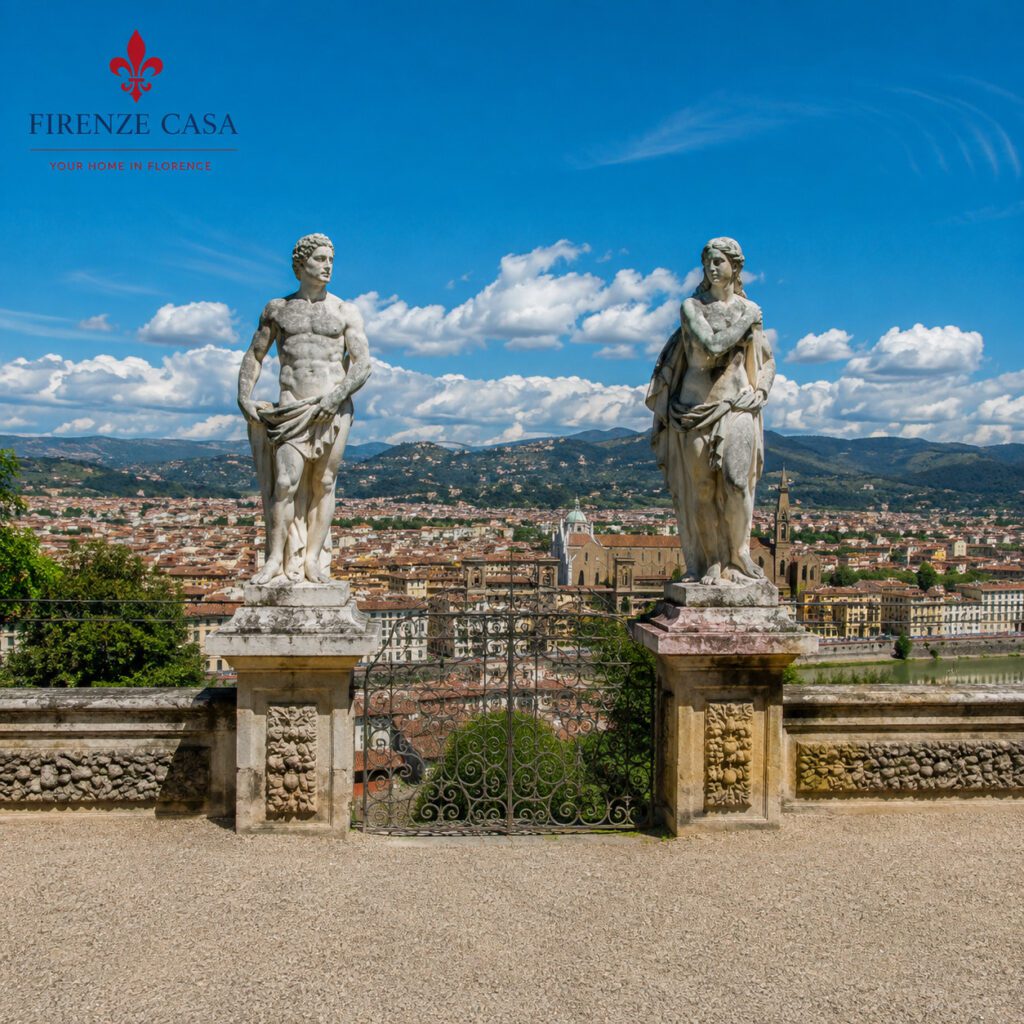
Bardini Garden Florence is one of the city’s most beautiful hillside gardens. Rising above the Arno in the Oltrarno, the historic garden combines a monumental Baroque staircase, wooded paths, terraces, seasonal flowers and spectacular views across Florence. Its most famous attraction is the wisteria pergola, which becomes a tunnel of purple, lilac and pink flowers in spring.
Smaller and more intimate than the Boboli Gardens, Giardino Bardini is one of Florence’s most rewarding green spaces. It is also an essential stop for anyone exploring the most beautiful gardens in Florence, from formal Medici landscapes to romantic parks and seasonal flower gardens.
🌿 At a Glance
Location: Oltrarno, south of the Arno
Address: Via de’ Bardi 1, Florence
Famous for: Wisteria pergola and panoramic views
Main features: Baroque staircase, terraces, woodland and historic agricultural landscape
Wisteria season: Usually April–May
Suggested visit: Around 1–1.5 hours
Why Visit Bardini Garden Florence?
Florence is famous for architecture, museums and Renaissance masterpieces, but some of its most memorable views come from its gardens. Bardini Garden offers an unusual combination of landscape, history and panorama within a relatively compact area.
The garden climbs steeply from the neighbourhood above the Arno towards Villa Bardini. As you gain height, the dome of Santa Maria del Fiore, Palazzo Vecchio and the rooftops of the historic centre gradually appear below you.
Unlike a completely formal garden, Giardino Bardini changes character as you walk through it. One section feels architectural and theatrical, another wooded and romantic, while other areas recall the land’s earlier agricultural use.
🌿 Firenze Casa Tip
Do not visit Bardini Garden only for the famous wisteria. The views across Florence are beautiful throughout much of the year, and the contrasting sections make the garden rewarding even outside the spring flowering season.
A Garden Made from Three Different Landscapes
One of the most interesting aspects of Bardini Garden Florence is that it was not conceived as a single unified garden. The landscape developed from different properties and uses that were eventually brought together.
Three main areas can still be recognised today. The most dramatic is the formal section centred on the great Baroque staircase. A second has the character of an English-style woodland garden, with winding paths and a more romantic atmosphere. The third preserves traces of the land’s agricultural past close to Florence’s historic walls.
This mixture gives Giardino Bardini much of its personality. Instead of following one strict design, visitors move through contrasting landscapes within a surprisingly small area.
The Baroque Staircase
The monumental Baroque staircase is one of the defining architectural features of Bardini Garden. It climbs dramatically up the hillside towards the Belvedere and creates a strong visual axis through the formal part of the garden.
From below, the staircase draws the eye upwards. From higher levels, the perspective reverses and Florence begins to dominate the view behind the garden. The combination of stairs, terraces, stone decoration and vegetation demonstrates an important principle of historic Italian garden design: landscape and architecture were intended to work together.
👀 Look Back as You Climb
It is tempting to concentrate on the staircase ahead, but turn around regularly. Some of the most beautiful views appear behind you as the rooftops and monuments of Florence gradually emerge below the garden.
The Famous Wisteria Pergola
For several weeks each spring, one feature transforms Bardini Garden into one of the most photographed places in Florence: the wisteria pergola.
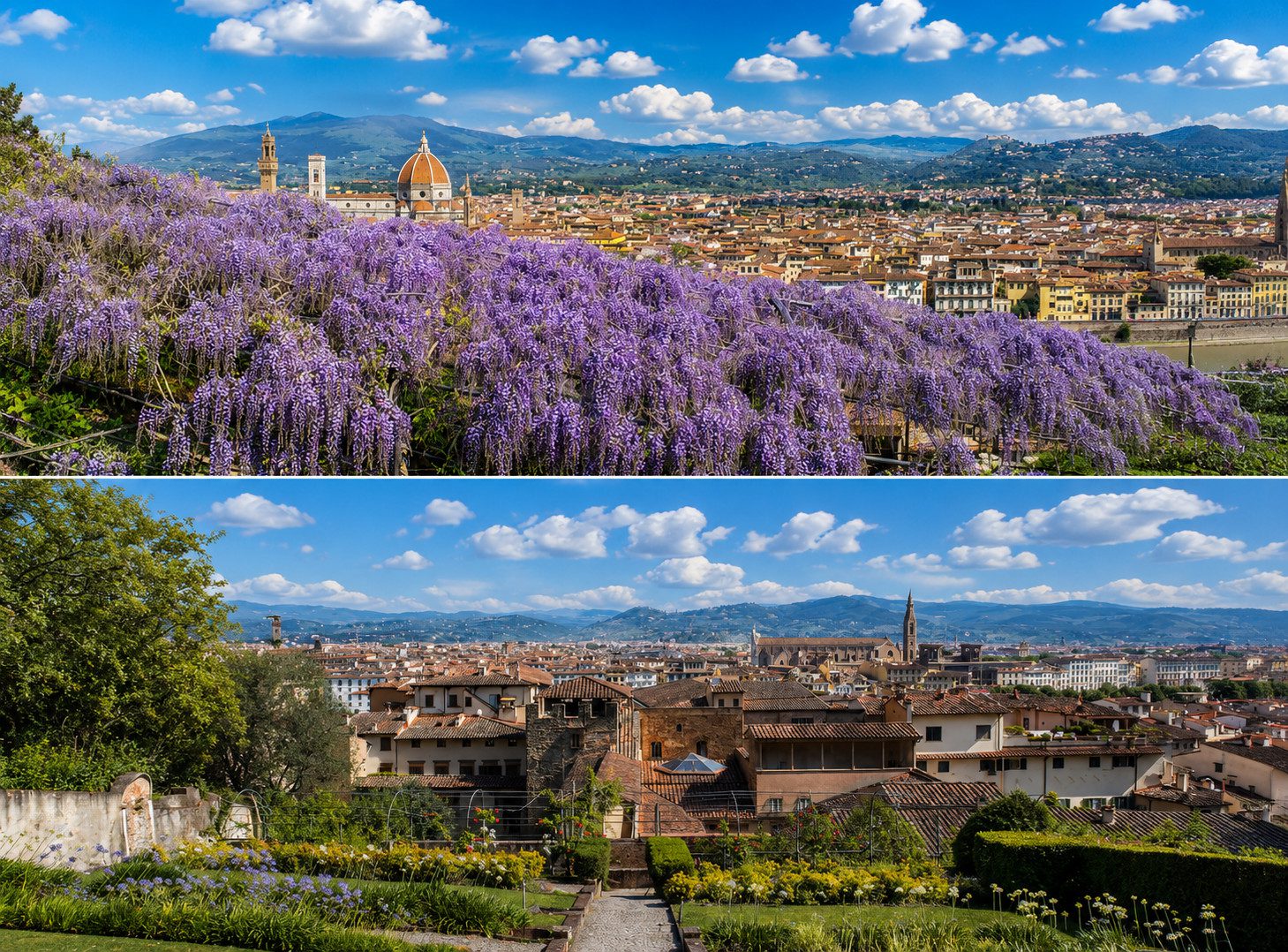
The pergola extends for approximately 70 metres and becomes a spectacular tunnel of hanging flowers during the main blooming period. Different varieties produce shades ranging from violet and deep purple to lilac and pink.
The experience is particularly striking because the flowers frame views towards Florence. Visitors walk beneath cascades of blossoms while glimpses of the city appear beyond them. Travellers interested in Florence’s seasonal flowers can also visit the Rose Garden below Piazzale Michelangelo and the nearby Iris Garden, which is especially beautiful during its short spring opening season.
💜 Did You Know?
The wisteria pergola is around 70 metres long and contains several varieties of wisteria. During peak flowering, the hanging blossoms create a natural tunnel in shades of purple, lilac, mauve and pink.
When Does the Wisteria Bloom?
The main flowering season usually falls between April and May, but exact timing varies from year to year. Warm spring weather can accelerate the bloom, while cooler periods may delay it, so visitors travelling specifically for the wisteria should check current conditions shortly before their visit.
The most spectacular phase is relatively short, which explains why the garden becomes especially popular at peak bloom. Yet missing the wisteria does not mean missing the garden: its panoramic views and historic landscape remain its enduring attractions.
One of the Best Views of Florence
The position of Bardini Garden on the hillside south of the Arno gives it one of its greatest attractions: an elevated view directly towards the historic centre. Brunelleschi’s dome rises above the rooftops, while Palazzo Vecchio and its tower provide another unmistakable landmark.
The view feels different from Piazzale Michelangelo. That famous terrace offers a broad panorama of Florence and the Arno valley, whereas Bardini creates a more intimate relationship between city and landscape. Branches, flowers, stone balustrades and terraces frame the skyline, making the panorama feel like part of the garden itself.
The Belvedere
The upper part of the garden rewards the climb with its panoramic Belvedere. From here, the historic centre spreads across the landscape below, revealing the dense pattern of streets, church towers and rooftops as well as the enormous scale of the cathedral dome.
Morning and late afternoon light can be particularly attractive, although conditions vary considerably with the season. Rather than searching for one perfect viewpoint, it is worth stopping at several levels as you move through the garden.
📷 Firenze Casa Tip
Allow time for photographs from several levels. The relationship between garden and skyline changes continuously as you move up or down the hillside.
The English-Style Woodland
A very different atmosphere awaits in the wooded section of Bardini Garden. Here the strict architectural lines give way to winding paths, shade and a more informal landscape influenced by the English landscape garden.
Rather than imposing complete symmetry on nature, this approach favoured picturesque scenes and changing perspectives. The contrast with the Baroque staircase is particularly effective: within a short walk, visitors move from formal architecture into an environment that feels quieter and more spontaneous.
This romantic approach to landscape can also be experienced at Villa il Ventaglio Park, another Florentine garden where winding paths and naturalistic scenery contrast with the city’s more formal historic gardens.
The Agricultural Side of the Garden
Not every part of the hillside was originally intended purely for pleasure. Sections of the property had practical agricultural uses, reflecting a long Florentine tradition in which villas, gardens and productive land existed side by side.
Fruit trees and cultivated areas once formed part of this landscape, helping to explain why the garden does not feel uniformly formal. This combination of ornamental and productive land also connects Bardini with the broader Tuscan landscape surrounding Florence.
From Historic Properties to Giardino Bardini
The landscape visitors see today developed over centuries. Different properties occupied the hillside before the area was eventually brought together and transformed.
In the early twentieth century, the complex came into the hands of Stefano Bardini, the celebrated Florentine antiquarian and art dealer. Bardini reshaped parts of the property and enriched the garden with decorative elements reflecting his distinctive taste.
His involvement explains the name by which the garden is known today, although its history extends well beyond Bardini himself and preserves traces of several earlier phases.
🏛️ Context
Stefano Bardini is also associated with the nearby Museo Bardini. The museum focuses on his world of collecting and the international art market, while the garden reveals another aspect of his interest in historic objects, architecture and carefully composed surroundings.
Villa Bardini
At the top of the garden stands Villa Bardini, occupying one of the most panoramic positions on the hillside. The villa provides an architectural destination above the terraces and regularly hosts exhibitions and cultural events.
The building and garden work particularly well together visually. The villa crowns the hillside, while the garden creates a gradual transition from the streets near the Arno to the panoramic landscape above.
Bardini Garden or Boboli Gardens?
The two gardens are often compared, but they offer very different experiences. The Boboli Gardens are monumental: created behind Palazzo Pitti for the Medici court, they cover a much larger area and represent one of the great historic examples of Italian garden design.
Bardini Garden is smaller, steeper and more intimate. Its greatest strengths are the changing hillside landscape, spring flowers and close panoramic relationship with Florence. If you have time, there is little reason to choose between them: the two gardens complement each other extremely well.
Boboli demonstrates the scale and ambition of a grand-ducal garden, while Bardini offers a more concentrated landscape experience. Together they provide one of the best introductions to the variety of historic garden design in Florence.
Is Bardini Garden Worth Visiting Outside Wisteria Season?
Absolutely. The wisteria has become the garden’s most famous seasonal attraction, but reducing Giardino Bardini to a spring photo opportunity would overlook much of what makes it special.
The Baroque staircase, woodland, terraces and views remain interesting throughout the visiting season. Outside peak flowering, the atmosphere may also be calmer, allowing visitors to concentrate more easily on the landscape and viewpoints.
Spring and Summer at Bardini Garden
Spring is the most celebrated season. Wisteria provides the headline attraction, while fresh foliage and other flowering plants add colour throughout the garden. Mild temperatures also make the hillside climb particularly pleasant, although peak wisteria season can be busy.
Spring is also an excellent time to explore Florence’s wider garden culture. The Rose Garden and Iris Garden offer very different floral displays, while the historic Mostra dei Fiori reflects the city’s long enthusiasm for flowers and horticulture.
Summer changes the character of Bardini. Vegetation becomes fuller, the wooded areas provide valuable shade and the elevated position offers attractive views across the sunlit city. During the hottest months, a morning visit is usually more comfortable.
A Garden That Climbs
Visitors should be prepared for an important practical detail: Bardini Garden is built on a hillside. That topography creates its magnificent views, but it also means stairs, slopes, gravel and uneven surfaces.
Visitors with limited mobility should check current accessibility information before arriving, as some areas are easier to reach than others and the historic terrain limits completely step-free access.
👟 Practical Info
Bardini Garden is not a flat city park. Comfortable shoes are strongly recommended, especially if you plan to combine the garden with a longer walk through the Oltrarno.
Where Is Bardini Garden?
Giardino Bardini lies in the Oltrarno on the hillside south of the Arno, close to San Niccolò, Ponte alle Grazie and the Boboli Gardens. One of its entrances is at Via de’ Bardi 1, 50125 Florence.
Its central position makes the garden easy to combine with a walk from Piazza della Signoria, the Uffizi or Santa Croce. Within a relatively short distance, visitors leave the dense streets near the river and find themselves surrounded by greenery above the city.
How Long Do You Need?
Allow around one to one and a half hours for a relaxed visit to Bardini Garden itself. Photography enthusiasts or visitors arriving during wisteria season may want longer.
The garden combines naturally with Villa Bardini, Museo Bardini, San Niccolò or the Boboli Gardens. If you plan to visit both Bardini and Boboli, reserving a substantial part of the day is more comfortable than rushing through them.
What to Combine with Bardini Garden
Boboli Gardens
Combining Bardini with the Boboli Gardens provides an excellent introduction to two very different traditions of Florentine garden design. Boboli is grand and formal, while Bardini feels smaller, steeper and more intimate.
Rose Garden and Iris Garden
The Rose Garden and Iris Garden lie near Piazzale Michelangelo and are particularly attractive in spring. Together with Bardini, they can form a beautiful flower-and-panorama itinerary on the hills south of the Arno.
San Niccolò and Piazzale Michelangelo
The nearby San Niccolò area makes a natural continuation after the garden. Visitors who enjoy walking can continue uphill towards Piazzale Michelangelo and compare its famous panorama with Bardini’s more intimate views.
Highlights of Bardini Garden Florence
- Wisteria pergola – the spectacular flowering tunnel that has become the garden’s most famous attraction.
- Baroque staircase – the monumental architectural centrepiece of the formal garden.
- Belvedere – one of the garden’s finest panoramic viewpoints.
- Florence skyline – beautiful views towards the Duomo, Palazzo Vecchio and the historic centre.
- English-style woodland – a shaded and romantic contrast to the formal terraces.
- Historic agricultural landscape – traces of the hillside’s productive past.
- Villa Bardini – the panoramic villa overlooking the garden.
Why Bardini Garden Is Worth Visiting
Bardini Garden Florence reveals a different side of the city. Instead of entering another museum or Renaissance palace, visitors climb through greenery while Florence gradually unfolds below them.
The famous wisteria pergola makes spring especially spectacular, but the garden offers much more than one seasonal attraction. Its Baroque staircase, woodland, terraces and traces of an older agricultural landscape create a remarkably varied experience within a compact area.
Above all, Giardino Bardini succeeds because Florence is always present. The city appears between branches, above walls and beyond terraces until garden and skyline seem to become part of the same composition.
Frequently Asked Questions About Bardini Garden Florence
Is Bardini Garden worth visiting?
Yes. It combines historic garden design, seasonal flowers and some of the finest views across Florence in a relatively compact setting.
What is Bardini Garden famous for?
It is best known for its long wisteria pergola, monumental Baroque staircase and panoramic views of the Florence skyline.
When does the wisteria bloom at Bardini Garden?
The main flowering period usually occurs between April and May. Exact timing varies according to spring weather and temperatures.
Can you visit Bardini Garden outside wisteria season?
Yes. The terraces, architecture, woodland and panoramic views make the garden worthwhile throughout its visiting season.
Is Bardini Garden the same as Villa Bardini?
No. Villa Bardini is the historic building at the top of the property, while Giardino Bardini is the surrounding hillside garden.
How long should I spend at Bardini Garden?
Most visitors should allow around one to one and a half hours. Allow longer during wisteria season or if you enjoy photography.
Is Bardini Garden steep?
Yes. The garden occupies a hillside and includes slopes, stairs and uneven surfaces. The elevation is also what creates its exceptional views.
Can you visit Bardini Garden and Boboli Gardens on the same day?
Yes. The two gardens complement each other particularly well and can form an excellent garden-focused itinerary in the Oltrarno.
Further Reading on Firenze Casa
- The Most Beautiful Gardens in Florence – Complete Guide
- Boboli Gardens – Florence’s Great Medici Garden
- The Rose Garden in Florence – Giardino delle Rose
- The Iris Garden in Florence – Giardino dell’Iris
- Villa il Ventaglio Park – Romantic Garden in Florence
- Giardino Torrigiani – Florence’s Hidden Private Garden
- Parco delle Cascine Florence – The City’s Largest Park
- Mostra dei Fiori Florence – Historic Flower Show
References
- Fondazione Parchi Monumentali Bardini e Peyron – Giardino Bardini
- Comune di Firenze / FeelFlorence – Giardino Bardini
- Villa Bardini – Historical and visitor information
- Comune di Firenze – Historic Gardens of Florence
- Gallerie degli Uffizi – Boboli Gardens and historic garden context

