
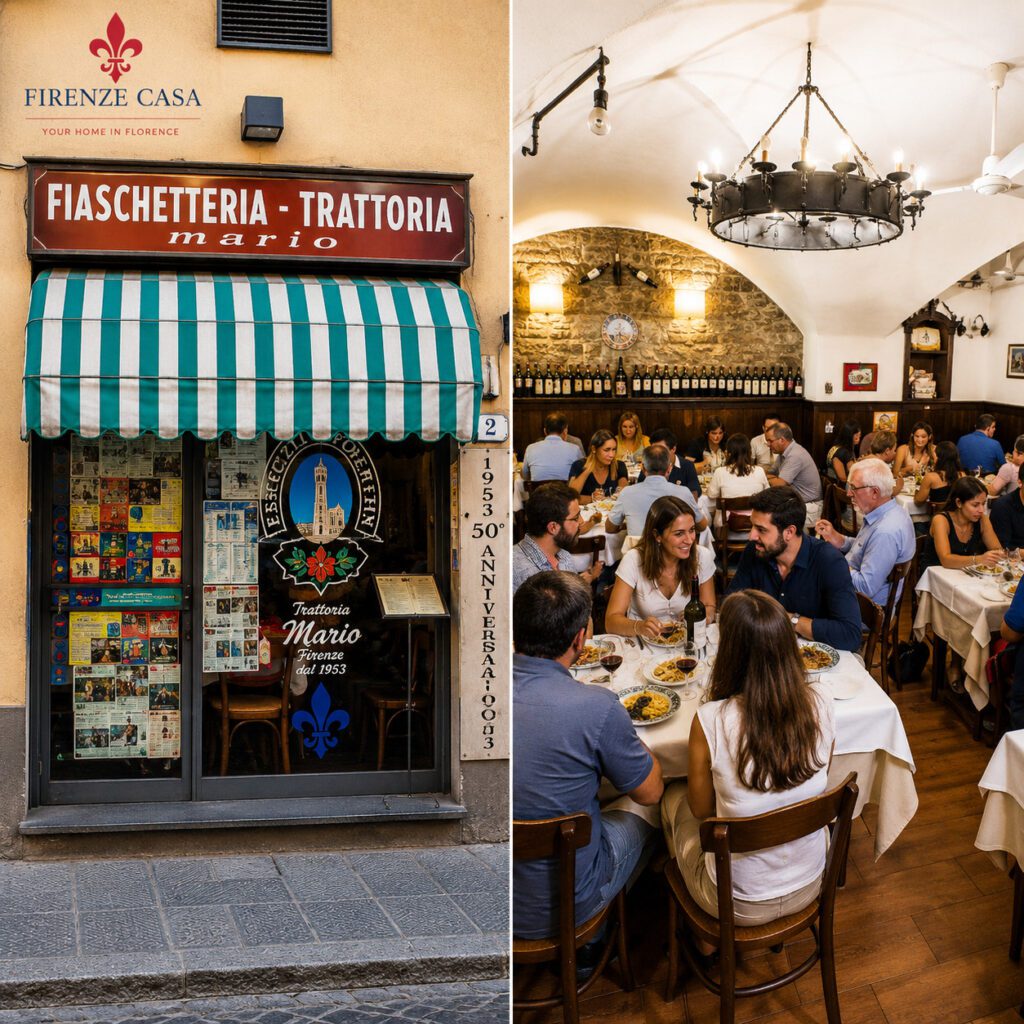
Trattoria Mario Florence is one of the city’s classic market trattorias. Hidden in Via Rosina beside the Mercato Centrale, this small family-run restaurant began in 1953 as a simple wine shop serving people who worked around the market.
Today, Mario is famous far beyond San Lorenzo, but several elements of its original character remain central to the experience: traditional Florentine food, a changing daily menu, close seating and the possibility of sharing a table with people you have never met.
For the wider story of Florence’s traditional dining culture, see our Historic Restaurants of Florence – Complete Guide.
Founded: 1953
Address: Via Rosina 2r
Neighbourhood: San Lorenzo
Nearby landmark: Mercato Centrale
Origins: Mescita di vini serving market workers
Cuisine: Traditional Florentine and Tuscan
Known for: Shared tables and changing daily dishes
Character: Small, informal and lively
From a Wine Shop to a Florentine Trattoria
The story of Trattoria Mario began on 1 March 1953, when Romeo, Amelia and their son Mario opened a small business on Via Rosina in the San Lorenzo district.
It was not initially the trattoria visitors know today. The premises operated primarily as a mescita di vini – a simple place where customers could stop for a glass of wine.
Its earliest clientele came naturally from the neighbouring Mercato Centrale. Porters, butchers, vegetable sellers and other market workers stopped here during or after their working day.
In 1957, the business developed into a trattoria serving hot meals. Straightforward Florentine cooking gradually became as important as the wine.
Mario began as a wine shop rather than a restaurant. Its transformation into a trattoria grew directly from the everyday life of the Mercato Centrale.
A Restaurant Shaped by the Mercato Centrale
The location of Trattoria Mario Florence is fundamental to its identity. The Mercato Centrale stands only steps away, and the relationship between restaurant and market has shaped Mario since its beginning.
Fresh ingredients from trusted market vendors naturally influenced what could be prepared in the kitchen. This also helps explain the tradition of a changing menu rather than an enormous permanent selection.
For visitors, the connection is still easy to experience. Walk through the market first, look at the vegetables, meat, cheese and other ingredients, and then continue around the corner for lunch.
Visit the Mercato Centrale before eating at Mario. Seeing the ingredients and market activity first provides useful context for the traditional dishes served nearby.
Shared Tables – Part of the Mario Experience
Perhaps nothing characterises Mario more clearly than its communal seating. Space is limited, and diners have traditionally shared tables instead of expecting a private table for every group.
For first-time visitors, this can initially feel unusual. But the practical arrangement often encourages conversation between people who would otherwise never meet.
Students, Florentines and international visitors may find themselves eating side by side. The result reflects an older idea of the trattoria as part of social and neighbourhood life rather than a completely private dining experience.
Do not be surprised if you are seated beside strangers. Shared tables are not an inconvenience to be apologised for at Mario – they are part of the restaurant’s traditional character.
The Sixteenth-Century Ceiling Above the Dining Room
One of Mario’s most interesting historical details is easy to overlook when the room is busy. Look upwards.
The wooden coffered ceiling is documented as dating from the middle of the sixteenth century. According to Florence’s historic-business records, it once belonged to stables associated with the building now known as Palazzo Alessandri.
The trattoria itself is therefore a twentieth-century institution occupying a setting that preserves a much older architectural fragment.
The restaurant opened in 1953, but the wooden ceiling above the dining room is roughly four centuries older.
Traditional Florentine Daily Cooking
The food at Mario belongs to the practical traditions of Florentine and Tuscan home cooking. Soups, pasta, beans, vegetables, stewed dishes and meat form the basis of a cuisine that values flavour and familiarity over elaborate presentation.
The menu changes regularly, and not every dish is available every day. That is part of the traditional trattoria philosophy rather than a limitation.
Instead of expecting a long catalogue of famous Tuscan specialities, it makes more sense to see what the kitchen has prepared that day.
For the broader culinary context, see our Florentine and Tuscan Food – Complete Guide.
Ribollita, Ragù and Other Tuscan Classics
Ribollita is one of the dishes most naturally associated with this style of cooking. Bread, beans and vegetables are transformed into a substantial soup, with cavolo nero playing an important role when in season.
The dish is closely connected with the resourceful Tuscan tradition explored in our guide to Cucina Povera.
Mario’s slowly cooked meat ragù is another characteristic preparation. Depending on the day and season, other dishes can include trippa alla fiorentina, peposo, ossobuco, baccalà, roast meats and beans.
Do not arrive with a rigid plan. Look at the day’s dishes first. A soup, ragù or stew may tell you more about traditional Florentine cooking than automatically ordering the most famous item on the menu.
Bistecca alla Fiorentina
Bistecca alla fiorentina is also closely associated with Mario.
The traditional steak is exceptionally thick and cooked over intense heat so that the exterior develops a crust while the interior remains distinctly rare. It is generally ordered by weight and shared.
The cooking level is an important part of the tradition. Visitors who prefer beef thoroughly cooked may enjoy another Florentine speciality more than bistecca.
A traditional Fiorentina is served very rare and normally shared. Check the weight and price before ordering, and choose another dish if you strongly prefer well-done beef.
Why the Menu Changes
A changing menu reflects the practical rhythm of a traditional kitchen. Rather than preparing an enormous selection every day, the cooks concentrate on a more limited number of dishes.
Seasonal ingredients, market availability and preparations traditionally associated with particular days can all influence what appears on the menu.
This approach connects Mario naturally with the food culture of the neighbouring market and with an older style of restaurant cooking based on what is available rather than what must always be offered.
Students, Politics and Mario in 1968
By the 1960s, Mario’s clientele was changing. Market workers were increasingly joined by students as Florence attracted young people from Italy and abroad.
The political and social upheavals of 1968 added another chapter. According to the restaurant’s historical account, students gathered here to discuss politics and culture over food and wine.
This does not turn Mario into a political institution, but it illustrates how an ordinary trattoria could become part of the social life of its neighbourhood and generation.
During the turbulent year of 1968, some of the debates transforming Italian society continued around Mario’s tables – accompanied by traditional food and red wine.
A Family Story Across Generations
Family continuity has been central to Trattoria Mario since Romeo, Amelia and Mario opened the business in 1953.
Later generations continued working in the restaurant, preserving a connection between family, kitchen and dining room rather than turning Mario into a recreation of a historic trattoria.
That distinction matters. The restaurant’s character was not designed retrospectively to look traditional; it developed gradually through decades of everyday use.
San Lorenzo Beyond the Medici
The San Lorenzo district is famous for the Basilica of San Lorenzo, the Medici Chapels and other monuments connected with one of Florence’s most powerful families.
But San Lorenzo also developed around commerce, markets, workshops and everyday urban life. The Mercato Centrale remains one of the clearest expressions of that history.
Mario belongs to this other side of San Lorenzo. Its protagonists are not princes or Renaissance artists but market workers, cooks, students, families and people stopping for lunch.
The monuments tell only part of San Lorenzo’s story. Its markets, shops and eating places reveal the neighbourhood as somewhere people worked and lived as well as somewhere the Medici built churches and palaces.
From Market Workers to International Visitors
Mario’s reputation eventually spread far beyond Florence. The earliest customers worked around the neighbouring market; today, visitors from around the world seek out the same small dining room.
That popularity inevitably changes the experience. It would be misleading to describe Mario today as an undiscovered local secret.
What remains interesting is that several defining features have survived despite its fame: communal seating, traditional dishes, a changing menu and the close physical relationship with the Mercato Centrale.
Seventy Years in San Lorenzo
In 2023, Trattoria Mario celebrated its seventieth anniversary.
The milestone was recognised locally and underlined the restaurant’s long association with San Lorenzo and its historic market community.
Seven decades after the family first served wine to people working nearby, the Mercato Centrale remained central to Mario’s identity.
What to Expect at Trattoria Mario
Mario is small, informal and often lively. Tables are close together, communal seating may be part of the experience, and the atmosphere is very different from quiet fine dining.
This is important to understand before visiting. The restaurant works best for people who enjoy activity and informality rather than privacy and elaborate service.
Its international reputation also means that you should not arrive expecting a restaurant untouched by tourism. Come instead for its distinctive combination of market history, traditional food and communal atmosphere.
Mario is best enjoyed on its own terms: choose from the day’s dishes, accept the close seating and enjoy the lively atmosphere rather than expecting a conventional restaurant experience.
Planning a Visit to Trattoria Mario
Trattoria Mario is located at Via Rosina 2r, immediately beside the Mercato Centrale in San Lorenzo.
The location makes it particularly easy to combine lunch with the market, Basilica of San Lorenzo, Medici Chapels and the surrounding historic streets.
Opening days, service hours and reservation arrangements can change. Check current information before planning your visit.
Frequently Asked Questions About Trattoria Mario
When was Trattoria Mario founded?
Trattoria Mario traces its history to 1 March 1953, when Romeo, Amelia and their son Mario opened the business in Via Rosina.
Was Mario always a restaurant?
No. It began primarily as a mescita di vini serving people working around the Mercato Centrale. It developed into a trattoria serving hot food in 1957.
Why is Trattoria Mario famous?
Mario is known for traditional Florentine cooking, its relationship with the Mercato Centrale, changing daily dishes and communal tables.
Do diners really share tables?
Communal seating has traditionally been part of the restaurant’s character, so diners may be seated alongside people they do not know.
What should I eat at Trattoria Mario?
Look first at the dishes available that day. Traditional choices can include ribollita, ragù, trippa alla fiorentina, peposo and bistecca alla fiorentina.
Is the ceiling really from the sixteenth century?
Florence’s historic-business records document the wooden coffered ceiling as dating from the mid-sixteenth century and associate it with former stables in the building now known as Palazzo Alessandri.
Is Trattoria Mario a tourist restaurant?
Mario is now internationally famous and attracts many visitors. Its historical identity, however, developed from the neighbouring market community rather than from tourism.
Where is Trattoria Mario?
The trattoria is at Via Rosina 2r in San Lorenzo, immediately beside Florence’s Mercato Centrale.
Why Trattoria Mario Is Worth Visiting
Trattoria Mario is worth visiting because its history is inseparable from the everyday life of San Lorenzo and the Mercato Centrale. It began as a wine shop for people working around the market and gradually developed into a family trattoria serving straightforward Florentine food.
The sixteenth-century ceiling adds an unexpected architectural layer, while the shared tables, changing menu and stories of students gathering here in the 1960s reveal how the restaurant became part of the neighbourhood’s social history.
Mario is no longer a secret known only to Florentines, and there is no reason to pretend otherwise. What makes it interesting is that beneath its international reputation, the original relationship between market, kitchen, family and communal dining remains clearly visible.
Further Reading on Firenze Casa
- Historic Restaurants of Florence – Complete Guide
- Mercato Centrale Florence
- Florentine and Tuscan Food – Complete Guide
- Cucina Povera Explained: The Philosophy Behind Tuscan Cooking
- Bistecca alla Fiorentina: A Complete Guide
- Trattoria Sabatino – Traditional Florentine Trattoria in San Frediano
- Antico Fattore – Florence’s Historic Artists’ Trattoria
References
- Trattoria Mario – Official history and restaurant information.
- Comune di Firenze / Destination Florence – Trattoria Mario, Attività Storiche Fiorentine.
- Comune di Firenze – Historical information on Trattoria Mario and San Lorenzo.
- Associazione Esercizi Storici, Tradizionali e Tipici Fiorentini – Trattoria Mario.
- Touring Club Italiano – Florence restaurant and neighbourhood information.

