
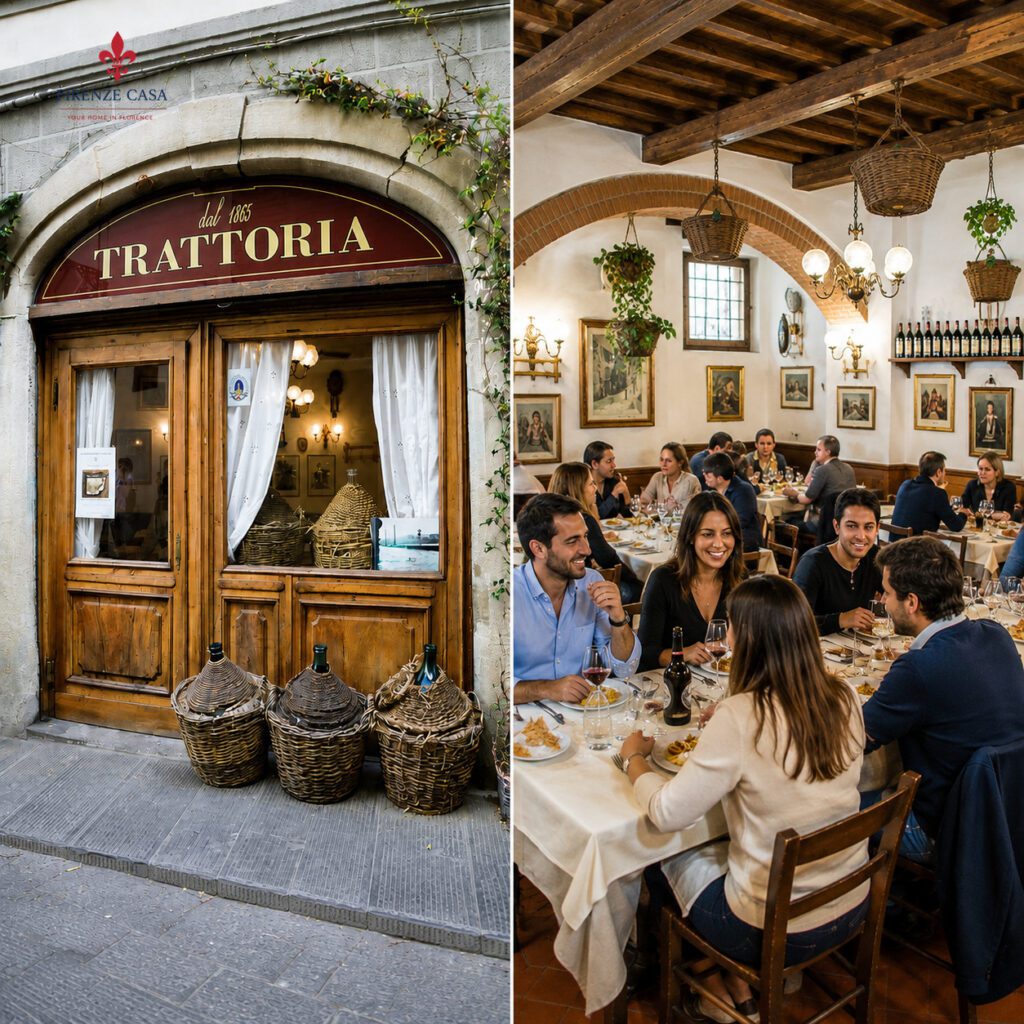
Antico Fattore Florence combines traditional Tuscan food with an extraordinary chapter of the city’s twentieth-century cultural history. Located on Via Lambertesca between the Uffizi Gallery and Ponte Vecchio, the trattoria became a regular meeting place for painters, sculptors, writers and musicians.
Its famous Wednesday gatherings eventually produced the Premio Letterario Antico Fattore. Among the writers recognised during its early years were Eugenio Montale and Salvatore Quasimodo – both future Nobel laureates.
This makes Antico Fattore much more than another old Florentine restaurant. Its history shows that Florence’s cultural life continued long after the Renaissance, sometimes developing not in academies or museums but around a table over food and wine.
Historic tradition: Since 1865
Trattoria associated with Giulio Vannucci: From 1908
Location: Via Lambertesca 1/3r
Area: Between the Uffizi and Ponte Vecchio
Known for: Artists’ gatherings and traditional Tuscan cuisine
Cultural landmark: Premio Letterario Antico Fattore
First literary prize: 1931
Famous names: Montale, Quasimodo, de Chirico, Morandi and Carrà
From 1865 to a Florentine Artists’ Trattoria
Antico Fattore traces its tradition to 1865, the year Florence became capital of the newly unified Kingdom of Italy. The historic Florentine register records the trattoria associated with Giulio Vannucci from 1908.
Its location on Via Lambertesca placed it close to Piazza della Signoria and the commercial life of central Florence. In its early years, the trattoria served traditional food to people connected with the surrounding markets and businesses.
The name Antico Fattore recalls this practical world. A fattore traditionally referred to a farm manager or estate steward.
During the following decades, however, the restaurant acquired another identity. By the late 1920s, artists, writers and musicians were gathering here regularly.
Antico Fattore did not begin as an elegant literary salon. Its cultural importance developed gradually when artists and intellectuals adopted an ordinary Florentine trattoria as one of their meeting places.
The Famous Wednesday Gatherings
Wednesday became a special evening at Antico Fattore. Painters, sculptors, writers and musicians gathered around the tables to eat, drink and discuss their work.
Names associated with this circle include Giorgio de Chirico, Giorgio Morandi, Carlo Carrà, Felice Carena, Libero Andreotti, Bruno Innocenti and Alberto Magnelli. Some lived in Florence, while others passed through the city for exhibitions and cultural events.
The setting was important precisely because it was informal. Antico Fattore became a cultural cenacolo without ceasing to be a restaurant.
Ideas moved between different artistic disciplines while dinner continued around them. This combination of ordinary restaurant life and serious cultural exchange gives the story much of its charm.
Some of twentieth-century Italy’s important artists met not in an academy or gallery but around a restaurant table. Food, wine and conversation turned Antico Fattore into an informal Florentine cultural salon.
How a Literary Prize Was Born over Dinner
The Wednesday gatherings eventually produced a wonderfully unconventional idea. Painters and sculptors were accustomed to having critics judge their work. Why should they not reverse the roles and become critics themselves?
The idea is closely associated with sculptor Libero Andreotti and the circle surrounding Giulio Vannucci. Visual artists would form the jury, while writers and poets submitted their work.
The result was the Premio Letterario Antico Fattore, first awarded in 1931.
Painters and sculptors who were accustomed to being judged decided to become judges themselves. A restaurant gathering was transformed into a literary competition.
Montale and Quasimodo – Two Future Nobel Laureates
The first years of the prize produced an extraordinary result. In 1931, Eugenio Montale received recognition for La casa dei doganieri. He would later receive the Nobel Prize in Literature in 1975.
The following year, Salvatore Quasimodo was recognised for Odore di Eucalyptus. Quasimodo received the Nobel Prize in Literature in 1959.
Within its first two years, the artistic circle surrounding a Florentine trattoria had therefore recognised two poets who would later receive the world’s most prestigious literary award.
This is one of the details that distinguishes Antico Fattore from restaurants whose history rests primarily on age or famous visitors. Here, cultural work was not merely consumed or discussed – it was actively encouraged and judged.
Montale and Quasimodo received recognition from the Antico Fattore circle decades before their Nobel Prizes. The little trattoria competition demonstrated remarkably good literary judgement.
When a Piano Arrived at Antico Fattore
The cultural experiments did not stop with poetry. Composer Mario Castelnuovo-Tedesco proposed a competition for music.
This created a practical problem: some of the artists on the jury could judge poetry by listening to it, but they could not adequately evaluate written musical scores.
The solution was characteristically direct. A piano was brought into the trattoria so that Castelnuovo-Tedesco could play the submitted compositions for the jury.
Accounts of the evening describe the event attracting considerable attention, with people gathering outside to listen to the music emerging from the restaurant.
When the artists discovered that judging musical scores was more difficult than judging poems, they solved the problem by bringing a piano into the restaurant.
Florence’s Twentieth-Century Cultural World
Antico Fattore’s story belongs to a wider Florentine cultural landscape. Writers, painters and musicians met in restaurants, workshops, theatres and cafés throughout the city.
Composer Luigi Dallapiccola was another presence associated with the trattoria, while figures connected with Florence’s musical life moved through the same cultural circles.
The restaurant therefore provides an interesting counterpart to Florence’s famous literary cafés. Places such as Caffè Giubbe Rosse became important meeting points for writers and artists, while Antico Fattore developed its own cultural circle around the dinner table.
This is an important reminder that Florence’s artistic history did not stop with Michelangelo and the Medici. The twentieth-century city continued to produce its own networks of creativity and debate.
Traditional Florentine Food
The cultural history should not obscure the original purpose of Antico Fattore: people came here to eat.
The restaurant remains associated with traditional Florentine and Tuscan cooking, including fresh pasta, soups and substantial meat dishes. Wild boar, porcini mushrooms and other seasonal ingredients connect the menu with the Tuscan countryside.
Ribollita, ossobuco and bistecca alla fiorentina belong naturally to this culinary world.
For the broader regional context, see our Florentine and Tuscan Food – Complete Guide.
Do not let the literary history distract completely from the menu. Antico Fattore began as a place to eat, and a traditional Tuscan dish provides the most natural connection with its past.
The Via dei Georgofili Bombing of 1993
Antico Fattore’s history also intersects with one of the darkest events in modern Florence.
Shortly after 1 a.m. on 27 May 1993, a car bomb exploded in nearby Via dei Georgofili. The Mafia attack killed five people, injured many others and caused severe damage to historic buildings and works of art in the surrounding area.
The Uffizi complex was affected, and Antico Fattore stood extremely close to the explosion. Florence’s register of historic businesses records the destruction of the restaurant’s hand-painted walls and antique furnishings.
The trattoria was restored and continued operating. Its present interior should therefore not be imagined as an untouched survival from the artistic gatherings of the 1920s and 1930s.
Antico Fattore’s continuity includes reconstruction. The 1993 bombing destroyed historic elements of the restaurant, making restoration part of its modern history.
Between the Uffizi and Ponte Vecchio
Antico Fattore occupies an exceptional position on Via Lambertesca, within the dense network of streets between Piazza della Signoria, the Uffizi and Ponte Vecchio.
The location creates an unusual historical contrast. Visitors can spend hours surrounded by Renaissance masterpieces in the Uffizi and then walk only a few minutes to a restaurant whose most fascinating stories belong to twentieth-century Florence.
This makes Antico Fattore particularly easy to combine with an exploration of the city’s artistic centre.
Antico Fattore works particularly well after visiting the Uffizi. The short walk moves you from Florence’s Renaissance art into a very different chapter of the city’s cultural history.
The Revival of the Premio Antico Fattore
The original prize did not continue uninterrupted. Historical circumstances brought its first period to an end, but the Antico Fattore tradition was later revived.
The revived prize maintained the association between Tuscany, literature and the historic name of the restaurant.
Among the distinguished writers connected with this later history was Toni Morrison, who received recognition associated with the revived prize in 1989. She would receive the Nobel Prize in Literature in 1993.
The modern history therefore added another extraordinary literary name to a tradition that had begun around a restaurant table decades earlier.
What to Notice During Your Visit
Knowing the history changes the experience of Antico Fattore. The rooms are not important simply because famous people once ate there.
Imagine the Wednesday gatherings when painters and sculptors discussed their work, the conversations surrounding Montale and Quasimodo, or the improbable evening when a piano was brought into the trattoria.
At the same time, remember the destruction of 1993. The restaurant represents restoration and continuity rather than an interior frozen unchanged since the early twentieth century.
That distinction makes the history more interesting rather than less authentic.
Planning a Visit to Antico Fattore
Antico Fattore is located at Via Lambertesca 1/3r, only a short walk from the Uffizi Gallery, Piazza della Signoria and Ponte Vecchio.
Its central location makes it easy to include in almost any day spent exploring historic Florence. Art and literature enthusiasts have an additional reason to visit because the restaurant’s cultural history is unusually substantial.
Opening days, menus and reservation arrangements can change, so check current information directly before visiting.
Frequently Asked Questions About Antico Fattore
How old is Antico Fattore?
Antico Fattore traces its tradition to 1865. Florence’s historic business register records the trattoria associated with Giulio Vannucci from 1908.
Why is Antico Fattore famous?
The restaurant became an important meeting place for twentieth-century artists, writers, sculptors and musicians and was the birthplace of the Premio Letterario Antico Fattore.
Which famous artists visited Antico Fattore?
Figures associated with its artistic gatherings include Giorgio de Chirico, Giorgio Morandi, Carlo Carrà, Libero Andreotti, Felice Carena and other important twentieth-century artists.
What was the Premio Antico Fattore?
It was a cultural prize created by the artistic circle surrounding the restaurant. Painters and sculptors became the jury for literary works, with the first edition awarded in 1931.
What is the connection with Eugenio Montale?
Montale received the first Antico Fattore literary prize in 1931 for La casa dei doganieri. He later received the Nobel Prize in Literature in 1975.
Was Salvatore Quasimodo also recognised?
Yes. Quasimodo received recognition from the Antico Fattore circle in 1932 and went on to win the Nobel Prize in Literature in 1959.
Was Antico Fattore damaged in the 1993 bombing?
Yes. The nearby Via dei Georgofili bombing severely damaged the restaurant and destroyed historic painted walls and furnishings. It was subsequently restored.
What food does Antico Fattore serve?
The restaurant specialises in traditional Florentine and Tuscan cuisine, including pasta, soups, meat dishes and bistecca alla fiorentina.
Why Antico Fattore Is Worth Visiting
Antico Fattore is worth visiting because few Florentine restaurants connect food and twentieth-century cultural history so directly. Artists did not simply appear occasionally as famous customers. They returned, formed a regular circle and turned their dinners into an organised cultural activity.
From those gatherings emerged a literary prize that recognised Montale and Quasimodo before either became a Nobel laureate. Music entered the story as well, while the destruction and reconstruction following the 1993 Georgofili bombing added a very different chapter.
Antico Fattore therefore tells a story that reaches far beyond traditional Tuscan cuisine. It reminds us that Florence’s artists continued to meet, debate and create long after the Renaissance – sometimes over dinner in an ordinary trattoria. 🎨🍷
Further Reading on Firenze Casa
- Historic Restaurants of Florence – Complete Guide
- Caffè Giubbe Rosse – Florence’s Historic Literary Café
- Florence in Literature – Complete Guide
- Florentine and Tuscan Food – Complete Guide
- Bistecca alla Fiorentina: A Complete Guide
- Trattoria Sostanza – Historic Florentine Trattoria Since 1869
References
- Trattoria Antico Fattore – Historical information on the restaurant.
- Comune di Firenze / Destination Florence – Antico Fattore and Florence’s historic businesses.
- Accademia dei Georgofili – Premio Antico Fattore.
- Accademia Italiana della Cucina – Antico Fattore and Florentine culinary traditions.
- Vannucci, Marcello – Firenze: dalle Giubbe Rosse all’Antico Fattore. Le Monnier.
- Touring Club Italiano – Firenze e dintorni.

