
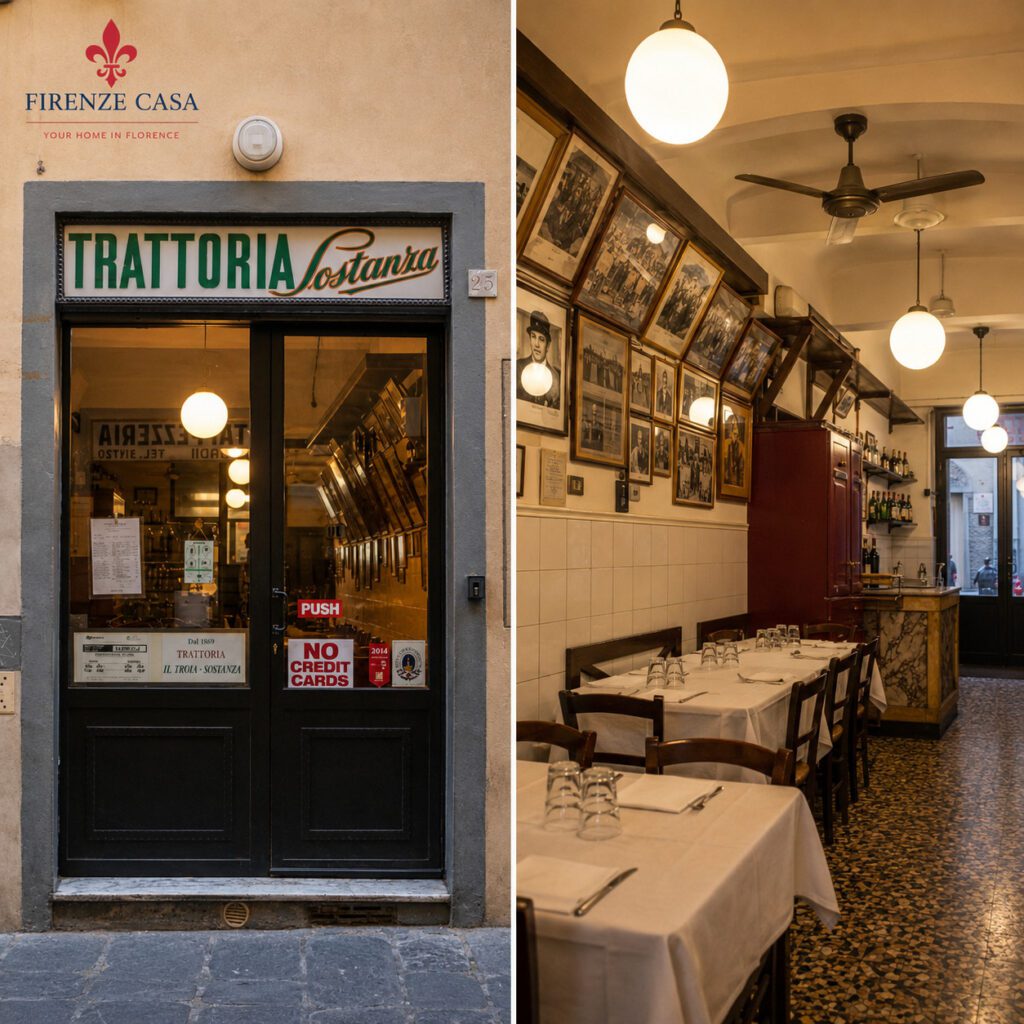
Trattoria Sostanza Florence is one of the city’s most enduring traditional trattorias. Founded in 1869 and hidden behind an unassuming entrance on Via del Porcellana, it remains famous for its compact dining room, straightforward atmosphere and a small group of dishes that have become closely associated with the restaurant.
Sostanza is particularly interesting because its history began while Florence was still capital of the Kingdom of Italy. More than 150 years later, the trattoria offers a form of continuity that is increasingly rare in heavily visited historic cities. For the wider context, see our Historic Restaurants of Florence – Complete Guide.
Founded: 1869
Location: Via del Porcellana 25/R
Historic nickname: Il Troia
Known for: Petto di pollo al burro, tortino di carciofi and bistecca alla fiorentina
Character: Small traditional Florentine trattoria
Historical context: Founded during the Firenze Capitale period
Best for: Traditional food and old-fashioned trattoria atmosphere
Planning: Reserve ahead when possible
A Florentine Trattoria Since 1869
Trattoria Sostanza traces its origins to 1869, an extraordinary moment in Florence’s history. The city had become capital of the newly unified Kingdom of Italy in 1865 and was undergoing rapid political, social and urban change.
New residents, officials and institutions arrived, while ambitious projects began transforming parts of Florence. Yet everyday life continued in neighbourhood shops, wine sellers, osterie and trattorias.
Sostanza emerged from this less monumental side of the city. Its founding date therefore provides a remarkably direct connection with the Florence explored in our article on Florence as Capital of Italy – Firenze Capitale 1865–1871.
Sostanza opened while Florence was still Italy’s national capital. Its history belongs not to the grand political buildings of Firenze Capitale but to the restaurants, shops and everyday businesses serving the people who lived in the changing city.
The Campolmi Tradition
The Campolmi name became closely associated with the restaurant and its culinary identity. Over generations, Sostanza developed the continuity that remains central to its reputation today.
Historical accounts of the business describe changes in management while emphasising the preservation of characteristic recipes and working traditions. That continuity matters more than the idea that absolutely nothing has changed since 1869.
A living restaurant must adapt. What makes Sostanza historically interesting is that its essential character remains recognisable despite those changes.
Why Sostanza Is Also Known as “Il Troia”
Many Florentines have long known the restaurant by the informal nickname Il Troia. Various anecdotes explain how the name developed, including stories connected with members of the Campolmi family and the lively atmosphere of the kitchen.
As with many traditions surrounding old restaurants, oral history and documented fact are not always easy to separate. It is therefore best understood as part of Sostanza’s local folklore rather than as a precisely established historical episode.
Historic Florentine restaurants often acquire nicknames, stories and anecdotes that become part of their identity. “Il Troia” belongs to this informal layer of Sostanza’s history.
Inside Trattoria Sostanza
Visitors expecting a grand historic dining room may be surprised. Sostanza remains compact, simple and considerably less theatrical than many restaurants that actively market their historical identity.
Tables stand close together and the room retains the practical character of a traditional trattoria. The attraction lies precisely in the absence of elaborate staging.
This atmosphere also distinguishes Sostanza from Florence’s historic buche, such as Buca Lapi, where vaulted cellar architecture forms a much more visible part of the experience.
Petto di Pollo al Burro – Sostanza’s Signature Dish
The dish most internationally associated with Sostanza is petto di pollo al burro. Chicken breast cooked generously in butter sounds almost too simple to become a restaurant signature, yet that simplicity is central to its appeal.
The cooking creates a deeply savoury exterior while keeping the chicken tender. Hot butter becomes part of the finished dish rather than merely a cooking fat.
Its fame illustrates an important principle of traditional cooking: a memorable dish does not necessarily require many ingredients. Technique, repetition and consistency can make an apparently simple preparation distinctive.
The butter chicken is interesting precisely because the recipe appears so straightforward. At Sostanza, technique and long familiarity with the dish matter more than complexity.
Tortino di Carciofi
Another Sostanza classic is the tortino di carciofi. Artichokes play an important role in Tuscan cooking, especially during their season, and this dish has developed an enthusiastic following of its own.
The tortino reflects the same philosophy as much of the restaurant’s cooking: a limited number of ingredients handled confidently rather than disguised beneath elaborate preparation.
For many diners, ordering both the artichoke tortino and butter chicken provides the most characteristic introduction to Sostanza.
Bistecca alla Fiorentina
Sostanza is also associated with one of Florence’s defining meat traditions: bistecca alla fiorentina.
The dish is much more specific than simply a large grilled steak. Thickness, grilling and the characteristically very rare interior all belong to the traditional preparation. Because of its size, bistecca is usually shared.
At a historic trattoria such as Sostanza, the steak connects the restaurant directly with the wider culture of Florentine meat cooking.
Traditional bistecca alla fiorentina is served very rare. If you prefer beef thoroughly cooked, another dish may provide a better experience than asking for a traditional bistecca to be cooked well done.
Other Traditional Florentine Dishes
Although butter chicken, artichoke tortino and bistecca attract much of the attention, Sostanza belongs to a much broader Florentine cooking tradition.
Trippa, soups and other simple preparations reflect a cuisine shaped by seasonal ingredients, practical household cooking and careful use of available food.
This approach is closely connected with the philosophy explored in our article on Cucina Povera. The broader culinary background appears in our Florentine and Tuscan Food – Complete Guide.
Sostanza and the Tradition of Simple Tuscan Cooking
Florentine cuisine was not built exclusively around prestigious ingredients or aristocratic banquets. Bread, beans, vegetables, offal, olive oil and inexpensive cuts of meat played fundamental roles in everyday cooking.
Restaurants such as Sostanza helped carry some of this culinary culture from domestic kitchens into public dining rooms.
Its most famous dishes are not necessarily examples of cucina povera in a strict historical sense, but the broader preference for direct flavours and relatively uncomplicated preparation belongs naturally within Tuscan food culture.
A Restaurant That Resisted Unnecessary Reinvention
Florence has changed enormously since 1869. Mass tourism transformed the historic centre, restaurant trends came and went, and expectations surrounding dining became increasingly international.
Sostanza nevertheless retained a recognisable identity. It did not need to become a contemporary fine-dining restaurant or recreate “old Florence” as a decorative theme.
This does not mean the restaurant remained frozen in time. Rather, its central idea survived: a compact Florentine trattoria with a small number of strongly identified dishes.
A historic restaurant differs from a museum because continuity depends on use. Recipes must still be cooked, customers must still arrive and the business must remain economically viable.
Where Is Trattoria Sostanza?
Trattoria Sostanza is located at Via del Porcellana 25/R, between the Santa Maria Novella area and the Arno in Florence’s historic centre.
The location makes it easy to combine with the western side of central Florence, including Ognissanti and Santa Maria Novella.
Its understated entrance suits the character of the restaurant. Sostanza does not depend on an imposing façade; most of what makes it interesting lies inside.
Planning a Visit
The dining room is small and Sostanza has an international reputation, so planning ahead is sensible if eating here matters to you.
Opening days, service times, holidays and reservation arrangements can change. Always check the restaurant’s current information shortly before your visit rather than relying on older guidebooks or blog posts.
Approach the restaurant with appropriate expectations as well. Sostanza is not about elaborate plating, an enormous menu or contemporary reinterpretations of Tuscan cuisine.
If Sostanza is one of the restaurants you particularly want to experience, do not leave the decision until the evening itself. Its small dining room is part of its charm but naturally limits availability.
Frequently Asked Questions About Trattoria Sostanza
When was Trattoria Sostanza founded?
Sostanza traces its history to 1869, when Florence was still capital of the Kingdom of Italy.
Why is Trattoria Sostanza famous?
It is known for its traditional atmosphere and signature dishes, particularly petto di pollo al burro, tortino di carciofi and bistecca alla fiorentina.
Why is Sostanza called Il Troia?
The nickname belongs to local restaurant folklore and is traditionally associated with personalities from Sostanza’s history. The precise origin is better treated as anecdotal than firmly documented.
Where is Trattoria Sostanza?
The restaurant is at Via del Porcellana 25/R in central Florence, between Santa Maria Novella and the Arno.
Do I need a reservation?
Planning ahead is strongly advisable because the restaurant is small and well known. Check the current reservation arrangements directly before visiting.
What should I order at Sostanza?
The butter chicken and artichoke tortino are particularly associated with the restaurant, while bistecca alla fiorentina offers a classic Florentine alternative.
Is Sostanza mainly for tourists today?
Its international reputation attracts many visitors, but popularity does not erase its long Florentine history. The restaurant remains interesting because of the continuity of its setting and cooking traditions.
Why Trattoria Sostanza Is Worth Visiting
Trattoria Sostanza is worth visiting because its history remains visible through use rather than display. The restaurant opened during Firenze Capitale and survived while the city around it changed dramatically.
Its small dining room and famous dishes provide a very different experience from Florence’s elegant historic restaurants or vaulted buche. Butter chicken and artichoke tortino have become as much a part of Sostanza’s identity as its nineteenth-century founding date.
For visitors interested in Florence beyond museums and monuments, eating here offers another kind of historical experience: sitting in a trattoria whose traditions have been carried forward through generations of cooks and diners.
Further Reading on Firenze Casa
- Historic Restaurants of Florence – Complete Guide
- Bistecca alla Fiorentina: A Complete Guide
- Florentine and Tuscan Food – Complete Guide
- Cucina Povera Explained: The Philosophy Behind Tuscan Cooking
- Florence as Capital of Italy – Firenze Capitale 1865–1871
- Buca Lapi – Historic Florentine Restaurant Since 1880
- Trattoria Cammillo – Historic Family Trattoria in Florence
References
- Associazione Esercizi Storici Tradizionali e Tipici Fiorentini – Trattoria Sostanza.
- Comune di Firenze – Historical information on Florence and Firenze Capitale.
- Regione Toscana – Tuscan food traditions and regional gastronomy.
- Accademia Italiana della Cucina – Florentine and Tuscan culinary traditions.
- Historical material on Trattoria Sostanza and the Campolmi tradition.

