
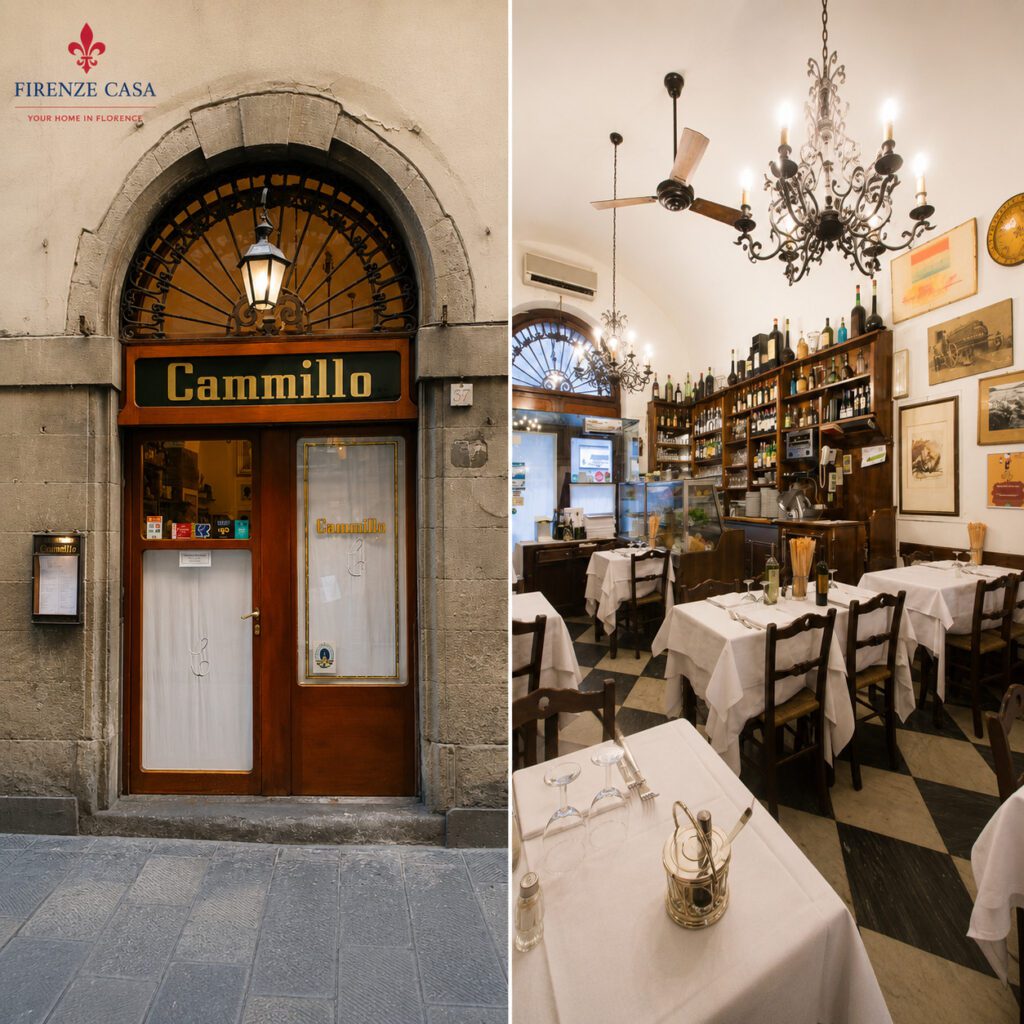
Trattoria Cammillo Florence is a classic family-run restaurant in the Oltrarno. Founded in 1945 and located on Borgo San Jacopo near Ponte Vecchio, it combines traditional Tuscan cooking with the atmosphere of a long-established Florentine trattoria.
Cammillo differs from Florence’s nineteenth-century buche. Its story belongs to twentieth-century Florence, and its character comes above all from family continuity, experienced service and a broad menu that extends well beyond the city’s famous bistecca.
For the wider culinary context, see our Historic Restaurants of Florence – Complete Guide.
Founded: 1945
Location: Borgo San Jacopo, Oltrarno
Type: Family-run Florentine trattoria
Known for: Traditional Tuscan and Florentine cooking
Character: Classic dining room and experienced service
Special strength: Broad menu and seasonal dishes
Nearby: Ponte Vecchio, Santo Spirito and Palazzo Pitti
Best for: A traditional Oltrarno dining experience
A Family Trattoria Since 1945
Trattoria Cammillo traces its history to 1945, placing its beginnings at a very different moment from Florence’s nineteenth-century historic restaurants.
The Second World War had just ended, and Florence was emerging from an extraordinarily difficult period. The bridges across the Arno had been destroyed in 1944, with Ponte Vecchio famously surviving while buildings at its approaches were demolished.
Against this background, the establishment of a restaurant in the Oltrarno belongs to the story of a city returning to everyday life. Over subsequent decades, Cammillo developed into one of Florence’s best-known family trattorias.
Cammillo opened in 1945, when Florence was beginning its post-war recovery. This gives the restaurant a distinctly twentieth-century history compared with the older Florentine buche.
Family Continuity at Cammillo
Family continuity is central to Cammillo’s identity. Rather than relying primarily on an unusual historic interior or a single famous dish, the restaurant built its reputation through generations of hospitality and cooking.
This kind of continuity involves much more than preserving recipes. Knowledge of ingredients, suppliers, seasonal dishes, service and the daily rhythm of a restaurant passes from one generation to another.
Cammillo therefore represents an important form of Florentine restaurant heritage: a business that became historic through decades of continuous family involvement.
Where Is Trattoria Cammillo?
Cammillo is located on Borgo San Jacopo, one of the historic streets of the Oltrarno and only a short walk from Ponte Vecchio.
The location places the restaurant in a particularly interesting part of Florence. Cross the river from the monumental centre and the character gradually changes towards the residential streets, artisan traditions and neighbourhood life associated with the Oltrarno.
Palazzo Pitti, Santo Spirito and San Frediano are all within walking distance, making Cammillo easy to combine with an exploration of this side of the Arno.
Explore the Oltrarno before dinner and return towards the historic centre across Ponte Vecchio afterwards. The Arno and surrounding streets are particularly atmospheric in the evening.
The Atmosphere of Trattoria Cammillo
Cammillo feels different from both a contemporary fine-dining restaurant and an underground Florentine buca. Its dining room belongs recognisably to the tradition of the established city trattoria.
White tablecloths, closely arranged tables, framed pictures and classic furnishings create an atmosphere shaped by decades of restaurant life rather than deliberately designed nostalgia.
The result is traditional without feeling like a museum. Cammillo remains first and foremost a working restaurant.
Traditional Tuscan and Florentine Cuisine
The menu reflects Florentine and Tuscan traditions but is broader than visitors might expect from a historic trattoria.
Pasta, meat, vegetables and seasonal preparations sit alongside familiar Florentine classics. This variety is important because Tuscan cuisine cannot be reduced to bistecca alone.
Olive oil, vegetables, beans, bread and carefully prepared meat form the foundations of many regional dishes, while seasonality continues to influence what appears on the table.
For the broader culinary picture, see our Florentine and Tuscan Food – Complete Guide.
Seasonality Matters
One of the pleasures of traditional Tuscan cooking is that the most interesting dishes can change with the season.
Artichokes are particularly associated with cooler months and spring, while mushrooms become important in autumn. Vegetables, game and other ingredients also follow agricultural rhythms that long shaped Tuscan household cooking.
A seasonal dish can therefore sometimes provide a more interesting experience than automatically choosing the most famous item on the menu.
Ask about seasonal dishes. At a traditional Tuscan restaurant, what is particularly good today may be more interesting than what is most famous internationally.
Bistecca alla Fiorentina
Cammillo also belongs naturally to Florence’s tradition of bistecca alla fiorentina.
The traditional steak is cut very thick and grilled over strong heat, leaving the interior characteristically very rare. Large cuts are intended for sharing and are commonly priced by weight.
The preparation deliberately remains straightforward. Quality of the meat and control of the grill matter more than elaborate sauces or presentation.
Bistecca alla fiorentina is normally shared. Check the weight and price before ordering, and remember that the traditional preparation leaves the centre very rare.
Why You Should Look Beyond the Bistecca
Ordering only bistecca can obscure one of Cammillo’s particular strengths: the breadth of its cooking.
Traditional pasta, vegetables, meat preparations and seasonal dishes allow diners to explore a wider range of Tuscan flavours. This makes Cammillo especially suitable for a group whose members do not all want the same type of meal.
It also reflects the reality of Florentine cuisine more accurately. Bistecca may be internationally famous, but everyday Tuscan cooking developed around a much larger repertoire of ingredients and dishes.
Cammillo and the Oltrarno
The Oltrarno is fundamental to Cammillo’s identity. Historically, the districts south of the Arno developed around homes, workshops, religious institutions, markets and artisan activity.
Tourism now reaches every part of central Florence, but the Oltrarno still offers a different urban rhythm from the streets immediately around the Duomo and Piazza della Signoria.
A family trattoria fits naturally into this environment because restaurants here formed part of neighbourhood life rather than existing only as destinations for travellers.
Borgo San Jacopo and Ponte Vecchio
Borgo San Jacopo runs close to the Arno immediately west of Ponte Vecchio. Its position gives visitors an excellent opportunity to explore one of Florence’s most historically layered areas.
The destruction of 1944 profoundly affected the approaches to Ponte Vecchio, and the neighbourhood subsequently underwent reconstruction. Cammillo’s post-war beginnings therefore belong to a district whose physical environment was itself being repaired and redefined.
Today, the short distance between Cammillo and Ponte Vecchio makes the restaurant easy to incorporate into an evening walk through central Florence.
Cammillo’s 1945 founding date gains additional meaning from its location near Ponte Vecchio. The surrounding streets were recovering from wartime destruction when the restaurant began its story.
How Cammillo Differs from Florence’s Historic Buche
Cammillo represents a different branch of Florence’s restaurant history from the traditional buca.
Buca Lapi is defined partly by its cellars beneath Palazzo Antinori, while Buca San Giovanni is closely associated with the Duomo district. Cammillo’s identity comes instead from family continuity and its Oltrarno setting.
| Restaurant | Distinctive Character |
|---|---|
| Trattoria Cammillo | Family trattoria in the Oltrarno |
| Buca Lapi | Historic cellars beneath Palazzo Antinori |
| Buca San Giovanni | Historic restaurant beside the Duomo |
| Trattoria Sostanza | Small nineteenth-century Florentine trattoria |
These differences are precisely what make Florence’s historic restaurant culture worth exploring.
Planning a Visit to Trattoria Cammillo
Cammillo’s location near Ponte Vecchio makes it easy to reach on foot from almost anywhere in central Florence.
The restaurant is well known and can become busy, so booking ahead is sensible when reservations are available. Opening days, service times and reservation arrangements can change, so check current information directly before visiting.
Allow time to explore the surrounding Oltrarno rather than crossing the river only for dinner. The neighbourhood provides much of the context that makes Cammillo interesting.
Frequently Asked Questions About Trattoria Cammillo
When was Trattoria Cammillo founded?
Cammillo traces its history to 1945, placing its origins in Florence’s immediate post-war period.
Where is Trattoria Cammillo?
The restaurant is on Borgo San Jacopo in the Oltrarno, a short walk from Ponte Vecchio.
Is Cammillo a Florentine buca?
No. Cammillo belongs primarily to the tradition of the family-run Florentine trattoria rather than the historic cellar restaurants known as buche.
What kind of food does Cammillo serve?
The restaurant is associated with traditional Tuscan and Florentine cuisine, including pasta, meat, vegetables and seasonal dishes.
Is Cammillo only known for bistecca?
No. Bistecca alla fiorentina is part of the traditional repertoire, but the breadth of the menu and seasonal cooking are important aspects of the restaurant’s identity.
What can I visit nearby?
Ponte Vecchio is only a short walk away. Palazzo Pitti, Santo Spirito, San Frediano and other parts of the Oltrarno are also easily reached on foot.
Should I reserve in advance?
Booking ahead is sensible, particularly during busy periods. Check the restaurant’s current reservation arrangements before visiting.
Why Trattoria Cammillo Is Worth Visiting
Trattoria Cammillo is worth visiting for its combination of family continuity, traditional cooking and Oltrarno atmosphere. Its history begins not in nineteenth-century Florence but in 1945, when the city and the neighbourhood around Ponte Vecchio were emerging from war.
The restaurant’s broad menu is another strength. Bistecca remains part of the Florentine tradition, but pasta, vegetables and seasonal dishes reveal a much wider picture of Tuscan cooking.
Cammillo therefore contributes something distinctive to Florence’s historic restaurant landscape: the story of a twentieth-century family trattoria that became an institution without needing to become a monument to itself.
Further Reading on Firenze Casa
- Historic Restaurants of Florence – Complete Guide
- Florentine and Tuscan Food – Complete Guide
- Bistecca alla Fiorentina: A Complete Guide
- Trattoria Sostanza – Historic Florentine Trattoria Since 1869
- Buca Lapi – Historic Florentine Restaurant Since 1880
- Buca San Giovanni – Historic Restaurant near Florence Cathedral
- Trattoria Sabatino – Traditional Florentine Trattoria in San Frediano
References
- Trattoria Cammillo – Historical and restaurant information.
- Comune di Firenze – Historical information on the Oltrarno and post-war Florence.
- Regione Toscana – Traditional Tuscan food and culinary heritage.
- Accademia Italiana della Cucina – Studies on Florentine and Tuscan culinary traditions.
- Historical studies on Borgo San Jacopo, Ponte Vecchio and Florence during the Second World War.

