
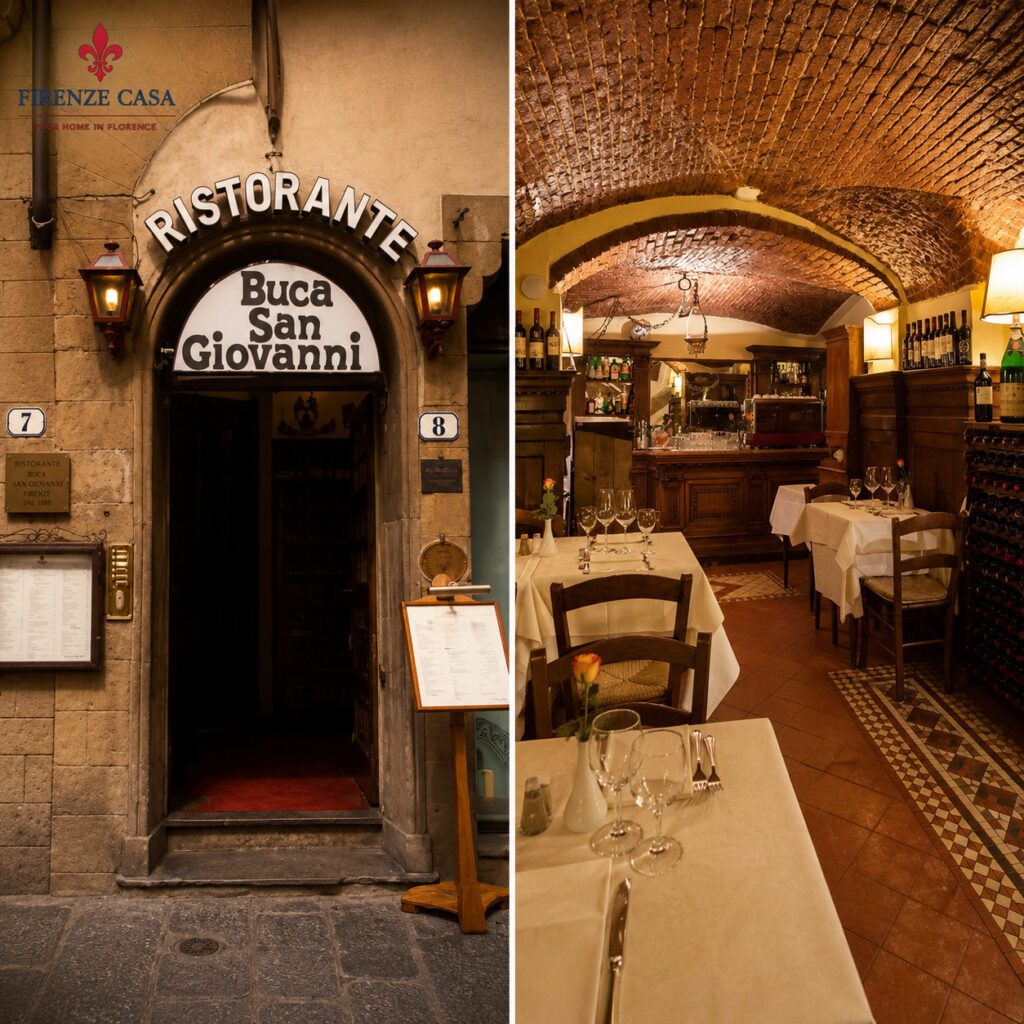
Buca San Giovanni Florence combines traditional Tuscan dining with an exceptional location beside the city’s cathedral complex. Only steps from Santa Maria del Fiore and the Baptistery of San Giovanni, the historic restaurant belongs to Florence’s distinctive tradition of buche – dining places associated with cellar and lower-level spaces in the old city.
What makes Buca San Giovanni particularly interesting is the contrast between monumental and everyday Florence. Outside stand some of the city’s greatest works of architecture; inside, food, wine and conversation preserve another layer of Florentine history.
For the wider culinary story, see our Historic Restaurants of Florence – Complete Guide.
Location: Piazza San Giovanni, near Florence Cathedral
Type: Historic Florentine restaurant and buca
Setting: Historic rooms beside the Duomo complex
Known for: Traditional Tuscan and Florentine cuisine
Nearby: Cathedral, Baptistery and Giotto’s Campanile
Name connection: San Giovanni, Florence’s patron saint
Best for: Combining traditional dining with the cathedral district
A Historic Restaurant in the Heart of Florence
Buca San Giovanni belongs to the long-established restaurants that preserve part of Florence’s historic dining culture. Its location could hardly be more central: the restaurant stands beside Piazza San Giovanni and the monumental complex of Florence Cathedral.
This part of the city has changed enormously over time. Florence’s years as capital of the Kingdom of Italy from 1865 to 1871 accelerated urban transformation, while later tourism turned the cathedral district into one of Europe’s busiest historic destinations.
Yet restaurants, shops and other businesses remind us that these streets were never created simply for sightseeing. The area around the Duomo has always been part of a living city.
What Is a Florentine Buca?
The Italian word buca literally means a hole or hollow. In Florence, however, the term also became associated with restaurants occupying lower-level rooms, cellars and other spaces beneath the historic city.
Such rooms were practical for storing wine and food because they remained naturally cooler than street level. Some gradually developed into places where Florentines could eat and drink.
Buca Lapi, Buca San Giovanni and Buca Mario preserve different versions of this distinctive restaurant tradition.
Florence has another city beneath the one we see from the street. Cellars, crypts, foundations and archaeological remains preserve layers of history below today’s pavements and piazzas.
Dining beside Florence Cathedral
The defining feature of Buca San Giovanni Florence is its extraordinary setting beside Piazza del Duomo and Piazza San Giovanni.
Santa Maria del Fiore dominates the area with Brunelleschi’s dome, while Giotto’s Campanile and the Baptistery complete one of Europe’s great architectural ensembles.
Today these monuments attract visitors from around the world. Historically, however, the surrounding streets were also filled with homes, workshops, religious institutions, shops and places to eat.
Buca San Giovanni therefore provides a useful reminder that the historic centre was never merely a collection of masterpieces. Monumental Florence and everyday Florence have always existed side by side.
Why the Name San Giovanni Matters
The restaurant’s name connects naturally with the Baptistery of San Giovanni, one of Florence’s most important religious buildings.
Saint John the Baptist is the patron saint of Florence, and the Baptistery played a central role in the religious life of generations of Florentines. Dante famously referred to his connection with the building, where Florentine citizens traditionally received baptism.
The monument’s geometric marble exterior and celebrated bronze doors became enduring symbols of the city.
The San Giovanni tradition extends beyond the building itself. Florence celebrates its patron saint every year on 24 June, when the Festa di San Giovanni culminates in the traditional fireworks over the Arno.
When you encounter the name “San Giovanni” in Florence, it often refers to Saint John the Baptist. His presence runs through the city’s religious traditions, monuments and annual celebrations.
Traditional Tuscan Cuisine
Buca San Giovanni is associated with the classic flavours of Tuscan and Florentine cooking. Bread, olive oil, vegetables, beans and meat form the basis of a cuisine that generally values strong ingredients over unnecessary complexity.
Traditional dishes such as ribollita, pappa al pomodoro, crostini and grilled meats developed from this approach.
For a broader introduction to these traditions, see our Florentine and Tuscan Food – Complete Guide.
Bistecca alla Fiorentina
Among Florence’s traditional meat dishes, none is more famous than bistecca alla fiorentina.
The steak is traditionally cut very thick and grilled over intense heat, creating a browned exterior while leaving the centre characteristically very rare. Large cuts are generally shared rather than ordered as individual steaks.
The apparent simplicity reflects an important principle of Tuscan cooking: the quality of the ingredient and control of the cooking matter more than elaborate sauces or presentation.
Check the weight before ordering a bistecca alla fiorentina. Traditional steaks are large and designed for sharing, and they are normally served very rare.
From Local Restaurant to International Florence
The cathedral district has changed dramatically since the era in which Florence’s historic restaurants developed. International travellers already visited the city in large numbers during the nineteenth century, but modern mass tourism transformed the scale completely.
Restaurants in the historic centre consequently face a particular challenge: they operate for an international clientele while remaining connected with Florentine culinary traditions.
This tension is part of the modern history of Florence. A historic restaurant does not remain authentic simply by refusing to change; it must preserve a recognisable identity while continuing to function in the contemporary city.
How Buca San Giovanni Differs from Other Historic Restaurants
Each establishment in our historic restaurant cluster represents a different aspect of Florentine dining culture.
| Restaurant | Distinctive Character |
|---|---|
| Buca San Giovanni | Historic dining beside the Duomo and Baptistery |
| Buca Lapi | Cellars beneath Palazzo Antinori |
| Buca Mario | Traditional Florentine buca since 1886 |
| Trattoria Sostanza | Small nineteenth-century trattoria |
| Trattoria Cammillo | Family tradition in the Oltrarno |
Buca San Giovanni’s strongest identity is therefore geographical as well as culinary. Few historic restaurants are so closely connected with Florence’s monumental centre.
The Duomo District Beyond the Monuments
It is easy to visit Piazza del Duomo and concentrate entirely on Brunelleschi, Giotto and the Baptistery. Yet the surrounding streets reveal another Florence.
Look into the narrower streets leading away from the piazza and the scale changes quickly. Shops, residential buildings and commercial spaces occupy a street pattern shaped over centuries.
Eating nearby can therefore complement rather than interrupt sightseeing. It shifts attention briefly from Florence’s exceptional monuments to the ordinary activities that have always surrounded them.
The Duomo is not an isolated monument. Look beyond the cathedral façade and notice how closely churches, shops, restaurants and narrow streets remain woven together.
Exploring the Area around Buca San Giovanni
The Cathedral of Santa Maria del Fiore, Giotto’s Campanile and the Baptistery are immediately nearby. From here, Florence’s historic centre unfolds in almost every direction.
Via dei Calzaiuoli leads towards Orsanmichele, Piazza della Signoria and Palazzo Vecchio. Piazza della Repubblica lies only a short walk west, while San Lorenzo and Santa Maria Novella are easily reached in the opposite direction.
This makes Buca San Giovanni particularly convenient as part of a day spent exploring central Florence rather than as a destination requiring a separate journey.
Return to Piazza del Duomo early in the morning or later in the evening if possible. Without the busiest daytime crowds, it becomes much easier to understand how the monumental complex fits into the surrounding city.
Planning a Visit to Buca San Giovanni
The central location makes Buca San Giovanni easy to include in almost any Florence itinerary. It is particularly convenient before or after visiting the Cathedral, Baptistery or nearby museums.
Historic restaurants in central Florence can become busy, so reservations are sensible when available. Opening days, service times and booking arrangements can change, and current information should always be checked directly before visiting.
As with any restaurant in such a heavily visited part of Florence, choose it for the combination of setting, history and food rather than simply because it appears on a list of historic establishments.
Frequently Asked Questions About Buca San Giovanni
Where is Buca San Giovanni?
Buca San Giovanni is in the historic centre of Florence beside the Cathedral and Baptistery of San Giovanni.
What does “buca” mean?
Buca literally means a hole or hollow. In Florentine restaurant culture, the term became associated with dining places occupying cellars or other lower-level historic spaces.
Why is the restaurant called San Giovanni?
The name reflects its location beside the Baptistery of San Giovanni. Saint John the Baptist is Florence’s patron saint.
What food is associated with Buca San Giovanni?
The restaurant is associated with traditional Tuscan and Florentine cooking, including classic pasta, meat and regional dishes.
Can I order bistecca alla fiorentina?
Bistecca is one of the classic dishes associated with traditional Florentine restaurants. Remember that an authentic bistecca is normally large, shared and served very rare.
What can I visit nearby?
Florence Cathedral, Giotto’s Campanile and the Baptistery are immediately nearby. Piazza della Repubblica, Orsanmichele, Piazza della Signoria and San Lorenzo are also within easy walking distance.
Should I reserve in advance?
Booking ahead is sensible when reservations are available, particularly during busy periods. Check current opening and reservation information directly.
Why Buca San Giovanni Is Worth Visiting
Buca San Giovanni is worth knowing because it brings everyday Florentine culture into direct contact with the city’s monumental heart. Outside stand the Cathedral, Giotto’s Campanile and the Baptistery; inside, the tradition of eating and gathering continues in a historic restaurant setting.
Its significance is therefore different from Buca Lapi beneath Palazzo Antinori or Sostanza with its nineteenth-century trattoria character. Buca San Giovanni belongs above all to the story of the Duomo district.
That juxtaposition is valuable. Florence is not only the architecture and art preserved around Piazza del Duomo, but also the everyday city that has continued to live around those monuments for generations.
Further Reading on Firenze Casa
- Historic Restaurants of Florence – Complete Guide
- Florentine and Tuscan Food – Complete Guide
- Bistecca alla Fiorentina: A Complete Guide
- Buca Lapi – Historic Florentine Restaurant Since 1880
- Buca Mario – Historic Florentine Buca Since 1886
- Trattoria Sostanza – Historic Florentine Trattoria Since 1869
- Trattoria Cammillo – Historic Family Trattoria in Florence
References
- Buca San Giovanni – Historical and restaurant information.
- Opera di Santa Maria del Fiore – History of Florence Cathedral and the Baptistery of San Giovanni.
- Comune di Firenze – Historical information on Piazza del Duomo and Florentine traditions.
- Accademia Italiana della Cucina – Studies on traditional Tuscan and Florentine cuisine.
- Historical studies on Florence’s buche and restaurant culture.

