
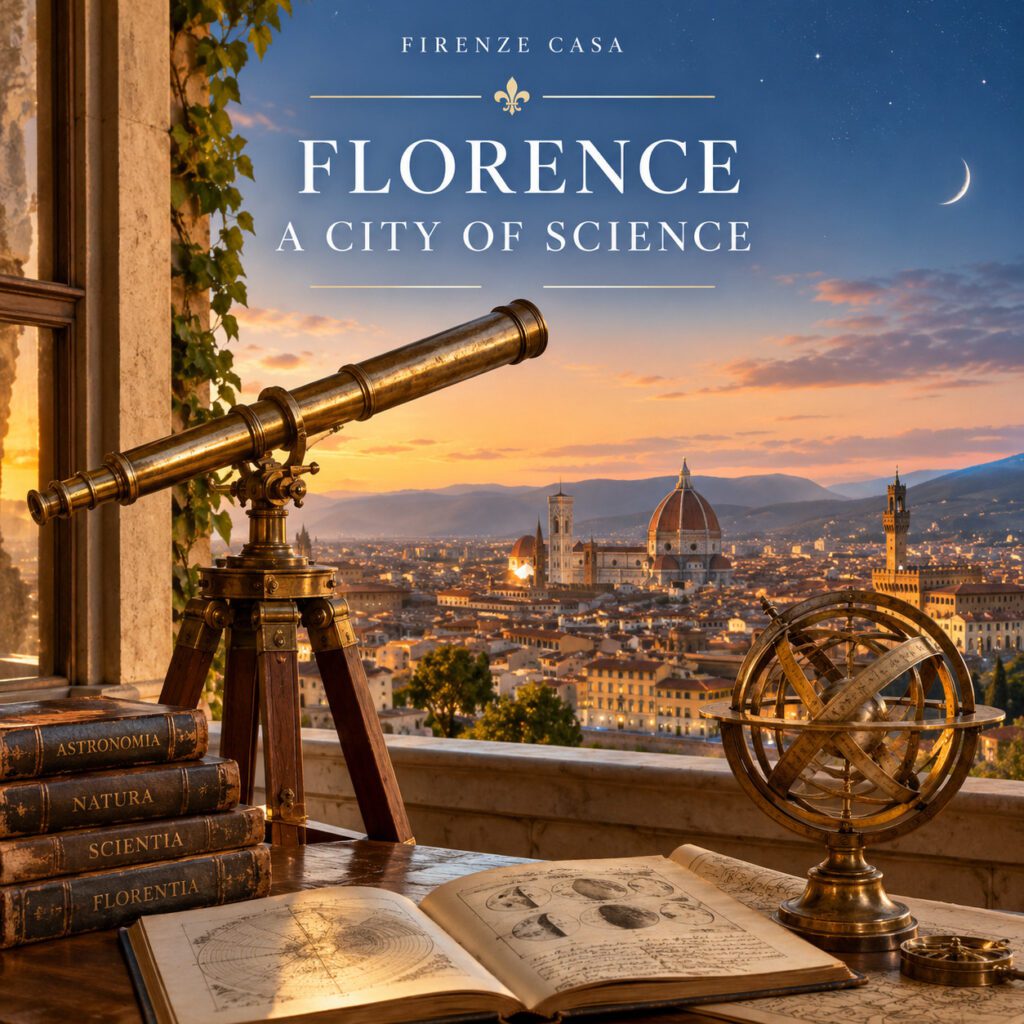
Florence City of Science may sound surprising in a place better known for Michelangelo, Botticelli and Brunelleschi. Yet behind the masterpieces of the Renaissance lies another Florentine tradition: observing nature, measuring the world, studying the human body and looking towards the stars.
Science in Florence was never completely separated from art, craftsmanship or political patronage. The same culture that valued perspective, geometry and anatomical observation also produced sophisticated mathematical instruments, astronomical research and experimental science. Later, the Lorraine grand dukes expanded this tradition through natural history, anatomy and scientific education.
Today, visitors can follow this less familiar history from the instruments of Museo Galileo to the anatomical collections of La Specola, the historic Osservatorio Ximeniano and the scientific institutions on the hill of Arcetri.
Central figure: Galileo Galilei
Important patrons: Medici and Lorraine grand dukes
Historic scientific museum: Museo Galileo
Natural history: La Specola and the University collections
Historic observatory: Osservatorio Ximeniano
Modern research: Arcetri
Key idea: In Florence, art, craftsmanship and scientific knowledge often developed together
Florence Beyond Art
The traditional image of Florence is dominated by art. Visitors come to see the Uffizi, Michelangelo’s David, Brunelleschi’s dome and churches filled with Renaissance masterpieces. This reputation is entirely justified, but it can hide another important part of the city’s history.
Florence was also a place where mathematicians calculated, astronomers observed, instrument makers constructed increasingly precise devices and naturalists collected and classified the physical world. Anatomists searched for better ways to represent the human body, while engineers combined practical knowledge with mathematics and experimentation.
The connection is particularly visible during the Renaissance in Florence. Artists studied geometry and anatomy, architects needed mathematics and engineering, and instrument makers depended on many of the same traditions of precision craftsmanship that produced jewellery, sculpture and luxury objects.
Modern categories can make art and science appear like separate worlds. Renaissance Florence was different. Observation, geometry, craftsmanship, anatomy and engineering frequently overlapped, while artists and scientists shared a fascination with understanding and representing the physical world.
Why Did Science Flourish in Florence?
There was no single reason. Florence possessed an unusual combination of wealth, skilled craftsmanship, political ambition and intellectual curiosity. Banking and international commerce generated money, workshops supplied highly trained craftsmen, and powerful patrons were prepared to invest in objects and ideas that demonstrated sophistication and prestige.
The same environment helped make Florence one of the great centres of Renaissance culture. Expensive scientific instruments required patrons just as paintings and sculptures did. Astronomical devices, globes, maps and mathematical instruments could demonstrate learning and power while also serving practical or experimental purposes.
The Medici family became particularly important in this story. Their cultural interests extended beyond the visual arts, and their collections included scientific instruments and objects designed to represent and measure the world.
The Medici – Patrons of Knowledge as Well as Art
Visitors usually associate Medici patronage with Botticelli, Michelangelo, palaces and churches. Yet the dynasty also collected mathematical and astronomical instruments. Beginning under Cosimo I, scientific objects became part of the grand-ducal collections and were displayed alongside maps, works of art and other prestigious objects.
This reveals an important aspect of court culture. A beautifully constructed scientific instrument could embody several qualities at once: technical skill, mathematical knowledge, wealth and intellectual ambition. Precision did not prevent beauty, and beauty did not make an object scientifically useless.
The Medici collections eventually included instruments associated with astronomy, geography, navigation and experimental physics. Their history survives today principally through Museo Galileo, where objects once belonging to the grand-ducal collections form one of the world’s great collections of historic scientific instruments.
Scientific instruments could also communicate power. A prince who possessed sophisticated maps, globes, clocks and astronomical devices presented himself as a ruler connected with knowledge, technology and the wider world.
Galileo Galilei and Florence
No person represents the scientific history of Florence more strongly than Galileo Galilei. Born in Pisa in 1564, Galileo developed important connections with Florence and the Medici court. His astronomical discoveries eventually allowed him to return to Tuscany under the patronage of Grand Duke Cosimo II.
Galileo improved the scientific use of the telescope and directed it towards the night sky. His observations of the Moon, the phases of Venus and four moons orbiting Jupiter contributed to a profound transformation in European astronomy. The Jupiter satellites became particularly connected with Florence because Galileo named them the Medicean Stars in honour of his patrons.
His relationship with the Medici demonstrates how scientific discovery and court patronage could reinforce one another. Galileo gained status and support, while the dynasty associated its name with discoveries that attracted attention throughout Europe.
Our dedicated guide to Galileo Galilei – Science, the Medici and Florence follows this story in detail, including his astronomical work, relationship with the Medici, conflict with church authorities and the places associated with him in Florence.
Museo Galileo – Measuring the World
For visitors who want to understand Florence City of Science, Museo Galileo is the essential starting point. Located beside the Uffizi in Palazzo Castellani, the museum preserves scientific instruments assembled principally through the Medici and Lorraine collections.
Its objects tell a much broader story than Galileo alone. Telescopes, globes, clocks, astronomical models, mathematical devices and experimental instruments reveal generations of attempts to measure time, map the Earth, understand the heavens and investigate physical phenomena.
The museum also demonstrates the close relationship between craftsmanship and science. Many instruments are visually magnificent, combining brass, wood, glass, engraving and elaborate decoration with precise technical functions.
At Museo Galileo, do not look only at what an instrument was designed to measure. Look at how it was made. Engraving, metalworking, glassmaking and precision mechanics show how Florentine scientific culture depended on exceptional craftsmanship.
The Accademia del Cimento – Experiment Instead of Authority
Galileo’s influence continued after his death. In 1657, Grand Duke Ferdinando II and Prince Leopoldo de’ Medici supported the creation of the Accademia del Cimento, one of the important early European organisations devoted to experimental investigation.
The academy studied natural phenomena through observation, measurement and specially designed instruments. Experiments involving temperature, atmospheric pressure and other physical processes reflected a changing approach to knowledge: rather than relying only on inherited authorities, investigators increasingly tested ideas against the physical world.
Its instruments also demonstrate why Florence provides such an interesting setting for the history of science. Experimental research required skilled makers capable of translating scientific questions into physical devices. The workshop and the laboratory were therefore closely connected.
From the Medici to the House of Lorraine
The death of the last Medici grand duke in 1737 did not end Florence’s scientific tradition. Under the House of Lorraine, scientific collecting and education developed in new directions. The Enlightenment placed increasing emphasis on classification, experimentation and the systematic study of nature.
Grand Duke Peter Leopold played a particularly important role. In 1775, the Imperial and Royal Museum of Physics and Natural History opened in Florence. Under its first director, Felice Fontana, it became an important centre for scientific research, education and the presentation of collections.
This development marks an important transition. Scientific objects were no longer primarily elements of a princely collection. Increasingly, collections became organised around research, teaching and the communication of knowledge.
La Specola – Anatomy and the Natural World
La Specola provides one of the clearest examples of this Enlightenment transformation. Its roots lie in the museum founded under Peter Leopold in 1775, while its collections bring visitors into the worlds of zoology, mineralogy and anatomy.
The anatomical wax models are particularly remarkable. Before photography, CT, MRI and digital three-dimensional visualisation, anatomists needed other methods of preserving and communicating complex structures. Wax offered a durable solution. Carefully modelled muscles, organs, vessels and nerves could be examined repeatedly without the limitations of a temporary dissection.
These objects are scientific teaching tools, but they are also works of extraordinary craftsmanship. The anatomical waxes therefore express the same relationship between accurate observation and skilled visual representation that appears repeatedly throughout Florence’s scientific history.
The anatomical waxes of La Specola are one of the best places in Florence to see the boundary between art and science disappear. Sculpture, colour, anatomical observation and medical teaching come together in objects created to make the invisible interior of the human body understandable.
Natural History – Collecting and Classifying Nature
Florence’s scientific heritage extends far beyond anatomy. The University of Florence preserves collections relating to zoology, botany, geology, palaeontology, mineralogy, anthropology and ethnology. Together they document centuries of attempts to collect, compare and classify the natural world.
The roots of this tradition reach back to the Medici period. The Giardino dei Semplici, established under Cosimo I in 1545, belongs to the early history of botanical study in Florence. Over the following centuries, collections became increasingly specialised as natural history developed into modern scientific disciplines.
This is an important part of the Florence science story because it broadens our perspective beyond famous individuals. Scientific knowledge also grew through thousands of specimens, careful classification, field research, teaching collections and generations of scholars whose names are far less familiar than Galileo’s.
Anthropology, Geology and Palaeontology
The University collections reveal just how broad scientific Florence became. Anthropology and ethnology brought together objects connected with different peoples and cultures, while geology and palaeontology examined a much deeper history written in rocks and fossils.
Florence’s palaeontological collections include fossils and skeletons that document environments dramatically different from modern Tuscany. They remind visitors that science changes the scale of historical thinking. Renaissance Florence may seem ancient when walking through the city, but geology and palaeontology extend the story millions of years further into the past.
This variety is one reason the idea of Florence City of Science deserves to stand independently from individual museum guides. Galileo and astronomy form only one chapter in a much larger culture of observation and classification.
Osservatorio Ximeniano – Science Hidden in the Historic Centre
Only a short distance from San Lorenzo lies one of Florence’s least expected scientific institutions: the Osservatorio Ximeniano. Leonardo Ximenes founded the observatory in 1756, and it remains in its historic location.
Its activities expanded well beyond astronomy. Over time, researchers worked in meteorology, cartography, hydraulics, seismology and other fields, creating a scientific institution hidden among the churches, palaces and streets of central Florence.
The observatory is particularly interesting because it demonstrates that scientific activity was not confined to museums. Florence also contained working institutions where scholars measured weather, observed astronomical phenomena, mapped territory and investigated earthquakes.
Walk through the streets around San Lorenzo and you might never imagine that a scientific observatory has operated here since the eighteenth century. The Osservatorio Ximeniano is a perfect example of the hidden scientific Florence behind the city’s famous monuments.
From La Specola to Arcetri
Astronomical observation eventually faced a practical problem. A growing modern city was not the ideal environment for increasingly sophisticated observations. Florence needed a new astronomical site away from the limitations of the old observatory at La Specola.
During the nineteenth century, astronomer Giovan Battista Donati promoted the creation of a new observatory on the hill of Arcetri. The new building was inaugurated in 1872 and designed to house the important Amici telescope.
The move created a symbolic continuity. Florence’s astronomical tradition left the increasingly crowded city and climbed into the same hills associated with Galileo’s final years.
Arcetri – From Galileo to Modern Astrophysics
Arcetri brings the history of science in Florence into the modern era. The hill contains not only the historic astrophysical observatory but also a concentration of institutions devoted to physics, astronomy and optics.
The Osservatorio Astrofisico di Arcetri developed from nineteenth-century astronomy into a modern research institution. During the twentieth century, the site became particularly important for solar physics, and its solar tower was inaugurated in 1925.
Today, the observatory forms part of Italy’s National Institute for Astrophysics, while the hill also hosts scientific institutions connected with the University of Florence, the National Research Council and the National Institute for Nuclear Physics. Arcetri therefore remains a place of active research rather than simply a monument to scientific history.
The scientific importance of the hill has received international recognition: Arcetri is designated a Historic Site by the European Physical Society.
Few places express the continuity of scientific Florence better than Arcetri. Galileo spent his final years on the hill, a major astronomical observatory opened there in the nineteenth century, and modern institutes continue research in astronomy, physics and optics today.
Enrico Fermi and the Scientific Hill of Arcetri
Arcetri also became important in twentieth-century physics. The hill’s scientific institutions formed an environment in which researchers exchanged ideas across astronomy, physics and related disciplines.
Enrico Fermi worked in Florence during the 1920s, and in 1926 he wrote an important paper associated with the development of the statistical theory now known as Fermi–Dirac statistics. The European Physical Society includes this episode among the reasons for recognising the Hill of Arcetri as a historic site.
This connection extends Florence’s scientific timeline far beyond Galileo. The city that contributed to the transformation of seventeenth-century astronomy also participated in the revolutionary physics of the twentieth century.
Scientific Instruments as Florentine Craftsmanship
There is a particularly Florentine dimension to the story of scientific instruments. The city possessed generations of highly skilled metalworkers, goldsmiths, glassworkers, engravers and precision craftsmen. Their expertise could serve art, luxury production or scientific investigation.
A telescope requires lenses; a measuring instrument needs accurate scales; a globe requires mathematical knowledge and precise craftsmanship. Scientific ideas therefore become useful only when someone can transform them into objects capable of making observations and measurements.
This connects scientific Florence with the city’s broader tradition of Florentine craftsmanship. The same culture that produced extraordinary decorative objects also helped create instruments designed to understand nature.
Observation – The Link Between Artists and Scientists
Perhaps the most interesting connection between art and science in Florence is observation. Renaissance artists wanted to understand how bodies moved, how light created volume and how perspective could represent three-dimensional space. Scientists increasingly wanted to investigate physical phenomena through direct observation and measurement.
These were not identical activities, but they shared an intellectual habit: looking closely at the world mattered. Knowledge inherited from ancient authors remained enormously important, yet observation could reveal things that texts did not explain.
Galileo’s telescope represents an extreme version of the same principle. An instrument extended human vision and revealed phenomena invisible to the naked eye. Anatomical models, microscopes and natural-history collections later extended the culture of seeing, comparing and understanding in different directions.
Science and the Renaissance
It would be too simple to describe modern science as something suddenly invented during the Renaissance. Medieval universities and scholars had already developed sophisticated traditions of mathematics, medicine, astronomy and natural philosophy, while major scientific developments occurred across Europe and the Islamic world.
Florence nevertheless became an important laboratory for new relationships between mathematics, engineering, visual representation, craftsmanship and observation. The intellectual environment described in our guide to the Renaissance in Florence therefore belongs to the history of science as well as to the history of art.
Florence did not invent modern science by itself, just as it did not create the Renaissance in isolation. Its importance lies in the unusual concentration of patrons, craftsmen, mathematicians, artists and investigators who helped create an environment in which new ideas could develop.
Where to Discover Scientific Florence Today
| Place | Main Theme | Why It Matters |
|---|---|---|
| Museo Galileo | Astronomy, mathematics and scientific instruments | Medici and Lorraine collections and original Galileo instruments |
| La Specola | Anatomy, zoology and natural history | Historic scientific museum and extraordinary anatomical waxes |
| Osservatorio Ximeniano | Astronomy, meteorology, cartography and seismology | Historic working scientific institution founded in 1756 |
| Arcetri | Astronomy, astrophysics, physics and optics | Historic and modern scientific research environment |
| Santa Croce | Memory of Galileo | Galileo’s monumental tomb |
| University Natural History Collections | Anthropology, botany, geology and palaeontology | Centuries of collecting, classification and scientific research |
Science Museums in Florence
Visitors interested in this side of the city can easily include scientific institutions within a broader museum itinerary. Museo Galileo is particularly convenient because it stands beside the Uffizi and the Arno, while La Specola can be combined with Palazzo Pitti and the Boboli Gardens.
The Osservatorio Ximeniano adds a much less familiar experience close to San Lorenzo. Visitors interested in the broader museum landscape can also consult our complete guide to Florence museums.
Not every scientific institution functions like a conventional museum, and access arrangements can vary. Check current official information before planning visits to observatories, research institutions or specialised university collections.
Florence – A City of Art and Science
The most interesting conclusion is not that Florence should replace its reputation as a city of art with a reputation as a city of science. The two stories belong together.
A Renaissance painter investigating perspective, an anatomist creating a wax model, an instrument maker engraving a mathematical scale and an astronomer pointing a telescope towards Jupiter were engaged in very different activities. Yet all depended on observation, specialised knowledge and the ability to translate ideas into visible or measurable form.
Florence became extraordinary partly because these worlds could exist so close together. Palazzo Vecchio contained both political symbolism and early Medici scientific collections. The Uffizi housed art and mathematical instruments. Palazzo Pitti became associated with experimental science through the Accademia del Cimento. Later, La Specola brought anatomy and natural history into a museum environment.
The result is a Florence that looks different once you know where to look. Behind the familiar city of paintings, sculptures and palaces lies another Florence of telescopes, anatomical models, fossils, measuring instruments and observatories.
Frequently Asked Questions About Florence City of Science
Was Florence important in the history of science?
Yes. Florence became an important centre for scientific collecting, astronomy, mathematics, experimentation and natural history. Galileo’s relationship with the Medici is the most famous example, but the city’s scientific tradition continued through the Accademia del Cimento, La Specola, the Osservatorio Ximeniano and Arcetri.
Why is Galileo connected with Florence?
Although Galileo was born in Pisa, he had strong connections with Florence and the Medici court. His patronage relationship with Cosimo II helped bring him back to Tuscany, and Florence today preserves important instruments and monuments associated with his life and work.
What is the best science museum in Florence?
Museo Galileo is the essential choice for astronomy, mathematics and historic scientific instruments. La Specola is particularly rewarding for visitors interested in anatomy, zoology and natural history.
What scientific instruments can you see in Florence?
Museo Galileo preserves telescopes associated with Galileo as well as globes, astronomical models, clocks, mathematical instruments and experimental devices from the Medici and Lorraine collections.
What is La Specola famous for?
La Specola is particularly famous for its historic anatomical wax models and natural-history collections. Its origins lie in the Imperial and Royal Museum of Physics and Natural History founded under Grand Duke Peter Leopold in 1775.
What is the Accademia del Cimento?
The Accademia del Cimento was established in Florence in 1657 under Medici patronage. It promoted experimental investigation of natural phenomena and became an important chapter in the development of seventeenth-century experimental science.
Is the Osservatorio Ximeniano still in Florence?
Yes. The Osservatorio Ximeniano remains in its historic location near San Lorenzo. Founded by Leonardo Ximenes in 1756, it developed activities in astronomy, meteorology, cartography, hydraulics and seismology.
Is Arcetri still used for scientific research?
Yes. Arcetri remains an active scientific environment. The astrophysical observatory forms part of Italy’s National Institute for Astrophysics, while other institutions on the hill work in physics, astronomy and optics.
What connects art and science in Florence?
Observation, geometry and craftsmanship provide some of the strongest connections. Artists studied anatomy, perspective and light, while scientists relied on skilled craftsmen to build precise instruments capable of measuring and observing the physical world.
Can I explore scientific Florence in one day?
You can experience an excellent introduction by visiting Museo Galileo and La Specola, although exploring the wider story through the Osservatorio Ximeniano, university collections and Arcetri requires more time.
Why Florence City of Science Is Worth Discovering
Florence City of Science reveals a side of the city that is easily overshadowed by Renaissance art. Galileo and his telescopes provide the most famous story, but they belong to a much broader tradition involving Medici scientific patronage, experimental physics, anatomy, natural history, astronomy and precision craftsmanship.
The story also continued long after the Renaissance. The Lorraine grand dukes transformed scientific collections into institutions for research and education, La Specola developed into one of Florence’s great scientific museums, the Osservatorio Ximeniano measured the physical world from the historic centre and Arcetri carried astronomical research into the modern age.
Most importantly, science does not represent a separate Florence hidden behind the artistic city. The two traditions repeatedly intersect. Beauty and knowledge, craftsmanship and measurement, observation and representation all formed part of the same extraordinary culture of curiosity.
Florence changed the way Europe looked at art. Its scientific heritage reminds us that generations of Florentines also helped change the way people looked at nature, the human body, the Earth and the universe.
Further Reading on Firenze Casa
- Galileo Galilei – Science, the Medici and Florence
- Museo Galileo – Science in Renaissance Florence
- La Specola – Natural History Museum
- Osservatorio Ximeniano – Florence’s Historic Observatory
- Arcetri Observatory – Astronomy Above Florence
- The Renaissance in Florence – Art, Architecture and a New World
- The Medici Family – The Dynasty That Shaped Florence
- Florence Museums – The Complete Guide
References
- Meridiani Firenze, No. 67, April 1998 – La capitale della scienza.
- Museo Galileo – History of the Medici and Lorraine scientific collections.
- Museo Galileo – Galileo instruments and the Accademia del Cimento.
- University of Florence, Sistema Museale di Ateneo – La Specola and the Natural History collections.
- Osservatorio Ximeniano – History of the observatory and Leonardo Ximenes.
- INAF – Osservatorio Astrofisico di Arcetri – History of the observatory and current research.
- European Physical Society – Historic Site: Hill of Arcetri, Florence.
- Comune di Firenze / FeelFlorence – Florence City of Science and scientific itineraries.

