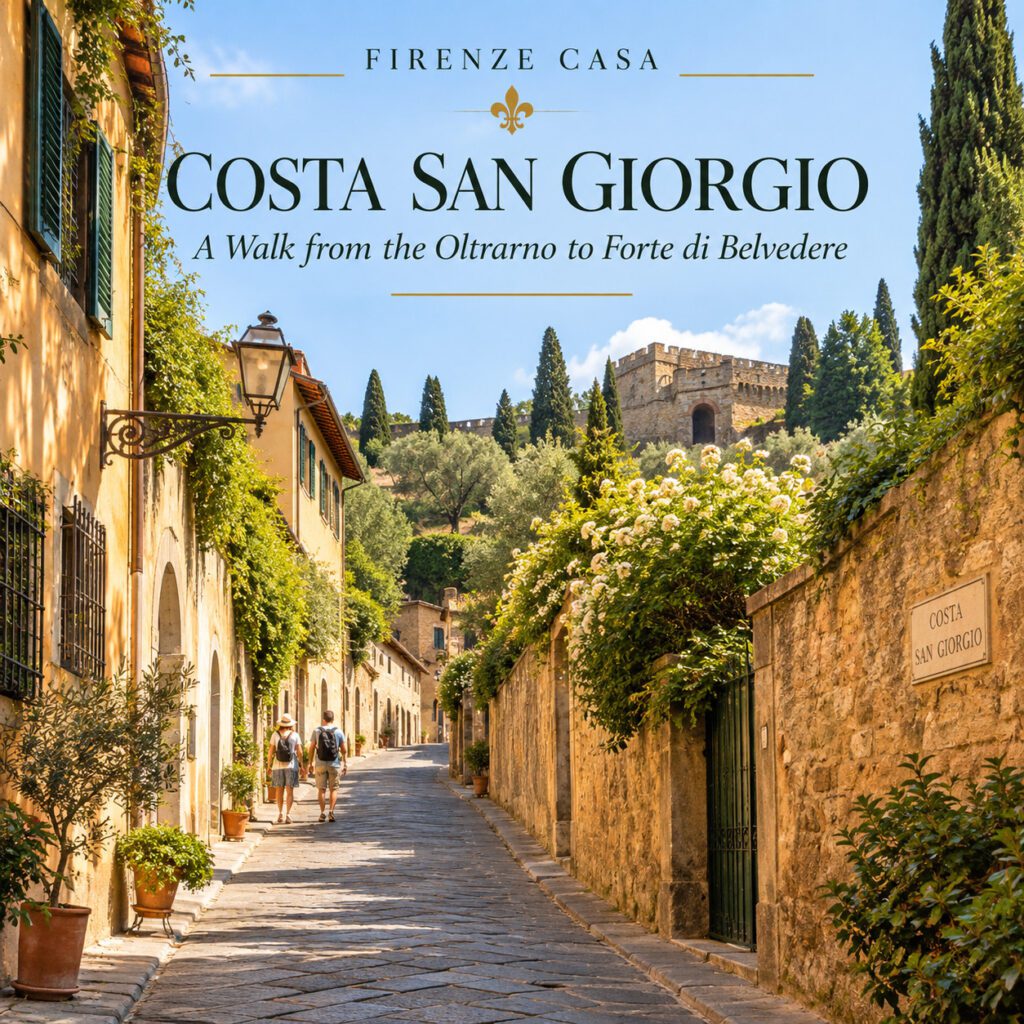
The Costa San Giorgio walk is one of the most atmospheric short climbs in Florence. Beginning only a few minutes from Ponte Vecchio, the route leaves the busy river crossings behind and rises through a quieter part of the Oltrarno towards Porta San Giorgio and Forte di Belvedere.
This is not a walk built around a long sequence of famous monuments. Its appeal comes from the street itself: old façades, high walls, changing levels, glimpses into side lanes and the gradual transition from the dense historic city to the green hills above Florence. By the time you reach the fortress, the relationship between the Oltrarno, Boboli and the southern defensive landscape becomes much easier to understand.
At a Glance
Route: Lower Oltrarno → Costa San Giorgio → Porta San Giorgio → Forte di Belvedere
Character: Historic street · Hillside walk · Medieval Florence · Medici landscape · Panoramic finish
Difficulty: Moderate uphill walk
Best for: Quiet Florence · Historic streets · Urban history · Views
Good to combine with: Forte di Belvedere · Boboli Gardens · Bardini Garden · San Niccolò
Why Walk Costa San Giorgio?
Florence is compact enough that famous sights often sit only minutes apart. Yet some of the city’s most rewarding walks are valuable precisely because they slow the journey down. Costa San Giorgio belongs to this second Florence.
The street climbs through the eastern side of the Oltrarno between the area near Santa Felicita and the old Porta San Giorgio. As the gradient increases, the commercial atmosphere around Ponte Vecchio quickly disappears. Residential façades, garden walls and historic buildings begin to dominate instead.
For travellers who enjoy discovering Florence on foot, the route offers something different from a conventional monument-to-monument itinerary. The destination matters, but so does the gradual climb itself.
Firenze Casa Tip
Walk slowly and look back from time to time. Costa San Giorgio changes character with every few metres of elevation, and the relationship between the narrow street and the city below becomes increasingly clear.
Where Does Costa San Giorgio Begin?
The lower end of Costa San Giorgio lies in the Oltrarno close to the Church of Santa Felicita and only a short distance from Ponte Vecchio. This makes the walk easy to add to a day exploring the southern side of the Arno.
If you arrive from the historic centre, cross Ponte Vecchio and enter the Oltrarno. Within minutes, the crowded bridge and riverfront give way to much narrower streets climbing towards the hills.
This rapid transition is one of the pleasures of the route. Florence changes surprisingly quickly once you leave the busiest streets around the bridge.
What Does “Costa” Mean in Florence?
In Florentine street names, the word costa often refers to a road climbing a steep slope. Costa San Giorgio therefore describes both the physical character of the street and its destination towards the area historically associated with Saint George.
The name suits the route perfectly. Rather than following a flat street across the city, you experience Florence vertically. Houses and walls adjust to the gradient, doorways appear at different heights and side passages descend sharply towards the lower Oltrarno.
The Walking Tour
1. Start in the Lower Oltrarno
Begin close to Santa Felicita, just south of Ponte Vecchio. This part of the Oltrarno still feels closely connected with the monumental centre across the river, yet the climb immediately introduces a more residential landscape.
Before heading uphill, it is worth noticing how compressed the geography is here. Ponte Vecchio, Palazzo Pitti, Via de’ Bardi and the steep southern hillside all lie within a remarkably small area.
2. Enter Costa San Giorgio
Once on Costa San Giorgio, the atmosphere becomes quieter. The street bends and climbs between old buildings rather than opening into large squares, creating an enclosed and distinctly local character.
This is the section to enjoy without rushing. Renaissance Florence often appears to visitors as a sequence of great façades and piazzas, but roads such as Costa San Giorgio reveal another urban scale: houses, retaining walls, small gardens and irregular plots fitted into difficult terrain.
Look at the Street, Not Just the Destination
The attraction of Costa San Giorgio is not one single monument. Its value lies in the way architecture adapts to the slope and in the gradual transition from the dense Oltrarno towards the fortified hills above Florence.
3. The House Associated with Galileo Galilei
One of the most interesting historical connections along the Costa San Giorgio walk is Galileo Galilei. Members of the Galilei family acquired houses here during the seventeenth century, and Galileo himself briefly stayed in the property during the later years of his life.
The buildings associated with the family stand along Costa San Giorgio, and the façade still preserves references to the scientist. The connection is especially appropriate in this elevated part of Florence, although Galileo’s most famous later residence was the Villa Il Gioiello at Arcetri.
For visitors interested in scientific Florence, this small detail creates an unexpected link between the narrow Oltrarno street and the much broader story explored in our Galileo Galilei in Florence guide.
Did You Know?
The Galilei family owned several adjoining houses on Costa San Giorgio. Galileo stayed here briefly in the late 1630s before returning to Arcetri, where he spent the final years of his life.
4. A Street Between City and Hillside
As you continue upward, Costa San Giorgio begins to feel less like a central Florentine street and more like a transition zone between city and countryside. Historically, houses here often had gardens or cultivated land behind them, a pattern that differed from the densely built commercial areas north of the Arno.
The hillside also had a practical importance. Stone extraction took place in this area, supplying building material directly from within the city walls before later transformations of the Boboli landscape changed the surroundings.
This combination of houses, gardens, stone and steep terrain helps explain why the southern side of Florence developed so differently from the flat streets around the Duomo and Santa Maria Novella.
5. The Boboli Landscape Beside the Route
Although Costa San Giorgio does not take you through the Boboli Gardens, the great Medici garden forms an essential part of the surrounding landscape. Behind Palazzo Pitti, Boboli climbs the same southern hillside and transforms it into terraces, avenues, sculpture and controlled views.
Walking outside the garden walls offers a useful contrast. Inside Boboli, nature became part of a carefully designed court landscape. On Costa San Giorgio, the same hill feels more urban and historical, shaped by streets, houses and fortifications.
Together, the two reveal how completely the Medici transformed the southern side of Florence.
6. San Giorgio alla Costa
The street takes its name from the historic church of San Giorgio alla Costa. The religious site has medieval origins and belongs to a group of old foundations that once occupied this hillside between the lower Oltrarno and the city walls.
For centuries, churches and monasteries formed part of the character of Costa San Giorgio alongside houses and workshops. This mixture explains why the street feels less formally planned than many Renaissance areas of Florence.
The young Giotto also had an important connection with the church through a Madonna created for this location, adding another layer to the cultural history of the hillside.
7. Approaching Porta San Giorgio
Towards the top of the climb, Porta San Giorgio marks a decisive change. The gate belonged to Florence’s final great medieval circuit of walls and protected one of the routes entering the city from the surrounding hills.
Its position becomes much easier to understand when approached on foot from below. Instead of appearing as an isolated surviving gate, it becomes part of a defensive landscape linking steep roads, walls and high ground.
The wider story of these fortifications is explored in our Florence City Walls and Fortresses guide.
Firenze Casa Context
Medieval Florence did not end abruptly at a flat city gate. In the Oltrarno, walls had to follow difficult hillside terrain. Walking to Porta San Giorgio makes the geography of the fortified city far easier to understand.
8. From the Medieval Gate to Medici Fortifications
The defensive importance of this hillside did not end with the Middle Ages. Changes in artillery and warfare eventually required stronger fortifications, and the Medici developed the elevated site above the Oltrarno into a much more sophisticated defensive complex.
This progression from medieval gate to late Renaissance fortress is one of the most interesting historical layers of the route. The walk effectively takes you from Florence’s medieval defensive system into the military world of the Medici grand dukes.
9. Finish at Forte di Belvedere
The Costa San Giorgio walk ends at Forte di Belvedere, officially the Fortezza di Santa Maria in San Giorgio del Belvedere. Ferdinando I de’ Medici commissioned the fortress at the end of the sixteenth century as part of the defensive system protecting the Oltrarno, Palazzo Pitti and the grand-ducal court.
The elevated position explains the name Belvedere. From this hillside, Florence and the surrounding countryside open out below, creating one of the clearest demonstrations of why military strategy and panoramic views so often share the same locations.
Rather than repeating the full history of the fortress here, continue with our dedicated Forte di Belvedere guide for its architecture, Medici connections and visitor information.
The Reward at the Top
Costa San Giorgio begins among the enclosed streets of the Oltrarno and finishes on high ground above Florence. The changing perspective is the real structure of the walk.
Why This Short Walk Explains Florence So Well
Many Florence walks connect monuments that belong to the same artistic period. Costa San Giorgio does something different. In a relatively short distance, it brings together medieval streets, religious foundations, Galileo, urban houses, Medici gardens, city walls and late Renaissance military architecture.
The route also demonstrates how strongly geography shaped Florence. The Arno, the Oltrarno and the steep southern hills were not merely a backdrop to the city’s history. They influenced where people lived, where walls could run and where rulers placed gardens and fortresses.
By the time you reach Forte di Belvedere, the city below looks different because you understand more clearly how its parts fit together.
Combine Costa San Giorgio with Bardini Garden
Visitors who want to extend the walk can combine the area with the Bardini Garden. Its hillside terraces and panoramic views provide a very different experience from the narrow architecture of Costa San Giorgio.
The combination works particularly well because both routes reveal the same topography in contrasting ways. Costa San Giorgio follows a historic urban street uphill, while Bardini turns the slope into a designed landscape of terraces, woodland and views.
Combine the Walk with Boboli and Palazzo Pitti
Another natural extension is the Medici landscape around Palazzo Pitti and the Boboli Gardens. Palazzo Pitti represents the grand-ducal residence below, Boboli the court garden climbing behind it, and Forte di Belvedere the fortified high point above.
Exploring all three makes the geography of Medici Florence unusually clear. Residence, garden and defence were not separate projects but parts of a wider system occupying the Oltrarno hillside.
Continue towards San Niccolò
If you still have energy after reaching the top, continue east along the hillside towards San Niccolò. This creates a longer walk through the surviving southern defensive landscape before descending towards the Arno.
San Niccolò has a different identity from Santo Spirito and San Frediano. Here, the river and the steep hillside sit unusually close together, creating one of the most distinctive geographical settings in Florence.
Or Continue towards Piazzale Michelangelo
A still longer extension can lead towards Piazzale Michelangelo. The two viewpoints belong to very different periods: Forte di Belvedere reflects Medici military Florence, while Piazzale Michelangelo emerged from the nineteenth-century transformation associated with Firenze Capitale.
Walking between them therefore links two radically different approaches to shaping Florence’s southern hills.
When Is the Best Time for the Costa San Giorgio Walk?
Morning and late afternoon are generally the most pleasant times, especially during the warmer months. The climb is not extremely long, but the gradient becomes noticeable and summer heat can make even short Florentine walks tiring.
Good walking shoes are more useful than formal footwear because the route involves sloping historic paving. Carrying water is sensible during warm weather, particularly if you plan to continue beyond Forte di Belvedere.
Firenze Casa Tip
During summer, avoid the hottest part of the afternoon. The walk becomes much more enjoyable when the temperature is lower and the changing light begins to soften the façades and hillside.
Walk It in Reverse
The route also works downhill. If you reach Forte di Belvedere or the surrounding hills first, descending Costa San Giorgio provides an easier physical option and gradually returns you to the dense streets around Ponte Vecchio.
The experience changes in reverse because the Oltrarno and historic centre increasingly appear ahead rather than behind you. This can be especially rewarding after a longer hillside walk.
Costa San Giorgio or Piazzale Michelangelo?
The two walks offer very different experiences. Piazzale Michelangelo provides the larger and more famous panorama, while Costa San Giorgio feels more intimate and historical.
Choose Piazzale Michelangelo if the principal goal is the iconic view over Florence. Choose Costa San Giorgio if you prefer a quiet historic street, layered urban history and a walk in which the journey itself matters as much as the panorama at the end.
Ideally, explore both. Together they reveal two contrasting ways of climbing above Florence.
Frequently Asked Questions
Where is Costa San Giorgio in Florence?
Costa San Giorgio lies in the Oltrarno and climbs from the area near Santa Felicita towards Porta San Giorgio and Forte di Belvedere.
Is the Costa San Giorgio walk difficult?
The route is relatively short but noticeably uphill. Visitors comfortable with ordinary city walking should generally find it manageable, although warm weather makes the climb more demanding.
What can I see along Costa San Giorgio?
The main interest lies in the historic street itself, together with the Galileo connection, San Giorgio alla Costa, hillside architecture, Porta San Giorgio and the approach to Forte di Belvedere.
Does Costa San Giorgio lead to Forte di Belvedere?
Yes. The street provides one of the most historically interesting pedestrian approaches to Forte di Belvedere from the lower Oltrarno.
Can I combine the walk with Boboli Gardens?
Yes. Boboli lies directly within the same hillside landscape behind Palazzo Pitti. Combining the two helps explain the relationship between the Medici residence, garden and fortress.
Can I continue towards Piazzale Michelangelo?
Yes. Visitors who want a longer hillside route can continue eastwards towards San Niccolò and Piazzale Michelangelo.
Why the Costa San Giorgio Walk Is Worth It
The Costa San Giorgio walk offers a type of Florence that is easy to miss when moving quickly between major attractions. Within minutes of Ponte Vecchio, the crowds thin and the city begins to climb between historic houses, walls and gardens.
Galileo adds an unexpected scientific connection, while Porta San Giorgio reveals the medieval defensive city. Above it, Forte di Belvedere introduces the later Medici transformation of the same hillside into a landscape of court power and military control.
Most importantly, the route turns geography into history. You feel the distance between river and hill, understand why fortifications occupied the high ground and see how the Oltrarno gradually opens towards the landscape beyond the historic centre.
It is a short walk, but one that explains an unusually large part of Florence.
Further Reading on Firenze Casa
- Walking Tours of Florence – The Complete Guide
- Forte di Belvedere – Florence’s Hilltop Fortress
- Boboli Gardens – Medici Garden Guide
- Bardini Garden – Wisteria and Panoramic Views
- Palazzo Pitti – Grand Ducal Palace
- Florence City Walls and Fortresses – Historic Guide
- Galileo Galilei in Florence
- San Niccolò – Florence’s Historic Riverside Quarter
- Piazzale Michelangelo – The Best View of Florence
- Neighbourhoods of Florence – Complete Guide
References
- Meridiani Firenze, No. 67, April 1998 – feature on Costa di San Giorgio and the route towards Forte di Belvedere.
- Comune di Firenze – historical information on Forte di Belvedere and Florence’s southern fortifications.
- Belvedere Firenze – historical and visitor information on Forte di Belvedere.
- Museo Galileo / Institute and Museum of the History of Science – historical information on the Galilei family houses on Costa San Giorgio.
- Repertorio delle Architetture Civili di Firenze – historical records for Costa San Giorgio and Casa Galilei.
- Comune di Firenze historical street records – information on Florence’s hillside streets and defensive landscape.