
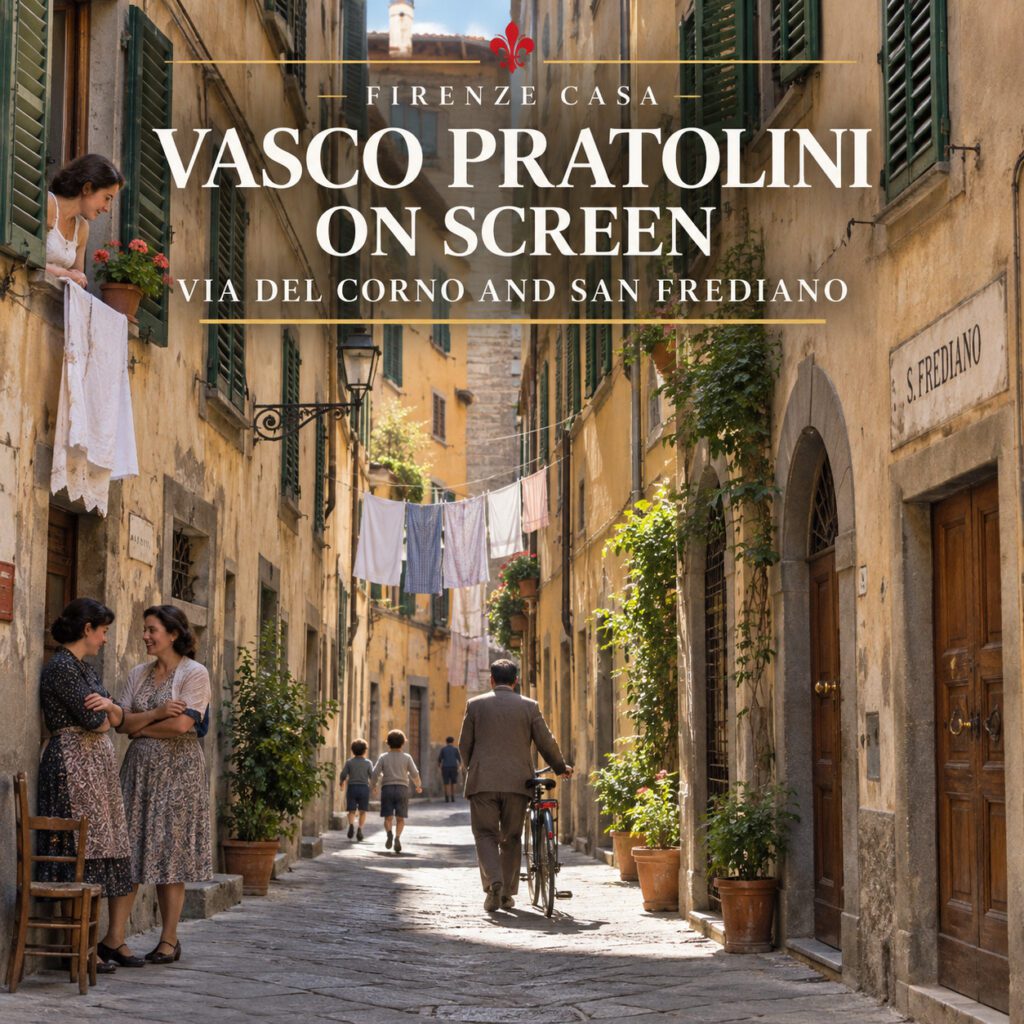
Vasco Pratolini on screen reveals a Florence far removed from the usual Renaissance postcard. His city is made of narrow streets, neighbours, workers, political arguments, romances and everyday encounters. Two films released in 1954 transformed this world into cinema: Carlo Lizzani’s Cronache di poveri amanti and Valerio Zurlini’s Le ragazze di San Frediano.
The two films explore very different sides of Florence. Via del Corno becomes the setting for a tense community living under Fascism, while San Frediano provides a lighter world of courtship, neighbourhood pride and popular humour. Together, they offer one of the most revealing cinematic portraits of twentieth-century Florence.
For visitors, Vasco Pratolini on screen also provides an unusual way to explore the city. Instead of moving from monument to monument, it encourages us to look at streets and neighbourhoods as places where Florentine life itself becomes the protagonist.
Writer: Vasco Pratolini (1913–1991)
Born: Florence
Key films: Cronache di poveri amanti and Le ragazze di San Frediano
Both released: 1954
Directors: Carlo Lizzani and Valerio Zurlini
Key locations: Via del Corno and San Frediano
Central theme: Everyday Florence and its inhabitants
Vasco Pratolini and the Florence of Ordinary People
Vasco Pratolini was born in Florence in 1913 and grew up within the popular districts of the city. His early life included numerous modest jobs, interrupted schooling and direct experience of the social environments that later entered his fiction. Rather than observing working-class Florence from a distance, he had lived inside it.
This experience fundamentally shaped his writing. Pratolini’s Florence is rarely organised around museums and famous monuments. Instead, individual streets and neighbourhoods become small worlds populated by families, shopkeepers, artisans, workers, young lovers and political activists.
That perspective also makes his work particularly suitable for cinema. Streets provide natural stages, while conversations through windows, encounters outside shops and relationships between neighbours create stories without requiring monumental settings.
Pratolini changes the usual hierarchy of Florence. The monument is no longer necessarily the protagonist. A street, a workshop, a doorway or a group of neighbours can become just as important as a Renaissance palace.
Via del Corno – When a Street Becomes the Protagonist
Few places are more closely associated with Pratolini than Via del Corno. The short street lies only a few steps from Palazzo Vecchio, between the monumental political centre of Florence and the area around Santa Croce.
Pratolini knew it personally. As a teenager, he lived with his grandmother at number 2 Via del Corno and later returned to the street. When developing Cronache di poveri amanti, he conceived an unusually powerful idea: the true protagonist of the novel would be the street itself.
That decision transforms Via del Corno into a miniature Florence. Its inhabitants observe one another, exchange information, fall in love, argue and become involved in the political tensions surrounding them. Private life and public history occupy the same few metres of urban space.
Via del Corno is remarkably short. That is precisely what makes Pratolini’s idea so effective: an entire social and political world is compressed into a single Florentine street.
Cronache di poveri amanti – Florence Under Fascism
Pratolini published Cronache di poveri amanti in 1947, although its story takes place during the Fascist period of the 1920s. The inhabitants of Via del Corno form a collective portrait of a community in which everyday relationships gradually become inseparable from political conflict.
Love affairs, friendships and rivalries continue, but Fascism increasingly enters the street. Political allegiance can no longer remain abstract when neighbours are threatened, beaten or forced to choose sides. The intimate scale of Via del Corno therefore makes the wider transformation of Italy visible through individual lives.
This is one reason Pratolini’s Florence feels so different from conventional historical narratives. National history is experienced from windows, workshops, bedrooms and street corners rather than government buildings.
Carlo Lizzani Brings Via del Corno to the Screen
Carlo Lizzani directed the film adaptation of Cronache di poveri amanti in 1954. Pratolini himself contributed to the screenplay and dialogue, helping to preserve the relationship between the inhabitants and the environment that surrounds them.
The story follows characters including Mario, Bianca, Milena, Maciste and Alfredo while political violence becomes increasingly impossible to escape. The street remains the organising principle. Individual stories overlap until Via del Corno seems almost to possess a collective memory of its own.
The film was selected for competition at the 1954 Cannes Film Festival and received an International Prize ex aequo. Its international recognition demonstrated that this intensely local Florentine story could communicate far beyond Florence.
Cronache di poveri amanti competed at the Cannes Film Festival in 1954 and received an International Prize ex aequo. Vasco Pratolini was directly involved in the screenplay and dialogue.
Via del Corno and the Political Geography of Florence
The location of Via del Corno gives the story another layer of meaning. Palazzo Vecchio and Piazza della Signoria are extremely close, yet Pratolini deliberately turns away from monumental political history and enters a narrow residential street.
This creates two Florences almost beside one another. One is the Florence of civic monuments, public ceremonies and famous historical figures. The other is the Florence of ordinary residents whose lives are nevertheless profoundly affected by politics.
Visitors exploring the history of Florence can therefore use Via del Corno to understand how twentieth-century history operated at neighbourhood level. It is also a striking contrast with nearby Palazzo Vecchio, where political power had been represented architecturally for centuries.
From Via del Corno to San Frediano
The second important chapter of Vasco Pratolini on screen takes us across the Arno into the Oltrarno. San Frediano has long been associated with artisans, workers and a particularly strong sense of neighbourhood identity.
Pratolini again focuses on people rather than monuments, but the atmosphere changes considerably. The political tension of Cronache di poveri amanti gives way to romantic competition, humour and the social theatre of a popular Florentine quarter.
Our guide to San Frediano explores the neighbourhood itself in greater detail. Pratolini’s importance there lies in the way he transformed its inhabitants and everyday relationships into modern Florentine literature.
Via del Corno: politics, community and life under Fascism.
San Frediano: romance, humour and neighbourhood identity.
Both are unmistakably Pratolini, yet they reveal very different possibilities within the same city.
Le ragazze di San Frediano
Pratolini’s Le ragazze di Sanfrediano was published in 1949. Its Florence is lighter than the world of Cronache di poveri amanti, but the neighbourhood remains essential. San Frediano is not simply where the characters happen to live; its social networks make the story possible.
At the centre is a handsome young man whose romantic confidence allows him to maintain relationships with several women. However, the women gradually become the real force of the story. Gossip, observation and neighbourhood communication make secrecy increasingly difficult.
The comedy depends upon the density of San Frediano. People know one another, information circulates quickly and private behaviour rarely remains private for long. Once again, Pratolini makes urban geography part of the narrative.
Valerio Zurlini’s San Frediano
Valerio Zurlini adapted the novel for his first feature film, released in 1954. The result has a much lighter tone than Lizzani’s Cronache di poveri amanti, combining romantic comedy with careful observation of popular neighbourhood life.
Zurlini’s film follows the self-confident Bob and the group of young women surrounding him. Rather than presenting San Frediano as picturesque scenery, the film draws energy from the neighbourhood’s social relationships. Courting, jealousy and gossip become collective activities because everyone appears connected to everyone else.
The film was also important in Zurlini’s career. Although lighter than the emotionally complex works for which he later became known, it already demonstrated his sensitivity to actors and his ability to create a convincing social environment.
Le ragazze di San Frediano was Valerio Zurlini’s first feature film. The adaptation combined comedy with an affectionate but observant portrait of popular Florentine life.
Why Both Films Appeared in 1954
It is remarkable that two major Pratolini adaptations appeared in the same year. Yet the coincidence also reflects the importance of literary realism and popular social environments within post-war Italian cinema.
Filmmakers were increasingly interested in ordinary streets and ordinary people. Italian Neorealism had already demonstrated the expressive power of real urban environments, non-monumental spaces and stories centred on everyday life. Pratolini’s fiction offered filmmakers a rich literary equivalent.
However, the two 1954 films should not simply be treated as identical examples of Neorealism. Lizzani’s political drama and Zurlini’s lighter comedy use different tones and cinematic strategies. What connects them most strongly is Pratolini’s conviction that an entire society can be discovered within a neighbourhood.
Pratolini, Cinema and Italian Realism
Pratolini was not merely a novelist whose books happened to be adapted for film. He also worked as a screenwriter, and his relationship with cinema reflected his wider interest in representing social environments through characters, language and dramatic situations.
His fiction belonged broadly to the realist and partly Neorealist traditions of twentieth-century Italian literature. Yet his Florence is more intimate than a sociological survey. Individual personalities, memories and emotional relationships continually prevent the neighbourhood from becoming an abstract symbol.
This human richness explains why Vasco Pratolini on screen works so effectively. Directors inherit not simply plots but populated worlds.
Pratolini’s great cinematic strength lies in environment. His stories already contain streets full of movement, conversations, conflicting loyalties and intersecting lives – elements that translate naturally into visual storytelling.
A Different Florence from the Renaissance City
Visitors often encounter Florence through Brunelleschi, Michelangelo, Botticelli and the Medici. Pratolini introduces another city: twentieth-century Florence, where historical architecture surrounds people whose immediate concerns are work, rent, politics, friendship and love.
The difference does not diminish monumental Florence. Instead, it restores another layer that can easily disappear when the historic centre is experienced primarily as a destination. A Renaissance façade may have stood for centuries, but generations of ordinary Florentines have lived their lives beside it.
This perspective complements our guide to the movies filmed in Florence. Cinema repeatedly transforms famous monuments, but Pratolini adaptations demonstrate that a modest street or neighbourhood can carry an equally powerful sense of place.
Pratolini and Italian Neorealism
The connection becomes particularly interesting when the films are compared with Roberto Rossellini’s Paisà. Rossellini’s 1946 film enters Florence during the fighting of 1944 and presents a city divided by war. Streets and buildings matter because people must survive and move through them.
Pratolini’s stories similarly remove Florence from the tourist postcard, but they operate differently. Via del Corno becomes a long-term social organism, while San Frediano becomes a network of personal relationships. The city is not merely recorded; it is reconstructed through memory and storytelling.
Together, these works reveal why post-war Italian cinema remains so valuable for anyone interested in Florence. They preserve social landscapes that architecture alone cannot record.
Walking Via del Corno Today
Via del Corno remains easy to overlook. Its position near Piazza della Signoria means that thousands of visitors pass close to it while following routes between Palazzo Vecchio, Santa Croce and the Uffizi.
Knowing Pratolini changes the experience. The street no longer appears merely as another narrow lane in the historic centre. Its scale helps explain the world of Cronache di poveri amanti: windows are close, doorways face one another and neighbours inevitably share the same limited urban space.
From Via del Corno, it is only a short walk towards the Arno. Crossing the river then provides a natural transition from Pratolini’s Via del Corno to his San Frediano.
Do not visit Via del Corno expecting a conventional attraction. Its importance lies precisely in its ordinariness. Read a few pages of Cronache di poveri amanti before visiting and the dimensions of the street suddenly make sense.
Walking into San Frediano
Crossing the Arno into the Oltrarno introduces a different urban atmosphere. San Frediano developed a particularly strong identity through its artisans, workshops and working population, while Porta San Frediano and the neighbourhood preserve important traces of this history.
The wider Oltrarno remains one of the best parts of Florence for understanding the relationship between craftsmanship and neighbourhood life. Our guide to the artisan districts of Florence explores this tradition beyond Pratolini’s literary world.
Modern San Frediano has inevitably changed, but Pratolini adds a historical imagination to the walk. Streets and squares become easier to read as social spaces rather than merely architectural ones.
A Pratolini Walk Through Florence
A literary and cinematic Pratolini route can connect the two worlds explored in the films. Begin at Via del Corno, close to Palazzo Vecchio, and spend a moment observing the proportions of the street before walking towards the Arno.
Cross into the Oltrarno and continue west towards San Frediano. The journey itself illustrates the contrast between the dense political world of central Florence and the popular neighbourhood on the opposite side of the river.
The route is particularly rewarding because it does not depend on collecting exact camera positions. Instead, it follows Pratolini’s urban imagination.
Via del Corno → Piazza della Signoria → Arno → Oltrarno → San Frediano.
The route connects the two Florentine worlds at the centre of Pratolini’s most memorable 1954 film adaptations.
Cronache di poveri amanti and Le ragazze di San Frediano Compared
The contrast between the two films is one of the most interesting reasons to watch them together. Cronache di poveri amanti is politically charged and increasingly tragic. Via del Corno becomes a place where Fascism enters everyday relationships and forces individuals to reveal their loyalties.
Le ragazze di San Frediano is lighter, more playful and driven by romantic complications. Nevertheless, it depends on the same fundamental idea: a neighbourhood is a network, and individual behaviour immediately affects the surrounding community.
One film asks what happens when politics enters a street. The other asks what happens when romance and deception circulate through a neighbourhood. Both answers are profoundly Florentine.
Cronache di poveri amanti: political, dramatic and collective.
Le ragazze di San Frediano: romantic, ironic and socially observant.
Together they demonstrate the remarkable range of Pratolini’s Florence.
Pratolini and Florence’s Neighbourhood Identity
One reason Pratolini remains important is his understanding that Florentine identity is not uniform. San Frediano, Santa Croce, the area around the Mercato Centrale and individual streets each developed distinctive social histories.
This neighbourhood perspective also appears elsewhere in Firenze Casa. Our guides to San Lorenzo and San Frediano examine districts whose identities were shaped by markets, artisans, workers and local traditions as much as by monumental architecture.
Pratolini gives these distinctions human voices. His Florence is made from overlapping communities rather than a single image of the city.
Vasco Pratolini Beyond These Two Films
Pratolini’s relationship with cinema extends far beyond the two films discussed here. Several of his other works were adapted for the screen, while he also contributed directly to screenplays and dialogue during his career.
For Florence, however, Via del Corno and San Frediano provide an ideal introduction because both demonstrate his extraordinary ability to turn urban environments into characters. They also allow visitors to connect literature and cinema with places that can still be explored on foot.
Pratolini is buried at the Cimitero delle Porte Sante above Florence. Our guide to the Cimitero delle Porte Sante places him among the writers, artists and other figures whose lives became part of the city’s cultural memory.
Frequently Asked Questions
Who was Vasco Pratolini?
Vasco Pratolini was a Florentine writer and screenwriter born in 1913. He became one of the major Italian writers of the twentieth century and was particularly known for realistic portrayals of ordinary people, neighbourhoods and social change.
Did Vasco Pratolini live in Via del Corno?
Yes. Pratolini lived in Via del Corno during his youth. His direct knowledge of the street later became fundamental to Cronache di poveri amanti.
What is Cronache di poveri amanti about?
The novel and film follow a community living in Via del Corno during the Fascist period. Personal relationships, political loyalties and violence gradually become inseparable.
Who directed Cronache di poveri amanti?
Carlo Lizzani directed the 1954 film. Vasco Pratolini contributed to its screenplay and dialogue.
Did Cronache di poveri amanti win an award at Cannes?
Yes. The film competed at the 1954 Cannes Film Festival and received an International Prize ex aequo.
Who directed Le ragazze di San Frediano?
Valerio Zurlini directed the 1954 adaptation. It was his first feature film.
Where is San Frediano in Florence?
San Frediano lies in the Oltrarno, south of the Arno and west of Santo Spirito. It has traditionally been associated with artisans, workers and strong neighbourhood identity.
Can you visit Pratolini locations in Florence?
Yes. Via del Corno and San Frediano can easily be explored on foot. They are living parts of Florence rather than preserved film sets, so their interest lies in comparing the modern city with Pratolini’s literary and cinematic worlds.
Why Vasco Pratolini on Screen Is Worth Rediscovering
Vasco Pratolini on screen offers something that even the most beautiful films about Florence cannot always provide: the city viewed from inside its neighbourhoods. Via del Corno and San Frediano are not backdrops chosen because they immediately identify Florence. They matter because communities live there.
Lizzani’s Cronache di poveri amanti turns a narrow street into a stage for love, political conflict and resistance. Zurlini’s Le ragazze di San Frediano uses another popular quarter for romance, humour and social observation. Their moods differ, but both preserve Pratolini’s fascination with the connections between people and place.
For modern visitors, that perspective is particularly valuable. Florence is one of the world’s great cities of art, yet it has never been only a collection of masterpieces. Pratolini reminds us that Florence is also made of streets, neighbours, memories and ordinary lives – and cinema allowed those lives to remain visible.
Further Reading on Firenze Casa
- Movies Filmed in Florence – Famous Films and Locations
- San Frediano – Florence’s Historic Artisan Quarter
- Paisà – Rossellini and Florence During the Second World War
- Artisan Districts of Florence – Oltrarno & San Frediano
- History of Florence
- Palazzo Vecchio – Historic Palace of Florence
- San Lorenzo – Florence’s Medici and Market Quarter
- Cimitero delle Porte Sante – Florence’s Monumental Cemetery
References
- Vasco Pratolini – Cronache di poveri amanti.
- Vasco Pratolini – Le ragazze di Sanfrediano.
- Carlo Lizzani – Cronache di poveri amanti, 1954.
- Valerio Zurlini – Le ragazze di San Frediano, 1954.
- Treccani – Dizionario Biografico degli Italiani: Vasco Pratolini.
- Treccani – Enciclopedia del Cinema: Vasco Pratolini and Valerio Zurlini.
- Festival de Cannes – Cronache di poveri amanti, 1954.
- Meridiani – Firenze, No. 67, April 1998 – “Cronache di una città”.

