
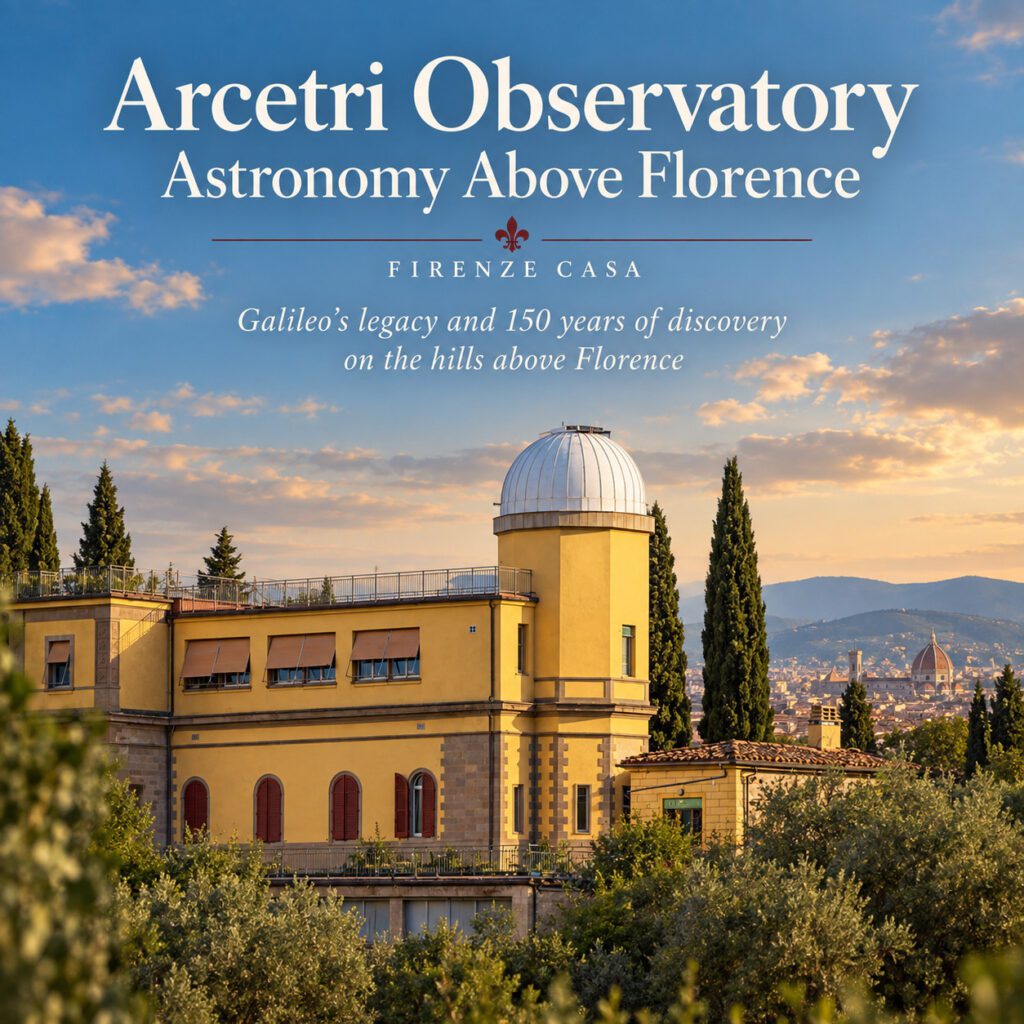
Arcetri Observatory rises above Florence on a hill long associated with astronomy and Galileo Galilei. Founded in the nineteenth century and officially inaugurated in 1872, the observatory created a new home for Florentine astronomy away from the increasingly unsuitable conditions of the city centre.
Its location was both practical and symbolic. Arcetri offered better conditions for observing the sky, while nearby Villa Il Gioiello had been the final home of Galileo. More than two centuries after Galileo looked towards the heavens, Florence established a major astronomical institution almost beside the place where he spent his final years.
Today, the Arcetri Observatory is part of Italy’s National Institute for Astrophysics and remains an active scientific research centre. Historic telescopes and archives therefore coexist with modern astrophysics, making Arcetri one of the most fascinating places for understanding Florence as a city of science.
At a Glance
Official name: INAF – Osservatorio Astrofisico di Arcetri
Location: Arcetri hills, south of central Florence
Foundation: 1869
Main observatory inaugurated: 27 October 1872
Founder: Giovan Battista Donati
Historic instrument: Amici refracting telescope
Historic fields: astronomy and spectroscopy
Today: active astrophysical research institute
Nearby: Villa Il Gioiello, Galileo’s final residence
Where Is Arcetri Observatory?
The Arcetri Observatory stands on the hills immediately south of Florence, above the dense streets of the historic centre.
This elevated landscape feels remarkably different from Piazza del Duomo, the Uffizi or Ponte Vecchio. Villas, gardens, cypress trees and old walls replace crowded streets, while views open towards Florence and the surrounding Tuscan hills.
Arcetri forms part of a wider scientific landscape around Pian dei Giullari. Today, the hill accommodates several institutions connected with physics, astronomy and scientific research.
Yet its most famous scientific association began centuries before the modern observatory was constructed.
Firenze Casa Perspective
Arcetri offers a different way to understand Florence. From these hills, the city of Renaissance art becomes a city of telescopes, mathematics, physics and scientific observation.
Galileo and the Hill of Arcetri
The connection between Arcetri and astronomy inevitably begins with Galileo Galilei.
After his trial by the Roman Inquisition in 1633, Galileo eventually settled at Villa Il Gioiello in Arcetri. The villa stood close to the convent of San Matteo, where his daughter Virginia lived as Sister Maria Celeste.
Galileo remained under house arrest, and his health deteriorated considerably. Nevertheless, scientific work continued. At Arcetri, he completed one of his most important books, Discourses and Mathematical Demonstrations Relating to Two New Sciences.
The work was published in Leiden in 1638 and brought together decades of investigation into motion and the strength of materials.
Galileo died at Arcetri on 8 January 1642.
Important Distinction
Galileo never worked at the Arcetri Observatory. He died more than two centuries before the present observatory was founded. The connection is geographical and symbolic: the nineteenth-century observatory was deliberately established close to the landscape associated with Galileo’s final years.
Why Florence Needed a New Observatory
Florence already possessed an astronomical observatory before Arcetri was created.
The earlier observatory formed part of the Imperial and Royal Museum of Physics and Natural History, the institution associated today with La Specola.
However, astronomers increasingly encountered practical problems there. The building offered limited space, while the observatory tower lacked the stability required for increasingly sophisticated instruments.
Moreover, Florence itself was changing. Public lighting and urban development gradually made astronomical observation from the centre more difficult.
A new location was therefore needed.
The hills of Arcetri provided a logical solution: they were close enough to Florence to remain connected with the city’s scientific institutions but sufficiently removed from the increasingly illuminated and congested centre.
Giovan Battista Donati and the Birth of Arcetri Observatory
The driving force behind the new observatory was astronomer Giovan Battista Donati.
Born in Pisa in 1826, Donati became director of the Florentine observatory in 1859. He was already internationally recognised for his astronomical work, particularly his studies of comets and stellar spectra.
Donati understood that astronomy was entering a new technological era. Larger telescopes and increasingly precise instruments demanded buildings specifically designed around scientific observation.
He therefore promoted the construction of a new observatory on the Arcetri hill.
The project began during an extraordinary moment in the city’s history. Florence had become capital of the Kingdom of Italy in 1865, and the city was being transformed through new roads, neighbourhoods, institutions and infrastructure.
The creation of the observatory belonged to this wider atmosphere of modernisation.
Florence Was Changing
Arcetri Observatory emerged during the years of Firenze Capitale. While Florence modernised its streets and expanded beyond its old walls, its scientific institutions were also entering a new age.
Why Arcetri Was Chosen
The location offered practical advantages for astronomy. Arcetri stood above the city, with more open horizons and fewer disturbances than the old observatory in central Florence.
However, scientific practicality was not the only consideration.
Villa Il Gioiello, Galileo’s final residence, stood nearby. Establishing the new Florentine observatory in this landscape therefore created a powerful connection between modern Italian astronomy and one of the greatest figures in the history of science.
Arcetri could look towards the future while deliberately acknowledging Galileo’s legacy.
That relationship remains one of the most compelling aspects of the site today.
The Observatory Opens in 1872
The development of the new observatory began in 1869, when the large Amici telescope was provisionally installed at Arcetri.
Construction continued during the following years, and the main observatory was officially inaugurated on 27 October 1872.
The ceremony brought together scientists, university representatives, politicians, local authorities and members of Florentine society.
Ironically, Donati himself could not attend. The astronomer responsible for creating the observatory had fractured his femur the previous day and was confined to bed.
The institution he had fought to establish nevertheless entered a new phase in the history of astronomy in Florence.
Did You Know?
Giovan Battista Donati missed the formal inauguration of his own observatory. He had broken his femur one day before the ceremony on 27 October 1872.
The Amici Telescope
At the centre of the new observatory stood an impressive scientific instrument: the Amici refracting telescope.
The telescope was created by Giovanni Battista Amici, one of nineteenth-century Italy’s most remarkable optical instrument makers. Its large refracting objective represented the increasing scale and precision of astronomical observation.
The old observatory in central Florence could not adequately accommodate the instrument. Indeed, providing a suitable home for the telescope became one of the reasons for constructing the new observatory at Arcetri.
Its dome was erected on the hill even before the main observatory building was complete, and the telescope was shown there to scientists in 1869.
In 1872, it was finally installed on the main building.
Look Through History
The Amici telescope represents the transition from the world of Galileo’s relatively simple telescopes to the large precision instruments of nineteenth-century astronomy.
From Astronomy to Astrophysics
The nineteenth century fundamentally changed the questions astronomers could ask.
Earlier astronomy concentrated heavily on measuring the positions and movements of celestial objects. New techniques increasingly allowed scientists to investigate what stars and other astronomical objects were physically made of.
Spectroscopy became one of the most important tools in this transformation.
By separating light into its component wavelengths, astronomers could analyse characteristic spectral lines and obtain information about the physical and chemical properties of distant objects.
Donati became one of the pioneers of this new approach.
In April 1872, while the Arcetri Observatory was still under construction, he carried out spectroscopic observations of sunspots using an instrument of his own design attached to a small Fraunhofer telescope.
The resulting study became the first astrophysical paper based on observations made at Arcetri.
Significantly, it appeared in the first volume of the Memorie della Società degli Spettroscopisti Italiani, regarded as the world’s first journal devoted specifically to astrophysics.
Why It Matters
Astronomy asks where celestial objects are and how they move. Astrophysics goes further by investigating their physical nature. Spectroscopy helped make that transformation possible, and Arcetri participated in this scientific revolution from its earliest years.
Wilhelm Tempel and the Nebulae
Donati’s time at the new observatory was tragically short. He died in 1873 after contracting cholera during a meteorological congress in Vienna.
The German astronomer Wilhelm Tempel subsequently became one of the important figures associated with early Arcetri.
Working under difficult conditions and with an Amici telescope that was not yet completely equipped, Tempel undertook remarkable observations of nebulae.
He produced detailed drawings and used the telescope to discover around one hundred galaxies that were later incorporated into the New General Catalogue.
His work demonstrates something easily forgotten in the age of digital astronomical imaging. Nineteenth-century astronomers often documented what they saw through meticulous hand drawings made during long nights at the telescope.
Astronomy Before Digital Images
Before electronic detectors and astronomical photography became dominant, a trained observer’s eye and hand were scientific instruments. Tempel’s drawings of nebulae preserve this remarkable period in the history of astronomy.
Arcetri and the Scientific Landscape of Florence
The observatory belongs to a much larger Florentine tradition of scientific investigation.
Visitors can encounter another side of this history at the Museo Galileo, where original scientific instruments illustrate centuries of astronomy, mathematics, navigation and experimental physics.
Meanwhile, the Osservatorio Ximeniano tells a different story. Founded by Leonardo Ximenes in 1756 near San Lorenzo, it developed activities in astronomy, meteorology, cartography, geodesy and seismology.
Finally, La Specola demonstrates how the study of nature expanded through zoology, anatomy and natural history.
These institutions should not be confused. Instead, together they reveal the remarkable breadth of scientific culture in Florence.
Arcetri Observatory or Osservatorio Ximeniano?
The two historic observatories represent different periods and different scientific environments.
The Osservatorio Ximeniano was founded in 1756 in the centre of Florence. Its long history eventually extended far beyond astronomy into meteorology, mapping and earthquake research.
The Arcetri Observatory emerged more than a century later on the hills south of the city. It was designed specifically to provide improved conditions for astronomical observation and subsequently became strongly associated with astrophysics.
One belongs to the scientific Florence of the eighteenth-century city centre; the other represents the emergence of modern astronomy on the hills above Florence.
Two Observatories, Two Stories
Osservatorio Ximeniano: founded 1756 near San Lorenzo – astronomy, meteorology, cartography and seismology.
Arcetri Observatory: developed from 1869 and inaugurated in 1872 – astronomy, spectroscopy and modern astrophysics.
Galileo’s Legacy at Arcetri
The presence of Galileo’s final home nearby gives Arcetri an unusual historical continuity.
Galileo’s telescopic observations had transformed humanity’s understanding of the heavens in the early seventeenth century. More than two centuries later, astronomers working on the same hills used spectroscopy and increasingly sophisticated telescopes to ask entirely new questions about the universe.
Yet Galileo’s importance should not obscure the achievements of later scientists.
The Arcetri Observatory was not created as a memorial to Galileo. It was established as a working scientific institution equipped for the astronomy of its own age.
That distinction makes the connection even more interesting. Arcetri did not merely preserve scientific history; it continued it.
From Historic Observatory to Modern Research Institute
The Arcetri Observatory is not simply a historic monument. Today, it forms part of the Istituto Nazionale di Astrofisica – INAF, Italy’s national organisation for astronomical and astrophysical research.
Modern astronomy no longer depends on researchers looking through a telescope beside their offices. Scientists analyse observations made by major ground-based observatories and space telescopes around the world while also developing advanced instruments and technologies for future research.
Arcetri participates in national and international scientific collaborations and works closely with other research institutions and universities.
Consequently, the hill that became associated with Galileo centuries ago remains connected with attempts to understand the universe today.
From Galileo to Modern Astrophysics
Arcetri’s scientific story spans very different technologies: Galileo’s seventeenth-century observations, nineteenth-century refracting telescopes and spectroscopy, and today’s international astrophysical research using instruments on Earth and in space.
The Historic Scientific Collections
More than 150 years of research have also created an important historical heritage at the observatory.
The collections include scientific instruments, books, documents and archival material connected with generations of astronomers working at Arcetri.
Some historical objects associated with the institution are preserved at the observatory, while others form part of the collections of Museo Galileo.
The historic library is particularly interesting because it demonstrates how scientific knowledge circulated through books, journals and correspondence long before digital communication transformed research.
Preserving this material allows the observatory to document not only discoveries but also the everyday process through which astronomy developed.
Can You Visit Arcetri Observatory?
Arcetri is an active research institution rather than a conventional museum with continuous tourist admission.
However, the observatory organises public outreach activities, guided visits and astronomical events at selected times.
Depending on the programme, visits can include the astronomical park, explanations of spectroscopy and cosmic rays, and observations with the historic Amici telescope or other instruments.
Evening events may provide opportunities to observe stars and planets when weather conditions permit.
Because programmes and availability change, visitors should always check the current information from the observatory before making a dedicated trip.
Practical Tip
Do not treat Arcetri Observatory like a conventional Florence museum. Public visits and observing evenings follow specific programmes and usually require advance arrangements. Check the current schedule before travelling to Arcetri specifically for the observatory.
What to Combine with Arcetri
The hill itself deserves to be understood as part of the experience.
Nearby Villa Il Gioiello connects the landscape directly with Galileo’s final years. From Arcetri, routes also lead towards San Miniato al Monte and the panoramic hills overlooking Florence.
Further downhill, Piazzale Michelangelo belongs to the nineteenth-century transformation of Florence that took place during approximately the same period in which the observatory was being created.
This creates an unusual itinerary: Galileo, nineteenth-century astronomy, the transformation of Firenze Capitale and panoramic Florence can all be explored within the landscape south of the Arno.
Firenze Casa Tip
Arcetri is best understood slowly. Rather than travelling to the observatory and immediately returning to the centre, explore the surrounding hill. The landscape itself explains why astronomers chose to leave the increasingly busy city below.
Frequently Asked Questions
Where is Arcetri Observatory?
Arcetri Observatory stands on the Arcetri hill south of central Florence, in the area of Pian dei Giullari.
When was Arcetri Observatory founded?
The observatory traces its foundation to 1869, when the Amici telescope was provisionally installed at Arcetri. The main observatory building was officially inaugurated on 27 October 1872.
Who founded Arcetri Observatory?
Astronomer Giovan Battista Donati was the driving force behind the creation of the new observatory.
Did Galileo work at Arcetri Observatory?
No. Galileo died in 1642, more than two centuries before the observatory was founded. However, he spent his final years at nearby Villa Il Gioiello, giving the location enormous symbolic importance.
Why was the observatory built outside central Florence?
The older astronomical facilities in Florence suffered from limited space, structural problems and the increasing effects of urban lighting. Arcetri offered better conditions for astronomical observation.
What is the Amici telescope?
The Amici telescope is a historic refracting telescope associated with Giovanni Battista Amici. Providing an appropriate location for this large instrument was one of the factors behind the development of the new observatory at Arcetri.
What is the difference between Arcetri Observatory and Osservatorio Ximeniano?
The Ximenian Observatory was founded in central Florence in 1756 and developed work in several scientific disciplines. Arcetri emerged more than a century later as a purpose-built astronomical observatory and subsequently became an important centre for astrophysics.
Is Arcetri Observatory still used for research?
Yes. It is part of Italy’s National Institute for Astrophysics and remains an active research institution involved in modern astrophysics and international scientific collaborations.
Can tourists visit Arcetri Observatory?
Public visits and astronomical events are organised at selected times, but the observatory is not a conventional museum with unrestricted daily admission. Current arrangements should be checked in advance.
Why Arcetri Observatory Is Worth Discovering
Arcetri Observatory reveals a Florence that many visitors never see.
The story begins with a practical nineteenth-century problem: astronomers needed to escape the increasingly unsuitable conditions of the city centre. Yet the solution placed them on a hill already associated with Galileo and the history of modern science.
Giovan Battista Donati brought spectroscopy and a new vision of astronomy to Arcetri. The Amici telescope represented the increasing power of nineteenth-century scientific instruments, while Wilhelm Tempel used it to explore distant nebulae and galaxies.
Meanwhile, astronomy itself evolved into astrophysics. Scientists no longer wanted simply to chart the heavens; they increasingly sought to understand the physical nature of the universe.
That scientific evolution continues today.
Florence changed the way Europe looked at painting, sculpture and architecture. From the hills of Arcetri, generations of scientists helped continue another Florentine tradition: looking carefully at the world – and far beyond it.
Further Reading on Firenze Casa
- Galileo Galilei – Science, the Medici and Florence
- Museo Galileo – Science in Renaissance Florence
- Osservatorio Ximeniano – Historic Observatory Florence
- La Specola – Natural History Museum Florence
- Florence Museums – Complete Guide
- Florence as Capital of Italy – Firenze Capitale 1865–1871
- Piazzale Michelangelo and Giuseppe Poggi
- Basilica of Santa Croce – Florence’s Monumental Church
References
- INAF – Osservatorio Astrofisico di Arcetri – institutional history and historical collections.
- INAF – Osservatorio Astrofisico di Arcetri – historical documentation on Giovan Battista Donati and the foundation of the observatory.
- INAF – Osservatorio Astrofisico di Arcetri – documentation on the Amici telescope.
- INAF – Osservatorio Astrofisico di Arcetri – public outreach and astronomical observation programmes.
- Meridiani – Firenze, No. 67, April 1998 – “Sotto le stelle di Arcetri”.
- Museo Galileo – historical documentation on Galileo Galilei and Florentine astronomy.
- Historical studies on nineteenth-century Italian astronomy and astrophysics.

