
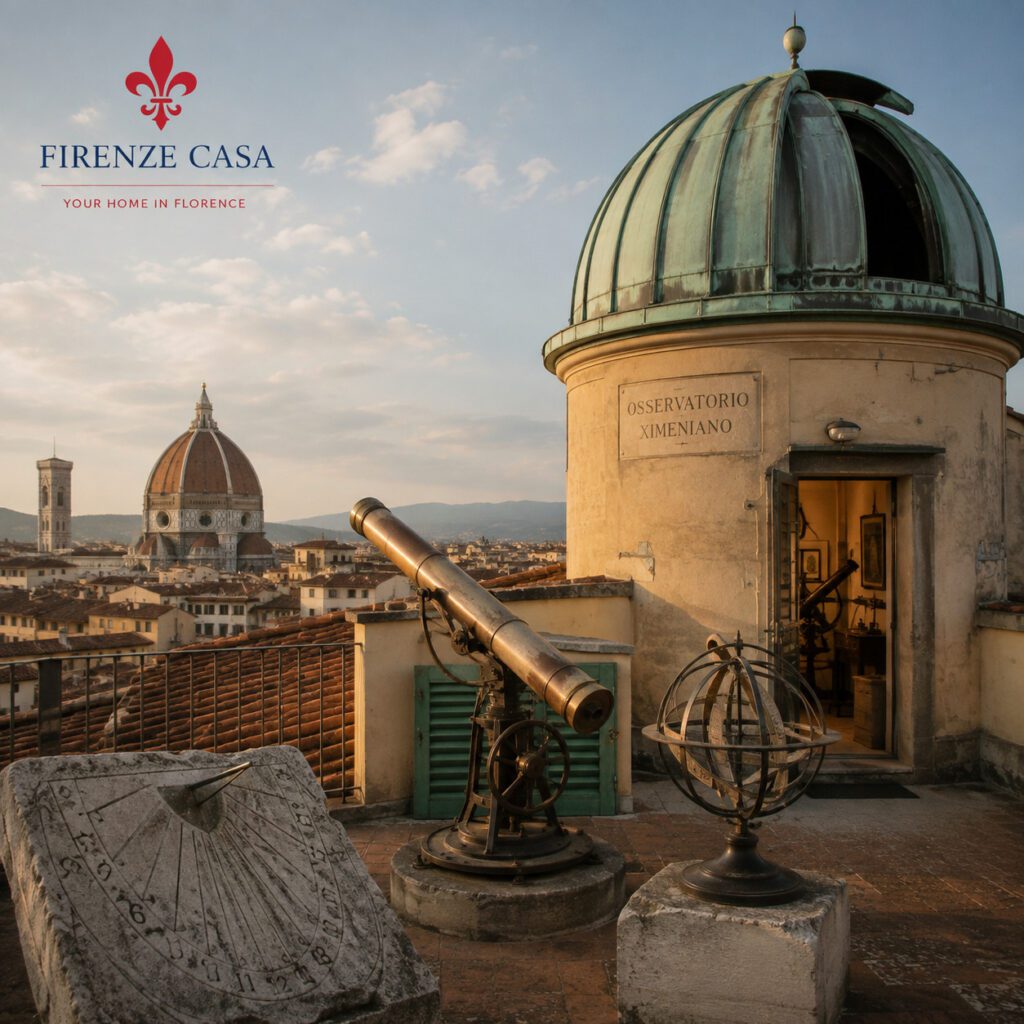
The Osservatorio Ximeniano is one of Florence’s most fascinating scientific institutions. Founded in 1756 by the Jesuit mathematician, astronomer and geographer Leonardo Ximenes, the observatory has occupied the same historic location in the heart of Florence for more than two and a half centuries.
Hidden near San Lorenzo, only a short walk from some of the city’s busiest monuments, it tells a very different Florentine story. Here the protagonists are astronomers, mathematicians, cartographers, meteorologists and pioneering researchers into earthquakes. Its historic instruments, maps, libraries and scientific archives make it one of the most unusual places in our Florence Secrets and Traditions – Complete Guide.
Founded: 1756
Founder: Leonardo Ximenes
Location: historic centre near San Lorenzo
Historic fields: astronomy, cartography, meteorology, geodesy and seismology
Collections: scientific instruments, maps, archives and historic libraries
Special interest: early earthquake research and long-term meteorological observations
Character: a historic scientific institution rather than a conventional museum
A Scientific Treasure in the Heart of Florence
Florence is usually associated with Renaissance art, Medici politics and monumental architecture. Yet the city also developed an important scientific tradition in which mathematics, astronomy, engineering and the observation of nature played major roles.
The Osservatorio Ximeniano belongs to this less familiar history. Its home is in the upper part of the former convent of San Giovannino, close to the Basilica of San Lorenzo and the Medici Chapels.
From this remarkable location, generations of scholars observed natural phenomena and assembled scientific records extending across centuries. The result is not simply a collection of old instruments but the history of scientific work carried out continuously within one Florentine institution.
Leonardo Ximenes and the Foundation of the Observatory
Leonardo Ximenes founded the observatory in 1756. Born in Trapani in Sicily in 1716, he became one of the most accomplished scientific figures working in eighteenth-century Tuscany.
His interests extended far beyond astronomy. Ximenes was a mathematician, geographer and hydraulic engineer who worked for the Grand Dukes of Tuscany and participated in important projects involving roads, waterways and territorial management.
The observatory initially concentrated particularly on astronomy and hydraulics, reflecting the interests of its founder. Ximenes also developed teaching activities connected with astronomy and hydraulic engineering.
When he died in 1786, he left his instruments and extensive library to the Piarist Fathers, the Padri Scolopi, who continued the institution he had created.
Leonardo Ximenes was not an astronomer isolated in an observatory. He applied mathematics and engineering to practical projects involving roads, waterways and the management of the Tuscan territory.
From Astronomy to a Centre of Scientific Research
Astronomy was among the earliest activities of the Osservatorio Ximeniano, but the institution gradually developed much broader interests.
Its history eventually encompassed meteorology, cartography, geodesy, seismology and radio technology. This range makes the observatory particularly interesting because visitors can follow the evolution of scientific measurement across several disciplines.
Instruments changed dramatically over the centuries, but the underlying principle remained remarkably consistent: observe natural phenomena, measure them accurately and preserve the resulting data.
Florence and the Observation of the Sky
The scientific observation of the heavens had deep roots in Florence long before the foundation of the Ximenian Observatory. Astronomy was important for calendars, geography, navigation and the measurement of time.
One of the most famous examples survives in Florence Cathedral. During the fifteenth century, Paolo dal Pozzo Toscanelli established a monumental solar gnomon associated with the Duomo. Sunlight entering through an opening high above the cathedral floor made precise solar observations possible.
Leonardo Ximenes later played an important role in restoring and using this historic astronomical instrument. The connection creates a fascinating bridge between Renaissance scientific culture and eighteenth-century Florence.
This broader intellectual history is easy to overlook when visiting Florence’s churches purely for their architecture and art. Our Complete Guide to the Most Beautiful Churches in Florence provides the wider context for buildings such as Santa Maria del Fiore and San Lorenzo.
Florence’s scientific history is sometimes literally built into its monuments. The Duomo served not only religious and architectural purposes but also became a place for precise astronomical observation.
Giovanni Inghirami and the Mapping of Tuscany
After Ximenes, several remarkable scholars shaped the development of the observatory. Among the most important was Giovanni Inghirami, who directed the institution during the first half of the nineteenth century.
Inghirami was a distinguished geographer and cartographer. He undertook extensive triangulation work across Tuscany and contributed to the production of the Carta Geometrica del Granducato di Toscana.
Creating an accurate map in the nineteenth century required painstaking field measurements. Surveyors established networks of precisely measured points across the landscape and used mathematical calculations to determine distances and positions.
The observatory consequently became an important centre not only for looking towards the sky but also for measuring and understanding the territory of Tuscany itself.
The Cartographic Heritage of the Observatory
The historic cartographic collection remains one of the most interesting parts of the institution’s heritage. It contains geographical, topographical and thematic maps as well as urban views, architectural drawings and documents connected with the representation of territory.
For anyone interested in how Florence and Tuscany were mapped before satellites and digital navigation, these materials reveal an entirely different world of scientific measurement.
They also demonstrate the close relationship between astronomy, mathematics and cartography. Determining positions on Earth accurately once depended heavily on astronomical observations and carefully constructed networks of measurements.
Florence and the Development of Meteorology
Meteorology became another major field of activity. The observatory accumulated meteorological observations over generations, creating an exceptionally long record of Florence’s weather.
Measurements of temperature, atmospheric pressure, rainfall and other conditions were collected systematically and used both locally and within broader scientific networks.
Historical datasets have acquired new importance because they allow researchers to compare modern conditions with measurements taken many decades earlier. Records created for immediate practical purposes can therefore become valuable evidence for later generations of scientists.
Long historical weather series are far more than curiosities. Measurements preserved over generations allow modern researchers to study environmental and climatic changes across unusually long periods.
Filippo Cecchi and the Study of Earthquakes
One of the most fascinating chapters in the history of the Osservatorio Ximeniano began under Filippo Cecchi, who directed the institution from 1872 to 1887.
Cecchi was a physicist with a strong talent for mechanical invention. He modernised the meteorological station and helped establish systematic earthquake research at the observatory.
He designed innovative instruments capable of recording movements of the ground. Historic examples form part of the scientific heritage preserved by the institution.
This work placed the observatory within the early development of instrumental seismology, when scientists were beginning to move from written descriptions of earthquakes towards mechanical recording and quantitative measurement.
The Florence Earthquake of 1895
Florence itself provided an important subject for seismological research. On 18 May 1895, a significant earthquake affected the city and surrounding area.
Giovanni Giovannozzi, who directed the observatory during this period, collected information and documentation concerning the event. Such records later became valuable for reconstructing the distribution and effects of historical earthquakes.
The episode is a reminder that Florence’s apparently permanent stone architecture exists within a landscape shaped not only by human history but also by natural processes.
Guido Alfani and a New Scientific Era
Another important figure was Guido Alfani, who directed the observatory for several decades during the early twentieth century. His research brought the institution considerable recognition in Italy and abroad.
Alfani concentrated particularly on seismology while continuing work in meteorology and astronomy. Under his direction, the observatory also embraced a revolutionary new technology: radio.
A radiotelegraphic station allowed the institution to receive precise time signals and meteorological information transmitted over long distances. The centuries-old observatory was therefore incorporated into the emerging international communication networks of the twentieth century.
Marconi and the Osservatorio Ximeniano
The history of radio provides one of the observatory’s most unexpected stories. Guglielmo Marconi, one of the pioneers of wireless communication, visited the station in 1913.
By then, radio was transforming communication across enormous distances. For an institution historically associated with telescopes, maps and mechanical instruments, wireless technology represented a radically different way of receiving scientific information.
The observatory preserves material connected with this period, adding another layer to its unusually broad technological history.
The observatory’s story stretches from eighteenth-century astronomical instruments to twentieth-century radio communication. Few Florentine institutions demonstrate technological change across such a long period so clearly.
A Museum of Historic Scientific Instruments
Today, the historic collections preserve instruments connected with several centuries of scientific activity. Visitors can encounter equipment related to astronomy, surveying, meteorology, seismology and radio technology.
These objects are especially interesting because many belong directly to work carried out at the institution. Rather than forming an artificial collection assembled later, they document the changing scientific activities of the observatory itself.
Mechanical instruments also reveal the extraordinary precision researchers achieved before electronic sensors and computers transformed scientific measurement.
The Historic Library and Archive
The observatory’s libraries add another dimension to the collection. The historic holdings include the original nucleus assembled by Leonardo Ximenes as well as later scientific books and journals.
The archive preserves meteorological and seismic records, correspondence, chronicles and scientific publications exchanged with institutions elsewhere in the world.
Particularly important are the historic seismic recordings. Long series of observations can provide modern researchers with evidence unavailable from any other source.
Books, instruments and archives therefore belong together. They represent the theory, measurement and interpretation through which generations of scholars tried to understand the physical world.
Florence as a City of Libraries and Knowledge
The Osservatorio Ximeniano belongs to a wider Florentine culture of collecting and preserving knowledge. Only a short walk away, historic libraries such as the Biblioteca Medicea Laurenziana preserve another side of the city’s intellectual heritage.
The Laurentian Library forms part of the San Lorenzo complex and was designed by Michelangelo to house the Medici manuscript collections. Rather than linking to a separate page whose exact URL we could not reliably verify, the library is covered within our verified Basilica of San Lorenzo guide.
The comparison is revealing. One institution preserved manuscripts and humanist scholarship; another accumulated measurements, maps and scientific instruments. Together, they demonstrate that Florence’s intellectual history extended far beyond painting and sculpture.
Surviving War and the Florence Flood
The twentieth century presented serious challenges. The observatory survived the Second World War despite difficult conditions and damage.
Another major disaster arrived with the catastrophic Florence flood of 1966. Water devastated archives, libraries, churches and works of art throughout the city, and the observatory also suffered losses.
The impact of that disaster is particularly visible in the history of the Basilica of Santa Croce, where water, mud and oil caused enormous damage to works of art and historic interiors.
New cooperation with national geophysical institutions subsequently helped modernise scientific equipment, allowing the observatory to continue a tradition of seismic research that had begun generations earlier.
Osservatorio Ximeniano or Museo Galileo?
Visitors interested in science may wonder how the observatory compares with the better-known Museo Galileo. The two tell complementary stories.
Museo Galileo presents an extraordinary overview of historical scientific instruments and the intellectual world associated with Galileo Galilei, the Medici and later Tuscan rulers. It is one of the highlights included in our Florence Museums – Complete Guide.
The Ximenian Observatory offers something different. Its instruments, archives and libraries accumulated around scientific activities performed within the same institution over generations.
For travellers with a serious interest in the history of science, experiencing both perspectives provides a far richer picture of scientific Florence.
Museo Galileo presents one of the world’s great collections of historic scientific instruments. The Ximenian Observatory is compelling for another reason: its collections grew out of scientific work carried out continuously within the institution itself.
Galileo and Florence’s Scientific Identity
Although Galileo lived before the foundation of the Osservatorio Ximeniano, his legacy provides essential context for understanding Florence’s scientific reputation.
The Medici court supported the collection of scientific instruments and helped create an environment in which mathematics, astronomy and natural philosophy could acquire considerable prestige. This scientific patronage forms another aspect of the much broader cultural influence explored in our guide to the Medici family.
Galileo himself is buried in Santa Croce, where his monumental tomb stands opposite that of Michelangelo. The juxtaposition is almost symbolic: one of Italy’s greatest scientists and one of its greatest artists share the same Florentine pantheon.
Why the Osservatorio Ximeniano Is Different
Florence has several institutions devoted to the history of knowledge, but the Ximenian Observatory is particularly fascinating because of its continuity.
Astronomy developed alongside meteorology, cartography and seismology. New technologies were introduced while earlier instruments, records and books remained part of the institution’s memory.
The result feels less like a conventional museum and more like a living archive of scientific Florence. More than two and a half centuries of observation have accumulated within the same historic setting.
Florence’s Renaissance masterpieces reveal what artists created. The Osservatorio Ximeniano shows something complementary: how generations of scholars measured, mapped and tried to understand the physical world around them.
Planning a Visit
The Osservatorio Ximeniano is located in the historic centre close to San Lorenzo and the Medici Chapels. Its central position makes it surprisingly easy to combine with major Florentine monuments.
However, it should not be treated like a conventional museum with continuous daily admission. Guided visits and special openings may be organised, and access arrangements can vary.
Visitors interested in seeing the historic collections should therefore check current information and arrange their visit in advance when necessary.
Check current visiting arrangements before making a dedicated trip. Because the observatory is very centrally located, it can easily be combined with San Lorenzo, the Medici Chapels and Piazza del Duomo.
What to Combine with the Observatory
The surrounding area contains some of Florence’s most important monuments. San Lorenzo, the Medici Chapels and the Laurentian Library are all nearby.
A visit can therefore create an unusual thematic itinerary. Within a remarkably small area, travellers can move from Medici patronage and Renaissance architecture to historic books, mathematics, astronomy and the scientific measurement of nature.
The nearby streets lead quickly towards Piazza del Duomo, where the history of the cathedral’s astronomical gnomon provides another connection with Leonardo Ximenes and the long scientific tradition of Florence.
Frequently Asked Questions
What is the Osservatorio Ximeniano?
It is a historic scientific observatory in central Florence founded by Leonardo Ximenes in 1756. Its activities have included astronomy, meteorology, cartography, seismology and radio technology.
Who was Leonardo Ximenes?
Leonardo Ximenes was an eighteenth-century Jesuit mathematician, astronomer, geographer and hydraulic engineer who worked extensively in Tuscany.
Is the observatory still active?
Yes. The institution preserves its scientific heritage while continuing activities connected with research, scientific culture and its historic collections.
What can visitors see?
The collections include instruments connected with astronomy, meteorology, surveying, seismology and radio technology, together with maps, archives and historic libraries.
Does the observatory have a connection with earthquakes?
Yes. It has an important tradition in seismology, including pioneering nineteenth-century instruments and extensive historic seismic records.
What is the difference between the Osservatorio Ximeniano and Museo Galileo?
Museo Galileo presents major historical scientific collections, while the Ximenian Observatory preserves instruments and archives produced through generations of scientific work within the same institution.
Can tourists visit the Osservatorio Ximeniano?
Visits may depend on guided tours or special openings rather than continuous museum admission. Check current arrangements before travelling specifically to the observatory.
Why the Osservatorio Ximeniano Is Worth Discovering
The Osservatorio Ximeniano reveals a Florence that many visitors never encounter. Behind the city of Michelangelo, Botticelli and Brunelleschi existed another world of mathematicians, astronomers, engineers and observers of nature.
From Leonardo Ximenes and eighteenth-century astronomy to nineteenth-century cartography and earthquake instruments, the observatory followed the evolution of modern science. Later generations added meteorological research and radio communication while preserving the records and instruments of their predecessors.
Most remarkable of all is the continuity of place. More than two and a half centuries of scientific history accumulated within the same Florentine institution.
For travellers searching for the lesser-known intellectual history of Florence, this historic observatory is a genuine discovery – a place where the city looked beyond its palaces and churches towards the sky, the weather and even the movements of the Earth itself.
Further Reading on Firenze Casa
- Florence Secrets and Traditions – Complete Guide
- Florence Museums – Complete Guide
- Basilica of San Lorenzo – The Medici Church of Florence
- The Medici Family – The Dynasty That Shaped Florence
- Basilica of Santa Croce – Florence’s Monumental Church
- Biblioteca Riccardiana – Florence’s Hidden Library of Manuscripts
- Biblioteca Marucelliana – Florence’s Historic Public Library
- Gabinetto Vieusseux – Florence’s Historic Literary Institution
References
- Fondazione Osservatorio Ximeniano di Firenze – historical documentation and institutional collections.
- Fondazione Osservatorio Ximeniano di Firenze – astronomy, meteorology, cartography, seismology and radiotechnology collections.
- Comune di Firenze – documentation on the history of scientific institutions in Florence.
- Istituto Nazionale di Geofisica e Vulcanologia – historical seismological records and scientific collaboration.
- Historical publications and archival material preserved by the Osservatorio Ximeniano.

