
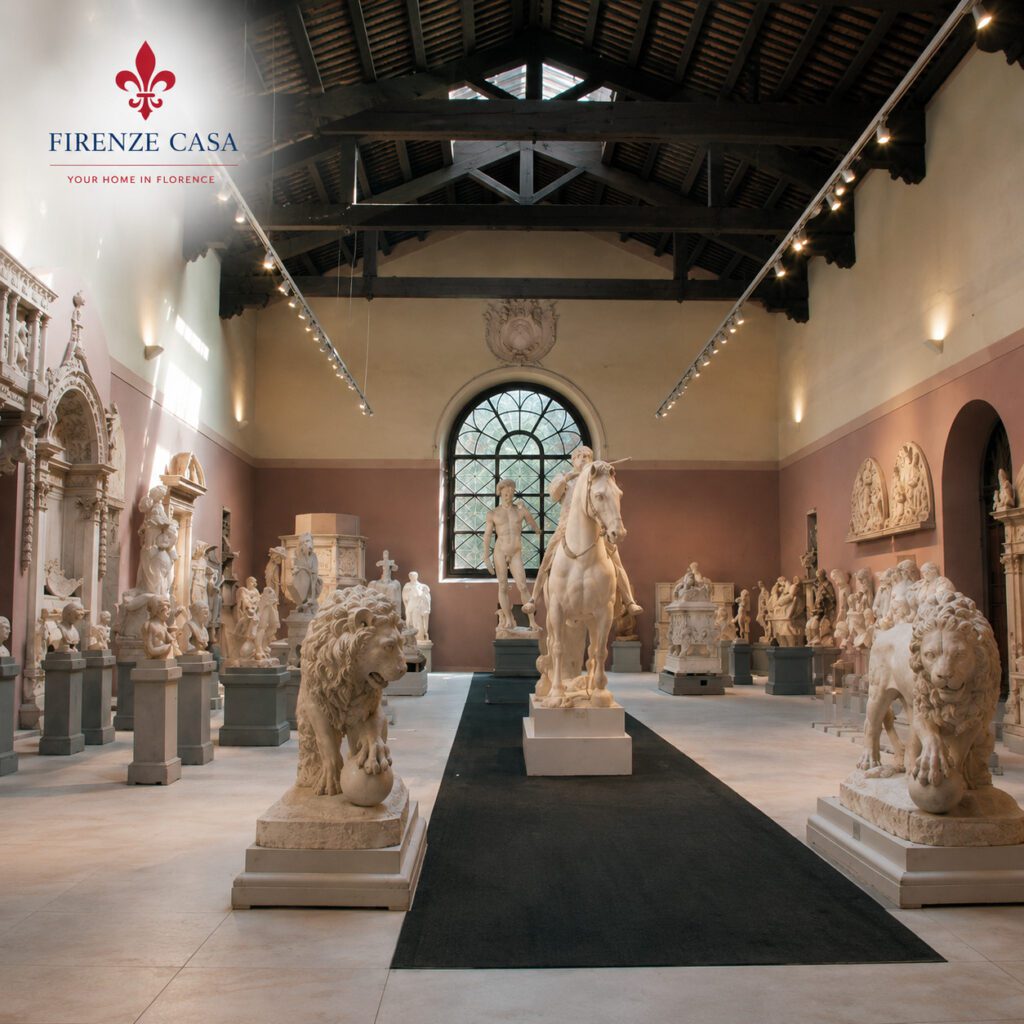
The Gipsoteca di Porta Romana is one of Florence’s most unusual collections of sculpture. Hidden within the historic art institute at Porta Romana, it preserves an extraordinary world of plaster casts reproducing masterpieces of Italian sculpture, architectural decoration and the human figure.
Unlike the Uffizi or Bargello, this is not primarily a collection assembled to display famous original works. The casts were teaching tools that allowed generations of artists and students to study proportion, anatomy, modelling and sculptural technique at close range. Today, the Gipsoteca offers a fascinating glimpse into how Florence taught artists to create, making it a natural part of our Florence Secrets and Traditions – Complete Guide.
Collection: Gipsoteca di Porta Romana
Location: Piazzale di Porta Romana, Florence
Institution: Liceo Artistico di Porta Romana
Main focus: historic plaster casts and moulds
Artists represented: Donatello, Ghiberti, Michelangelo and other Italian masters
Purpose: artistic education and study
Special interest: sculpture, drawing, craftsmanship and art education
What Is the Gipsoteca di Porta Romana?
The Gipsoteca belongs to the historic artistic institution at Piazzale di Porta Romana, today associated with the Liceo Artistico di Porta Romana. Its collection contains plaster reproductions of sculptures, reliefs, architectural details and anatomical models.
At first sight, the white plaster figures may resemble a museum filled with classical and Renaissance sculpture. Their purpose, however, was fundamentally different. These objects formed a working visual archive for artists and students.
Before high-resolution photography, digital archives and inexpensive international travel, accurate plaster casts offered one of the best ways to study important works of art away from their original locations.
A gipsoteca is a collection of plaster casts. During the nineteenth and early twentieth centuries, such collections played an important role in European art education.
Why Plaster Casts Were Important to Artists
Learning to draw and sculpt traditionally involved careful observation. Students studied the human body, geometry, drapery and the way great artists represented movement and expression. Plaster casts were ideal teaching tools because they reproduced three-dimensional form.
A student could walk around a cast, observe it from different angles and examine how light changed across its surface. Drawing the same figure repeatedly developed an understanding of proportion and volume.
For sculptors, casts provided even more information. They revealed how forms occupied space and how complex compositions were organised. The Gipsoteca therefore belongs as much to the history of artistic education as to the history of collecting.
Do not look at the casts only as copies. Imagine them surrounded by students drawing, measuring and modelling: their historical importance lies largely in the role they played in teaching artists how to see.
Porta Romana and Florence’s Tradition of Art Education
Porta Romana stands at the southern edge of Florence’s historic centre, where the old city walls controlled one of the principal routes towards Siena. The gate itself belongs to the wider history explored in our Florence City Walls and Fortresses – Historic Guide.
The institution associated with today’s Liceo Artistico di Porta Romana developed from earlier Florentine schools devoted to decorative and industrial arts. These schools reflected an important nineteenth-century concern: traditional craftsmanship had to adapt to a rapidly changing modern economy without losing the artistic skills for which Florence had long been famous.
Drawing, sculpture, decoration and applied arts therefore remained central to teaching. A collection of high-quality casts fitted naturally into this educational environment.
The Oronzio Lelli Collection
A particularly important chapter in the history of the Gipsoteca di Porta Romana is connected with Oronzio Lelli, a Florentine specialist in mould-making and plaster casting active during the nineteenth century.
Lelli operated a workshop producing casts after important sculptures and decorative works. Such workshops served academies, museums, artists and collectors at a time when reproductions of celebrated artworks circulated widely across Europe.
In 1922, the art institute acquired a substantial collection of moulds and casts associated with the Lelli workshop. This greatly enriched the Gipsoteca and preserved an important part of Florence’s historic tradition of artistic reproduction.
The casts preserve more than the forms of famous sculptures. They also document the specialist skills of mould-makers and craftsmen whose work helped transmit Florentine art around the world.
A Gallery of Renaissance Sculpture in Plaster
One of the pleasures of the collection is encountering familiar forms in an unfamiliar setting. Plaster casts reproduce works associated with some of the great names of Italian sculpture, allowing visitors to concentrate on shape rather than material.
Among the documented casts are reproductions after works by Donatello, Lorenzo Ghiberti, Jacopo della Quercia, Mino da Fiesole, Antonio Rossellino and Michelangelo. Reliefs, statues, architectural ornaments and individual details create an extraordinary visual catalogue of sculptural traditions.
Many of the original masterpieces represented by such casts are dispersed among churches and museums. The Bargello Museum, for example, brings together exceptional original sculptures by Donatello, Michelangelo, Verrocchio and other major Renaissance artists.
The Gipsoteca offers the complementary perspective: not simply the masterpieces themselves, but how their forms were reproduced, compared and studied by later generations.
Michelangelo and the Gipsoteca
Michelangelo has an especially interesting connection with the history of the collection. A full-scale plaster cast of his David, made in the nineteenth century by Clemente Papi, was transferred from the Accademia di Belle Arti to the Gipsoteca in 1929.
The monumental figure occupied a prominent position at the end of the central gallery and became a focal point within the historic display. Its placement allowed Michelangelo’s sculpture to enter into a visual dialogue with other examples of ancient and Renaissance art.
The original David is preserved in the Accademia Gallery, itself an institution with deep roots in artistic education. Comparing the history of the original with that of its plaster reproductions reveals how one masterpiece could fulfil very different roles in Florentine culture.
The history of the cast also demonstrates that plaster reproductions could have lives of their own. They were moved, studied, restored and sometimes used to assist research and conservation.
From Michelangelo’s Bacchus to Ghiberti
The collection extends well beyond a single famous sculpture. A documented plaster cast reproduces Michelangelo’s Bacchus, whose marble original is preserved in the Bargello. Other casts reproduce Renaissance reliefs and architectural decoration.
The Gipsoteca also preserves casts connected with Lorenzo Ghiberti’s celebrated Baptistery doors. These reproductions allowed students to examine complex relief compositions closely and understand the combination of sculpture, perspective and narrative that made Ghiberti’s work so influential.
Elsewhere, casts after Jacopo della Quercia and other masters broaden the collection beyond Florence and create a visual survey of important developments in Italian sculpture.
Another excellent place to understand the central role of sculpture in Florentine public life is Orsanmichele, whose exterior niches were commissioned by the city’s guilds from artists including Donatello, Ghiberti and Verrocchio.
Anatomy as Part of Artistic Training
Not every object in a historic cast collection reproduces a famous sculpture. Anatomical models also played an important role in artistic training. Understanding muscles, posture and the structure of the human body was essential for artists attempting to represent figures convincingly.
The Gipsoteca preserves examples of this teaching tradition. Such objects occupy an intriguing space between science and art: they were practical educational instruments, yet their careful modelling also reflects Florence’s centuries-old fascination with human anatomy.
Artists such as Leonardo da Vinci and Michelangelo studied the body intensively because anatomical knowledge could improve artistic representation. The models at Porta Romana belong to the later educational tradition that continued this close observation of the human form.
The Art of Making a Cast
Creating an accurate plaster cast required considerable technical skill. A mould had to capture the surface of the original without damaging it, often using multiple sections so that complex forms could be reproduced.
Plaster was then poured or applied into the mould. Once hardened, individual sections could be removed, assembled and carefully finished. Large sculptures required particularly sophisticated techniques.
Florence developed specialist craftsmen who mastered these processes. The history of the Gipsoteca therefore preserves not only the memory of famous sculptors but also that of the skilled artisans responsible for reproducing their work.
This continuity between fine art and skilled manual work remains an important part of Florence’s identity. The city’s long tradition of specialist workshops is explored further in our Traditional Workshops in Florence – Complete Guide.
Why Copies Have Historical Value
Modern visitors sometimes instinctively value an original artwork and dismiss a reproduction. Historically, however, plaster casts served purposes that make them important objects in their own right.
They documented sculptures, circulated artistic knowledge and supported education. In some cases, historic casts can preserve information about the condition of an original at the moment the mould was taken. If the original was later damaged or altered, an old cast may become valuable evidence.
The casts also document changing ideas about which artists and works were considered worthy of study. A historic gipsoteca can therefore reveal the artistic canon of a particular period.
A Different Way to Experience Renaissance Sculpture
Florence usually presents Renaissance sculpture through individual masterpieces. Michelangelo’s David dominates the Accademia, while the Bargello contains exceptional works by Donatello, Verrocchio, Michelangelo and others.
The Gipsoteca di Porta Romana offers a different experience. Here, reproductions bring works from different places together and encourage comparison. Material and colour become secondary, while form, proportion and composition move to the foreground.
For anyone interested in how artists actually studied sculpture, this can be surprisingly revealing.
White plaster changes the way sculpture is perceived. Without the different colours and textures of marble, bronze or terracotta, the eye concentrates more strongly on contours, modelling, shadow and volume.
The Historic Setting at Porta Romana
The setting contributes greatly to the atmosphere. The Gipsoteca occupies spaces associated with the historic art school rather than a purpose-built modern museum, preserving the connection between the objects and their original educational function.
Rows of pale sculptures and reliefs create the impression of an enormous three-dimensional archive. Instead of encountering an isolated masterpiece on a museum pedestal, visitors enter a world shaped by study, repetition and comparison.
Porta Romana itself also marks the transition from the dense Oltrarno towards the hills south of Florence. Its combination of historic gate, artistic institution and nearby gardens makes the area particularly rewarding for visitors exploring beyond the most familiar routes.
From Craftsmanship to Modern Design
The history of the Porta Romana art school connects traditional Florentine craftsmanship with modern artistic education. Florence had long been famous for sculpture, metalwork, woodwork, textiles and decorative arts. During the nineteenth and twentieth centuries, art schools faced the challenge of preserving these skills while responding to changing design and production methods.
Historic casts became part of that bridge between past and present. Students could study Renaissance masters while developing skills intended for their own contemporary work.
The collection therefore represents continuity rather than simple nostalgia. It shows how Florence repeatedly used its artistic past as a foundation for new generations of artists and designers.
Why the Gipsoteca Is a Florence Secret
The Gipsoteca remains far less famous than Florence’s major museums. Its location outside the most heavily visited part of the historic centre contributes to that relative obscurity, as does its connection with an educational institution rather than a conventional tourist museum.
Yet these characteristics are precisely what make it interesting. The collection reveals a part of Florence’s artistic infrastructure that visitors rarely consider. Renaissance masterpieces did not influence later generations automatically: schools, teachers, workshops, casts and craftsmen helped transmit that knowledge.
The Gipsoteca preserves this hidden network of artistic learning and offers precisely the kind of quieter cultural discovery that makes lesser-known Florence so rewarding.
Planning a Visit
The Gipsoteca is associated with an active educational institution rather than operating exactly like one of Florence’s major public museums. Access arrangements can therefore be more limited and may change according to school activities, special openings or organised visits.
Visitors should check current access conditions before making a special journey. Opening arrangements for lesser-known institutional collections can differ significantly from those of conventional museums.
Do not assume that the Gipsoteca follows normal museum opening hours. Check current access information before visiting and treat the collection as a special destination rather than a spontaneous museum stop.
What to Combine with the Gipsoteca
Porta Romana is an excellent starting point for exploring the southern side of Florence. The historic gate marks an important entrance through the former city walls, while the nearby Oltrarno offers a very different atmosphere from the streets around the Duomo and Piazza della Signoria.
From Porta Romana, visitors can continue towards the Boboli Gardens and Palazzo Pitti or explore the quieter residential streets beyond the busiest tourist routes.
For sculpture enthusiasts, another rewarding approach is to combine the Gipsoteca with the Bargello and Accademia. Together, the three places reveal original Renaissance masterpieces, the history of artistic education and the reproduction of sculpture for study.
Frequently Asked Questions
What is the Gipsoteca di Porta Romana?
It is a historic collection of plaster casts associated with the art institute at Porta Romana. The collection includes reproductions of sculptures, reliefs, architectural details and anatomical models.
Are the sculptures originals?
The collection is primarily important for its historic plaster casts and moulds rather than original marble or bronze masterpieces. Their value lies in artistic education, reproduction and craftsmanship.
Why did art schools use plaster casts?
Casts allowed students to study important sculptures in three dimensions. They could draw, measure and compare forms without needing direct access to originals in museums, churches or other cities.
Is the Gipsoteca connected with Michelangelo?
Yes. Its history includes reproductions after Michelangelo, including a historic full-scale cast of David transferred to the collection in 1929.
What is special about the Oronzio Lelli collection?
The acquisition of casts and moulds associated with Lelli’s Florentine workshop in 1922 substantially enriched the Gipsoteca and preserved an important example of nineteenth-century cast-making culture.
Can tourists visit the Gipsoteca?
Access may be possible but can be limited because the collection belongs to an active educational institution. Check current arrangements before travelling specifically to Porta Romana.
Should I visit the Gipsoteca or the Bargello?
Visit the Bargello for original Renaissance masterpieces and the Gipsoteca to understand how sculpture was reproduced, compared and taught. For sculpture enthusiasts, the two experiences complement each other particularly well.
Why the Gipsoteca di Porta Romana Is Worth Discovering
The Gipsoteca di Porta Romana tells a story that Florence’s famous museums rarely reveal. The city’s artistic greatness depended not only on individual geniuses and original masterpieces, but also on generations of teachers, students and skilled craftsmen who transmitted artistic knowledge.
Plaster casts played an important role in that process. They allowed sculptures to travel without the originals moving, brought distant masterpieces into classrooms and gave students the opportunity to understand three-dimensional form through direct observation.
The collection also preserves the history of specialist Florentine mould-makers such as Oronzio Lelli and the educational traditions connecting Renaissance sculpture with modern artistic training.
For visitors willing to move beyond Florence’s conventional museum itinerary, the Gipsoteca offers something genuinely different: not another gallery of celebrated masterpieces, but a fascinating look behind the scenes of how Florence taught generations of artists to see, draw and sculpt.
Further Reading on Firenze Casa
- Florence Secrets and Traditions – Complete Guide
- Bargello Museum – Renaissance Sculpture in Florence
- Accademia Gallery – Home of Michelangelo’s David
- Orsanmichele – Florence’s Church of Art and Guilds
- Traditional Workshops in Florence – Complete Guide
- Florence City Walls and Fortresses – Historic Guide
- Palazzo Pitti – History, Architecture & Museums
References
- Ministero della Cultura – Catalogo Generale dei Beni Culturali, Gipsoteca dell’Istituto Statale d’Arte di Firenze.
- Liceo Artistico di Porta Romana e Sesto Fiorentino – historical information on the institute and its collections.
- Caputo Calloud, Annarita – studies and catalogues of the plaster casts of the Gipsoteca.
- Bernardini, Luciano; Caputo Calloud, Annarita; Mastrorocco, Marina – La scultura italiana dal XV al XX secolo nei calchi della Gipsoteca.
- Bernardini, Luciano; Caputo Calloud, Annarita; Mastrorocco, Marina – Donatello e il primo Rinascimento nei calchi della Gipsoteca.
- Victoria and Albert Museum – research on historic plaster casts of Michelangelo’s David and Florentine cast-making.

