
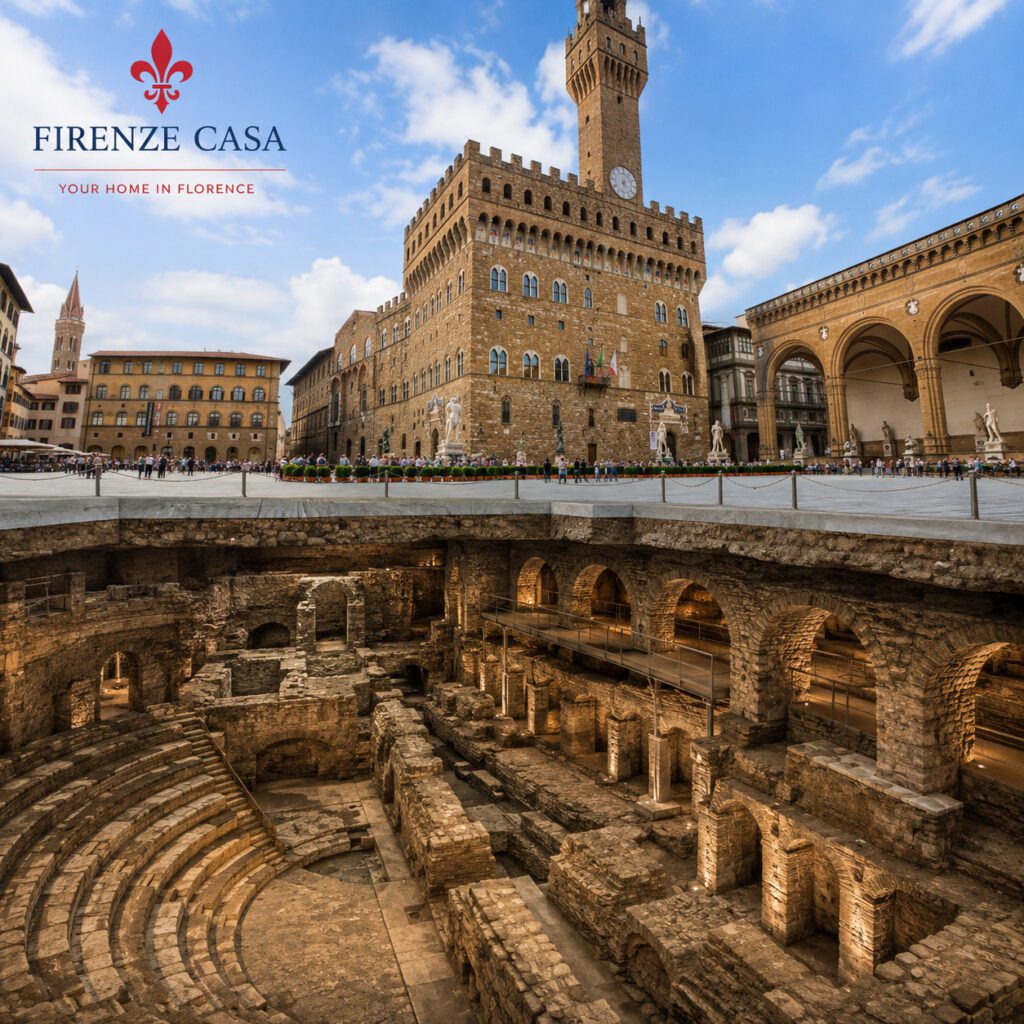
Roman Florence beneath Palazzo Vecchio reveals a side of the city that many visitors never imagine. Below the medieval fortress and Renaissance palace survive remains of the ancient Roman theatre of Florentia, together with traces of the buildings and streets that occupied this part of Florence during later centuries.
Standing today in Piazza della Signoria, it is easy to think of Florence primarily as a medieval and Renaissance city. Yet beneath Palazzo Vecchio lies evidence of a much older urban landscape. The archaeological remains provide a fascinating glimpse into Florentia, the Roman settlement from which modern Florence developed, and form one of the oldest layers explored in our Florence Secrets and Traditions – Complete Guide.
Location: beneath Palazzo Vecchio, Piazza della Signoria
Main remains: Roman theatre of Florentia
Origins: late 1st century BC, with later enlargement
Estimated capacity: around 8,000–10,000 spectators
Later layers: medieval streets, houses, wells and reused Roman structures
Excavations: major investigations between 2004 and 2010
Main interest: Roman Florence and the archaeological layers beneath the modern city
The Roman Theatre of Ancient Florentia
The most important archaeological remains beneath Palazzo Vecchio belong to the Roman theatre of Florentia. The earliest phase probably dates to around the foundation of the Roman colony in the late first century BC.
The theatre was later enlarged, probably during the major development of Florence in the late first or early second century AD. At its greatest extent, archaeologists estimate that it may have accommodated around 8,000 to 10,000 spectators.
This was therefore no modest provincial entertainment venue. Its dimensions demonstrate that imperial Florentia had developed into a substantial urban centre with the public architecture expected of a Roman city.
The theatre forms part of a much broader story stretching from ancient Florentia to the modern city, explored in our History of Florence.
Where the Roman Theatre Once Stood
The ancient theatre occupied an area extending beneath parts of present-day Palazzo Vecchio and neighbouring Palazzo Gondi. Its semicircular seating area, or cavea, faced towards what is now Piazza della Signoria, while the stage area extended towards Via dei Leoni.
Visitors walking through this part of Florence today therefore cross the footprint of a monumental Roman building without seeing almost any evidence of it at street level.
The contrast is extraordinary. Piazza della Signoria later became the political heart of medieval and Renaissance Florence, while beneath it and the surrounding buildings survives evidence of a completely different city.
Piazza della Signoria belongs to an area where ancient, medieval and Renaissance structures overlap. The Roman theatre beneath Palazzo Vecchio is one of the clearest examples of this remarkable urban stratification.
What Archaeologists Discovered Beneath Palazzo Vecchio
Preliminary archaeological investigations beneath the palace took place in 1997 and 1998. A more extensive excavation campaign followed between 2004 and 2010.
Archaeologists uncovered sections of the theatre’s supporting structures and underground radial corridors known as burelle. These passages supported the seating above and formed part of the circulation system of the enormous building.
Among the discoveries was part of a vomitorium, a passage through which spectators entered or left the seating areas. Archaeologists also identified the inner edge of the orchestra, another important component of the Roman theatre.
Fragments of amphorae found within the structures provided valuable chronological evidence. Some vessels had been broken and reused within drainage systems, helping archaeologists understand phases of construction and expansion.
What Was Roman Florentia Like?
The archaeological remains help us imagine a Florence very different from the towers, palaces and churches of the medieval city. Florentia followed an organised Roman street plan and contained public buildings, baths and entertainment structures.
The theatre would have brought together thousands of inhabitants for performances and public spectacles. Its size reflects the growing importance of Florentia during the imperial period.
The centre of the Roman settlement lay around today’s Piazza della Repubblica, where the principal north-south and east-west streets crossed. The ancient forum occupied this central area, which remained important throughout subsequent centuries.
Our article on the lost Mercato Vecchio follows this remarkable continuity from the Roman forum through the dense medieval market district to today’s Piazza della Repubblica.
Roman Florentia was considerably smaller than the historic centre visitors explore today. Its ancient street plan and archaeological remains nevertheless continue to influence the shape of central Florence.
From Roman Theatre to Medieval Florence
The end of the Roman theatre did not mean the end of activity on the site. By around the fifth century AD, the building gradually lost its original function as the political and economic structures of the Western Roman Empire changed.
Building materials were removed and reused elsewhere, while surviving Roman substructures acquired completely new purposes. Former corridors served at different times as storage spaces, animal shelters and other practical areas.
During the medieval period, some of the ancient burelle were even used as prisons. The elevated remains of the theatre were incorporated into a fortified structure traditionally known as the Guardingo.
Gradually, houses, streets and other buildings appeared over and around the Roman remains. By the twelfth and thirteenth centuries, the site had become part of the dense fabric of medieval Florence.
The Medieval Streets Beneath the Palace
The excavations revealed much more than Roman structures. Archaeologists also discovered medieval wells, house foundations and traces of buildings dating approximately from the twelfth to the fourteenth centuries.
Particularly evocative is evidence of a medieval street frontage with doorways and surviving paving. These remains belonged to the neighbourhood that existed here before the expanding civic palace absorbed the area.
The archaeological site therefore preserves not one vanished Florence but several. Roman architecture, medieval houses and the later palace occupy successive layers of the same urban space.
Later generations repeatedly reused earlier structures. Beneath Palazzo Vecchio, Roman corridors, medieval buildings and later architecture literally occupy different layers of the same place.
Palazzo Vecchio Rises Above the Ancient City
Construction of the great civic palace began in 1299. As the Palazzo della Signoria – today’s Palazzo Vecchio – developed and later expanded, earlier structures gradually disappeared beneath its growing architectural footprint.
The builders sometimes made practical use of what was already underground. Ancient Roman structures could provide foundations or support for later construction.
Above these archaeological layers, Palazzo Vecchio became one of the defining monuments of Florence. Its history as the seat of republican government and later a Medici palace is explored alongside the city’s other major civic and family residences in The Most Beautiful Palaces in Florence.
The relationship between palace and theatre is particularly striking: one of Florence’s greatest symbols of medieval civic power stands directly above the remains of a monumental building created for Roman public life.
Palazzo Gondi and the Ancient Theatre
The Roman theatre extended beyond the footprint of Palazzo Vecchio into the area beneath neighbouring Palazzo Gondi. This creates another fascinating connection between ancient and Renaissance Florence.
Palazzo Gondi was commissioned by Giuliano Gondi from the celebrated architect Giuliano da Sangallo around the end of the fifteenth century. Its elegant Renaissance architecture therefore stands above ground once occupied by one of Florentia’s major public monuments.
The Gondi family belonged to Florence’s influential banking and merchant elite. Their palace beside Palazzo Vecchio demonstrates how completely later generations transformed the ancient urban landscape while continuing to build on the same ground.
Rediscovering the Roman Theatre
The existence of Roman structures in this area had long been known, but modern archaeological investigation made it possible to understand the theatre more precisely.
Excavations revealed enough of its surviving architecture to reconstruct important aspects of the building’s dimensions and organisation. They also documented the extraordinary sequence of later uses that transformed the site after antiquity.
The result is one of Florence’s most compelling archaeological stories: a Roman entertainment complex gradually becoming part of the medieval city and eventually disappearing beneath its most famous civic palace.
Roman Florence Beyond Palazzo Vecchio
The theatre was only one element of ancient Florentia. The Roman settlement followed a regular street plan enclosed by defensive walls, and traces of that ancient organisation remain embedded within the modern historic centre.
Piazza della Repubblica occupies approximately the heart of Roman Florentia, while other archaeological evidence survives beneath streets and buildings elsewhere in the centre. Our Florence City Walls and Fortresses – Historic Guide traces the expansion of the city from its compact Roman defences through the much larger medieval wall circuits.
Another extraordinary survival is the ancient amphitheatre. Although the monument itself is largely hidden beneath later construction, the curved street pattern around Piazza de’ Peruzzi still preserves part of its shape.
The Peruzzi family later established residences in this area, creating another remarkable overlap between Roman Florentia and medieval family Florence.
From the Etruscans to Roman Florence
Even Roman Florentia was not the beginning of human history in the region. The Florentine plain and surrounding hills preserve important evidence of earlier Etruscan settlement.
The Tomba della Montagnola at Sesto Fiorentino dates to the seventh century BC and demonstrates the presence of wealthy Etruscan communities centuries before the Roman colony of Florentia was established.
Fiesole provides another important piece of this ancient landscape, preserving both Etruscan and Roman remains in the hills above Florence. Together, these sites place the archaeological remains beneath Palazzo Vecchio within a much longer history of settlement in the region.
Florence’s Renaissance masterpieces represent only one chapter of a much longer history. Etruscan sites, Roman Florentia and medieval Florence all survive within or around the modern city.
Can You Visit the Archaeological Site?
The archaeological route beneath Palazzo Vecchio has allowed visitors to walk among remains associated with the Roman theatre and later medieval structures.
Access conditions can change, however, and the archaeological route has experienced periods of closure. Visitors interested specifically in the Scavi del Teatro romano di Firenze should therefore check current information from the Museo di Palazzo Vecchio before planning their visit.
Even when the underground route is unavailable, Palazzo Vecchio remains essential for understanding Florence. Knowing that the Roman theatre survives beneath the palace completely changes the way Piazza della Signoria appears above.
Stand in Piazza della Signoria and imagine the layers beneath your feet: Roman spectators entering a monumental theatre, medieval houses and streets replacing it, and finally Palazzo Vecchio rising above them.
Why This Hidden Site Matters
Florence is celebrated throughout the world for the Renaissance, but its history did not begin with the Medici, Brunelleschi or Michelangelo. Long before the medieval skyline emerged, Florentia had already developed as a Roman city.
The archaeological remains beneath Palazzo Vecchio make that continuity tangible. Few places demonstrate so clearly how Florence repeatedly rebuilt itself while preserving fragments of earlier periods below the surface.
Above ground stands one of the great symbols of medieval civic power. Below it survive the corridors of a Roman theatre. Between them lie traces of medieval houses and streets. Together, they tell almost two thousand years of urban history within a remarkably compact space.
Frequently Asked Questions
What lies beneath Palazzo Vecchio?
Important remains of the Roman theatre of Florentia survive beneath Palazzo Vecchio, together with medieval streets, wells and building remains from later phases of the site.
How old is the Roman theatre of Florence?
Its earliest phase probably dates to the late first century BC. The theatre was subsequently enlarged during the Roman imperial period.
How many spectators could the Roman theatre hold?
Archaeological reconstructions suggest a capacity of approximately 8,000 to 10,000 spectators at its greatest extent.
Where was the centre of Roman Florentia?
The Roman forum occupied approximately the area of today’s Piazza della Repubblica, where the principal streets of the ancient settlement crossed.
Was the Roman theatre still visible in medieval Florence?
Parts of its structure survived and were reused for new purposes. Medieval buildings gradually incorporated or covered the ancient remains.
Can you visit the Roman theatre beneath Palazzo Vecchio?
The archaeological route has been accessible at various times, but opening conditions can change. Check current Palazzo Vecchio information before planning a visit specifically to the excavations.
Are there other Roman remains in Florence?
Yes. Roman structures and street patterns survive beneath several parts of the historic centre, including traces of the forum, city walls and amphitheatre.
Why Roman Florence Beneath Palazzo Vecchio Is Worth Discovering
Roman Florence beneath Palazzo Vecchio reveals the extraordinary depth of the city’s history. A monument most visitors associate with medieval politics and Renaissance art stands directly above one of ancient Florentia’s great public buildings.
The Roman theatre is fascinating in its own right, but the later layers make the site even more important. Roman corridors became medieval spaces, houses and streets appeared above the ancient structure, and Palazzo Vecchio eventually transformed the entire area once again.
Understanding these layers changes the experience of Florence. Piazza della Signoria is no longer simply a magnificent Renaissance setting but part of an urban landscape that has been continuously rebuilt for almost two millennia.
Few places demonstrate more clearly that some of Florence’s most fascinating history remains hidden beneath the city we see today.
Further Reading on Firenze Casa
- Florence Secrets and Traditions – Complete Guide
- History of Florence
- Tomba della Montagnola – Etruscan Tomb near Florence
- The Lost Mercato Vecchio of Florence
- Florence City Walls and Fortresses – Historic Guide
- The Most Beautiful Palaces in Florence
- The Gondi Family: Banking and Power in Florence
- The Peruzzi Family: Banking and Politics in Florence
References
- Comune di Firenze – Museo di Palazzo Vecchio, Piano terra e sottosuolo.
- Comune di Firenze – Gli Scavi del Teatro romano di Firenze.
- Fondazione MUS.E – Museo di Palazzo Vecchio.
- De Marinis, Giuliano – archaeological studies of Roman Florentia and the Roman theatre.
- Maetzke, Guglielmo – studies on the archaeology and urban development of ancient Florence.

