
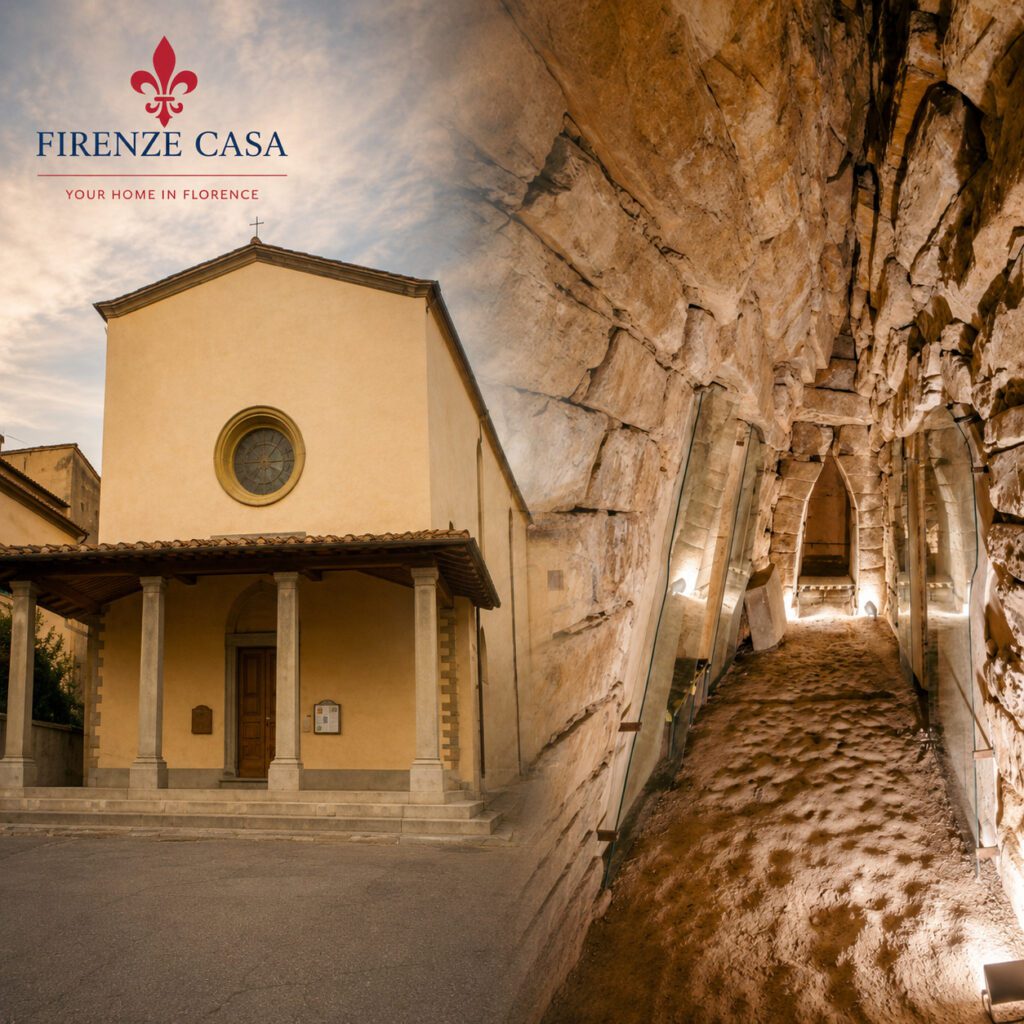
Tomba della Montagnola is one of the most remarkable archaeological sites near Florence. Hidden beneath an artificial mound at Sesto Fiorentino, the monumental Etruscan tomb offers an extraordinary glimpse into Tuscany long before the rise of Roman Florentia and Renaissance Florence.
Visitors who associate Florence mainly with medieval towers, Renaissance palaces and Medici history may therefore find the site particularly surprising. Only a short distance from the historic centre lies evidence of a much older civilisation that shaped central Italy centuries before Rome dominated the region. The tomb represents the oldest historical layer explored in our Florence Secrets and Traditions – Complete Guide.
Site: Tomba della Montagnola
Location: Sesto Fiorentino, northwest of Florence
Period: Etruscan, 7th century BC
Type: monumental tumulus tomb
Main interest: Etruscan architecture and funerary culture
Historical context: the Florentine plain before Roman Florentia
Best for: archaeology, ancient Tuscany and visitors looking beyond Renaissance Florence
An Etruscan Monument at Sesto Fiorentino
The tomb stands in Sesto Fiorentino, northwest of central Florence. Today, this landscape forms part of the wider Florentine metropolitan area, but archaeological discoveries demonstrate that people occupied and used the plain around Florence thousands of years before the medieval and Renaissance city emerged.
The Tomba della Montagnola dates to the Etruscan period and is generally associated with the seventh century BC. It therefore predates many of Florence’s most familiar historical monuments by well over a millennium.
The structure belonged to an elite burial tradition. Its considerable dimensions and carefully constructed interior indicate the wealth and status of the people for whom it was created.
The Tomba della Montagnola reveals a layer of Tuscan history easily overlooked when visiting Florence. Its monumental architecture demonstrates the wealth, craftsmanship and sophisticated burial traditions of the Etruscans.
Inside the Tomba della Montagnola
From the outside, the monument is concealed beneath a mound. Inside, visitors encounter a carefully planned architectural complex constructed from stone.
A long entrance passage, or dromos, leads towards the burial chambers, creating a gradual transition from the outside world into the enclosed funerary space. The construction demonstrates considerable technical knowledge and careful planning.
Particularly impressive is the monumental central chamber with its stone architecture. The arrangement of the spaces and precision of the masonry give the tomb the character of an underground building rather than a simple grave.
The architecture itself is one of the great attractions of the Montagnola tomb. Notice how carefully the Etruscan builders created the entrance passage, chambers and supporting stone elements rather than concentrating only on the objects once placed inside.
The World of the Etruscans
The Etruscans were among the most influential civilisations of ancient Italy. Before Roman expansion transformed the peninsula, Etruscan communities controlled large areas of Tuscany and neighbouring regions.
Their culture developed sophisticated cities, trade networks, religious practices and artistic traditions. Burial sites provide some of the most important surviving evidence for understanding their society.
Monumental tombs were more than places for the dead. They expressed family identity, wealth and social status, allowing archaeologists to reconstruct aspects of communities that left comparatively few surviving written records.
For visitors interested in exploring this civilisation more broadly, Fiesole – History, Etruscans and the Hills Above Florence provides an important comparison. Ancient Fiesole was already an established Etruscan centre long before Florence became the dominant city of the Arno Valley.
Etruscan History Before Florence
Florence itself became important much later. The Roman settlement of Florentia was established centuries after the construction of the Montagnola tomb.
The surrounding landscape, however, already belonged to a populated and culturally active region. Archaeological discoveries around Sesto Fiorentino demonstrate that the Florentine plain has a history extending far beyond the conventional story of Florence.
This deeper chronology is essential to understanding the city. Our History of Florence begins with the Etruscan and Roman background before following the city through its medieval expansion, Renaissance flowering and later history.
Florence did not suddenly appear with the Romans or flourish only with the Medici. Its landscape preserves traces of successive civilisations extending deep into antiquity.
The Renaissance represents only a small part of the history of the Florentine landscape. Etruscan monuments around Florence take visitors back more than two thousand years before Michelangelo, Leonardo and the Medici.
Why Was the Tomb Built Beneath a Mound?
Large burial mounds were visible expressions of status in several ancient Mediterranean cultures. The mound covering the Montagnola monument transformed the burial place into a significant feature of the landscape.
Over the centuries, vegetation and later development made the ancient structure far less obvious. This contrast explains part of the site’s appeal today: what initially appears to be an unassuming location conceals an elaborate ancient monument underground.
The Italian word montagnola evokes the idea of a small hill or mound. In this case, the name perfectly reflects the physical character of the archaeological site.
Architecture for the Dead
The monumental scale of the tomb reflects an important aspect of Etruscan funerary culture. Elite burial places could be conceived almost as architecture for the dead, with passages and chambers creating carefully organised internal spaces.
The construction required considerable labour and technical expertise. Large stone elements had to be transported, positioned and combined into a stable underground structure capable of surviving beneath the weight of the mound.
This architectural ambition helps explain why Etruscan tombs are so important to archaeologists. Even when grave goods have disappeared or been disturbed, the structure itself preserves evidence of social organisation, craftsmanship and beliefs surrounding death.
The Discovery of the Ancient Tomb
The Tomba della Montagnola was discovered in the twentieth century. Archaeological investigation subsequently revealed the scale and importance of the monument concealed beneath the mound.
Its rediscovery added significantly to knowledge of Etruscan settlement and elite culture in the area north of Florence. The tomb can also be considered alongside other archaeological discoveries around Sesto Fiorentino that demonstrate the ancient importance of the Florentine plain.
Today, the monument provides a rare opportunity to encounter Etruscan architecture close to one of Europe’s most famous Renaissance cities.
From the Etruscans to Roman Florentia
The Montagnola tomb and Roman Florence belong to very different historical periods, yet experiencing them together creates a fascinating chronological journey.
Roman Florentia developed on the Arno plain centuries after the tomb was constructed. Its organised street grid, forum, baths, theatre and amphitheatre introduced a different form of urban culture to the landscape.
Much of Roman Florence now lies beneath the medieval and Renaissance city. Our article on Roman Florence Beneath Palazzo Vecchio explores archaeological remains beneath one of Florence’s most famous civic monuments, while Via delle Terme preserves the memory of Roman baths beneath the modern streets.
Seen together, these sites demonstrate that the history of Florence and its surroundings consists of many cities and cultures layered across the same landscape.
Combine an interest in Roman Florence with the Etruscan sites around Sesto Fiorentino and Fiesole. Together, they create a fascinating journey through the centuries before medieval Florence emerged.
Ancient Fiesole and the Florentine Plain
Fiesole provides another essential piece of this ancient landscape. Its hilltop position was occupied long before Roman Florence developed in the valley below, and archaeological remains preserve both Etruscan and Roman phases.
The archaeological area includes evidence of an Etruscan sanctuary later transformed under Roman rule, as well as the Roman theatre and baths. This continuity makes Fiesole particularly valuable for understanding how Etruscan and Roman cultures overlapped in the region.
Montagnola offers something different. Instead of an ancient urban centre, visitors encounter an elite funerary monument whose architecture reveals the beliefs and social hierarchy of Etruscan society.
Together, Fiesole and Montagnola demonstrate that the area surrounding Florence was anything but empty before Florentia was founded.
Discovering Etruscan Florence in the Archaeological Museum
Visitors who want to understand the Etruscans without leaving central Florence should also consider the National Archaeological Museum of Florence. Its collections include important Etruscan material alongside Egyptian, Greek and Roman objects.
The museum provides useful context for archaeological sites such as Montagnola because objects help reconstruct aspects of Etruscan religion, craftsmanship and daily life that architecture alone cannot reveal.
It is also one of the lesser-known institutions included in our Free Museums in Florence: First Sunday Free Entry Guide.
A Different Side of Florence
Visiting the Montagnola tomb changes the chronological perspective of a stay in Florence. After seeing Palazzo Vecchio, the Duomo or the great Renaissance churches, entering an Etruscan burial monument feels like travelling into an entirely different world.
This contrast makes the site especially rewarding for travellers looking beyond Florence’s famous attractions. It reveals that some of the area’s most intriguing historical places lie outside conventional tourist routes.
The tomb also complements archaeological traces within Florence itself. Roman remains beneath the modern city tell one chapter of its ancient history, while Etruscan sites outside the centre reveal an even earlier one.
This hidden chronology is also explored in Hidden Stories of Florence – Complete Guide, where Roman structures and other forgotten layers can still be traced through the streets of the modern city.
Visiting the Tomba della Montagnola
The archaeological site lies in Sesto Fiorentino, a relatively short distance northwest of central Florence. Access, however, requires more planning than a visit to a major city museum.
Opening arrangements for archaeological sites can change, and access may be limited to particular days, guided visits or special openings. Visitors should therefore check current information with the responsible cultural authorities before travelling specifically to the site.
This limited accessibility also contributes to its atmosphere. Unlike Florence’s major museums, the Montagnola tomb remains a comparatively little-known destination.
Check current access arrangements shortly before visiting. Smaller archaeological sites may have limited opening days or require advance planning.
Who Should Visit?
The site is particularly worthwhile for travellers interested in archaeology, the Etruscans and the earliest history of Tuscany. It also appeals to repeat visitors who already know Florence’s major Renaissance monuments and want to explore something different.
The Tomba della Montagnola is more than an alternative attraction. It provides historical context for the entire region. By stepping inside the ancient monument, visitors encounter a civilisation that helped shape Tuscany long before Florence became one of Europe’s great cities.
Frequently Asked Questions
Where is the Tomba della Montagnola?
The tomb is located in Sesto Fiorentino, northwest of central Florence, within the wider Florentine metropolitan area.
How old is the Tomba della Montagnola?
The monumental tomb dates to the Etruscan period and is generally associated with the seventh century BC.
What type of tomb is Montagnola?
It is a monumental Etruscan tumulus tomb concealed beneath an artificial mound, with an entrance passage and carefully constructed internal chambers.
Who were the Etruscans?
The Etruscans were one of the major civilisations of pre-Roman Italy. Their cities, trade networks, art and religious traditions were particularly influential in Tuscany and neighbouring regions.
Is the Tomba della Montagnola older than Roman Florence?
Yes. The tomb predates the Roman foundation of Florentia by several centuries and represents a much earlier layer of the region’s history.
Can you visit the Tomba della Montagnola?
Access arrangements can be limited or change over time. Check current information before travelling specifically to the archaeological site.
What can I combine with a visit?
Fiesole and Florence’s archaeological museums and Roman sites provide excellent context for understanding the Etruscan and Roman history of the region.
Why the Tomba della Montagnola Is Worth Discovering
The Tomba della Montagnola challenges the familiar image of Florence and reveals a history stretching far beyond the Renaissance. Beneath a modest mound near the modern city survives monumental architecture created more than two and a half millennia ago.
Its stone chambers and passageways connect today’s Florentine landscape with the world of the Etruscans. Together with the archaeological remains of Fiesole and Roman Florentia, the tomb helps reconstruct a much longer history of human settlement in the region.
It also demonstrates why exploring beyond central Florence can be so rewarding. The great Renaissance monuments tell only one chapter of a landscape inhabited, transformed and reinterpreted by successive civilisations.
For anyone curious about what existed before Roman Florentia and Renaissance Florence, the Montagnola tomb provides one of the most fascinating answers.
Further Reading on Firenze Casa
- Florence Secrets and Traditions – Complete Guide
- Fiesole – History, Etruscans and the Hills Above Florence
- History of Florence – From Roman Florentia to the Renaissance and Beyond
- Roman Florence Beneath Palazzo Vecchio – Archaeological Site
- Via delle Terme – The Roman Baths Hidden Beneath Florence
- Florence’s Lost Roman Amphitheatre
- Hidden Stories of Florence – Complete Guide
- Free Museums in Florence: First Sunday Free Entry Guide
References
- Ministero della Cultura – archaeological heritage and Etruscan sites in Tuscany.
- Soprintendenza Archeologia, Belle Arti e Paesaggio per la città metropolitana di Firenze.
- Comune di Sesto Fiorentino – archaeological heritage and local history.
- Regione Toscana – Etruscan archaeological heritage in Tuscany.
- Archaeological studies on Etruscan settlements and monumental tombs of the Florentine plain.

