
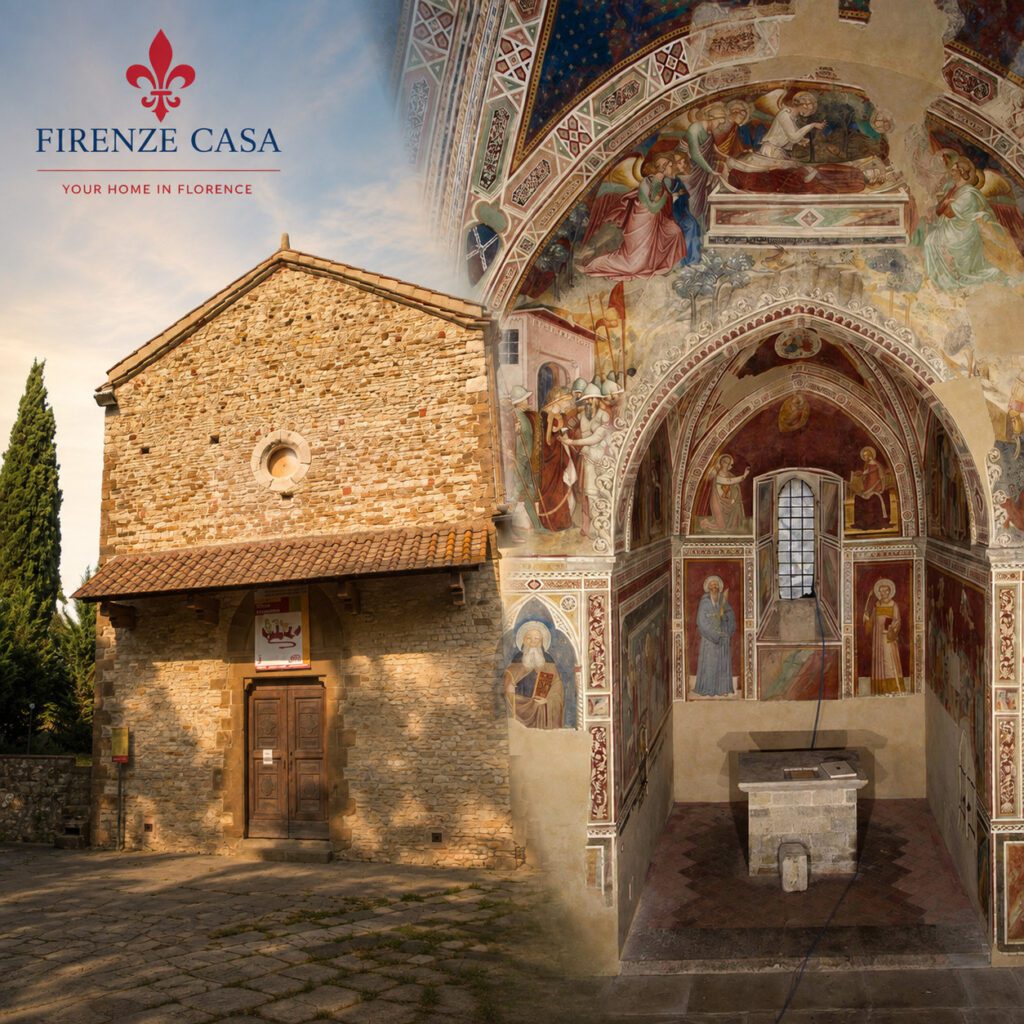
Oratorio di Santa Caterina delle Ruote belongs to the quieter and less familiar side of Florence. Away from the city’s famous museums and monumental churches, this historic oratory reflects the close relationship between religious devotion, art and the world of Florentine confraternities.
Small oratories once formed an important part of everyday life in Florence. They provided spaces where lay religious communities could meet, pray and organise charitable activities, revealing a side of the city that is easily overshadowed by its great basilicas and palaces. Santa Caterina delle Ruote belongs naturally in our Florence Secrets and Traditions – Complete Guide.
Site: Oratorio di Santa Caterina delle Ruote
Dedication: Saint Catherine of Alexandria
Historic context: Florentine confraternity and devotional life
Main themes: religion, community and sacred art
Symbol: the wheel of Saint Catherine
Character: intimate and little known
Access: potentially limited; check current arrangements before visiting
A Hidden Oratory in Florence
The Oratorio di Santa Caterina is dedicated to Saint Catherine of Alexandria, one of the most widely venerated saints of medieval Christianity. Her Italian name, Santa Caterina delle Ruote, refers to the wheel associated with her martyrdom.
Devotion to Saint Catherine became particularly widespread during the Middle Ages. She was regarded as a symbol of learning, courage and steadfast faith, and churches, chapels and religious communities dedicated to her appeared throughout Italy.
In Florence, her cult formed part of a much broader religious landscape. Confraternities and charitable institutions created intimate places of worship alongside the city’s parish churches, monasteries and great basilicas.
Florence once contained a dense network of confraternities. Their chapels and oratories provide valuable evidence of how religion influenced everyday social life beyond the city’s great churches.
Florence and Its Religious Confraternities
To understand small oratories such as Santa Caterina delle Ruote, it helps to look beyond Florence’s famous ecclesiastical monuments. Medieval and Renaissance society included numerous lay confraternities whose members gathered for prayer, charitable work and religious ceremonies.
These organisations brought together citizens from different parts of Florentine society. Some cared for the poor or sick, while others assisted pilgrims, organised funerals or provided religious education. Their meeting places could also become important centres of artistic patronage.
Relatively small buildings could therefore contain paintings and decorations of considerable quality. Their art was not simply ornamental: images helped create an environment for devotion and communal worship.
The Oratorio del Ceppo offers another fascinating example of this world, combining confraternity life with charity, education, Renaissance art and even a connection with the young Luigi Cherubini.
Santa Caterina delle Ruote and Sacred Art
Art played an essential role in Florentine religious institutions. Paintings depicting saints, biblical events and episodes from Christian tradition provided both decoration and visual narratives for worshippers.
Saint Catherine offered artists especially dramatic subject matter. According to Christian tradition, she defended her faith before the Roman emperor and survived an attempt to execute her on a breaking wheel. The wheel subsequently became her principal identifying attribute.
Florentine artists repeatedly represented Catherine during the medieval and Renaissance periods. A dedication to Santa Caterina therefore connects the oratory with a rich tradition of religious imagery found throughout Florence’s churches, chapels and museums.
The Symbolism of Saint Catherine’s Wheel
The unusual name delle Ruote literally means “of the wheels” and derives from the instrument associated with Catherine’s attempted martyrdom.
According to her traditional story, the torture device miraculously broke before it could kill her. Catherine was subsequently executed by beheading, but in Western art the wheel remained her most recognisable symbol.
Artists often depicted the saint beside a broken wheel, sometimes accompanied by a sword, book or palm of martyrdom. These attributes allowed viewers to recognise her immediately at a time when religious images communicated complex stories visually.
When exploring Florentine churches and museums, watch for a female saint accompanied by a wheel. It is one of the easiest ways to identify Saint Catherine of Alexandria in Christian art.
A Different Perspective on Renaissance Florence
Visitors often experience Renaissance Florence through grand commissions created for powerful families, wealthy merchants and major religious institutions. Yet smaller devotional communities also commissioned art and architecture.
This smaller scale provides a different perspective on the Renaissance. Rather than expressing civic power or dynastic ambition, an oratory reflects the religious practices and identity of a particular community.
The contrast becomes especially clear when comparing such spaces with the legacy of Florence’s great families, whose patronage transformed palaces, churches and chapels across the city. Our guide to the most famous Florentine families explores this more public and often highly competitive form of patronage.
Oratories, by contrast, could retain an intimacy that monumental churches could not reproduce. Architecture, paintings and devotional objects were created for relatively small groups of worshippers who shared a common religious identity.
Why Florence’s Small Oratories Matter
Florence’s historic centre can sometimes seem dominated by a relatively small number of celebrated monuments. The city’s cultural landscape becomes much richer once visitors begin exploring its lesser-known religious buildings.
Oratories reveal how Florentines organised themselves into communities and how closely charity, religion and art could be connected. For historians, these institutions provide valuable evidence about social networks and devotional practices.
Another remarkable confraternity setting survives at the Chiostro dello Scalzo, where an intimate architectural space preserves Andrea del Sarto’s celebrated monochrome fresco cycle. Together, places such as the Scalzo, the Ceppo and Santa Caterina reveal a Florence that existed alongside the city’s monumental religious institutions.
Beyond Florence’s Monumental Churches
The contrast with Florence’s great basilicas is particularly revealing. Santa Croce, Santa Maria Novella, San Lorenzo and Santo Spirito tell stories of powerful religious orders, influential patrons and major artistic commissions.
Small oratories occupied a different position within the same religious landscape. Their scale was modest, but they brought worship much closer to the daily lives of specific communities.
Visitors interested in seeing how these different institutions fit together can begin with our guide to the most beautiful churches in Florence and then explore the smaller chapels, cloisters and oratories scattered between them.
Hidden Florence Beyond the Famous Landmarks
The appeal of Santa Caterina delle Ruote lies partly in this sense of discovery. Florence contains countless historic interiors concealed behind relatively modest façades and doors.
Some belong to former convents. Others originated as confraternity meeting rooms, private chapels or charitable institutions. Together, they form an almost invisible network beneath the Florence experienced by most visitors.
The nearby principle is familiar throughout the city: an apparently ordinary street can suddenly reveal a medieval church, Renaissance courtyard or forgotten religious interior. The Secret Courtyards of Florence offer another way to explore this less obvious architectural landscape.
Discovering such places gradually changes the way visitors understand Florence. Instead of seeing the city simply as a collection of masterpieces, they begin to recognise a complex urban society in which neighbourhoods, religious groups and local traditions played essential roles.
One of the pleasures of Florence is discovering that important history is not confined to famous buildings. Small chapels, courtyards and oratories often preserve stories that have survived for centuries almost unnoticed.
A Quieter Way to Experience Florence
Places such as Santa Caterina delle Ruote also encourage a different way of visiting the city. They are not attractions to rush through between timed museum reservations but reminders that Florence rewards curiosity and slower exploration.
This is one of the ideas behind Quiet Florence: The Best Places We Never Queued For. The quieter city does not replace the Uffizi, the Duomo or Santa Croce; it complements them by revealing details and places that are easily missed when every day is organised around major sights.
An oratory, a courtyard or a small historic church may require only a short visit, yet such discoveries often provide a more intimate sense of Florence as a living city rather than an open-air collection of famous monuments.
Visiting Santa Caterina delle Ruote
The Oratorio di Santa Caterina delle Ruote should not be approached like a conventional museum with predictable daily opening hours. Historic religious sites of this kind may have restricted or changing access.
Visitors interested in seeing the interior should therefore verify current information before travelling specifically for the site. Special openings, cultural initiatives or organised visits may provide opportunities to enter.
Even when access requires some planning, discovering such places can be particularly rewarding. They provide a quieter experience of Florence and encourage visitors to explore beyond the city’s busiest routes.
Do not rely on standard museum opening patterns when planning a visit. Access to small historic religious institutions can be irregular, so check current arrangements shortly beforehand.
Frequently Asked Questions
Who was Saint Catherine of Alexandria?
Saint Catherine was an early Christian martyr whose cult became widespread during the Middle Ages. She was especially associated with learning, courage and steadfast faith.
Why is she called Santa Caterina delle Ruote?
The name refers to the wheel associated with her attempted martyrdom. A broken wheel became her most recognisable attribute in Christian art.
What was a Florentine confraternity?
A confraternity was an association of laypeople organised around religious devotion and often charitable or social activities. Many also commissioned artworks for their chapels and meeting rooms.
Why are Florence’s small oratories important?
They reveal how religion, charity and community life operated beyond the city’s great churches. Their intimate spaces also preserve a different form of Florentine artistic patronage.
Can you visit the Oratorio di Santa Caterina delle Ruote?
Access may be limited or irregular. Visitors should check current arrangements before making a special journey.
Is Santa Caterina delle Ruote worth discovering?
Yes, particularly for visitors interested in hidden Florence, religious history and places beyond the conventional sightseeing routes.
Why Santa Caterina delle Ruote Is Worth Discovering
Oratorio di Santa Caterina delle Ruote represents a quieter layer of Florence’s religious and social history. Its significance lies not in monumental scale but in what small devotional institutions reveal about the communities that once shaped everyday life in the city.
The dedication to Saint Catherine connects the oratory with centuries of Christian imagery, while its confraternity context places it within a network of lay religious organisations that combined worship, charity and communal identity.
Places such as this also broaden our understanding of Renaissance Florence. Great families, guilds, monasteries and political institutions transformed the city, but smaller communities contributed to its cultural landscape as well.
For travellers interested in the lesser-known layers of Florence, Santa Caterina delle Ruote is precisely the kind of place that makes exploring the city endlessly fascinating.
Further Reading on Firenze Casa
- Florence Secrets and Traditions – Complete Guide
- Oratorio del Ceppo – A Hidden Oratory in Florence
- Chiostro dello Scalzo – Florence’s Hidden Renaissance Cloister
- Cappella di San Luca – Florence’s Chapel of the Painters
- The Most Beautiful Churches in Florence – Complete Guide
- Quiet Florence: The Best Places We Never Queued For
- Secret Courtyards of Florence – Hidden Gems & Tranquil Spaces
- The Most Famous Florentine Families in History
References
- Comune di Firenze – historical and cultural documentation on Florence.
- Regione Toscana – cultural heritage and historic religious sites in Tuscany.
- Treccani – Santa Caterina d’Alessandria and Christian iconography.
- Studies on Florentine confraternities and lay religious institutions.
- Studies on religious patronage and devotional art in Renaissance Florence.

