
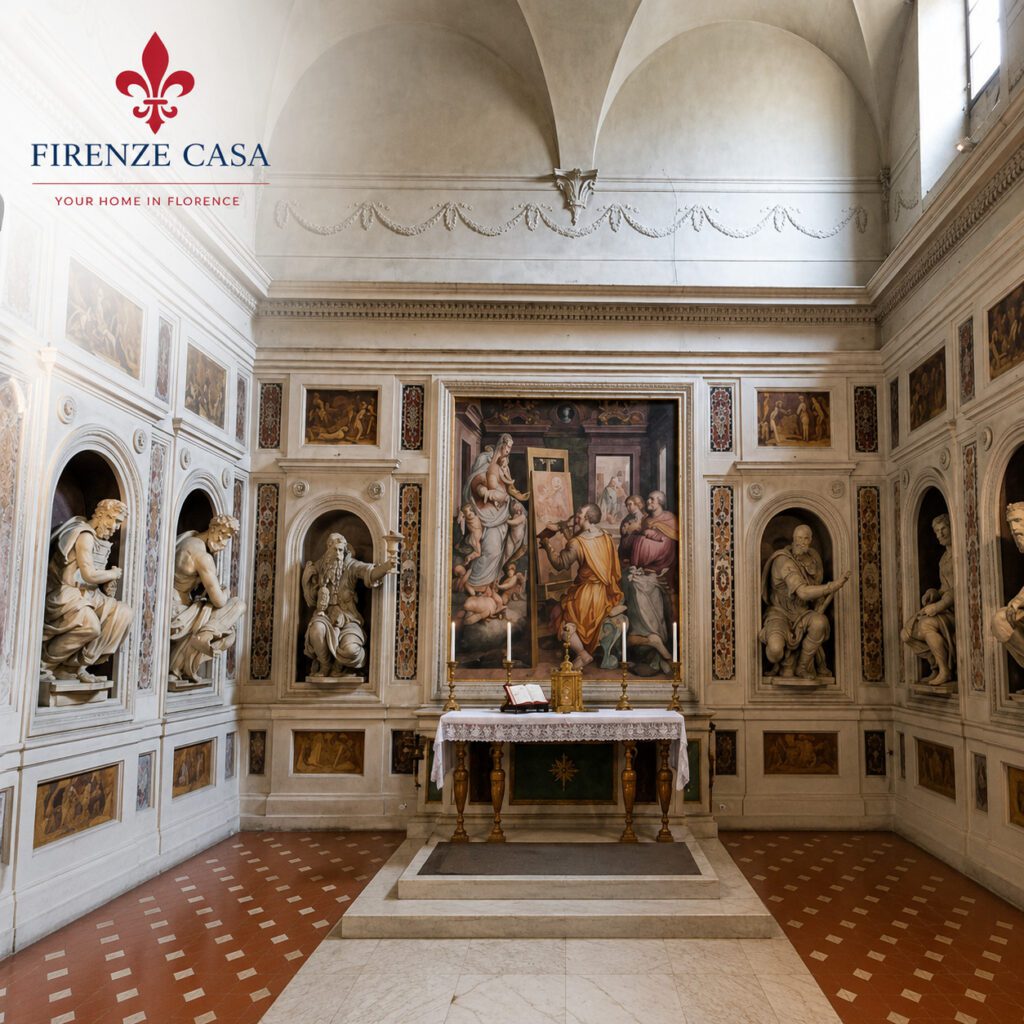
Cappella di San Luca Florence, also known as the Cappella dei Pittori or Chapel of the Painters, is one of the city’s most fascinating lesser-known artistic spaces. Located within the complex of the Santissima Annunziata, the chapel is closely connected with the artists who helped shape Florence’s extraordinary cultural heritage.
Its story brings together religion, art and professional identity. The chapel became associated with the Accademia del Disegno, the institution founded in the sixteenth century that brought together many of Florence’s leading painters, sculptors and architects. It is exactly the kind of lesser-known cultural site explored in our Florence Secrets and Traditions – Complete Guide.
Also known as: Cappella dei Pittori – Chapel of the Painters
Location: Santissima Annunziata complex
Historic connection: Compagnia di San Luca and Accademia del Disegno
Patron saint: Saint Luke, traditional patron of painters
Key figures: Giorgio Vasari, Michelangelo, Pontormo and other Florentine artists
Main theme: the professional and intellectual identity of Renaissance artists
Best combined with: Santissima Annunziata, Museo degli Innocenti, San Marco and the Accademia Gallery
Where Is the Cappella di San Luca?
The Cappella di San Luca forms part of the Basilica della Santissima Annunziata complex on Piazza della Santissima Annunziata. The square itself is one of Florence’s most harmonious Renaissance spaces.
Brunelleschi’s celebrated Ospedale degli Innocenti stands on one side, while the basilica dominates the northern end. Yet much of the artistic history hidden within the religious complex can easily escape the attention of visitors crossing the piazza.
The chapel belongs to this less obvious Florence. It therefore fits particularly well into an itinerary devoted to small historic spaces beyond the city’s most famous attractions.
Why Is It Called the Chapel of the Painters?
The alternative name Cappella dei Pittori reflects the chapel’s strong association with Florence’s artistic community. Its dedication to Saint Luke provides the key to understanding that connection.
According to Christian tradition, Saint Luke the Evangelist was also a painter and was even credited with creating an image of the Virgin Mary. Saint Luke consequently became the traditional patron saint of painters, and artists’ guilds and academies across Europe adopted him as a symbolic protector.
In Florence, where painting occupied such an important position in civic and religious culture, the association was especially appropriate.
Saint Luke’s traditional association with painting explains why so many European artists’ organisations chose him as their patron. The dedication of Florence’s artists’ chapel therefore belongs to a much wider artistic tradition.
The Accademia del Disegno and the Chapel
The history of the Cappella di San Luca Florence is closely linked with the Accademia del Disegno. Founded in 1563 under the patronage of Cosimo I de’ Medici, the academy became a landmark institution in the history of European art.
Giorgio Vasari played an important role in its establishment. The academy developed from the earlier Compagnia di San Luca, which had already brought artists together under the protection of their patron saint.
The new institution helped elevate the social and intellectual status of artists. Painting, sculpture and architecture were increasingly understood not merely as manual crafts but as disciplines based on design, knowledge and creative thought.
The Italian concept of disegno was central to this idea. It referred not only to drawing but also to the intellectual conception behind artistic creation.
Why the Accademia del Disegno Mattered
For centuries, painters and sculptors had worked within a system strongly influenced by guilds and workshops. Renaissance ideas gradually changed perceptions of the artist’s role.
The Accademia del Disegno helped formalise this transformation. Artists could increasingly present themselves as educated creators rather than simply skilled craftsmen.
Florence was particularly suited to this development. The city had already produced generations of celebrated painters, sculptors and architects, while Medici patronage encouraged ambitious artistic projects.
The academy therefore formed part of a broader cultural shift that eventually influenced artistic education far beyond Tuscany.
The word disegno carried enormous importance in Renaissance Florence. It could mean drawing, but it also expressed the intellectual conception behind a work of art. This idea helped elevate artists from craftsmen to creative thinkers.
Giorgio Vasari and Florence’s Artistic Community
Giorgio Vasari provides an important link between the chapel, the academy and the wider history of Florentine art. Today, he is famous as the author of Lives of the Most Excellent Painters, Sculptors, and Architects.
Vasari was also a successful painter and architect who worked closely with Duke Cosimo I de’ Medici and became deeply involved in Florence’s cultural institutions. His architectural legacy elsewhere in the city includes the Uffizi and the Vasari Corridor.
His support for the Accademia del Disegno reflected his broader view of artistic achievement. Vasari regarded disegno as fundamental to painting, sculpture and architecture and placed Florence at the centre of his narrative of Italian art.
The Cappella di San Luca can therefore be understood within Vasari’s vision of a shared Florentine artistic tradition.
Michelangelo and the Accademia
Michelangelo Buonarroti occupied an exceptional position within Florentine artistic culture. Although he spent much of his later life in Rome, Florence continued to regard him as one of its greatest artists.
The Accademia del Disegno honoured Michelangelo as an outstanding model for artists. His command of sculpture, painting and architecture embodied the Renaissance ideal of creative mastery across several disciplines.
After Michelangelo died in Rome in 1564, his body was brought back to Florence. Elaborate funeral ceremonies demonstrated his extraordinary status within the city’s artistic community.
He was ultimately buried in the Basilica of Santa Croce, where his monumental tomb was designed by Giorgio Vasari. Visitors who want to encounter Michelangelo’s most famous Florentine sculpture can see the original David at the Accademia Gallery.
Artists and Memorials in the Cappella di San Luca
The chapel is also notable for its association with the memory of important artists. Several figures connected with Florentine art were buried or commemorated within this setting.
Among the names traditionally associated with the chapel are Jacopo Pontormo and Benvenuto Cellini. Their connection strengthens the sense that this was not simply a devotional space but also a place of collective artistic memory.
That makes a visit particularly evocative. The people remembered here belonged to the same artistic world whose paintings, sculptures and buildings visitors encounter throughout Florence.
Think of the chapel as a meeting point between living artistic practice and memory. Its importance lies not only in decoration but also in the generations of Florentine artists connected with the space.
Art Inside the Cappella di San Luca
The interior reflects the close relationship between religious devotion and artistic identity. Works by artists associated with Florence’s artistic circles contribute to the chapel’s historical character.
Rather than functioning like a modern gallery, however, the artworks belong to a carefully defined religious environment. Their original context remains essential to understanding them.
The relatively intimate dimensions also create a very different experience from visiting the Uffizi or the vast interior of Santa Croce. Here, art and architecture can be appreciated within a compact and historically specific setting.
The Chapel and Santissima Annunziata
The location of the chapel within Santissima Annunziata adds another layer of significance. The basilica has deep connections with Florentine religious life and art and became one of the city’s most important centres of Marian devotion.
For centuries, pilgrims visited the church to venerate its celebrated image of the Annunciation. Wealthy families and patrons commissioned important architectural and artistic projects throughout the complex, while artists including Andrea del Sarto and Pontormo worked here.
The Cappella di San Luca therefore belongs naturally within this environment, yet its particular association with artists gives it a distinctive identity.
Piazza della Santissima Annunziata
A visit to the chapel should include time to appreciate Piazza della Santissima Annunziata, one of the spaces highlighted in our guide to the most beautiful squares in Florence.
The Ospedale degli Innocenti, designed by Filippo Brunelleschi, introduced a graceful arcade whose proportions influenced the architectural character of the piazza. Later buildings responded to its rhythm and helped create the remarkable visual unity visitors see today.
The history behind Brunelleschi’s façade can be explored further at the Museo degli Innocenti, which combines Renaissance architecture and art with the remarkable social history of the institution created to care for abandoned children.
Giambologna’s equestrian monument to Ferdinando I de’ Medici and Pietro Tacca’s fountains add further layers of dynastic history and sculpture to the square. The piazza therefore provides an ideal setting for understanding the cultural environment surrounding the Chapel of the Painters.
A Different Way to Experience Renaissance Florence
Most visitors encounter Renaissance Florence through famous objects. Botticelli’s paintings, Michelangelo’s David and Brunelleschi’s dome understandably dominate many itineraries.
The Cappella di San Luca Florence offers another perspective. It tells the story of artists as members of a professional and intellectual community.
They trained in workshops, competed for commissions and depended on patrons. At the same time, they formed associations, participated in religious life and gradually claimed a higher social status.
Understanding these relationships makes Florence’s famous masterpieces more meaningful. Behind every individual work stood a complex world of workshops, institutions and professional connections.
Combine the Cappella di San Luca with Santissima Annunziata and the Museo degli Innocenti. Together, they create an excellent exploration of Renaissance art, architecture and social history away from Florence’s busiest museum circuit.
Florence and the Changing Status of Artists
The Renaissance fundamentally changed the way European society viewed certain artists. Earlier painters and sculptors often belonged firmly to the world of craftsmen.
By the sixteenth century, however, leading figures could achieve international fame and move within elite political and intellectual circles. Michelangelo provides the most spectacular example, but the transformation affected the artistic profession more broadly.
Institutions such as the Accademia del Disegno helped reinforce this change, while writers such as Vasari created narratives that presented artists as exceptional creative personalities.
The Chapel of the Painters therefore represents more than a religious curiosity. It belongs to an important chapter in the emergence of the modern idea of the artist.
Why the Cappella di San Luca Is Easy to Miss
Florence contains so many major attractions that smaller spaces inevitably receive less attention. Visitors to Piazza della Santissima Annunziata may naturally focus on Brunelleschi’s architecture or the basilica itself.
The chapel consequently remains unfamiliar to many travellers, yet this relative obscurity is part of its appeal. Instead of entering another crowded museum, visitors discover a place closely tied to the people who created Florence’s artistic reputation.
Its atmosphere makes it a natural companion to other quieter Renaissance sites in this cluster, particularly the Chiostro dello Scalzo, where Andrea del Sarto’s monochrome fresco cycle survives in another intimate setting.
Who Should Visit the Cappella di San Luca?
The chapel is especially interesting for travellers who already have some familiarity with Florentine Renaissance art. Names such as Vasari, Michelangelo and Pontormo immediately make the historical connections more vivid.
Visitors interested in social history will also find the site rewarding. The development of the artists’ academy reveals how professions, education and social status changed during the Renaissance.
Finally, anyone searching for quieter cultural experiences should consider the chapel. It represents exactly the kind of small historic place that can easily disappear behind Florence’s famous monuments.
Planning Your Visit
The Cappella di San Luca forms part of a religious complex rather than a conventional museum. Access arrangements can therefore differ from standard museum opening hours.
Visitors should check current information before planning a special visit. Religious ceremonies, restoration work or institutional requirements can occasionally affect access.
Because the chapel lies close to several other important sites, it can easily form part of a broader itinerary around Piazza della Santissima Annunziata and San Marco.
Check current access conditions before making a special journey to the chapel. Smaller historic religious spaces in Florence sometimes have more limited visiting arrangements than major museums.
What Else Is Nearby?
The surrounding neighbourhood contains an exceptional concentration of cultural sites. Immediately on the piazza stand the Basilica della Santissima Annunziata and the Museo degli Innocenti.
A short walk leads towards San Marco, while the Accademia Gallery with Michelangelo’s David is also nearby. Together, these sites make the northern part of the historic centre especially rewarding for visitors interested in Renaissance art.
Adding the Cappella di San Luca provides a less familiar dimension to an otherwise classic itinerary: instead of looking only at individual masterpieces, visitors encounter part of the institutional world in which Florentine artists defined themselves.
Frequently Asked Questions
What is the Cappella di San Luca in Florence?
The Cappella di San Luca is a historic chapel within the Santissima Annunziata complex. It became closely associated with Florence’s community of painters, sculptors and architects and is also known as the Cappella dei Pittori.
Why is it called the Cappella dei Pittori?
The name means Chapel of the Painters. Saint Luke was traditionally regarded as the patron saint of painters, while the chapel became associated with Florence’s artistic organisations.
What was the Accademia del Disegno?
The Accademia del Disegno was an important Florentine artistic institution founded in 1563 under Cosimo I de’ Medici. Giorgio Vasari played a major role in its creation.
Is the chapel connected with Michelangelo?
Yes. Michelangelo held an exceptional position within the artistic culture represented by the Accademia del Disegno, which participated in his elaborate Florentine commemoration after his death in 1564.
Where is the Cappella di San Luca?
The chapel is located within the Basilica della Santissima Annunziata complex on Piazza della Santissima Annunziata.
What can I combine with a visit?
Santissima Annunziata, Museo degli Innocenti and the Accademia Gallery are all nearby and create a particularly coherent Renaissance itinerary.
Is the Cappella di San Luca worth visiting?
Yes, particularly for visitors interested in Renaissance art and the lives of Florentine artists. Its connection with the Accademia del Disegno gives it historical importance far beyond its intimate scale.
Why the Chapel of the Painters Matters
Cappella di San Luca Florence reveals a side of the Renaissance that is easy to overlook. Florence’s artists did not work as isolated geniuses. They belonged to workshops, religious associations and increasingly sophisticated professional institutions.
The chapel became part of this shared artistic world. Its dedication to Saint Luke linked religious devotion with professional identity, while its association with the Accademia del Disegno reflected the changing status of artists in Renaissance society.
Figures such as Vasari, Michelangelo and Pontormo connect this intimate space with the much larger story of Florentine art. For travellers willing to look beyond Florence’s famous museums, the Cappella dei Pittori offers precisely the kind of discovery that makes the city endlessly fascinating.
Behind one more historic doorway lies not simply another chapel, but part of the story of how Florence learned to celebrate its artists.
Further Reading on Firenze Casa
- Florence Secrets and Traditions – Complete Guide
- Chiostro dello Scalzo – Florence’s Hidden Renaissance Cloister
- Basilica della Santissima Annunziata – Florence’s Marian Sanctuary
- Museo degli Innocenti – Art and Social History
- Accademia Gallery Florence – Michelangelo’s David
- Basilica of Santa Croce – Florence’s Monumental Church
- The Medici Family – The Dynasty That Shaped Florence
- The Most Beautiful Churches in Florence
References
- Accademia delle Arti del Disegno – historical information on the institution and the Compagnia di San Luca.
- Basilica della Santissima Annunziata – historical information on the church complex and its chapels.
- Comune di Firenze – historical and cultural information on Piazza della Santissima Annunziata.
- Ministero della Cultura – information on Florentine artistic and religious heritage.
- Treccani – biographical information on Giorgio Vasari, Michelangelo Buonarroti and Jacopo Pontormo.
- Vasari, Giorgio – Lives of the Most Excellent Painters, Sculptors, and Architects.

