
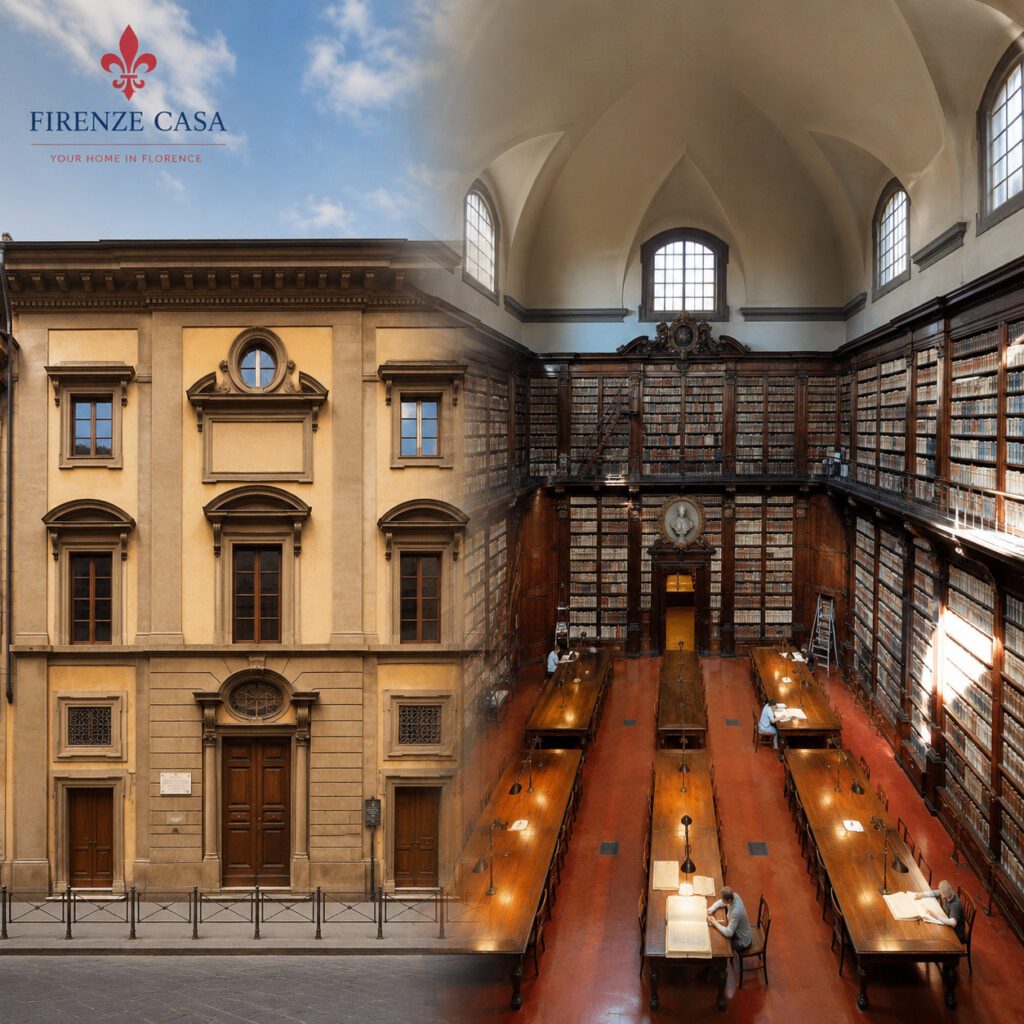
Biblioteca Marucelliana Florence is one of the city’s most fascinating historic libraries. Located on Via Cavour, only a short walk from Piazza San Marco, it preserves an extraordinary world of books, manuscripts, drawings and documents behind a relatively discreet façade.
Florence is famous for museums filled with Renaissance masterpieces, yet some of its most remarkable cultural institutions were created not simply to display art but to preserve and share knowledge. The Biblioteca Marucelliana belongs firmly to this quieter intellectual side of the city and fits naturally into our Florence Secrets and Traditions – Complete Guide.
Location: Via Cavour, Florence
Opened: 1752
Founder: based on the collection and wishes of Francesco Marucelli
Architect: Alessandro Dori
Collections: manuscripts, rare books, drawings, prints and historic documents
Special interest: public access to knowledge and eighteenth-century intellectual culture
Character: working scholarly library rather than conventional museum
A Library Created for the Public
The origins of the Biblioteca Marucelliana are closely connected with the Florentine scholar and bibliophile Francesco Marucelli, who died in 1703. His remarkable collection of books formed the foundation for a library intended to serve a wider intellectual community.
His nephew Alessandro Marucelli continued the project and commissioned a purpose-built library in Florence. The institution opened to the public in 1752, making it an important chapter in the history of public access to knowledge in the city.
This principle was significant. Great collections of books had long existed in monasteries, universities and aristocratic residences, but access was often restricted. The Marucelliana represented a broader idea: books and scholarship should be available to readers beyond a private circle.
The Marucelliana was conceived as a library open to a wider public rather than simply as a prestigious private collection. That purpose distinguishes it from many earlier European libraries.
Francesco Marucelli and His Collection
Francesco Marucelli was born in Florence in 1625 and spent much of his life in Rome. A scholar and passionate bibliophile, he assembled an extensive collection covering a wide range of subjects.
His interests reflected the intellectual culture of his age. Books were increasingly important instruments of systematic research, while substantial libraries gave scholars access to knowledge accumulated across disciplines and centuries.
Marucelli wanted his collection to have a life beyond that of its owner. His legacy ultimately helped create an institution that has preserved and expanded this intellectual inheritance for generations.
The Architecture of the Biblioteca Marucelliana
The historic library building was designed by the Florentine architect Alessandro Dori. Its relatively restrained exterior gives little indication of the spaces and collections inside.
The contrast is characteristic of Florence, where remarkable interiors are often hidden behind façades that visitors pass without noticing. Inside the Marucelliana, architecture, bookshelves and historic furnishings evoke an institution designed around study rather than spectacle.
The building itself therefore belongs to the history of the library. Books were no longer merely treasured objects stored within a private residence; they were organised within spaces specifically intended for consultation and scholarship.
Rather than approaching the Marucelliana like an art museum, notice how architecture and furniture organise the space around reading and scholarship. The building reflects the idea of the library as an institution of knowledge.
Manuscripts, Rare Books and Historic Collections
Over the centuries, the Biblioteca Marucelliana Florence expanded far beyond the original Marucelli collection. Its holdings include manuscripts, early printed books, historical publications, drawings, prints and other documentary material.
These collections are particularly valuable for researchers studying Italian cultural and intellectual history. Some materials extend far beyond Florence itself, demonstrating the international networks through which books and ideas circulated.
Historic libraries therefore differ fundamentally from conventional museums. Their treasures are not necessarily displayed permanently in showcases; much of their significance lies in collections preserved for research and consultation.
The Marucelliana and Enlightenment Florence
The opening of the library in the mid-eighteenth century belongs to a period when Tuscany was experiencing important intellectual and institutional changes. Florence remained deeply connected to its Renaissance heritage, but new ideas about science, education and public knowledge were transforming European society.
Libraries played an important role in this development. Organising collections and widening access allowed knowledge to circulate more effectively among scholars and educated readers.
The Marucelliana can therefore be understood as part of Florence’s transition from the world of Renaissance and aristocratic collections towards the more public intellectual institutions associated with the Enlightenment.
Only a short distance away, the Osservatorio Ximeniano, founded just four years after the Marucelliana opened, reflects another side of this eighteenth-century culture of organised knowledge through astronomy, cartography, meteorology and scientific observation.
Florence is often viewed primarily through the Renaissance. The Marucelliana and other eighteenth-century institutions remind us that the city continued to develop as an important centre of scholarship and science.
Florence as a City of Books
The Biblioteca Marucelliana belongs to a much larger Florentine tradition of books, manuscripts and scholarship. Renaissance humanists had already transformed the collection and study of texts, while later libraries developed new ways of preserving and sharing knowledge.
The Biblioteca Riccardiana offers a complementary perspective through its origins in the prestigious private collection of the Riccardi family. The Marucelliana, by contrast, is particularly notable for the public purpose behind its foundation.
A century later, the Gabinetto Vieusseux introduced yet another model: a reading room and circulating library designed to connect Florence with contemporary newspapers, journals and intellectual debates from across Europe.
Together these institutions reveal a city of readers, librarians and scholars as well as painters, sculptors and architects.
From Historic Libraries to Literary Florence
Books were not simply collected in Florence; they shaped the city’s cultural identity. From Dante and Renaissance humanism to nineteenth- and twentieth-century writers, literature remained an important part of Florentine life.
Our Florence in Literature – Complete Guide follows this wider story through writers, books, literary institutions and places associated with the city.
The connection is important because libraries such as the Marucelliana provided the infrastructure through which texts survived and scholarship continued. Florence’s literary history depends not only on celebrated authors but also on the institutions that preserved what they and earlier generations wrote.
Biblioteca Marucelliana and Biblioteca Riccardiana
The Marucelliana and Riccardiana offer two particularly revealing perspectives on Florence’s library culture.
The Biblioteca Riccardiana developed from the private collection of the Riccardi family and remains closely associated with Palazzo Medici Riccardi. Its manuscripts and historic setting evoke the world of aristocratic collecting.
The Marucelliana represents a different development. Its foundation reflects the gradual transformation of the library from a private repository of knowledge towards a public scholarly institution.
Exploring both stories therefore provides a broader understanding of how books were collected, preserved and made accessible in Florence across different periods.
The Riccardiana grew from aristocratic collecting; the Marucelliana was conceived with broader public access in mind. Together they illustrate how the role of libraries changed over time.
Via Cavour and the Intellectual Geography of Florence
The location of the Marucelliana makes it particularly easy to overlook. Via Cavour is one of the main routes between the Duomo area and Piazza San Marco, and many visitors walk past the library on their way to more famous attractions.
Yet this part of Florence contains an extraordinary concentration of institutions connected with art, religion, education and scholarship. The Accademia Gallery, best known for Michelangelo’s David, developed from an institution closely connected with artistic education.
Nearby San Marco adds another intellectual layer through the former Dominican monastery and its connections with Fra Angelico, Savonarola and Renaissance religious culture.
The Marucelliana therefore belongs to an unusually rich cultural corridor running north from the cathedral through the Medici district towards San Marco.
Why the Biblioteca Marucelliana Matters
The importance of the Biblioteca Marucelliana cannot be measured by visitor numbers. Its significance lies in the continuity of its intellectual purpose.
Libraries such as this preserve fragile connections with the past. Manuscripts, correspondence, printed books and drawings allow later generations to reconstruct how people thought, communicated and understood their world.
Florence would not possess the same extraordinary historical memory without institutions devoted to preserving these materials. Museums safeguard paintings and sculptures; libraries perform an equally important role for written and graphic culture.
If you already know the Uffizi, Accademia and Palazzo Pitti, historic libraries such as the Marucelliana offer an excellent way to discover a quieter and more specialised layer of Florentine culture.
Visiting the Biblioteca Marucelliana
The library is located on Via Cavour in Florence’s historic centre, within easy walking distance of Piazza San Marco, the Accademia Gallery and the Medici district.
Visitors should remember that the Biblioteca Marucelliana remains a working cultural and research institution rather than a conventional tourist attraction. Access conditions and the availability of historic spaces can therefore differ from those of a museum.
Anyone planning a visit specifically to see the historic interiors or collections should check current information beforehand.
Combine the area with Piazza San Marco and the Accademia Gallery. For a broader overview of nearby collections, our Florence Museums – Complete Guide can help you plan a route without trying to fit too many institutions into one day.
Florence Beyond the Famous Museums
The Biblioteca Marucelliana represents exactly the kind of place that rewards visitors who look beyond the city’s headline attractions.
Its importance does not depend on monumental paintings or famous sculptures. Instead, it preserves something equally fundamental to Florence’s identity: the accumulated knowledge of generations.
Behind its bookshelves and historic reading spaces lies a story about collectors who wanted knowledge to survive them, scholars who depended on libraries for their work and a city that gradually opened more of its intellectual heritage to a wider public.
For travellers interested in Florence beyond the standard itinerary, the Marucelliana offers a valuable reminder that the city’s cultural history was created not only in workshops, churches and palaces but also in libraries and reading rooms.
Frequently Asked Questions
What is the Biblioteca Marucelliana?
It is a historic public and scholarly library on Via Cavour in Florence. Its collections include manuscripts, rare books, drawings, prints and other documentary material.
When did the Biblioteca Marucelliana open?
The library opened to the public in 1752. Its foundation grew from the collection and wishes of the Florentine scholar Francesco Marucelli.
Why is the Marucelliana historically important?
It was conceived to make a substantial scholarly collection available beyond a private circle, reflecting changing eighteenth-century ideas about access to knowledge.
Is the Biblioteca Marucelliana a museum?
No. It remains primarily a working library and research institution, although its historic collections and spaces have considerable cultural interest.
How does it differ from the Biblioteca Riccardiana?
The Riccardiana developed from an aristocratic private collection, while the Marucelliana is particularly significant for the broader public purpose behind its foundation.
Which attractions are near the Biblioteca Marucelliana?
The Accademia Gallery, Piazza San Marco and the Medici district are all nearby, making the library part of an exceptionally rich cultural area of central Florence.
Why the Biblioteca Marucelliana Is Worth Discovering
Biblioteca Marucelliana Florence reveals an intellectual side of the city that is easy to miss. Its history shows how a private passion for books could evolve into an institution created to preserve and share knowledge.
The library also helps broaden the familiar story of Florence beyond the Renaissance. Its eighteenth-century foundation belongs to a later period in which scholarship, science and public institutions were changing the cultural life of Tuscany.
Together with the Riccardiana, the Vieusseux and other Florentine libraries, it demonstrates that the city’s extraordinary heritage depended not only on creating works of art but also on collecting texts, preserving documents and making knowledge available to future generations.
For anyone who wants to discover Florence beyond its famous museums, the Marucelliana is a compelling part of that quieter cultural landscape.
Further Reading on Firenze Casa
- Florence Secrets and Traditions – Complete Guide
- Florence in Literature – Complete Guide
- Biblioteca Riccardiana – Florence’s Hidden Library of Manuscripts
- Gabinetto Vieusseux – Florence’s Historic Literary Institution
- Osservatorio Ximeniano – Florence’s Historic Observatory
- Accademia Gallery – Home of Michelangelo’s David
- Florence Museums – Complete Guide
References
- Biblioteca Marucelliana – institutional history and collections.
- Ministero della Cultura – Biblioteca Marucelliana.
- Treccani – Francesco Marucelli and Italian cultural history.
- Italian library catalogues and historical bibliographic resources.
- Studies on libraries and intellectual culture in eighteenth-century Florence.

