Monte Ceceri rises immediately beside Fiesole, yet beneath its quiet woodland lies one of the most important working landscapes in the history of Florence. For centuries, quarrymen extracted Pietra Serena from these slopes. The elegant blue-grey sandstone eventually became one of the characteristic materials of Florentine architecture.
Generations of quarry workers and scalpellini extracted, shaped and transported the stone from the hills towards Florence. Renaissance architects then transformed the material into columns, arches, doorways and architectural details that still define many historic buildings today.
The story of Monte Ceceri Pietra Serena therefore creates an extraordinary connection between landscape and architecture. When you walk through the wooded park today, you explore the place where part of Florence physically came from.
Location: Fiesole, in the hills above Florence
Historic importance: Major quarrying area for Pietra Serena
Material: Fine-grained blue-grey sandstone
Traditional workers: Cavatori and scalpellini – quarrymen and stonecutters
Historic quarries: Including Cava Braschi and Cava Sarti
Landscape today: Approximately 44 hectares of protected woodland
Renaissance connection: Pietra Serena became a defining material of Florentine architecture
Leonardo connection: Monte Ceceri is traditionally associated with Leonardo da Vinci’s studies of human flight
What Is Monte Ceceri?
Monte Ceceri is a wooded hill immediately east of the historic centre of Fiesole. Today, it feels like a natural retreat, with paths winding through trees, abandoned quarries and occasional panoramic views towards Florence and the surrounding Tuscan landscape.
Its peaceful appearance is deceptive, however. For centuries, quarrymen worked intensively on these slopes. They removed stone generation after generation and consequently created rock faces, underground chambers, quarry roads and excavated spaces that remain visible among the vegetation.
The landscape visitors experience today is therefore partly natural and partly man-made. Monte Ceceri is not simply a hill with several abandoned quarries. Instead, centuries of quarrying helped create the shape and character of the hill itself.
What initially appears to be an unusual rock face may actually be the wall of an old quarry. As you follow the paths through Monte Ceceri, you repeatedly encounter traces of extraction hidden beneath the vegetation. Consequently, the entire park becomes an open-air record of centuries of stoneworking.
What Is Pietra Serena?
Pietra Serena is a fine-grained sandstone with a restrained grey colour and often a subtle blue tone. Craftsmen can work the stone with considerable precision. Therefore, it became particularly suitable for columns, arches, cornices, staircases, doorways and sculptural architectural details.
The stone occurs naturally in the hills around Fiesole, Monte Ceceri, Maiano and Settignano. Because these deposits lay close to Florence, architects and craftsmen had access to an exceptionally useful local material. Historic quarrying around Fiesole has now ceased, while quarries elsewhere in Tuscany, particularly around Firenzuola in the Mugello, continue to produce Pietra Serena.
However, Pietra Serena should not be confused with Pietraforte, another sandstone closely associated with Florence. Pietraforte has a warmer colour and offers considerable resistance. As a result, builders frequently chose it for façades, fortifications and paving. Pietra Serena, by contrast, became especially important for finely worked architectural elements and interiors.
| Stone | Typical Colour | Historic Use in Florence |
|---|---|---|
| Pietra Serena | Grey to blue-grey | Columns, arches, cornices, portals, staircases and architectural details |
| Pietraforte | Warm brown to ochre | Façades, walls, structural masonry and paving |
Our article Why Are the Streets of Florence Paved with Stone? explores this distinction in greater detail and explains how different local stones helped create the characteristic appearance of Florence.
A Quarrying Tradition Older Than Renaissance Florence
The relationship between Fiesole and stone is extremely old. The surrounding landscape provided building material long before Renaissance Florence existed, while local stoneworking traditions have roots that extend back to antiquity.
Evidence of quarrying becomes particularly clear during the medieval period. By the later Middle Ages, quarrymen and stonecutters formed an important part of the economy around Fiesole. Moreover, extraction expanded dramatically as Florence grew below.
The connection between the two cities was therefore physical as well as economic. Florence required enormous quantities of building material, while the hills surrounding Fiesole contained valuable stone and communities with the skills necessary to extract and work it.
During the fifteenth century, this relationship became even more important because Renaissance architecture created new demand for precisely cut Pietra Serena. As a result, stone from the hills became part of a completely new architectural language developing in Florence.
The Renaissance did not develop entirely inside Florence. Its buildings depended on materials and skilled workers from the surrounding landscape. Monte Ceceri therefore reminds us that behind celebrated architects stood quarrymen, stonecutters, transport workers and generations of specialised craftsmen.
The Scalpellini – The Stonecutters of Fiesole
The history of Monte Ceceri cannot be separated from the scalpellini, the skilled stonecutters who worked the material from the surrounding hills. Quarrying stone and transforming it into an architectural element required different skills, so each stage depended on specialised knowledge.
First, quarrymen had to understand the geology of the mountain. They identified useful layers of stone, removed less valuable material and separated blocks without damaging them. Afterwards, workers had to move the heavy blocks from difficult hillside terrain towards workshops or construction sites.
The scalpellini then transformed rough stone into usable architectural elements. With their tools and accumulated knowledge, they created columns, capitals, arches, cornices, steps and decorative details with remarkable precision.
Moreover, these skills often passed from one generation to the next. Stoneworking consequently became part of the cultural identity of communities around Fiesole, Maiano and Settignano, where stonecutters, sculptors and quarries remained closely connected.
How the Quarries Changed Monte Ceceri
Centuries of extraction profoundly reshaped the mountain. Rather than simply removing stone from the surface, quarrymen followed useful geological layers. Consequently, they developed different forms of excavation according to the position and quality of the material.
Some quarries operated in the open air, while others extended deep into the mountain. In these underground or partly enclosed quarries, workers sometimes left pillars of rock standing to support the ceiling. This technique allowed them to extract more stone while maintaining the stability of the excavation.
As a result, Monte Ceceri developed into a complex working landscape of quarry faces, chambers, access tracks and routes for moving stone downhill. Although vegetation has softened their appearance considerably, many of these traces remain visible today.
Monte Ceceri becomes easier to understand once you stop seeing the quarries as isolated holes in the mountain. Instead, paths, level areas, rock faces and excavated chambers reveal a connected working environment in which generations of quarrymen extracted, prepared and transported stone towards Fiesole and Florence.
Cava Braschi – Quarrying Inside the Mountain
One of the most fascinating surviving sites is Cava Braschi. Here, quarrymen followed the useful stone into the rock rather than simply removing material from an exposed surface.
Over time, the quarry developed into a substantial internal space. As extraction progressed, workers retained rock supports and therefore created an environment that can resemble an artificial cavern. The structure demonstrates how carefully quarrymen had to balance the extraction of valuable stone with the need to keep the excavation stable.
Cava Braschi is particularly valuable because it makes historic quarrying techniques physically understandable. Instead of imagining workers simply cutting stone from the side of a hill, visitors can recognise how they followed geological layers deep into the mountain.
However, abandoned quarry interiors can present serious hazards. Visitors should therefore remain on authorised paths and respect any barriers or access restrictions.
Cava Sarti – An Open-Air Quarry
Cava Sarti provides a useful contrast. It is a large open-air quarry situated below the panoramic area associated with Leonardo da Vinci and demonstrates another way in which workers exploited the stone-bearing layers of Monte Ceceri.
Comparing Cava Sarti with Cava Braschi makes the quarry landscape much easier to understand. The different methods did not simply reflect individual preferences. Instead, quarrymen adapted their work to geology, terrain and the position of useful stone within the mountain.
Together, the surviving quarries therefore transform Monte Ceceri into something approaching an open-air museum of historic stone extraction. At the same time, nature has gradually reclaimed much of the former working landscape.
From Monte Ceceri to Renaissance Florence
The importance of Monte Ceceri Pietra Serena becomes clearest after returning to Florence. Throughout the city, the same blue-grey stone appears against pale plaster inside Renaissance churches, cloisters and palaces.
This contrast became one of the most recognisable visual characteristics of Florentine Renaissance architecture. Grey columns and arches clearly define the structural geometry of a space, while pale walls provide a calm background.
Therefore, architects valued Pietra Serena for more than its practical qualities. They discovered that the material could become part of the intellectual language of Renaissance design. Through stone, they could make proportion, clarity, repetition and geometric order immediately visible.
Brunelleschi and Pietra Serena
Filippo Brunelleschi played a decisive role in transforming Pietra Serena into one of the defining materials of Renaissance Florence. Instead of hiding structural elements beneath decoration, he used grey stone to emphasise columns, arches and cornices against light plastered surfaces.
The effect becomes particularly clear inside the Basilica of San Lorenzo. Slender grey columns and rounded arches create a regular rhythm through the church and therefore make its proportions immediately legible.
Brunelleschi developed the same fundamental relationship between grey stone and pale surfaces in other projects. Consequently, Pietra Serena became inseparable from the visual vocabulary of early Renaissance architecture. Later generations of Florentine architects then continued and developed this architectural language.
After walking through Monte Ceceri, look again at the grey columns and arches of Renaissance Florence. The architectural stone no longer feels like an abstract design element. Instead, it becomes part of the geological landscape surrounding the city.
Stone, Architecture and the Hills of Florence
Monte Ceceri demonstrates why Florence cannot be understood only through the monuments of its historic centre. The city continuously depended on the surrounding landscape for stone, timber, agricultural products, water and specialised labour.
Our guide to The Hills of Florence explores this relationship more broadly. Fiesole and Settignano were not simply beautiful viewpoints above the city. Their quarries, workshops, villas and agricultural landscapes also formed part of Florence’s economy and cultural development.
Stone provides a particularly powerful example because the connection remains visible. Material extracted from the hills survives in buildings kilometres away. As a result, we can read landscape and architecture as parts of the same historical system.
Monte Ceceri and the Craftsmen Behind Florence
Florentine art history naturally focuses on celebrated names such as Brunelleschi, Donatello and Michelangelo. Yet monumental architecture and sculpture could not have existed without enormous networks of less famous workers.
Quarrymen understood rock, while stonecutters knew how to shape it. Carters and labourers transported heavy blocks across difficult terrain. Finally, workshop craftsmen transformed architectural drawings into physical elements that builders could assemble on construction sites.
Monte Ceceri therefore complements our guide to Traditional Florentine Workshops. Renaissance Florence depended not only on individual genius but also on an extraordinary culture of specialised manual knowledge.
A Renaissance column begins long before an architect places it in a building. First, someone must identify the right stone. Then workers extract it, move it down the hill and shape it with extraordinary precision. Monte Ceceri preserves the landscape of those largely anonymous workers.
Why Is Monte Ceceri Covered with Trees Today?
The wooded Monte Ceceri visitors see today looks very different from the intensely worked landscape of the quarrying period. Centuries of extraction had heavily altered large areas and left parts of the hill comparatively bare.
Beginning in the early twentieth century, and particularly from 1929 onwards, extensive reforestation changed the landscape. Workers planted trees to restore the environment and help stabilise slopes affected by long-term quarrying and erosion.
Pines and cypresses formed part of this programme, while Mediterranean vegetation and deciduous woodland developed across different parts of the hill. Over time, the former industrial landscape consequently acquired the green appearance that now makes Monte Ceceri feel like a natural park.
Nevertheless, nature has not erased the quarry landscape. Instead, trees and historic excavations now occupy the same space, creating one of the most interesting aspects of Monte Ceceri today.
From Quarry Landscape to Protected Park
Today, Monte Ceceri forms a protected area of natural and historical importance. The park covers approximately 44 hectares and preserves both woodland and physical evidence of centuries of quarrying.
These two aspects cannot easily be separated. The forest has environmental value, while the abandoned quarries preserve the material culture of generations of workers who shaped the landscape.
Paths now lead visitors through the former quarrying area. Along the way, walkers can discover rock faces, excavations and panoramic points while moving through a landscape considerably quieter than it was during centuries of active extraction.
Imagine Monte Ceceri When the Quarries Were Working
The modern forest can make it difficult to imagine the mountain during its working life. Instead of birdsong and quiet paths, repeated blows of iron tools against stone, workers’ voices and the movement of heavy blocks would have filled the landscape.
Quarry roads connected excavations with loading areas and routes towards the settlements below. Meanwhile, workers moved between individual quarries and stonecutters shaped material that would eventually become part of buildings in Fiesole and Florence.
For generations, therefore, quarrying was not picturesque heritage. It was demanding physical work and an essential part of the local economy.
The silence of the forest is relatively recent. Imagine the same hillside filled with quarrymen, stonecutters, tools, carts and freshly exposed rock. What is now a place for walking once formed an important working landscape.
Leonardo da Vinci and Monte Ceceri
Monte Ceceri has another famous association: Leonardo da Vinci and the dream of human flight. Leonardo studied birds, air currents, wing structures and mechanical devices because he wanted to understand whether humans might one day fly.
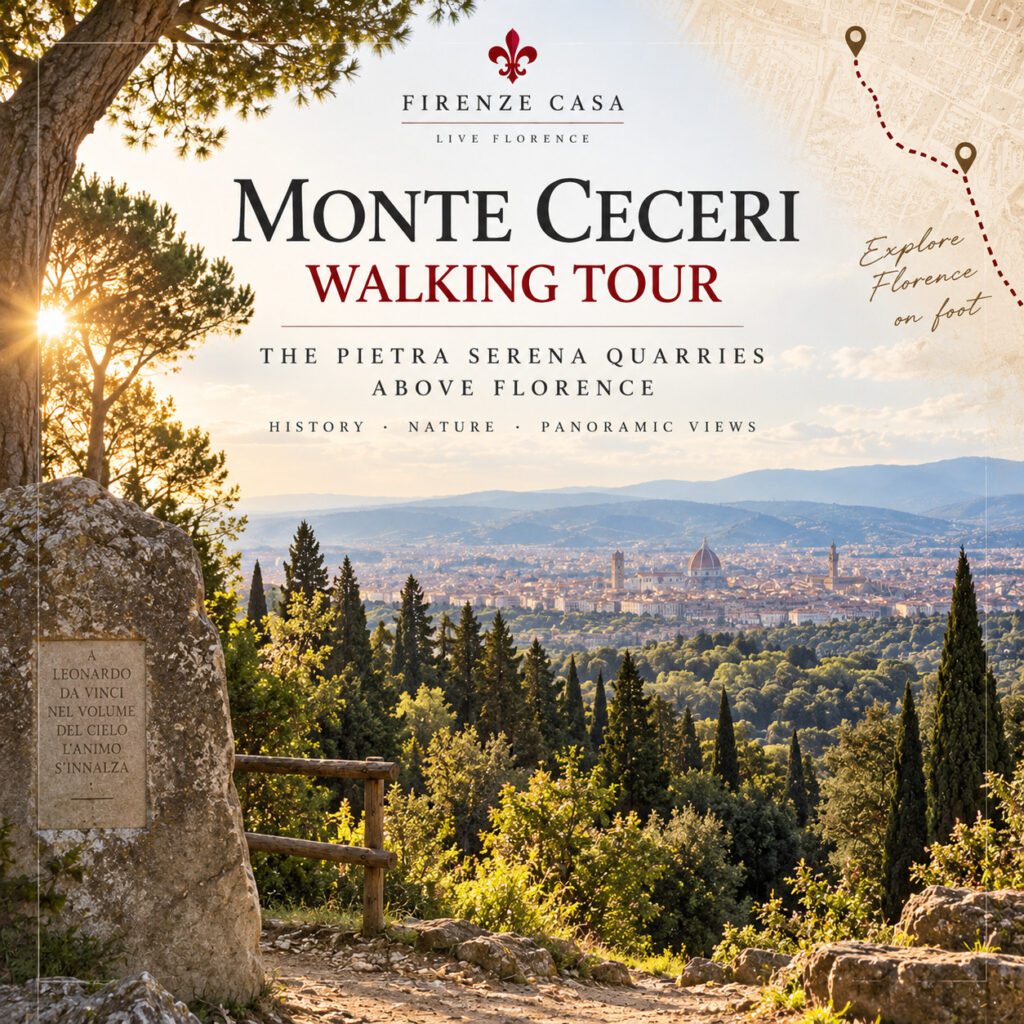
The hill is traditionally associated with experiments involving Leonardo’s ideas for flying machines and his assistant Tommaso Masini, known as Zoroastro. Today, a memorial at Piazzale Leonardo recalls this connection.
However, the story requires some caution. Leonardo unquestionably studied flight and referred to Monte Ceceri in his writings. The popular account of an actual successful manned flight from the hill, by contrast, belongs to later tradition rather than securely documented history.
Nevertheless, the association remains fascinating. High above Florence, birds circle over the valley while the landscape falls away towards the city. Consequently, it is easy to understand why Monte Ceceri became so closely associated with Leonardo’s fascination with flight.
Leonardo’s writings connect Monte Ceceri with his extraordinary reflections on flight. Although the romantic story of a successful human flight from the hill is not firmly established, the landscape remains an evocative place to consider one of his most ambitious ideas.
Piazzale Leonardo – Florence from Above
Piazzale Leonardo provides one of the important reference points within Monte Ceceri. From its elevated position, visitors can enjoy broad views towards Florence and experience a completely different relationship with the city.
From the hills, Florence appears as part of the Arno Valley rather than as an isolated collection of monuments. Therefore, the surrounding landscape becomes almost as important as the dome and towers visible below.
This perspective also explains why Fiesole and Monte Ceceri work so well together. The ancient settlement, quarry landscape and Renaissance city become parts of one geographical environment rather than separate destinations.
Monte Ceceri, Maiano and Settignano
The quarrying landscape did not stop at the boundaries of Monte Ceceri. Instead, historic stoneworking extended through the hills towards Maiano and Settignano, creating a network of quarries, paths and communities associated with stone.
Settignano became particularly famous for generations of stonecutters and sculptors. Its history therefore demonstrates how technical skills developed around local materials could eventually contribute to the artistic world of Florence.
The old routes through these hills consequently connected much more than villages. They linked sources of raw material, working communities and the city that consumed their skills and stone.
Our article Settignano – A Historic Village in the Hills of Florence explores this neighbouring landscape and its relationship with stoneworkers, artists and Florentine villa culture.
Walking Through the Historic Quarries
A network of paths allows visitors to explore Monte Ceceri on foot and discover former quarries among the woodland. Some routes continue towards Maiano, Settignano and the surrounding hills. However, a visit does not need to become a long trekking excursion.
Instead, treat the park as a historical landscape rather than simply a hiking destination. Stop at quarry faces, notice changes in the rock and look for traces of old working routes. In particular, Cava Braschi and Cava Sarti help explain how differently individual quarries could develop.
Paths can be uneven, stony and steep in places. Therefore, suitable footwear is advisable, particularly after rain. Visitors should also respect barriers and never enter abandoned quarries where access is restricted.
Do not approach Monte Ceceri simply as a walk through the woods. Once you understand what the rock faces and excavations represent, the experience changes completely. The landscape becomes a historical document that you can read step by step.
Monte Ceceri from the Firenze Casa Apartment in Fiesole
For guests staying at our Firenze Casa apartment in Fiesole, Monte Ceceri offers something particularly special because the historic quarry landscape begins almost on the doorstep.
One of the entrances to the paths of Monte Ceceri lies only about five minutes from the apartment. Therefore, guests can leave the accommodation on foot and move almost immediately from the streets of Fiesole into woodland shaped by centuries of quarrying.
Moreover, there is no need to organise a separate excursion or spend hours travelling from Florence. Monte Ceceri can become part of an early morning walk, a few quiet hours in the hills or a longer exploration towards Maiano and Settignano.
One of the entrances to Monte Ceceri is only around five minutes from our Fiesole apartment. Guests can therefore walk directly from their stay towards the historic Pietra Serena quarries and the wooded landscape above Florence. It is one of the experiences that makes staying in Fiesole fundamentally different from simply making a short day trip from the city centre.
Why Monte Ceceri Changes the Way You See Florence
After visiting Monte Ceceri, Pietra Serena in Florence becomes much more than a beautiful grey architectural material. Every column and arch begins with geology, extraction and human labour.
The hills provided the stone. Quarrymen extracted it, scalpellini shaped it and workers transported it. Finally, architects such as Brunelleschi gave the material a new visual purpose. Together, those stages transformed stone from the landscape above Florence into one of the defining features of Renaissance architecture.
This is precisely why Monte Ceceri deserves more than a passing mention in a guide to Fiesole. It explains something fundamental about Florence itself: the Renaissance city emerged through a constant exchange between urban creativity and the landscape surrounding it.
Interesting Facts About Monte Ceceri and Pietra Serena
- Monte Ceceri lies immediately east of the historic centre of Fiesole.
- The protected park covers approximately 44 hectares.
- The area has a stoneworking tradition extending back many centuries, with roots reaching into antiquity.
- Quarrying expanded significantly as Florence grew during the later Middle Ages and Renaissance.
- Pietra Serena is a fine-grained sandstone with a characteristic grey to blue-grey colour.
- Craftsmen valued the stone for columns, arches, cornices, portals and other precisely worked architectural elements.
- Filippo Brunelleschi helped make Pietra Serena a defining material of Florentine Renaissance architecture.
- Historic quarries include Cava Braschi and Cava Sarti.
- Workers developed some quarries as open excavations, while others extended deep into the rock.
- The skilled stonecutters associated with the quarrying landscape were known as scalpellini.
- Large-scale reforestation in the early twentieth century helped create the wooded landscape visible today.
- Monte Ceceri is traditionally associated with Leonardo da Vinci’s studies of human flight.
- The historic quarries around Fiesole no longer operate.
- Quarries elsewhere in Tuscany, particularly around Firenzuola, continue to produce Pietra Serena.
Frequently Asked Questions
What is Monte Ceceri?
Monte Ceceri is a wooded hill beside Fiesole above Florence. Today, visitors explore it as a protected natural and historical area. For centuries, however, quarrymen extracted Pietra Serena from its slopes.
What is Pietra Serena?
Pietra Serena is a fine-grained grey to blue-grey sandstone traditionally used in Tuscan architecture. Because craftsmen can shape it precisely, Renaissance architects frequently chose it for columns, arches, cornices, doorways and other architectural details.
Did Florence use Pietra Serena from Monte Ceceri?
Yes. The quarries around Fiesole, Monte Ceceri, Maiano and Settignano provided an important historical source of Pietra Serena for Florence. Consequently, the material became one of the characteristic stones of Florentine architecture.
Why did Brunelleschi use Pietra Serena?
Its colour and workability made Pietra Serena particularly effective for precisely shaped architectural elements. Moreover, Brunelleschi used the grey stone against pale plaster to make columns, arches and geometric relationships clearly visible.
What is the difference between Pietra Serena and Pietraforte?
Pietra Serena is generally grey or blue-grey, and craftsmen widely used it for finely worked architectural elements. Pietraforte, by contrast, has a warmer brown colour and offers greater durability for façades, structural masonry and paving.
Can you still see the old quarries?
Yes. Visitors can see abandoned quarries throughout Monte Ceceri, including important examples such as Cava Braschi and Cava Sarti. However, safety restrictions limit access to some quarry interiors.
Who were the scalpellini?
The scalpellini were skilled stonecutters who shaped stone into architectural and decorative elements. Their specialised knowledge formed an important part of the craft tradition around Fiesole, Maiano and Settignano.
Did Leonardo da Vinci fly from Monte Ceceri?
Leonardo certainly studied human flight and referred to Monte Ceceri in connection with his ideas. However, historians treat the popular story of a successful manned flight from the hill as a later tradition rather than firmly documented fact.
Why is Monte Ceceri wooded today?
Centuries of quarrying heavily altered the landscape. Beginning in the early twentieth century, reforestation helped stabilise and restore the slopes. As a result, woodland gradually created the green environment visitors experience today.
Is Monte Ceceri close to Fiesole?
Yes. Monte Ceceri lies directly beside Fiesole, so visitors can easily reach it on foot from the town. For guests staying at Firenze Casa in Fiesole, one of the entrances to the Monte Ceceri paths is only around five minutes from the apartment.
Why Monte Ceceri Is Worth Discovering
Monte Ceceri is one of the rare places where the landscape surrounding Florence explains the architecture inside the city. Its abandoned Pietra Serena quarries reveal the origins of a material that became inseparable from Florentine Renaissance design.
As you walk through the forest, you encounter the physical world behind that architecture: rock strata, quarry faces, old working routes and the remains of excavations where generations of quarrymen earned their living. Moreover, the history of the scalpellini adds the human story, while Brunelleschi demonstrates what could happen when their material reached the hands of an extraordinary architect.
Leonardo’s association with the hill adds another fascinating layer. Nevertheless, the real importance of Monte Ceceri lies beneath your feet. The mountain supplied stone to a city whose architecture would influence the world.
For visitors staying in Fiesole, that history is remarkably close. Within minutes, the streets give way to woodland and old quarries. Afterwards, when you return to Florence, the grey arches and columns of the Renaissance city will never look quite the same again.
Further Reading on Firenze Casa
- Fiesole – History, Etruscans and the Hills Above Florence
- The Hills of Florence – Exploring the City Above the Arno Valley
- Settignano – A Historic Village in the Hills of Florence
- Etruscan Fiesole – Origins of the Ancient Hill Town
- Basilica of San Lorenzo – The Medici Church of Florence
- Why Are the Streets of Florence Paved with Stone?
- Traditional Florentine Workshops – Where Craftsmanship Survives
- Florence Cathedral – Complete Guide
References
- Comune di Fiesole – historical and environmental information on Monte Ceceri and the Pietra Serena quarry landscape.
- Feel Florence – I sentieri delle cave a Fiesole.
- Visit Tuscany – Il Parco di Montececeri.
- Visit Tuscany – Making Pietra Serena.
- Città Metropolitana di Firenze – Montececeri protected area and Sentiero degli Scalpellini.
- ISPRA – historical and geological studies of Pietra Serena quarrying at Monte Ceceri and Fiesole.
- Club Alpino Italiano, Sezione di Firenze – historic quarry routes between Fiesole, Monte Ceceri and the Florentine hills.
- Historical studies of Florentine architecture, Pietra Serena and Renaissance stoneworking.