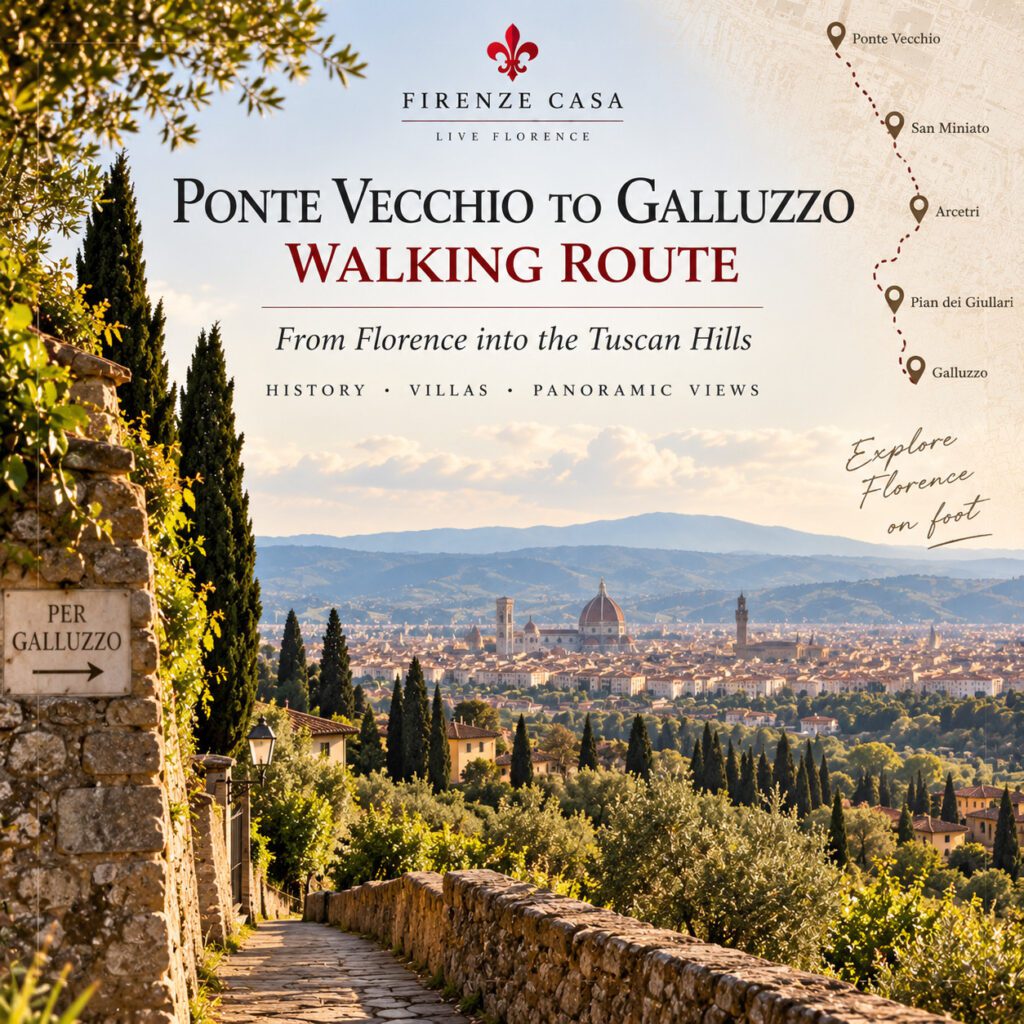
Walking from Ponte Vecchio to Galluzzo reveals one of the most beautiful transitions in Florence: the gradual journey from the historic city into the Tuscan hills. The route begins beside the Arno, climbs towards Piazzale Michelangelo and San Miniato al Monte, continues through Arcetri and Pian dei Giullari, and finally descends towards Galluzzo on the southern edge of Florence.
Unlike a conventional city walking tour, the Ponte Vecchio to Galluzzo route changes character continuously. Medieval streets give way to panoramic terraces, villas, cypress-lined roads and quieter hillside landscapes. By the time you reach Galluzzo, central Florence feels surprisingly distant.
The idea for this walk has a long history. A late twentieth-century Florence guide already described essentially the same route, linking Ponte Vecchio with Piazzale Michelangelo, San Miniato, Arcetri, Poggio Imperiale, Pian dei Giullari and Galluzzo. Today, it remains a wonderful way to understand how closely Florence and its surrounding hills belong together.
At a Glance
Start: Ponte Vecchio
Finish: Galluzzo
Optional extension: Certosa di Firenze
Allow: Around 2½–3 hours for the walk, excluding long visits and breaks
Character: Urban streets, climbs, panoramic viewpoints, villas and quiet hillside roads
Main areas: Ponte Vecchio, Piazzale Michelangelo, San Miniato, Arcetri, Pian dei Giullari, Poggio Imperiale and Galluzzo
Difficulty: Moderate, with noticeable climbs and descents
Best for: Walking, views, history, architecture and the southern hills of Florence
Why Walk from Ponte Vecchio to Galluzzo?
Florence is usually experienced from the inside. Visitors move through narrow streets between churches, palaces, museums and piazzas while the surrounding landscape remains largely invisible. This walk reverses that perspective.
You begin at one of the busiest places in the historic centre and gradually leave monumental Florence behind. First, the route climbs above the Arno. Then gardens, churches and panoramic roads appear. Farther south, villas and vegetation increasingly replace dense urban streets.
Consequently, the route is not simply a way of reaching Galluzzo on foot. Its real subject is the changing relationship between Florence and the countryside surrounding it.
The Idea Behind the Walk
Do not think of Galluzzo simply as the destination. The most rewarding part of this route is watching Florence change around you. Within a few hours, the setting moves from Ponte Vecchio and the Arno to cypress-lined hills, historic villas and the quieter landscape south of the city.
The Ponte Vecchio to Galluzzo Route
| Stage | What to Expect |
|---|---|
| 1. Ponte Vecchio | Historic Florence and the Arno |
| 2. Piazzale Michelangelo | Climb above the city and panoramic views |
| 3. San Miniato al Monte | Romanesque architecture and a quieter panorama |
| 4. Arcetri | Science, Galileo and green residential hills |
| 5. Pian dei Giullari | Historic villas and Tuscan hillside atmosphere |
| 6. Poggio Imperiale | Grand-ducal villa landscape |
| 7. Galluzzo | Historic village on the southern edge of Florence |
| 8. Certosa di Firenze | Optional final climb to the historic monastery |
The exact streets between these areas can be adapted according to current conditions, weather and personal preference. Therefore, this guide treats the historic itinerary as a sequence of places rather than giving rigid turn-by-turn instructions that may become outdated.
1. Begin at Ponte Vecchio
The walk begins at Ponte Vecchio, where Florence and the Arno have met for centuries. The present bridge dates mainly from the fourteenth century, while shops, goldsmiths and the Vasari Corridor have added further layers to its history.
At this point, you are still completely inside monumental Florence. The Uffizi, Palazzo Pitti, Piazza della Signoria and Santo Spirito all lie nearby, while crowds move continuously across the bridge.
That intensity makes Ponte Vecchio an ideal starting point. Over the next few hours, the atmosphere will change almost completely.
Before You Start
Pause beside the Arno before beginning the climb. Galluzzo lies only a few kilometres away, yet the landscape between the river and the southern hills creates the feeling of leaving one Florence and gradually entering another.
2. Climb Towards Piazzale Michelangelo
From the Arno, continue towards the hills rising south of the city. Several approaches are possible, but the important idea is to gain height gradually while moving towards Piazzale Michelangelo.
The climb introduces the geographical structure of Florence. At river level, buildings dominate the view. As you rise, however, the streets begin to open and the historic centre gradually becomes visible as a whole.
Piazzale Michelangelo provides the famous panorama. Brunelleschi’s dome, Palazzo Vecchio, Santa Croce, the Arno and the historic bridges suddenly appear together rather than as separate monuments encountered at street level.
The piazzale itself belongs to nineteenth-century Florence. Giuseppe Poggi designed it during the transformation of Florence when the city briefly served as capital of Italy. Therefore, even this celebrated viewpoint forms part of a much larger story about how Florence expanded into its surrounding hills.
Our Piazzale Michelangelo & San Miniato Walking Tour explores this first hillside section in greater detail.
3. Continue to San Miniato al Monte
Many visitors turn back after Piazzale Michelangelo. On the Ponte Vecchio to Galluzzo walk, however, the journey has only just begun.
Continue uphill towards San Miniato al Monte. The crowds usually begin to thin, while cypresses, stone walls and hillside vegetation increasingly shape the surroundings.
The basilica is one of Florence’s great Romanesque monuments. Its geometric marble façade predates the Renaissance city that dominates the panorama below, while the elevated terrace provides another magnificent view across Florence.
San Miniato also marks an important psychological point on the route. From here onwards, you are no longer simply climbing to a famous viewpoint. Instead, you begin to enter the wider landscape of the southern Florentine hills.
Do Not Turn Back Here
For most visitors, San Miniato is the end of a panoramic walk. For this route, it is the gateway to the next Florence: Arcetri, historic villas, quiet roads and the hills leading towards Galluzzo.
4. Into the Hills of Arcetri
Beyond the famous viewpoints, the atmosphere changes noticeably. Arcetri occupies the hills south of central Florence and combines residential streets, villas, gardens, scientific history and areas of vegetation.
The district is inseparable from Galileo Galilei. After his trial in Rome, Galileo spent his final years at Villa Il Gioiello in Arcetri, where house arrest restricted his movements but did not end his scientific work.
The area is also associated with astronomical research. The presence of the Arcetri Observatory reinforces a connection between the Florentine hills and the history of science that extends far beyond the familiar story of Renaissance painting and sculpture.
Yet Arcetri is equally important for the walk because of its landscape. Villas, stone walls, gardens and quieter roads begin to replace the dense city below. As a result, the transition towards the Tuscan countryside becomes increasingly apparent.
Florence and Science
Arcetri adds an unexpected dimension to this walk. Within a relatively small hillside area, the landscape connects Galileo’s final years with later astronomical research while offering some of the quietest surroundings close to central Florence.
5. Pian dei Giullari – Villas Above Florence
Continue through the hills towards Pian dei Giullari. This is one of the sections where the route begins to feel distinctly different from a conventional Florence walking tour.
Historic villas appear among gardens, stone walls and vegetation. The road follows the contours of the hills rather than the regular street pattern of the centre, while glimpses of the surrounding landscape repeatedly open between buildings and trees.
Pian dei Giullari belongs to the larger villa culture that developed around Florence. Wealthy families sought residences outside the crowded centre, where they could combine proximity to the city with gardens, agriculture, views and a healthier hillside environment.
The villas also demonstrate that the Tuscan landscape surrounding Florence was never simply empty countryside. For centuries, agriculture, elite residences, religious institutions, scientific sites and working communities occupied these hills.
This relationship between city and landscape is explored more broadly in The Hills of Florence.
Look Beyond the View
The beauty of the southern hills is obvious, but their history matters just as much. Villas, farms, churches and old roads reveal a landscape that has been closely connected with Florence for centuries.
6. Poggio Imperiale and the Grand-Ducal Landscape
Another important landmark along the wider route is Villa del Poggio Imperiale. The imposing residence stands above Porta Romana and belongs to the network of villas and estates associated with Tuscany’s ruling dynasties.
The property has earlier origins, but the Medici and later Habsburg-Lorraine rulers transformed it substantially. Its present monumental character therefore reflects several centuries of court culture rather than one single architectural period.
Poggio Imperiale also helps explain the geography of this side of Florence. Palazzo Pitti represented grand-ducal power within the city, while villas and estates extended court life outward into the surrounding hills.
Consequently, this section of the walk connects urban Florence with a landscape of residences, gardens and roads that once served the political and social elite of Tuscany.
7. Leaving Monumental Florence Behind
After Arcetri, Pian dei Giullari and Poggio Imperiale, the route increasingly becomes a landscape walk. Streets twist between hills, vegetation becomes more prominent and the monumental skyline of Florence gradually disappears behind you.
This is perhaps the most important part of the entire journey. There may be fewer famous sights, but the relationship between city and countryside becomes much easier to understand.
Olive trees, cypresses, gardens, stone walls and villas create the landscape commonly associated with Tuscany. Yet here it begins only a short distance from Ponte Vecchio.
The contrast explains why the Ponte Vecchio to Galluzzo route works so well. You do not travel to the Tuscan countryside by car or train. Instead, you watch it gradually emerge around you as you walk away from Florence.
Firenze Casa Perspective
There is no precise point where Florence ends and Tuscany begins. This walk makes that clear. The dense historic city gradually opens into villas, gardens and hills until the surrounding landscape becomes the dominant experience.
8. Descending Towards Galluzzo
The final section descends towards Galluzzo, a historic settlement on the southern edge of Florence. After the quiet hillside roads, reaching the village brings everyday urban life back into the route.
Galluzzo developed along important routes leading south from Florence. Its position still makes it a gateway between the city and the countryside towards Impruneta and Chianti.
Unlike the historic centre, Galluzzo is primarily a place where Florentines live rather than an area shaped around tourism. Cafés, local businesses and residential streets therefore provide an interesting final contrast with Ponte Vecchio, where the walk began.
After several hours on foot, this change feels appropriate. The route started at an international symbol of Florence and finishes in an ordinary Florentine neighbourhood at the edge of the Tuscan hills.
9. Optional Extension to the Certosa di Firenze
If you still have time and energy, continue from Galluzzo towards the Certosa di Firenze, also known as the Certosa del Galluzzo. The large monastic complex rises above the surrounding landscape on Monte Acuto and provides a magnificent historical conclusion to the walk.
Niccolò Acciaiuoli founded the Certosa in the fourteenth century. The Acciaiuoli belonged to the world of Florentine banking and international politics, and the monastery became one of the most impressive monuments associated with the family.
The complex developed over several centuries and includes churches, cloisters, monastic spaces and important works of art. Pontormo’s connection with the Certosa adds another important link with Florentine artistic history.
The interior is not a conventional museum that visitors can simply enter at any moment. Guided visits operate according to current arrangements, so check the official visiting information before planning the Certosa as the final stop of the walk.
A Perfect Finale
If the timing works, the Certosa transforms the walk into a complete journey from medieval Florence to a medieval monastery in the hills. Allow additional time for the climb and for a guided visit rather than treating the Certosa as a quick final stop.
A Walk Through Several Florences
One reason this route works so well is the variety of historical periods encountered along the way. Ponte Vecchio represents medieval Florence, while San Miniato reaches even farther back into the city’s Romanesque past.
Piazzale Michelangelo introduces nineteenth-century urban planning. Arcetri brings Galileo and the history of science into the journey, while Poggio Imperiale reflects Medici and grand-ducal villa culture.
Finally, Galluzzo and the Certosa connect the route with medieval banking, monastic life and the historic roads leading south from Florence.
Few walks around the city combine so many different aspects of Florentine history while simultaneously moving from a dense urban environment into an increasingly green landscape.
Florence from Inside and Outside
The route also changes the way you see Florence geographically. At Ponte Vecchio, the city surrounds you. From Piazzale Michelangelo and San Miniato, you look back at it from above. Farther south, Florence gradually becomes part of a larger valley landscape.
This progression is important because the historic centre can easily create the impression of a self-contained city. In reality, Florence always depended on the hills and countryside around it.
Food arrived from farms, stone came from quarries, wealthy families built villas outside the walls and roads connected the city with villages, monasteries and agricultural estates throughout Tuscany.
Walking towards Galluzzo therefore reveals a Florence whose history does not stop at the edge of the UNESCO historic centre.
How Long Does the Ponte Vecchio to Galluzzo Walk Take?
The historic description of the route estimated approximately two and a half hours of walking to Galluzzo, with additional time required for the climb to the Certosa. Today, however, it makes sense to allow considerably more time if you want to enjoy the route rather than simply complete it.
For most visitors, around three hours of actual walking is a useful starting point. Add time for photographs, panoramic stops and visits to San Miniato or other sites along the way.
If you plan to visit the Certosa as well, the route can easily become a substantial half-day excursion. In that case, check its current visiting arrangements before leaving central Florence.
How Difficult Is the Walk?
The route is not technically difficult, but it involves significant changes in elevation. The climb from the Arno towards Piazzale Michelangelo and San Miniato is the most obvious ascent, while the rolling hills farther south add further climbs and descents.
Comfortable walking shoes are therefore important. In addition, carry water during warmer weather because the route extends well beyond the compact centre where cafés and shops appear every few metres.
Summer heat can make the hills demanding around midday. Spring and autumn generally provide more comfortable walking conditions, while clear winter days can offer excellent views.
Firenze Casa Tip
This is not a walk to rush. Start reasonably early, wear proper shoes and allow time to stop. The route is most rewarding when the changing landscape becomes part of the experience rather than simply the space between individual sights.
Which Direction Is Best?
Walking from Ponte Vecchio to Galluzzo creates the strongest narrative because the surroundings become progressively quieter and greener. You physically walk out of Florence and into the hills.
The opposite direction is also possible, especially if you prefer to finish in the historic centre. However, beginning in Galluzzo means that the gradual transition from city to countryside becomes a transition in the opposite direction.
For the Firenze Casa route, I would therefore choose Ponte Vecchio as the starting point. The journey from one of Florence’s busiest landmarks towards the quieter southern hills is what gives the walk its distinctive character.
Returning from Galluzzo
You do not need to walk back to central Florence. Public transport connects Galluzzo with the city, which makes this route particularly practical as a one-way walk.
Because routes and timetables can change, check the current public transport information on the day of your walk. This is especially useful if you extend the route to the Certosa and finish later than expected.
The possibility of returning by bus also means that you can enjoy the hillside sections without worrying about repeating the entire distance in the opposite direction.
When Is the Best Time for the Walk?
Spring is particularly attractive because the hills are green and temperatures are usually comfortable. Autumn offers similarly pleasant conditions, often with warm light and fewer extremely hot days.
Summer requires more planning. Start early, carry sufficient water and avoid the hottest part of the afternoon whenever possible. Although some sections offer shade, much of the route remains exposed to the Tuscan sun.
Winter can be surprisingly rewarding on clear days. The air may provide excellent visibility across Florence, while the famous viewpoints generally attract fewer visitors than during the main season.
Interesting Facts About the Route
- The walk begins at Ponte Vecchio, the oldest surviving bridge in Florence.
- The route climbs from the Arno into the southern hills of the city.
- Piazzale Michelangelo was created during the nineteenth-century transformation of Florence.
- San Miniato al Monte is one of Florence’s great Romanesque churches.
- Galileo spent his final years at Villa Il Gioiello in Arcetri.
- Arcetri remains closely associated with astronomy and scientific research.
- Pian dei Giullari preserves the atmosphere of Florence’s historic villa landscape.
- Villa del Poggio Imperiale became an important residence of Tuscany’s ruling dynasties.
- Galluzzo historically occupied an important position on routes leading south from Florence.
- The Certosa di Firenze was founded by the Florentine statesman and banker Niccolò Acciaiuoli.
- The historic concept of this walk already connected Ponte Vecchio with Galluzzo through the southern hills decades ago.
- The route can be walked in one direction because public transport connects Galluzzo with central Florence.
Frequently Asked Questions
Can you walk from Ponte Vecchio to Galluzzo?
Yes. A historic walking route connects the centre of Florence with Galluzzo through the southern hills. The journey can include Piazzale Michelangelo, San Miniato al Monte, Arcetri, Pian dei Giullari and Poggio Imperiale.
How long does the Ponte Vecchio to Galluzzo walk take?
The historic route was described as approximately two and a half hours of walking. Today, allowing around three hours of actual walking is more comfortable, while visits, photographs and breaks will increase the total time.
Is the walk difficult?
The route is moderately demanding rather than technically difficult. However, it includes noticeable climbs and descents, particularly between the Arno and the southern hills.
Do I need hiking equipment?
No specialist hiking equipment is normally necessary, but comfortable walking shoes are important. Water and sun protection are also advisable during warmer months.
Does the route pass Piazzale Michelangelo?
Yes. Piazzale Michelangelo forms one of the major early stages of the route and provides the classic panoramic view across Florence.
Does the walk include San Miniato al Monte?
Yes. Continuing from Piazzale Michelangelo to San Miniato creates a natural transition from the famous viewpoint towards the quieter southern hills.
Why is Arcetri important?
Arcetri is closely associated with Galileo Galilei, who spent his final years at Villa Il Gioiello. The area also has an important connection with astronomical research.
What is Pian dei Giullari?
Pian dei Giullari is a historic hillside area south of Florence characterised by villas, gardens, vegetation and quieter roads. It forms part of the transition between urban Florence and the surrounding countryside.
Is Galluzzo worth visiting?
Yes. Galluzzo offers a different perspective on Florence and provides access to the Certosa di Firenze, one of the most important historic monastic complexes south of the city.
Can I visit the Certosa at the end of the walk?
Yes, but the interior operates with guided visits and specific access arrangements. Therefore, check current visiting times before planning the monastery as the final stop.
Do I have to walk back to Florence?
No. Public transport connects Galluzzo with central Florence, making this route particularly suitable as a one-way walk.
Why This Walk Is Worth It
Ponte Vecchio to Galluzzo is more than a long walk through Florence. It is a journey from the compact historic city into the landscape that has surrounded and supported it for centuries.
The route begins among medieval architecture and crowds beside the Arno. It then climbs towards famous panoramas before passing Romanesque San Miniato, scientific Arcetri, historic villas and the quieter roads of Pian dei Giullari.
Gradually, Florence stops feeling like a collection of monuments and becomes part of a much larger Tuscan landscape. By the time you descend towards Galluzzo, the transformation is complete.
That is what makes this route particularly characteristic of Firenze Casa. Instead of simply showing you another list of sights, it allows you to experience the relationship between Florence and its hills step by step.
Further Reading on Firenze Casa
- Florence Walking Routes – Explore the City by Theme
- The History of Ponte Vecchio – Florence’s Most Famous Bridge
- Piazzale Michelangelo & San Miniato Walking Tour
- Piazzale Michelangelo – The Best View of Florence
- San Miniato al Monte – Romanesque Basilica in Florence
- Galileo Galilei – Science, the Medici and Florence
- Villa del Poggio Imperiale – Medici Villa in Florence
- Galluzzo from Florence – Certosa and a Historic Tuscan Village
- The Hills of Florence – Exploring the City Above the Arno Valley
References
- Meridiani – Firenze, historical walking itinerary from Ponte Vecchio to Galluzzo.
- Comune di Firenze – Firenze Walking City and historical information on Galluzzo.
- Feel Florence – Gavinana and Galluzzo, Arcetri, Pian dei Giullari and the southern hills of Florence.
- Feel Florence – Viale dei Colli and panoramic walking routes south of the Arno.
- Certosa di Firenze – history and current visitor information.
- Comune di Firenze – cultural and historical information on Arcetri and Galileo Galilei.
- Historical studies and visitor resources on San Miniato al Monte, Poggio Imperiale and the Florentine hills.