Villa del Poggio Imperiale is one of the most important historic villas in Florence. Rising above Porta Romana on the hills south of the historic centre, the residence combines Medici history, grand-ducal court culture and a monumental Neoclassical façade.
Its appearance differs markedly from the romantic image of a secluded Tuscan country villa. Instead, Villa del Poggio Imperiale stands at the end of a long avenue and presents itself almost like a palace above the city. Behind that formal exterior, however, lies a history shaped by several ruling dynasties and centuries of architectural transformation.
Location: South of Florence, above Porta Romana
Earlier name: Poggio Baroncelli
Important owners: Baroncelli, Salviati, Medici and Habsburg-Lorraine
Key Medici figure: Maria Magdalena of Austria
Architectural character: Renaissance origins with major Baroque and Neoclassical transformations
Known for: Monumental façade, grand-ducal interiors and Chinese Rooms
UNESCO: Part of the Medici Villas and Gardens in Tuscany
Current use: Educandato Statale della Santissima Annunziata
Public access: Limited; check current arrangements
Worth seeing for: Medici history, court culture and Neoclassical architecture
Villa del Poggio Imperiale forms an essential part of our Historic Villas of Florence and Fiesole – Complete Guide.
Where Is Villa del Poggio Imperiale?
Villa del Poggio Imperiale stands south of Florence’s historic centre, above Porta Romana. A long avenue, today known as Viale del Poggio Imperiale, climbs directly towards the residence.
This approach is one of the villa’s defining features. Rather than disappearing into the countryside, the building occupies a commanding position above Florence and terminates the rising avenue with a monumental architectural statement.
The location also creates a clear transition between city and landscape. As visitors leave Porta Romana behind, dense urban streets gradually give way to gardens, villas and the quieter hills south of Florence.
Approach the villa from Porta Romana if possible. The long uphill avenue makes the architecture far more dramatic and reveals how carefully the residence relates to the city below.
From Poggio Baroncelli to a Grand-Ducal Residence
The origins of Villa del Poggio Imperiale predate the Medici period. The estate was originally known as Poggio Baroncelli, after the Florentine Baroncelli family.
During the sixteenth century, the property passed to the Salviati, another important Florentine dynasty. Political tensions eventually changed its future when the estate came under Medici control.
From that point onwards, the villa entered the orbit of Florence’s ruling family. What had begun as a private country residence gradually developed into a property closely associated with dynastic life and grand-ducal power.
Many Florentine villas changed meaning as ownership changed. A private family estate could become a court residence, administrative property or institutional building while retaining earlier architectural layers.
Maria Magdalena of Austria and the Medici Villa
A decisive chapter began in the early seventeenth century with Maria Magdalena of Austria, wife of Cosimo II de’ Medici. She acquired the estate in 1622 and commissioned extensive alterations.
Under her ownership, the residence expanded and acquired a more courtly character. Architect Giulio Parigi played an important role in creating a villa suitable for a member of one of Europe’s most powerful dynastic families.
Maria Magdalena also gave the property the name by which it is known today. The word Imperiale refers to her connection with the imperial Habsburg family rather than to an emperor who lived at the villa.
The name “Poggio Imperiale” recalls Maria Magdalena of Austria’s Habsburg ancestry. Its imperial reference is dynastic rather than a record of an emperor residing there.
A Villa Connected with the Women of the Medici Court
Villa del Poggio Imperiale has a particularly interesting association with important women of the Medici dynasty.
After Maria Magdalena of Austria, other female members of the ruling family used and transformed the residence. Among them was Vittoria della Rovere, wife of Grand Duke Ferdinando II de’ Medici.
This history offers a useful counterpoint to the more familiar narratives centred on male rulers. Poggio Imperiale reveals how grand-ducal residences also formed part of the domestic, ceremonial and cultural world of the women of the Medici court.
Poggio Imperiale adds an important dimension to Medici history because several powerful women shaped the residence. The villa therefore offers a different perspective from the more male-dominated political story of Palazzo Vecchio.
The Road from Porta Romana
The long avenue from Porta Romana creates one of Florence’s most striking relationships between urban planning and villa architecture.
As the road climbs, the villa remains visible as a destination above the city. This strong visual axis gives the residence a ceremonial character very different from villas hidden behind walls and vegetation in the hills around Fiesole.
The effect also reinforces the villa’s relationship with Florence itself. Although Poggio Imperiale stands outside the dense historic centre, it never feels disconnected from the city.
Notice how the villa terminates the rising avenue from Porta Romana. Architecture, road and hillside work together to create a formal approach worthy of a grand-ducal residence.
After the Medici
The death of Gian Gastone de’ Medici in 1737 ended the male line of the Medici grand dukes. Tuscany then passed to the House of Habsburg-Lorraine.
Poggio Imperiale remained an important residence under the new dynasty. Rather than preserving the Medici villa unchanged, the Habsburg-Lorraine rulers adapted it to new courtly tastes and requirements.
As a result, the building visible today cannot be described as a single-period Renaissance villa. Its architecture records several major phases extending from Medici Florence into Enlightenment and Neoclassical Tuscany.
The Architectural Transformation of the Villa
During the eighteenth century, architects including Gaspare Maria Paoletti contributed to the development of the complex. Apartments changed, interiors evolved and the residence increasingly reflected the refined court culture of Habsburg-Lorraine Tuscany.
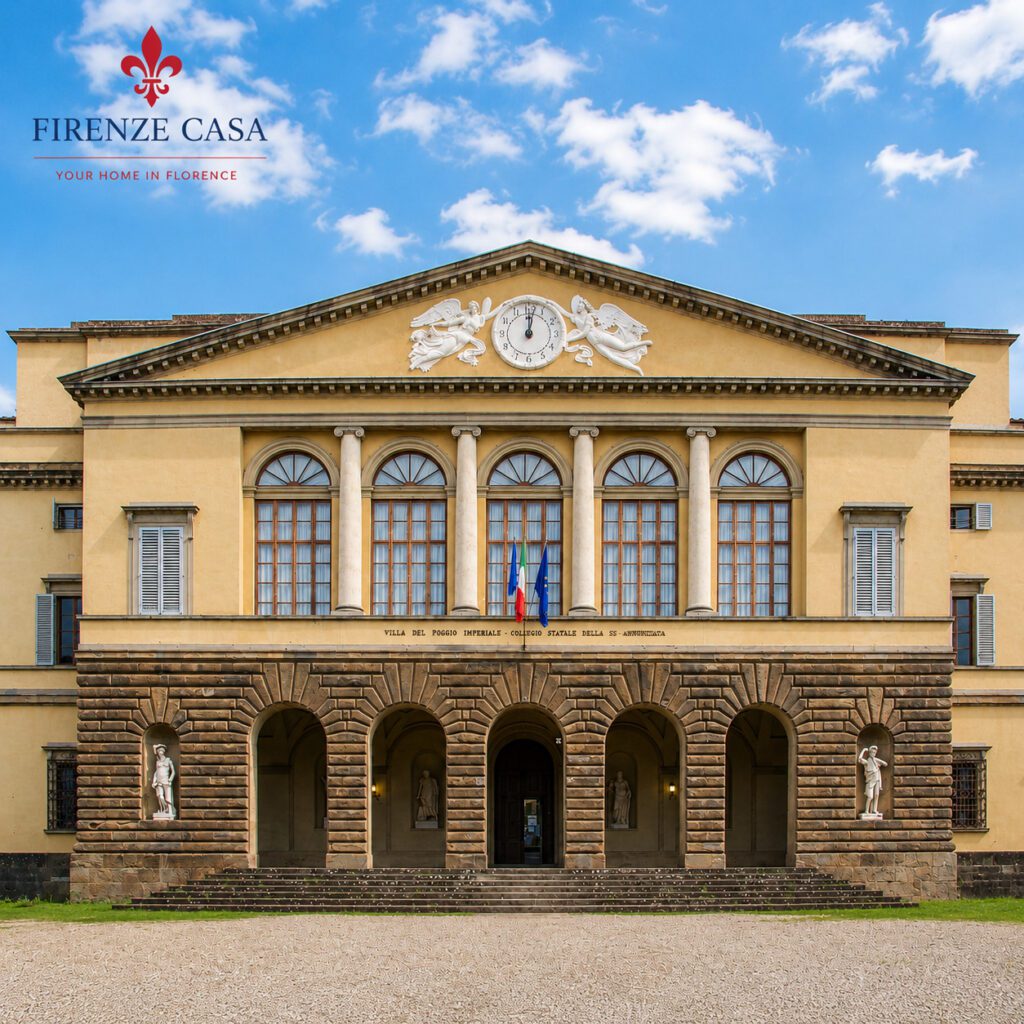
The most dramatic visual transformation followed around the beginning of the nineteenth century. Pasquale Poccianti helped give the principal façade much of its present monumental Neoclassical character.
Today, the long symmetrical elevation, central portico and classical architectural vocabulary dominate the approach to the villa.
These later interventions explain why Poggio Imperiale looks so different from many earlier Medici estates.
Do not expect Poggio Imperiale to resemble one untouched Renaissance villa. Its importance lies precisely in the way successive generations transformed the residence while preserving traces of earlier phases.
Why Does Poggio Imperiale Look So Different from Other Medici Villas?
Visitors familiar with Villa Medici a Fiesole or Villa Medicea di Castello may be surprised by Poggio Imperiale.
Villa Medici a Fiesole depends strongly on terraces and its intimate relationship with the hillside landscape. Castello, meanwhile, is especially important for its Renaissance garden and symbolic programme.
Poggio Imperiale belongs to a more monumental courtly world. Its broad Neoclassical façade reflects later architectural tastes and the ceremonial ambitions of Tuscany’s ruling dynasties.
Comparing the three villas therefore provides an excellent introduction to the evolution of elite country architecture around Florence.
The Interior of Villa del Poggio Imperiale
The interior preserves rooms and decorative schemes from different periods in the villa’s long history. Grand apartments and reception spaces recall its centuries as a residence of Tuscany’s ruling elite.
Because successive owners altered the property, visitors encounter a layered interior rather than one uniform style. Earlier decorative traditions coexist with later Neoclassical spaces.
This variety makes the villa especially interesting architecturally. The interiors provide a visual record of changing court culture across several generations.
The Chinese Rooms
Among the most distinctive treasures of Villa del Poggio Imperiale are rooms decorated with Chinese painted and paper panels.
During the eighteenth century, European courts developed a strong fascination with Chinese and East Asian art. Porcelain, lacquerware, textiles and decorative panels circulated through international trade networks and became highly valued luxury objects.
The rooms at Poggio Imperiale belong to this wider culture of collecting and chinoiserie. At the same time, authentic imported decorative materials give them exceptional historical interest.
They also remind visitors that eighteenth-century Florence participated in international cultural and commercial networks extending far beyond Tuscany.
Some of the most surprising interiors at Poggio Imperiale look far beyond Florence. Their Chinese decoration reflects the cosmopolitan collecting culture of eighteenth-century European courts.
The Villa and the Napoleonic Era
The political upheavals of the Napoleonic period also reached Tuscany and Villa del Poggio Imperiale.
During the years of French influence, the villa became associated with Elisa Bonaparte Baciocchi, Napoleon’s sister, who ruled Tuscany as Grand Duchess.
Her presence added another powerful female figure to the history of the residence. More broadly, it demonstrates how closely the villa’s story followed the changing political fortunes of Tuscany.
Medici rule, Habsburg-Lorraine government and Napoleonic control all left their mark on the same property.
Maria Anna of Saxony and Later Court Life
During the nineteenth century, Poggio Imperiale continued to serve members of the grand-ducal family. One notable resident was Maria Anna of Saxony, wife of Leopold II, Grand Duke of Tuscany.
The villa therefore remained part of the network of court properties surrounding Florence until the final decades of grand-ducal rule.
However, the political order was changing rapidly. The Risorgimento and the unification of Italy would soon bring an end to the old Tuscan state.
From Grand-Ducal Villa to School
After the political changes of the nineteenth century, Poggio Imperiale acquired a very different function. The complex became closely associated with the Educandato Statale della Santissima Annunziata.
This educational role has helped keep the villa active rather than transforming the entire property into a conventional museum.
At the same time, the institutional use affects visitor access. Poggio Imperiale remains a historic monument, but it is also a working educational environment.
Historic buildings often survive because they acquire new functions. Poggio Imperiale continues to serve an educational purpose while preserving architectural and decorative elements from its grand-ducal past.
A UNESCO Medici Villa
Villa del Poggio Imperiale belongs to the group of Medici Villas and Gardens in Tuscany recognised as a UNESCO World Heritage Site.
The UNESCO ensemble demonstrates how the Medici reshaped the relationship between architecture, gardens and cultivated landscape across Tuscany.
These estates served leisure and representation, but they also connected with agriculture, administration, collecting and intellectual life.
Poggio Imperiale occupies a distinctive place within the group because later Habsburg-Lorraine and Neoclassical transformations visibly extend its story far beyond the Medici period.
The Medici villas changed the idea of an elite country residence. Architecture, gardens and cultivated landscape became part of a unified environment that influenced villa culture far beyond Tuscany.
Villa del Poggio Imperiale and Palazzo Pitti
There is a natural historical and geographical relationship between Poggio Imperiale and Palazzo Pitti.
Both residences served Tuscany’s ruling dynasties, but they fulfilled different roles. Palazzo Pitti represented grand-ducal power within Florence, while Poggio Imperiale offered a more spacious court residence above the city.
Together with the Boboli Gardens and other Medici estates, these properties reveal how the ruling family created a network of palaces, gardens and villas extending outward from central Florence.
Palazzo Pitti represents the court within Florence. Poggio Imperiale shows how that same court expanded into the surrounding hills and villa landscape.
Can You Visit Villa del Poggio Imperiale?
Villa del Poggio Imperiale does not operate like one of Florence’s major public museums. Because the complex houses an active educational institution, visitor access may depend on scheduled openings, organised tours or special occasions.
Anyone specifically interested in seeing the interiors should therefore check current arrangements before travelling to the villa.
Even when interior access is unavailable, the approach from Porta Romana and the monumental exterior remain worthwhile for visitors interested in Florence’s architectural landscape.
Location: Above Porta Romana, south of central Florence
Current use: Educandato Statale della Santissima Annunziata
Regular museum access: No
Possible access: Scheduled visits, organised tours or special openings
UNESCO status: Part of the Medici Villas and Gardens in Tuscany
Best advice: Check current visitor information before planning an interior visit
What to See near Villa del Poggio Imperiale
The villa lies within an attractive area for exploring the southern side of Florence. Porta Romana provides the natural starting point, while Palazzo Pitti and the Boboli Gardens lie nearby in the Oltrarno.
Visitors can therefore combine Poggio Imperiale with a broader exploration of grand-ducal Florence. The route reveals how court life extended from the urban palace into gardens and hillside residences beyond the old city walls.
The surrounding southern hills also provide a quieter contrast with the heavily visited historic centre.
Combine Poggio Imperiale with Porta Romana, Palazzo Pitti and the Boboli Gardens. Together, they form a particularly clear route through the landscape of grand-ducal Florence.
Why Villa del Poggio Imperiale Is Worth Discovering
Villa del Poggio Imperiale is worth discovering because few historic villas around Florence show so clearly how architecture changes with political power. Its story connects Renaissance families, the Medici court, the Habsburg-Lorraine dynasty, Napoleonic Tuscany and modern educational life.
The architecture tells the same story in stone. Earlier phases coexist with later grand-ducal alterations and an imposing Neoclassical façade.
Moreover, the villa’s long avenue and commanding hillside position create a relationship with Florence unlike that of the more secluded estates around Fiesole.
For visitors exploring the historic villas of Florence and Fiesole, Poggio Imperiale is therefore essential. It demonstrates that Florentine villa culture continually evolved according to new owners, political circumstances and architectural fashions.
Follow the avenue uphill from Porta Romana and Florence gradually changes character. Poggio Imperiale marks the point where the dense city begins to open towards the historic landscape of villas and gardens that once surrounded the grand-ducal capital.
Frequently Asked Questions
Where is Villa del Poggio Imperiale?
The villa stands on the hills south of central Florence, directly above Porta Romana at the end of Viale del Poggio Imperiale.
Why is it called Poggio Imperiale?
The name refers to Maria Magdalena of Austria and her Habsburg imperial ancestry. It does not indicate that an emperor lived permanently at the villa.
Was Villa del Poggio Imperiale a Medici villa?
Yes. The estate became closely associated with the Medici and later formed part of the wider network of villas belonging to Tuscany’s ruling dynasty.
Why does the villa look Neoclassical?
Although the property has earlier origins, major later transformations reshaped its appearance. In particular, nineteenth-century work gave the principal façade its monumental Neoclassical character.
What are the Chinese Rooms?
They are historic interiors decorated with Chinese painted and paper panels, reflecting eighteenth-century European interest in East Asian art and collecting.
Who lived at Poggio Imperiale?
Important residents included Maria Magdalena of Austria, Vittoria della Rovere, members of the Habsburg-Lorraine dynasty, Elisa Bonaparte Baciocchi and Maria Anna of Saxony.
Is Villa del Poggio Imperiale a UNESCO site?
Yes. It forms part of the UNESCO World Heritage property Medici Villas and Gardens in Tuscany.
Can you visit Villa del Poggio Imperiale?
Access is more limited than at a conventional museum because the villa houses an educational institution. Visitors should check current arrangements for tours or special openings.
Is the exterior worth seeing without an interior visit?
Yes. The long approach from Porta Romana and the monumental façade make the villa worthwhile even when the historic interiors are not accessible.
Further Reading on Firenze Casa
Continue exploring Florence’s historic villas and the changing relationship between architecture, gardens and dynastic power:
- Historic Villas of Florence and Fiesole – Complete Guide
- Villa di Fontallerta – Historic Villa near Fiesole
- Villa Medici a Fiesole – Renaissance Villa near Florence
- Villa Medicea di Castello – Medici Villa and Gardens in Florence
- Villa di Maiano – Historic Villa in the Hills of Florence
- Villa La Pietra – Florence’s Historic Acton Family Estate
- Villa Le Balze – Historic Villa and Gardens in Fiesole
- Palazzo Pitti – Grand Ducal Palace of Florence
References
- UNESCO World Heritage Centre – Medici Villas and Gardens in Tuscany
- Regione Toscana – Medici Villas and Gardens in Tuscany
- Comune di Firenze – Villa del Poggio Imperiale
- Educandato Statale della Santissima Annunziata – Historical Information on Villa del Poggio Imperiale
- Ministero della Cultura – Historical and Architectural Documentation Concerning Villa del Poggio Imperiale
- Architectural Studies on the Medici and Habsburg-Lorraine Villas of Florence and Tuscany