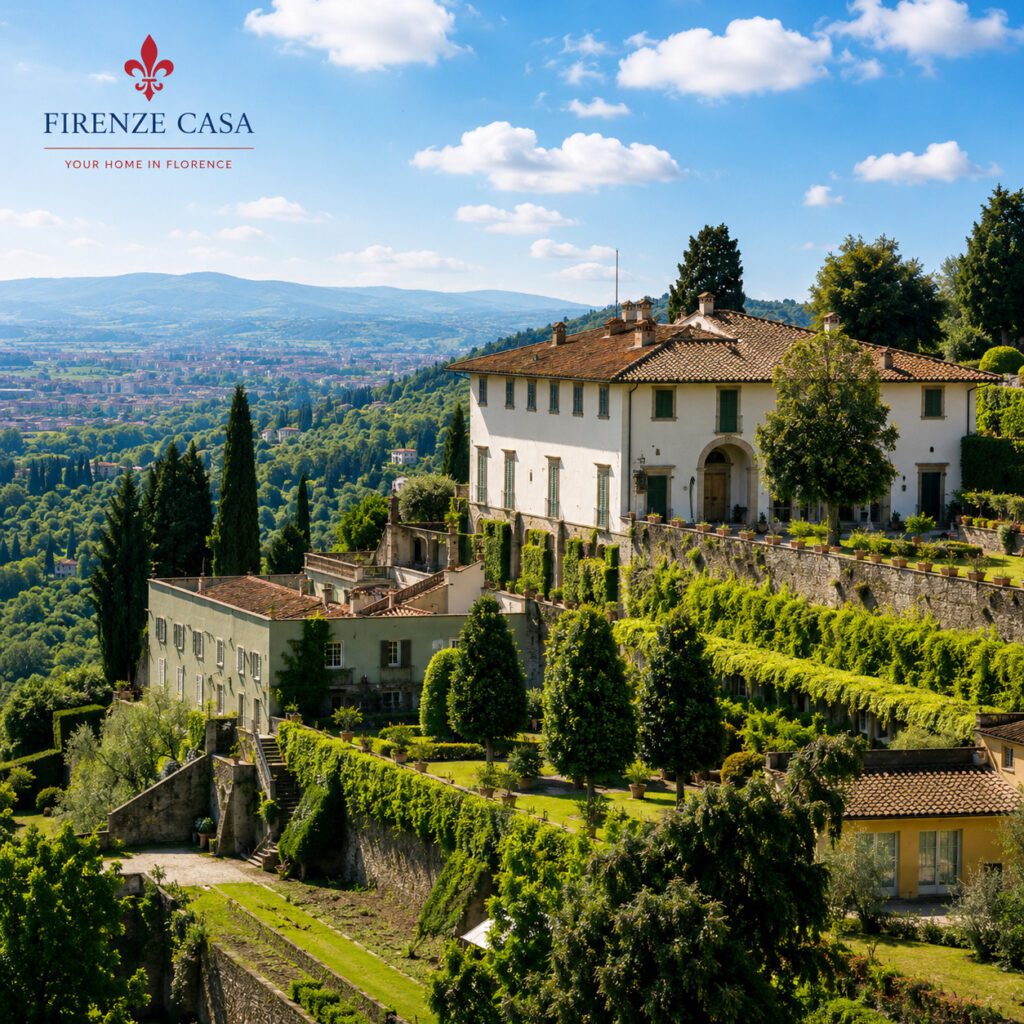
Villa Medici a Fiesole is one of the most important early Renaissance villas near Florence. Perched on the slopes below the ancient town of Fiesole, the residence combines elegant architecture, terraced gardens and sweeping views across the Florentine landscape.
More importantly, the villa represents a decisive moment in the transformation of the country residence from a fortified retreat into a place designed for leisure, contemplation and enjoyment of nature. Its restrained proportions and close relationship with the surrounding countryside helped establish ideas that would influence Renaissance villa architecture throughout Tuscany.
Location: Fiesole, in the hills above Florence
Period: 15th century
Built for: Giovanni de’ Medici
Traditional architectural attribution: Michelozzo di Bartolomeo
Known for: Early Renaissance villa architecture and terraced gardens
Historic significance: An important transition from fortified country residence to humanist villa
UNESCO: Part of the Medici Villas and Gardens in Tuscany
Public access: Private property; access is limited
Worth knowing for: Renaissance architecture, Medici history and landscape design
Villa Medici a Fiesole is one of the key properties featured in our Historic Villas of Florence and Fiesole – Complete Guide.
A Medici Retreat in the Hills of Fiesole
The history of Villa Medici a Fiesole is closely connected with the rise of the Medici family in fifteenth-century Florence. The residence was built for Giovanni de’ Medici, a son of Cosimo de’ Medici, during the middle decades of the century.
Its location was carefully chosen. Fiesole had long attracted wealthy Florentines seeking cooler air, open countryside and distance from the crowded streets of the city.
Yet the hills remained close enough for residents to maintain political, commercial and social connections with Florence. From the villa, withdrawal from urban life did not mean isolation from it.
For the Medici, such residences offered places for conversation, study, hospitality and recreation while also demonstrating the family’s growing cultural sophistication.
The hills of Fiesole offered the Medici something difficult to find inside Florence: distance without disconnection. The city remained visible below while the villa provided space for leisure, study and cultivated country life.
Michelozzo and the Architecture of the Villa
The design of Villa Medici a Fiesole has traditionally been associated with Michelozzo di Bartolomeo, one of the architects most closely connected with Medici patronage.
The attribution has been discussed by modern scholars, so it is better to regard the villa as belonging to the architectural culture that developed around the Medici during the early Renaissance rather than presenting Michelozzo’s authorship as completely certain.
What is clear is that the residence differs fundamentally from a medieval fortified country house. Massive defensive towers and fortress-like enclosures are replaced by balanced proportions and a much more open relationship with the surroundings.
Long façades, loggias and terraces create architectural order while connecting the residence with gardens and distant views.
The importance of the villa lies partly in what it lacks. Instead of presenting itself as a defensive stronghold, it opens towards terraces, gardens and views – a fundamental change in the idea of a country residence.
From Medieval Stronghold to Renaissance Villa
The transformation represented by Villa Medici a Fiesole reflects a broader cultural change in fifteenth-century Florence. Wealthy families increasingly viewed the countryside not simply as agricultural territory or a place requiring protection, but as an environment for intellectual and aesthetic enjoyment.
Classical literature helped shape this ideal. Renaissance humanists admired ancient descriptions of rural retreats where cultivated owners could read, converse and contemplate nature away from the pressures of urban life.
The hills around Florence provided an ideal setting for this rediscovered concept. From Fiesole, the city remained visible in the distance, allowing villa residents to leave Florence physically without leaving its cultural world.
The Renaissance villa represented more than a new architectural style. It reflected a new attitude towards country life, combining classical ideals, cultivated leisure and a growing appreciation of landscape.
The Terraced Gardens
One of the most attractive features of Villa Medici a Fiesole is the relationship between the residence and its gardens. Because the property occupies a steep hillside, the grounds are organised across a series of terraces.
Stone walls, stairways, clipped vegetation and carefully arranged garden spaces create transitions between architecture and landscape. Rather than separating the villa from nature, the design draws the surrounding countryside into the experience of the residence.
The terraces also exploit the dramatic topography of the Fiesole hills. Views extend across Florence and the Arno valley while slopes and vegetation frame the city from above.
The panorama is not merely a pleasant consequence of the location. Terraces, gardens, architecture and views work together as parts of one carefully composed environment.
A New Relationship Between Architecture and Landscape
Villa Medici a Fiesole demonstrates one of the central ideas of Renaissance villa architecture: a building could be designed in direct dialogue with its natural surroundings.
The residence does not dominate the hillside through monumental scale. Instead, terraces and architectural openings connect interior spaces with gardens and distant views.
The result is an environment in which landscape effectively becomes an extension of the architecture.
This principle would become increasingly sophisticated in later Tuscan villas. Gardens developed into elaborate sequences of terraces, fountains, sculpture, avenues and viewpoints, but the comparatively restrained arrangement at Fiesole already contains many of the essential ideas.
The Medici and the Culture of Country Life
The Medici owned numerous rural residences around Florence, and these properties served different purposes. Some remained closely connected with agricultural estates and hunting grounds, while others became increasingly refined settings for leisure and political representation.
Villa Medici a Fiesole belongs to an earlier and more intimate phase of this development. Its scale reflects the ideal of a cultivated retreat rather than grand dynastic display.
That distinction becomes particularly clear when the villa is compared with Villa Medicea di Castello or Villa del Poggio Imperiale.
Together, these residences reveal how Medici villa culture evolved from relatively intimate Renaissance retreats into increasingly elaborate dynastic and courtly environments.
Fiesole represents an early and intimate Renaissance ideal. Castello later developed the relationship between villa, garden and dynastic symbolism, while Poggio Imperiale eventually became a monumental grand-ducal residence.
Lorenzo de’ Medici and the Fiesole Landscape
The Medici family’s association with Fiesole also places the villa within the intellectual world of Renaissance Florence. The hills surrounding the city became closely connected with humanist culture, poetry and philosophical discussion.
Lorenzo de’ Medici inherited the property after the death of his uncle Giovanni. The wider Medici circle included some of the most influential writers, philosophers and artists of fifteenth-century Florence.
Country residences provided suitable settings for cultivated leisure away from the political intensity of the city. Reading, conversation, music and hospitality could all form part of villa life.
Later traditions have sometimes romanticised the intellectual gatherings associated with Medici villas. Nevertheless, the relationship between humanist culture, country life and the landscape remains fundamental to understanding residences such as Villa Medici a Fiesole.
Renaissance villas were not simply luxurious holiday homes. For Florence’s elite, they could provide spaces for reading, conversation, music, hospitality and intellectual exchange.
Later Owners and Changing Fortunes
Like many historic villas around Florence, Villa Medici a Fiesole passed through different owners after its Medici period. Successive generations inevitably adapted the property to changing tastes and ways of life.
Nevertheless, the essential character of the site survived. The relationship between the main building, its terraces and the surrounding landscape remains the defining feature of the estate.
This continuity allows the villa to communicate something unusually important. It shows not simply how wealthy Florentines lived, but how Renaissance architects and patrons began to rethink the relationship between domestic architecture and nature.
Villa Medici a Fiesole and Villa Le Balze
One of the most interesting comparisons within the Fiesole landscape is between Villa Medici a Fiesole and Villa Le Balze.
The Medici villa belongs to the fifteenth century and represents an early stage in the development of Renaissance villa architecture. Le Balze, by contrast, was created centuries later for an international owner and consciously reinterpreted many of the same principles.
Both properties respond to steep terrain through terraces and make distant views an essential part of the architectural experience.
The comparison demonstrates the extraordinary longevity of the Florentine villa ideal. Ideas developed during the Renaissance remained influential enough to inspire sophisticated new residences in the twentieth century.
Villa Medici a Fiesole helps explain Villa Le Balze. The first represents the emergence of the Renaissance hillside villa; the second shows how that architectural idea could still inspire designers almost five centuries later.
Villa Medici a Fiesole and the UNESCO Medici Villas
Villa Medici a Fiesole forms part of the UNESCO World Heritage property Medici Villas and Gardens in Tuscany, which brings together a group of residences and gardens associated with the Medici dynasty.
These sites demonstrate how the Medici transformed rural residences into sophisticated cultural landscapes. Architecture, gardens and surrounding countryside became expressions of wealth, political influence and Renaissance ideas about nature.
Within this group, the Fiesole villa is especially important because it represents an early stage in that development.
Its significance therefore extends far beyond the history of one Medici residence.
The Medici villas are important not simply as individual buildings. Together, they demonstrate a new relationship between residence, garden and cultivated landscape that became highly influential beyond Tuscany.
Can You Visit Villa Medici a Fiesole?
Villa Medici a Fiesole is a historic private property and does not operate like a conventional museum with regular public opening hours. Access may therefore be limited, and visitors should verify current arrangements before planning a trip specifically to see the property.
Fortunately, Fiesole itself offers many reasons to explore the area. Archaeological sites, historic churches, narrow streets and panoramic viewpoints make the hill town one of the most rewarding excursions from central Florence.
Nearby Villa di Maiano, Villa Le Balze and Villa di Fontallerta provide further context for understanding the extraordinary villa landscape surrounding Fiesole.
Location: Fiesole, above Florence
Type: Historic Renaissance villa
UNESCO status: Part of the Medici Villas and Gardens in Tuscany
Regular museum access: No
Public access: Limited; check current arrangements
Best combined with: Fiesole and the surrounding historic villa landscape
Best advice: Do not plan a dedicated interior visit without confirming current access
Why Villa Medici a Fiesole Is Worth Knowing
Villa Medici a Fiesole is worth knowing because it represents a fundamental change in the history of Renaissance architecture. Here, the defensive character of the medieval country residence gave way to openness, proportion and engagement with the surrounding landscape.
The countryside became something to observe and enjoy rather than merely control. Gardens, terraces and distant views formed part of the experience of domestic architecture.
The villa may lack the immense scale of Palazzo Pitti or the elaborate gardens of later Medici estates, but its historical significance is arguably more fundamental.
For anyone exploring the historic villas of Florence and Fiesole, this is one of the essential buildings for understanding how the Florentine villa itself developed.
Villa Medici a Fiesole does not impress through sheer size. Its importance lies in an idea: the moment when a country residence could open towards gardens, views and cultivated landscape and become a place for living with nature rather than defending against it.
Frequently Asked Questions
Where is Villa Medici a Fiesole?
The villa stands on the hills below Fiesole, overlooking Florence and the surrounding Tuscan landscape.
When was Villa Medici a Fiesole built?
The villa was created during the fifteenth century for Giovanni de’ Medici, son of Cosimo de’ Medici.
Who designed Villa Medici a Fiesole?
The villa has traditionally been attributed to Michelozzo di Bartolomeo, although aspects of this attribution have been debated by modern scholars.
Why is Villa Medici a Fiesole important?
It represents an important early stage in the development of the Renaissance villa, moving away from the defensive character of medieval country residences towards architecture designed for leisure and engagement with the landscape.
Did Lorenzo de’ Medici own the villa?
Yes. Lorenzo inherited the property after the death of his uncle Giovanni de’ Medici.
Does Villa Medici a Fiesole have gardens?
Yes. Terraced gardens form an essential part of the property and connect the residence with the steep hillside and views towards Florence.
Is Villa Medici a Fiesole a UNESCO World Heritage Site?
Yes. It forms part of the UNESCO World Heritage property Medici Villas and Gardens in Tuscany.
Can you visit Villa Medici a Fiesole?
The villa is privately owned and does not operate as a conventional public museum. Visitors should check current access arrangements before planning a dedicated visit.
Is Villa Medici a Fiesole worth seeing?
Yes, particularly for anyone interested in Renaissance architecture, Medici history and the relationship between villas, gardens and the Tuscan landscape.
Further Reading on Firenze Casa
Continue exploring the villas and gardens that shaped the historic landscape of Florence and Fiesole:
- Historic Villas of Florence and Fiesole – Complete Guide
- Villa Le Balze – Historic Villa and Gardens in Fiesole
- Villa di Maiano – Historic Villa in the Hills of Florence
- Villa di Fontallerta – Historic Villa near Fiesole
- Villa Medicea di Castello – Medici Villa and Gardens in Florence
- Villa del Poggio Imperiale – Medici Villa in Florence
- Villa La Pietra – Florence’s Historic Acton Family Estate
References
- UNESCO World Heritage Centre – Medici Villas and Gardens in Tuscany
- Acidini Luchinat, Cristina (ed.) – The Medici, Michelangelo & the Art of Late Renaissance Florence
- Lazzaro, Claudia – The Italian Renaissance Garden: From the Conventions of Planting, Design, and Ornament to the Grand Gardens of Sixteenth-Century Central Italy
- Hale, J. R. – Florence and the Medici: The Pattern of Control
- Kent, F. W. – Lorenzo de’ Medici and the Art of Magnificence
- Historical and Architectural Studies on the Medici Villas of Florence and Tuscany