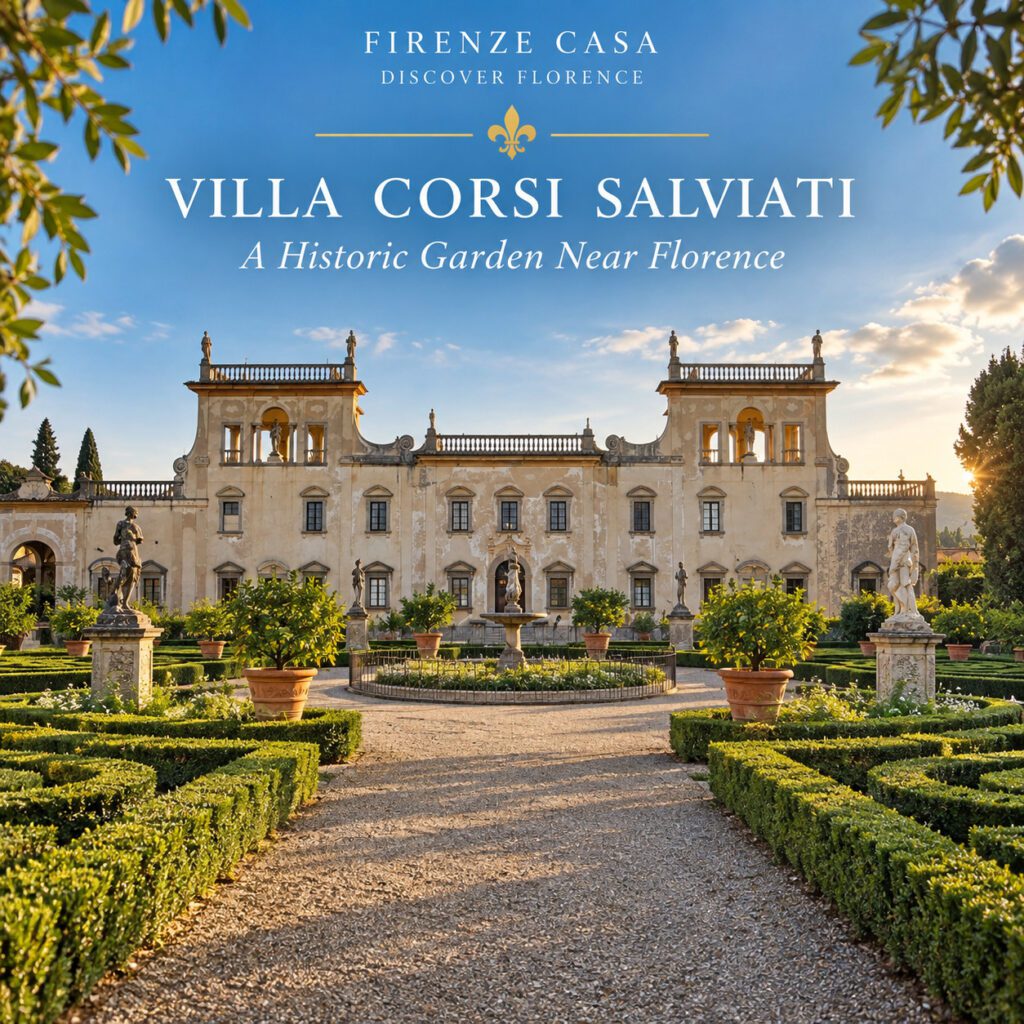
Villa Corsi Salviati near Florence is one of the most fascinating historic villas of Sesto Fiorentino. Behind its elegant Baroque façade lies a garden shaped by more than four centuries of changing taste, from the formal Italian garden to Romantic landscaping, exotic nineteenth-century botany and an early twentieth-century revival of historic garden design.
Its full name, Villa Guicciardini Corsi Salviati, also tells an unusually rich family story. Three important Florentine names became connected with the estate over time, while generations of owners transformed a sixteenth-century country house into an extraordinary combination of architecture, sculpture, water and landscape.
At a Glance
Location: Sesto Fiorentino, north-west of Florence
Address: Via Antonio Gramsci 456, Sesto Fiorentino
Origins: Corsi estate acquired in 1503
Architecture: Renaissance origins with major Baroque transformations
Garden: Italian garden, woodland, romantic lake, maze and green theatre
Historic families: Corsi, Salviati and Guicciardini
Known for: More than four centuries of garden history
Where Is Villa Corsi Salviati?
Villa Corsi Salviati stands in Sesto Fiorentino, immediately north-west of Florence. Today, urban development surrounds much of the area, making the survival of such an extensive historic garden particularly remarkable.
The location reflects an important tradition among wealthy Florentine families. From the Renaissance onwards, noble and mercantile households increasingly established country residences outside the city, combining agricultural estates with places designed for leisure, entertainment and display.
This wider tradition is explored in Historic Villas of Florence and Fiesole. Villa Corsi Salviati offers an especially revealing example because successive generations continued adapting both the house and garden for centuries.
From a Country House to a Florentine Villa
The documented history begins in 1503, when Simone di Jacopo Corsi acquired an agricultural estate with what contemporary documents described as a casa da signore, or manor house. A walled garden already existed behind the residence, with geometric grass beds and a central basin.
The Corsi belonged to the prosperous Florentine mercantile world. Like other successful families, they gradually transformed wealth generated in the city into land, architecture and social prestige in the surrounding countryside.
Over the following five centuries, their descendants repeatedly enlarged and redesigned the estate. As a result, Villa Corsi Salviati does not represent one single architectural moment. Instead, it records changing ideas about aristocratic life from the Renaissance to the twentieth century.
Five Centuries in One Place
Villa Corsi Salviati is especially valuable because generations did not simply replace everything that came before. Renaissance, Baroque, Romantic and twentieth-century elements still interact within the same historic landscape.
Why Does the Villa Have Three Family Names?
The full name Villa Guicciardini Corsi Salviati can initially seem confusing. In fact, it preserves an extraordinary sequence of family inheritances.
The Corsi created the villa and remained closely associated with it for centuries. In 1796, after the principal Salviati line became extinct, its name and inheritance passed to the Corsi. The family consequently became known as Corsi Salviati.
A further transition followed after Marquis Bardo Corsi Salviati died in 1907 without a male heir. His grandson Giulio Guicciardini inherited the family estate, titles and names and became Giulio Guicciardini Corsi Salviati.
The villa therefore connects directly with two other important dynasties already explored on Firenze Casa: the Salviati family and the Guicciardini, whose urban residence is explored in Palazzo Guicciardini in Florence.
The Seventeenth-Century Transformation
The modest Renaissance residence changed substantially during the seventeenth century. Giovanni Corsi and his brother Monsignor Lorenzo Corsi invested heavily in the property, expanding both the villa and its gardens as the family’s social status increased.
They entrusted important work to Gherardo Silvani, one of the leading Florentine architects of the period. Between 1627 and 1641, Silvani helped transform the residence into a more unified and prestigious villa, adding rooms and reshaping its architectural appearance.
The garden changed at the same time. New water features, geometric beds, woodland and architectural elements created a more theatrical relationship between house and landscape. Two small elliptical basins placed in front of the façade survive from this development.
A Garden Designed as Theatre
The garden gradually became an extension of the architecture. Formal axes directed the eye, clipped vegetation defined spaces and water introduced movement and reflection. Sculpture provided another layer, turning individual areas into carefully staged scenes.
This theatrical quality became even stronger during the eighteenth century. Rather than functioning simply as land surrounding a country residence, the garden offered a sequence of spaces designed to be experienced while walking.
That combination of architecture and landscape places Villa Corsi Salviati within the broader Florentine tradition explored in Beautiful Gardens in Florence, alongside famous examples such as the Boboli Gardens and Bardini Garden.
Look Closely
The garden is not simply a collection of beautiful plants. Paths, hedges, basins, statues and architecture create carefully controlled views, revealing how historic Italian gardens turned walking into a sequence of visual experiences.
The Baroque Villa We See Today
A major new phase began after Antonio Corsi inherited the property in 1729. Architects Pietro Paolo Giovannozzi and especially Ferdinando Ruggeri helped give the villa much of the Baroque character visible today.
Ruggeri redesigned the principal façades, replacing the heavier appearance of earlier periods with a more elegant architectural composition. The façade facing the road gained a strongly emphasised central axis, while the garden side became more closely integrated with terraces, decorative elements and the surrounding landscape.
The large limonaia, or Lemon House, also belongs to this period. Citrus trees were an important feature of Tuscan aristocratic gardens because they combined beauty, rarity and prestige. During colder months, large containers could be moved into protected buildings such as this one.
Water as the Garden’s Connecting Element
Water has played a fundamental role at Villa Corsi Salviati since its earliest documented gardens. Basins, fountains, channels and later the Romantic lake created both practical and decorative connections between different parts of the estate.
Supplying enough water presented a considerable engineering challenge. The Corsi repeatedly invested in systems capable of serving the villa, formal garden and agricultural land, especially as increasingly ambitious water features appeared.
The result is a landscape in which water repeatedly reappears in different forms. Sometimes it follows the geometry of the formal garden; elsewhere, particularly around the nineteenth-century lake, it creates an impression of natural scenery.
The English Garden Arrives in Sesto Fiorentino
By the beginning of the nineteenth century, European garden fashion had changed dramatically. Straight axes, geometric parterres and clipped hedges increasingly competed with the apparently natural landscapes associated with the English garden.
Villa Corsi Salviati embraced this new aesthetic in 1815. Marquis Amerigo Corsi preserved the Baroque garden immediately around the villa but transformed the eastern area into a large landscaped garden.
Woodland replaced more formal spaces, while designers created an artificial lake with an island and small bridge. A grotto simulated a natural source feeding the water, and two artificial hills introduced changes of level. A secluded belvedere provided views across the surrounding countryside.
Two Garden Worlds
One of the most fascinating features of Villa Corsi Salviati is the contrast between formal Italian geometry and the apparently natural scenery of the nineteenth-century landscape garden. The two styles reveal completely different ideas of how nature should be experienced.
The Romantic Lake
The artificial lake became the centrepiece of the new landscape garden. A small island, reached by a stone bridge, once contained a rustic hut, while dense vegetation helped separate the scene visually from the formal spaces around the villa.
The surrounding woodland included plants typical of Tuscany and Mediterranean scrub, some brought from the family’s estates in the Maremma. Small boats could even be used on the water, transforming the lake into a private place for recreation as well as contemplation.
This was a very different garden philosophy from the Baroque parterre. Instead of demonstrating human control over nature through symmetry, the Romantic garden attempted to create emotion through shade, water, woodland and carefully constructed views that appeared spontaneous.
A Nineteenth-Century Botanical Collection
The garden changed again during the second half of the nineteenth century. Marquis Francesco Antonio Corsi Salviati began introducing exotic plants, reflecting the European fascination with species arriving from distant parts of the world.
His son Bardo Corsi Salviati expanded this interest dramatically after 1866. Palms, cycads and other ornamental plants transformed parts of the garden, while heated greenhouses allowed delicate species to survive the Tuscan winter.
The collection became known well beyond Florence. Bardo’s garden functioned almost like a botanical library, combining scientific curiosity, horticultural experimentation and aristocratic display. The Ragionieri family of gardeners played an important role in this period, helping develop and maintain the increasingly ambitious collection.
From Art to Botany
Nineteenth-century aristocratic gardens were often laboratories as well as places of beauty. Rare plants demonstrated international connections, horticultural knowledge and the ability to create artificial climates inside sophisticated heated greenhouses.
Giulio Guicciardini and the Return to the Italian Garden
After Bardo’s death in 1907, his grandson Giulio Guicciardini Corsi Salviati inherited the estate. Rather than continuing the nineteenth-century expansion of exotic planting, Giulio became fascinated by the earlier history of the villa.
He studied documents preserved in the family archive before undertaking an extensive restoration of the eighteenth-century garden. The formal parterre returned with low box hedges, geometric patterns, citrus trees in pots and seasonal flowers. At the same time, Giulio respected important elements created during other periods rather than attempting to erase every later intervention.
His research eventually resulted in the 1937 publication La Villa Corsi in Sesto. This unusual combination of owner, historian and garden restorer helps explain why the estate preserves so many visible layers today.
The Boxwood Maze
One of the garden’s most delightful features is its boxwood maze. Giulio created it in 1921, recalling a maze known to have existed here in the early eighteenth century but for which no original design survived.
Without an exact historical plan to copy, he devised a new layout inspired by the famous maze at Hampton Court in England. The result therefore combines historical memory with early twentieth-century interpretation.
The maze also demonstrates Giulio’s approach to restoration. He did not attempt to create an archaeological reconstruction of one single moment. Instead, he revived historical ideas while allowing the garden to remain a living landscape.
The Green Theatre
Another remarkable feature appeared in 1921–22. Giulio created a small green theatre, or teatro di verzura, using clipped vegetation to form the architectural elements of a stage.
He drew inspiration from the gardens of Mirabell in Salzburg, which he had studied in his notebooks. Box, cypress, yew and ivy created wings, backdrop and other theatrical elements, while a statue of Apollo marked the rear of the stage.
The theatre transformed horticulture into architecture. Rather than constructing walls from stone, gardeners shaped living plants into an outdoor performance space – one of the most memorable examples of the playful character found in historic Italian gardens.
Firenze Casa Detail
The maze and green theatre may look much older, but both largely reflect Giulio Guicciardini Corsi Salviati’s early twentieth-century interpretation of historic garden traditions. They are part of the villa’s history rather than modern tourist additions.
The Garden Today
Today, the garden remains remarkable for the coexistence of its different historical identities. Visitors encounter the formal Italian garden, lawn, holm oak wood, old ragnaia, Romantic lake, sculptural decorations, maze and green theatre within one estate.
Many statues and stone ornaments date particularly from the eighteenth century. Together with the architecture and vegetation, they create an environment in which no single period completely dominates.
This layering distinguishes Villa Corsi Salviati from gardens reconstructed to represent only one historical moment. Here, changing ideas about nature remain visible: Renaissance order, Baroque theatricality, Romantic landscape, Victorian botanical enthusiasm and twentieth-century historicism.
Can You Visit Villa Corsi Salviati?
The garden can be visited on selected opening dates rather than through unrestricted daily access. According to the villa’s current visitor information, admission to the garden is free, but advance reservation is required. Published visiting hours on available dates are generally from 9:30 to 12:30.
Because opening calendars and access arrangements can change, visitors should always check the villa’s current information before travelling specifically to Sesto Fiorentino. Group tours can also be arranged in advance under the conditions published by the estate.
Practical Information
Address: Via Antonio Gramsci 456, Sesto Fiorentino
Garden access: Selected dates with advance reservation
Admission: Currently free for garden visits
Published hours: Generally 9:30–12:30 on available dates
Important: Check the current calendar before making a special journey
Villa Corsi Salviati and the Florentine Villa Tradition
Villa Corsi Salviati becomes even more interesting when compared with other historic residences around Florence. Villa di Maiano, Villa Peyron and Villa I Tatti each demonstrate a different relationship between architecture, gardens and the Tuscan landscape.
Corsi Salviati stands apart because its garden functions almost as a timeline. Rather than representing primarily one owner’s vision, it preserves the changing ambitions of a family across generations.
It also expands the geographical perspective beyond the famous hills east and south of Florence. Sesto Fiorentino and the northern plain formed an equally important landscape of villas, farms and aristocratic estates connected with the city.
Why Villa Corsi Salviati Is Worth Discovering
Villa Corsi Salviati near Florence is worth discovering because few gardens explain the evolution of Florentine garden culture so clearly. Its story begins with a Renaissance country estate, expands into Baroque theatricality, embraces the Romantic landscape garden, experiments with exotic botany and finally returns to the geometry of the Italian garden.
The family history adds another layer. Corsi, Salviati and Guicciardini are not simply names attached to the building; their succession explains how the property survived and changed over centuries.
For visitors who already know Boboli and Florence’s famous central gardens, Villa Corsi Salviati reveals something different: the long life of a private Florentine estate where every generation left traces without completely erasing what came before.
Firenze Casa Perspective
Do not look for one “perfect” historical garden here. The fascination of Villa Corsi Salviati lies precisely in its layers. Renaissance geometry, Baroque spectacle, Romantic nature and twentieth-century revival all remain part of the same landscape.
Frequently Asked Questions
Where is Villa Corsi Salviati?
Villa Corsi Salviati is in Sesto Fiorentino, immediately north-west of Florence, at Via Antonio Gramsci 456.
What is the villa’s full name?
Its full historic name is Villa Guicciardini Corsi Salviati. The three surnames reflect the Corsi family’s history and later inheritances connecting the estate with the Salviati and Guicciardini families.
When did the Corsi family acquire the villa?
Simone di Jacopo Corsi acquired the estate in 1503. At that time, it already included a manor house and a walled garden.
Why is the garden important?
The garden preserves more than four centuries of development, combining formal Italian design, Baroque elements, nineteenth-century landscape gardening, exotic botanical collections and twentieth-century revival features.
Does Villa Corsi Salviati have a maze?
Yes. Giulio Guicciardini Corsi Salviati created the present boxwood maze in 1921, inspired partly by the historic maze at Hampton Court.
What is the green theatre?
The teatro di verzura is an outdoor theatre formed largely from clipped vegetation. Giulio created it in 1921–22 after studying historic European gardens, including Mirabell in Salzburg.
Is there an English-style garden?
Yes. In 1815, part of the estate became a Romantic landscape garden with woodland, an artificial lake, an island, a small bridge, a grotto and a secluded viewpoint.
Can you visit Villa Corsi Salviati?
The garden currently opens on selected dates with advance reservation. Because schedules can change, visitors should check current arrangements before planning a visit.
Further Reading on Firenze Casa
- Historic Villas of Florence and Fiesole – Complete Guide
- Beautiful Gardens in Florence
- The Salviati Family – Wealth, Politics and Medici Connections
- Palazzo Guicciardini – Historic Palace in Florence
- The Most Famous Florentine Families – Complete Guide
- Villa Peyron – A Hidden Garden Above Florence
- Villa I Tatti – Bernard Berenson’s Home in Florence
- Boboli Gardens – Florence’s Historic Garden
- Bardini Garden – A Panoramic Garden in Florence
References
Villa Guicciardini Corsi Salviati – History of the Villa.
Villa Corsi Salviati – History of the Garden.
The Seventeenth and Eighteenth-Century Transformations – Villa Corsi Salviati.
The Early Nineteenth Century – Villa Corsi Salviati.
The Later Nineteenth Century – Villa Corsi Salviati.
Giulio Guicciardini Corsi Salviati and the Twentieth Century – Villa Corsi Salviati.
Villa Guicciardini Corsi Salviati: Arte e Storia, edited by Luisa Capodieci and Maria Grazia Messina.
Regione Toscana – Villa Guicciardini Corsi Salviati.