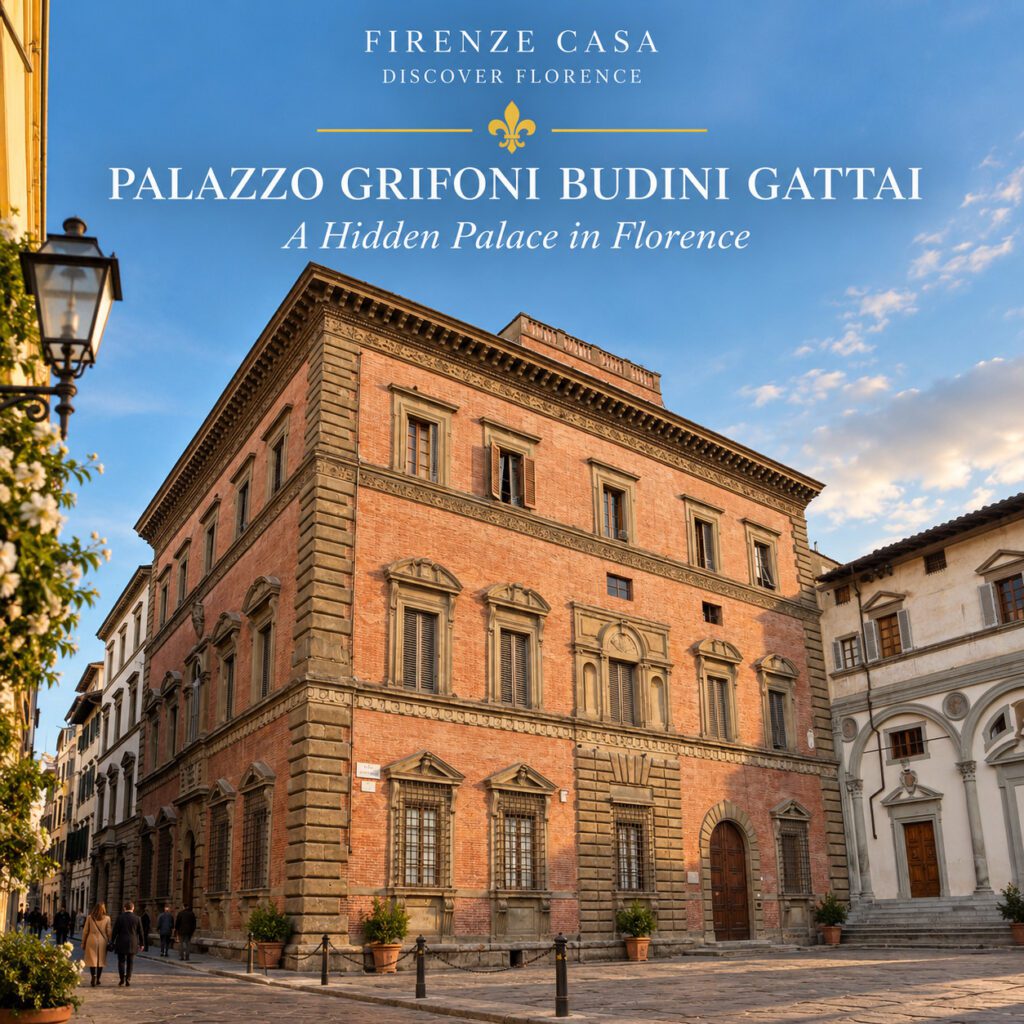
Palazzo Grifoni Budini Gattai is one of Florence’s most intriguing historic palaces. Standing at the corner of Piazza Santissima Annunziata and Via dei Servi, it occupies an exceptionally prominent position, yet many visitors pass without knowing what lies behind its imposing façade.
The palace combines several very different chapters of Florentine history. Bartolomeo Ammannati shaped much of its sixteenth-century architecture for Ugolino Grifoni, a powerful secretary of Cosimo I de’ Medici. Later owners transformed the residence, while the Budini Gattai family created remarkably rich interiors around 1900. Behind the building, meanwhile, survives a historic garden that adds an unexpected green space to this densely built part of Florence.
At a Glance
Location: Piazza Santissima Annunziata / Via dei Servi, Florence
Historic name: Palazzo Grifoni
Later name: Palazzo Budini Gattai
Principal Renaissance architect: Bartolomeo Ammannati
Original patron: Ugolino Grifoni
Main construction phase: Second half of the 16th century
Later interiors: Late 19th century
Garden: Historic private garden behind the palace
Public access: Mainly during exhibitions, events and special openings
Where Is Palazzo Grifoni Budini Gattai?
Palazzo Grifoni Budini Gattai occupies the south-eastern corner of Piazza Santissima Annunziata, where the square meets Via dei Servi. This position places it within one of Florence’s most carefully composed architectural spaces.
Looking south along Via dei Servi reveals Brunelleschi’s dome rising above the street, while the Basilica della Santissima Annunziata, Ospedale degli Innocenti and surrounding loggias create an extraordinary Renaissance setting. The palace contributes something different to this ensemble: instead of a religious or charitable institution, it represents private family ambition.
Its location also makes it a natural addition to the wider architectural story explored in Historic Palaces of Florence.
Before the Palace
The site had a history long before the Grifoni arrived. Land in this area belonged to the Servite order associated with the nearby Basilica della Santissima Annunziata. During the fifteenth century, plans emerged to develop parts of the land with private residences.
Eventually, houses occupied the corner where the present palace stands. Ugolino Grifoni acquired property here in 1549 and decided to replace the earlier buildings with a residence worthy of his family’s growing position in Florentine society.
A Prestigious Address
Building beside Piazza Santissima Annunziata was not simply a matter of convenience. Ugolino Grifoni chose one of Florence’s most prestigious architectural settings, directly connected with Via dei Servi and the ceremonial route towards the cathedral.
Who Was Ugolino Grifoni?
Ugolino Grifoni belonged to a family whose political importance increased considerably during the sixteenth century. His own career became closely connected with Cosimo I de’ Medici, whom he served as secretary.
This relationship matters when interpreting the palace. Florence had changed from the republican world that produced many of its great fifteenth-century family residences into the capital of a Medici state. Successful administrators and courtiers could now build their status through service to the duke as well as through traditional banking and mercantile wealth.
Grifoni therefore wanted more than a comfortable home. His new residence communicated his position within the political world created around Cosimo I.
From Giuliano di Baccio d’Agnolo to Ammannati
The architectural history of the palace is complex. Giuliano di Baccio d’Agnolo became involved in the initial project, but after his death Bartolomeo Ammannati assumed the decisive role in developing the building.
Most of the major sixteenth-century structure took shape during the 1560s and early 1570s. Ammannati designed the principal architectural composition, including important parts of the façade, ground floor and courtyard.
Older literature sometimes associated the building strongly with Bernardo Buontalenti. Modern scholarship gives Ammannati the central role, although the long construction history involved several architects and later interventions.
Bartolomeo Ammannati in Florence
Bartolomeo Ammannati was one of the leading architects and sculptors working in Florence under Cosimo I. His career demonstrates how closely architecture, sculpture, engineering and Medici patronage could interact during the sixteenth century.
Elsewhere in Florence, visitors encounter Ammannati at Palazzo Pitti and on Ponte Santa Trinita. Palazzo Grifoni reveals another side of his work: the design of an elite private residence within an already prestigious urban setting.
Comparing these buildings also helps reveal the variety of later Renaissance architecture. Ammannati could work on enormous court projects, bridges and sophisticated family palaces without simply repeating one architectural formula.
Look at Ammannati Differently
Visitors often associate Ammannati primarily with the Fountain of Neptune or Ponte Santa Trinita. Palazzo Grifoni shows how the same architect translated the sophisticated architectural language of Cosimo I’s Florence into a private aristocratic residence.
A Palace of Late Renaissance Florence
Palazzo Grifoni Budini Gattai belongs to the architectural world often described as Florentine Mannerism or the late Renaissance. Its design moves beyond the massive fortress-like appearance associated with earlier family palaces while retaining the sense of order and prestige expected from an elite residence.
Architectural stone frames windows and entrances, while carefully controlled proportions organise the façades. The building also responds to its unusual corner position between the open piazza and the long perspective of Via dei Servi.
Originally, however, the palace did not look exactly as it does today. Later generations expanded and completed parts of the structure, demonstrating once again how Florentine palaces often evolved across centuries rather than emerging from a single building campaign.
The Façade Was Completed Later
One of the most interesting details is that the façade towards Piazza Santissima Annunziata remained incomplete for generations. The sixteenth-century building did not initially possess the fully balanced appearance visitors see today.
In 1772, Pietro Grifoni commissioned work that completed the façade towards the square and helped give the palace its present overall form. The intervention respected the earlier architectural language sufficiently well to create the impression of a more unified design.
This makes Palazzo Grifoni particularly interesting when viewed from the piazza. What appears to be a coherent Renaissance façade actually contains the history of later completion and adaptation.
The Hidden Garden
Behind the palace lies one of its least expected features: a historic garden. Ammannati probably participated in the original garden design, and by around 1573 an Italian-style arrangement had developed behind the residence.
A monumental fountain formed an important feature of the sixteenth-century garden. Its sculptural decoration included Jason, Venus and sea creatures and is attributed to Giovanni Bandini. During the eighteenth century, owners enlarged and altered the garden, moving the earlier fountain and creating a new wall fountain incorporating the figure of Venus.
The garden changed again during the nineteenth century. Today, its curving flower beds, mature vegetation and collections of camellias and azaleas reveal a very different aesthetic from the formal sixteenth-century design.
Hidden Behind the Façade
From Piazza Santissima Annunziata, few visitors would imagine a historic garden behind the palace. Its survival creates a remarkable contrast between Florence’s dense urban streets and the private green spaces once enjoyed by aristocratic families.
The Greenhouse and Exotic Plants
The later garden contains another attractive reminder of nineteenth-century horticultural taste: an iron-and-glass greenhouse dating from around 1892. Structures like this allowed wealthy families to cultivate plants that required protection from colder winter conditions.
The garden also includes banana trees, camellias and azaleas. Such planting reflects the nineteenth-century fascination with ornamental and exotic species that transformed many historic European gardens.
These later botanical additions did not erase the Renaissance origins of the garden. Instead, they added another historical layer, making the space a record of changing attitudes towards private urban landscapes.
The Monument to a Lost Tree
One of the garden’s most unusual details is the Monument to the Lost Tree. Created in 1908, it commemorates an old camphor tree that died during the winter.
The idea of erecting a monument to a tree may initially seem eccentric. Yet it reveals how individual specimens could become emotionally and historically important within long-established private gardens.
It also adds a surprisingly personal dimension to the palace. Among grand architecture, frescoes and aristocratic family histories, the memorial preserves the memory of a single living element of the garden.
From the Grifoni to the Riccardi
The Grifoni remained associated with the palace until the family line became extinct around the end of the eighteenth century. In 1800, the property passed to the Riccardi family.
The Riccardi name already occupies an important place in Florentine palace history through Palazzo Medici Riccardi. Their ownership of Palazzo Grifoni demonstrates the complex movement of property among aristocratic families through inheritance and changing family fortunes.
Other owners followed. The palace passed to the Mannelli and later the Antinori before entering the hands of the families whose names it carries today.
Caroline Bonaparte Lived Here
A particularly intriguing episode occurred in the nineteenth century. In 1832, Caroline Bonaparte Murat, the younger sister of Napoleon Bonaparte and widow of Joachim Murat, lived in the palace.
Her presence connects the building briefly with European history far beyond Tuscany. Caroline had been Queen of Naples during the Napoleonic period, and her later residence in Florence illustrates the city’s continuing attraction to aristocrats, political exiles and international elites.
It is a small episode in the palace’s long history, but one that reinforces how Florentine residences could become temporary stages for much wider European stories.
Did You Know?
Caroline Bonaparte, Napoleon’s younger sister and the former Queen of Naples, lived in Palazzo Grifoni in 1832. The episode briefly connects this Florentine Renaissance palace with the extraordinary political world created by the Bonaparte family.
The Window That Is Never Closed
Palazzo Grifoni Budini Gattai is associated with one of Florence’s most romantic and mysterious legends: the story traditionally known as the “finestra sempre aperta”, or “window that is never closed”. Today, however, the detail visitors can most easily recognise from Piazza Santissima Annunziata is a shutter that is traditionally kept partly open.
According to the best-known version of the legend, a young woman who lived in the palace watched from this window as her husband left Florence for war. She waited for him to return, looking out across the piazza day after day. He never came back, yet she continued to keep watch from the same window for the rest of her life.
After the woman died, the shutters were finally closed. According to the story, strange disturbances immediately began inside the room: furniture moved, books fell and objects seemed to shift without explanation. When the shutters were opened again, everything became quiet. From then on, tradition demanded that the shutter associated with the legend should never be completely closed.
A Florentine Legend
Look carefully at the façade of Palazzo Grifoni Budini Gattai facing Piazza Santissima Annunziata. The legendary window is the far-right window on the second floor. Its shutter is traditionally kept at least partly open – the visible detail behind Florence’s famous story of the “window that is never closed”.
Was the Woman Waiting for Ferdinando I?
Another version gives the legend a Medici connection. The equestrian monument to Ferdinando I de’ Medici in Piazza Santissima Annunziata appears to gaze towards the palace. This inspired a story that the mysterious woman was actually the Grand Duke’s lover and watched for him from the window.
There is no reliable historical evidence for either version of the story, and the chronology of the palace makes the Ferdinando interpretation particularly doubtful. Nevertheless, the partly open shutter has become part of the folklore surrounding Palazzo Grifoni Budini Gattai. It is a perfect example of how Florence’s buildings preserve not only documented history, but also stories that generations of Florentines have continued to tell.
The Budini Gattai Transformation
The most important modern transformation began after the Budini Gattai acquired the palace at the end of the nineteenth century. Leopoldo Gattai and his son-in-law Francesco Budini commissioned architect Giuseppe Boccini to modernise the residence in 1891–92.
The project introduced a monumental two-flight staircase and transformed the interiors of the piano nobile. Rather than imitating the Renaissance rooms, the owners created spaces reflecting contemporary Florentine taste at the end of the nineteenth century.
This decision produced one of the palace’s greatest surprises. Behind a sixteenth-century façade survives an interior world belonging largely to Florence around 1900.
Florentine Interiors Around 1900
The decorative programme involved artists including Augusto Burchi, Giulio Bargellini and Galileo Chini. Their work created richly painted and furnished rooms whose character differs dramatically from the restrained stone architecture outside.
The interiors combine frescoes, decorative painting, textiles, furnishings and ornamental details into coherent ensembles. Because so much of this decoration survives, the rooms provide unusual evidence of how Florence’s wealthy social elite wanted to live and represent itself at the turn of the twentieth century.
This is precisely what makes Palazzo Grifoni Budini Gattai more than another Renaissance palace. Visitors can read two very different Florences within the same building: the courtly world of Cosimo I and the cosmopolitan bourgeois-aristocratic world around 1900.
Two Florences in One Palace
The exterior belongs primarily to sixteenth-century Florence, while much of the spectacular piano nobile reflects the taste of the late nineteenth century. That contrast is one of the palace’s greatest historical strengths.
Galileo Chini and the Decorative Arts
The participation of Galileo Chini adds particular interest to the later interiors. Chini became one of the major figures associated with Italian decorative art around the turn of the twentieth century and later developed a highly distinctive artistic career.
At Palazzo Budini Gattai, his contribution belongs to a wider decorative programme rather than functioning as an isolated artwork. Together with the other artists, he helped create interiors in which architecture, painting and decoration work as a complete environment.
The rooms therefore provide an important counterpoint to the Renaissance Florence that dominates most visitors’ understanding of the city. Florence continued to produce sophisticated decorative culture long after the Medici period had ended.
Palazzo Grifoni and Piazza Santissima Annunziata
The palace should also be understood as part of the surrounding square. Piazza Santissima Annunziata developed over several centuries but achieved an unusual degree of architectural harmony.
Brunelleschi’s Ospedale degli Innocenti established the architectural rhythm on the eastern side. Later buildings responded to this visual language, while the Basilica della Santissima Annunziata anchors the northern end of the space.
Palazzo Grifoni closes part of the southern edge beside Via dei Servi. Its presence demonstrates how private aristocratic architecture could participate in a square otherwise strongly shaped by religious and charitable institutions.
Via dei Servi and the View of the Duomo
The palace also occupies one of Florence’s most beautiful urban perspectives. From Piazza Santissima Annunziata, Via dei Servi leads almost directly towards Florence Cathedral, with Brunelleschi’s dome appearing dramatically above the street.
Standing near Palazzo Grifoni therefore allows visitors to experience architecture at several scales simultaneously. The palace defines the immediate street corner, the piazza creates a larger Renaissance space and the distant dome connects both with Florence’s monumental centre.
This relationship between building, street and distant landmark explains why the palace’s location matters almost as much as its individual architectural details.
Firenze Casa Tip
Stand near the corner of Palazzo Grifoni and look south along Via dei Servi. The view towards Brunelleschi’s dome is one of Florence’s finest examples of how streets, palaces and monuments combine to create an architectural perspective.
The Kunsthistorisches Institut in the Palace
Palazzo Grifoni Budini Gattai also has an important connection with modern art-historical research. The Kunsthistorisches Institut in Florenz, part of the Max Planck Society, has used spaces within the palace for its photographic and archival collections and scholarly activities.
The institute’s presence creates an appropriate modern chapter in the history of a building already closely connected with art and architecture. Historic rooms that once represented private family prestige have consequently become spaces for studying the artistic heritage of Italy.
The relationship has also contributed to detailed documentation of the Budini Gattai interiors, including an extensive photographic campaign before the institute moved into the piano nobile.
Can You Visit Palazzo Grifoni Budini Gattai?
Palazzo Grifoni Budini Gattai does not operate as a conventional museum with unrestricted daily public access. The building remains privately owned and serves several functions, including events and institutional activities.
However, parts of the palace open on particular occasions, including temporary exhibitions, cultural events and special visits. The Kunsthistorisches Institut also occasionally organises public initiatives connected with its activities in the building.
Anyone hoping to see the interiors should therefore check current programmes before visiting. Even when the palace is closed, its exterior can easily be studied from Piazza Santissima Annunziata and Via dei Servi.
Practical Information
Address: Piazza Santissima Annunziata 1 / Via dei Servi 51, Florence
Exterior: Freely visible from the piazza and street
Interior: No regular museum-style access
Special access: Possible during exhibitions, events and selected cultural openings
Nearby: Basilica della Santissima Annunziata, Ospedale degli Innocenti and National Archaeological Museum
Why Palazzo Grifoni Budini Gattai Is Worth Discovering
Palazzo Grifoni Budini Gattai is worth discovering because it contains several Florences within one building. Its origins belong to the political world of Cosimo I, while Ammannati’s architecture reflects the sophisticated language of the later Renaissance. Its garden preserves centuries of changing taste, and its richly decorated interiors reveal an entirely different Florence around 1900.
The palace also demonstrates why smaller historic residences matter. Palazzo Vecchio, Palazzo Pitti and Palazzo Strozzi tell monumental stories of government and dynastic power, but buildings such as Palazzo Grifoni reveal how individual families positioned themselves within those larger political systems.
Most importantly, its location transforms the way we read Piazza Santissima Annunziata. Once the palace’s story becomes visible, the square no longer appears simply as a harmonious Renaissance ensemble. It becomes a meeting place of religion, charity, private ambition, Medici politics and centuries of changing Florentine life.
Frequently Asked Questions
Where is Palazzo Grifoni Budini Gattai?
The palace stands at the corner of Piazza Santissima Annunziata and Via dei Servi in the historic centre of Florence.
Who built Palazzo Grifoni?
Ugolino Grifoni commissioned the palace during the sixteenth century. Giuliano di Baccio d’Agnolo became involved in the initial project, while Bartolomeo Ammannati played the decisive role in developing most of the Renaissance building.
Who was Ugolino Grifoni?
Ugolino Grifoni was an important official and secretary of Cosimo I de’ Medici. His new palace reflected the family’s increasing prestige within ducal Florence.
Why is it called Palazzo Budini Gattai?
The palace changed owners several times after the Grifoni family line ended. The Budini Gattai acquired it at the end of the nineteenth century and carried out an important renovation of its interiors.
Does Palazzo Budini Gattai have a garden?
Yes. A historic private garden survives behind the palace. Its origins reach back to the sixteenth century, although later owners repeatedly modified its layout and planting.
Who decorated the later interiors?
Artists involved in the late nineteenth-century decorative programme included Augusto Burchi, Giulio Bargellini and Galileo Chini.
Did Napoleon’s sister live in the palace?
Yes. Caroline Bonaparte, Napoleon’s younger sister and widow of Joachim Murat, lived in the palace in 1832.
Can you visit Palazzo Grifoni Budini Gattai?
The palace does not operate as a regular public museum. However, parts of the building can open during exhibitions, cultural initiatives and special events, so current arrangements should be checked before visiting.
Further Reading on Firenze Casa
- Historic Palaces of Florence – Complete Guide
- Piazza Santissima Annunziata – Florence’s Renaissance Square
- Basilica della Santissima Annunziata – Florence’s Sanctuary
- Cosimo I de’ Medici – The Duke Who Transformed Florence
- Palazzo Pitti – Grand Ducal Palace of Florence
- Ponte Santa Trinita – Florence’s Renaissance Bridge
- Florence Cathedral – Santa Maria del Fiore
- National Archaeological Museum Florence
References
Regione Toscana – Palazzo Budini Gattai.
Comune di Firenze / FeelFlorence – Palazzo Budini Gattai.
Kunsthistorisches Institut in Florenz – Palazzo Grifoni Budini Gattai.
Repertorio delle Architetture Civili di Firenze – Palazzo Grifoni all’Annunziata.
Ministero della Cultura – Catalogo Generale dei Beni Culturali: Palazzo Budini Gattai.
Palazzo Budini Gattai – Historical and architectural information.