
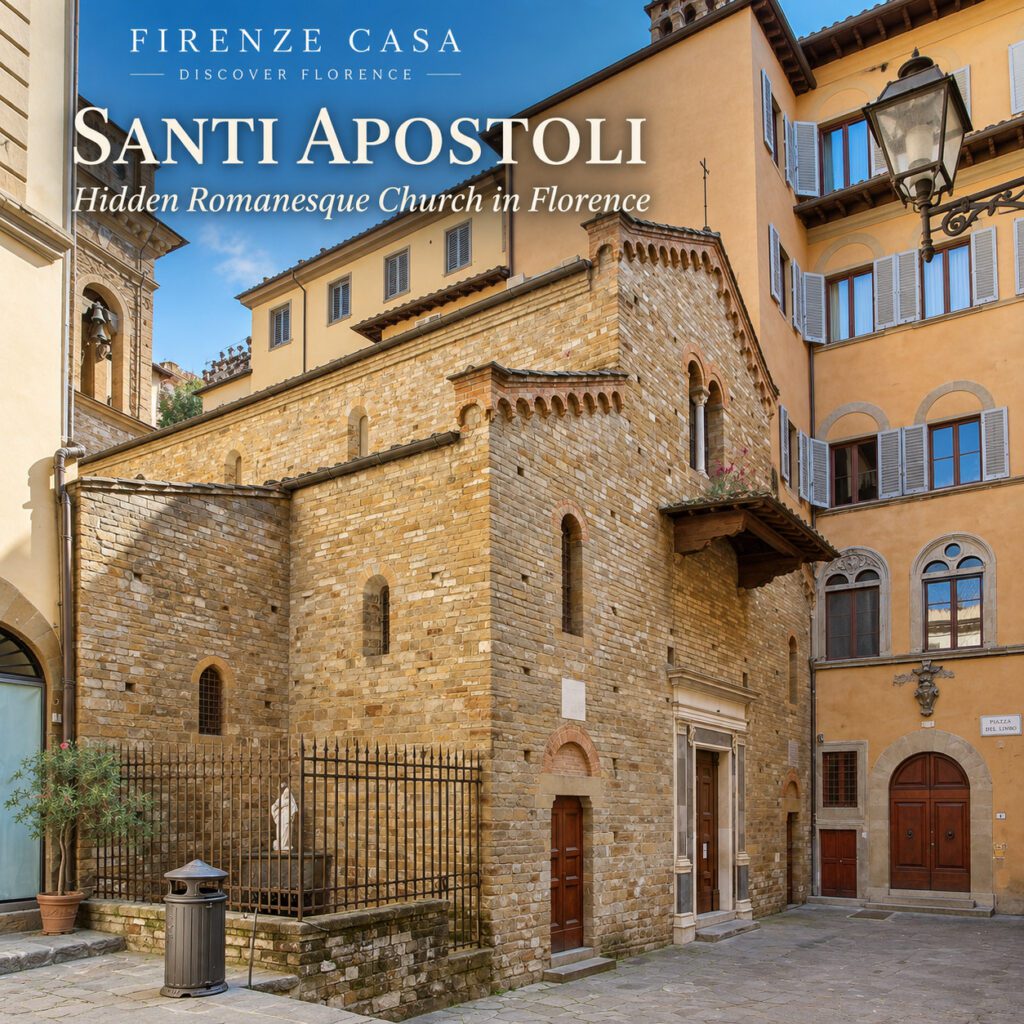
Santi Apostoli Florence is one of those places that rewards travellers who occasionally turn away from the city’s busiest sightseeing routes. Hidden on the tiny Piazza del Limbo, only a few minutes from Ponte Vecchio and Piazza della Signoria, the church preserves an unexpectedly quiet fragment of medieval Florence.
You do not need to plan a major excursion around Santi Apostoli. Instead, consider it a short and worthwhile stop while exploring the historic centre. Its Romanesque interior, ancient columns and remarkable connection with Florence’s Scoppio del Carro make this small church far more interesting than its modest appearance suggests.
Location: Piazza del Limbo, historic centre of Florence
Character: Small Romanesque church
First documented: 1075
Known for: Medieval architecture and the sacred flints associated with the Scoppio del Carro
Best combined with: Ponte Vecchio, Piazza della Signoria and an Arno walk
Time needed: A short visit is usually sufficient
Why Visit Santi Apostoli?
Florence contains churches that require hours to appreciate properly. Santi Apostoli is different. Its appeal lies in discovering a remarkably old and atmospheric building almost hidden within one of the most visited parts of the city.
The church stands close to the Arno, yet Piazza del Limbo feels surprisingly removed from the movement around nearby Ponte Vecchio. Stepping inside reveals a simple basilican interior whose round arches, stone surfaces and reused ancient columns create an atmosphere very different from Florence’s richly decorated Renaissance churches.
Do not make a special journey across Florence simply to see Santi Apostoli. Visit when you are already exploring Ponte Vecchio, Piazza della Signoria or the northern bank of the Arno. Its central location makes it an excellent 15–20 minute cultural detour.
One of Florence’s Oldest Churches
A stone inscription on the façade traditionally attributes the foundation of Santi Apostoli to Charlemagne around the year 800. It is an appealing story, but it should be treated as tradition rather than established historical fact.
The church is first documented in 1075, and the surviving building belongs principally to the Romanesque period. This alone makes Santi Apostoli particularly interesting in a city whose international image is dominated by the Renaissance.
Its relatively small dimensions also help visitors understand the scale of medieval Florence before monumental churches such as Santa Maria del Fiore transformed the cityscape.
The traditional association with Charlemagne is part of the church’s historical identity, but the documentary evidence begins much later. For visitors, the important point is that Santi Apostoli preserves an unusually strong impression of medieval Florence.
Piazza del Limbo – A Name with a Medieval Story
The tiny square outside the church has one of the most unusual names in central Florence: Piazza del Limbo.
According to local history, the area was once associated with the burial of children who died before baptism. Medieval Christian theology traditionally placed such souls in Limbo, giving the square the name that survives today.
The story adds another layer to the experience of visiting Santi Apostoli. Piazza del Limbo is easy to cross without noticing, yet its name preserves a fragment of medieval religious belief within the modern city.
Piazza del Limbo is a good example of why it is worth looking at Florence’s street and square names. They often preserve stories that have disappeared almost completely from the buildings around them.
Inside Santi Apostoli
The interior is striking because of its restraint. A central nave and two side aisles are divided by columns supporting rounded arches, creating a simple rhythm that recalls early Christian basilicas.
Several columns are made from green Prato marble, while some capitals and architectural elements were reused from ancient Roman buildings. The church stands in an area associated with Roman Florence, and the incorporation of older materials reinforces the sense of historical layering.
A decorated wooden roof was added during the Middle Ages, while chapels introduced in later centuries brought Renaissance and early modern elements into the otherwise austere interior.
Did Santi Apostoli Influence Brunelleschi?
The harmonious proportions and classical simplicity of Santi Apostoli have traditionally been discussed in relation to the architectural culture that later shaped the Florentine Renaissance. The church is sometimes said to have influenced Filippo Brunelleschi’s renewed interest in classical forms.
Rather than treating that connection as a simple documented line of influence, it is more useful to notice how naturally the round arches, columns and clear proportions anticipate architectural qualities that Renaissance Florence would later rediscover and transform.
The Stones of the Holy Sepulchre
The most remarkable story inside Santi Apostoli Florence is connected not simply with the church but with one of Florence’s most spectacular surviving traditions.
Three pieces of flint traditionally associated with the Holy Sepulchre in Jerusalem are preserved here. According to Florentine tradition, Pazzino de’ Pazzi distinguished himself during the First Crusade and received the stones as a reward after the capture of Jerusalem in 1099.
The historical details of this medieval story cannot be treated as securely documented fact. Its importance lies instead in the tradition that developed around the relics and continues to connect Santi Apostoli with Easter celebrations in Florence.
From Santi Apostoli to the Scoppio del Carro
On Holy Saturday, the stones are ceremonially taken from Santi Apostoli to Florence Cathedral. They are used in the ritual of lighting the sacred Easter fire that ultimately forms part of the celebrations culminating in the famous Scoppio del Carro.
On Easter Sunday, the enormous historic cart known as the Brindellone stands outside the Duomo. During the cathedral liturgy, the mechanical dove known as the Colombina travels along a wire and ignites the cart’s spectacular fireworks.
Knowing that part of this famous ceremony begins with objects preserved inside this quiet little church makes Santi Apostoli much more memorable.
If you have already seen Florence’s Scoppio del Carro at Easter, Santi Apostoli reveals a surprisingly quiet part of the tradition behind the spectacle. Our complete guide to the Scoppio del Carro explains how the ceremony unfolds at the Duomo.
Santi Apostoli and the Pazzi Family
The sacred stones also connect the church with one of the most famous families in Florentine history. The Pazzi family became wealthy bankers and political rivals of the Medici before entering history through the dramatic Pazzi Conspiracy of 1478.
The Easter tradition, however, recalls a much earlier chapter in the family’s legendary history. The stones were originally preserved elsewhere in Florence and were transferred to Santi Apostoli in the late 18th century after the suppression of the church where they had previously been kept.
The connection is a useful reminder that Florentine families left traces far beyond their palaces and political conflicts. Their identities were also shaped by religious patronage, traditions and civic ceremonies.
Art to Look For Inside the Church
Santi Apostoli should not be approached as a miniature Uffizi. Its greatest attraction is the building itself and the atmosphere created by its medieval architecture. Nevertheless, several works deserve attention.
Giovanni della Robbia
A polychrome glazed terracotta tabernacle by Giovanni della Robbia is one of the most distinctive Renaissance works inside. The Della Robbia family transformed glazed terracotta into one of the most recognisable artistic forms of Renaissance Tuscany.
Jacopo di Cione and Niccolò di Pietro Gerini
The church also preserves a late 14th-century polyptych by Jacopo di Cione and Niccolò di Pietro Gerini depicting the Virgin and Child with saints. It provides a valuable contrast with the later Renaissance works for which Florence is better known.
The Altoviti Family
Several monuments and chapels recall the Altoviti, another prominent Florentine family. Their presence brought works by artists including Benedetto da Rovezzano, Bartolomeo Ammannati and Giorgio Vasari into the church.
Vasari’s Allegory of the Immaculate Conception, commissioned by the banker Bindo Altoviti in 1540 and completed in 1541, was an important early Florentine church commission for the artist.
Rather than trying to identify every artwork, first look down the nave and concentrate on the columns, capitals and rounded arches. The architectural simplicity is what makes Santi Apostoli feel so different from many of Florence’s better-known churches.
The Florence Flood of 1966
Santi Apostoli stands very close to the Arno and suffered serious damage during the catastrophic Florence flood of 4 November 1966. Water and mud entered the church and affected both the building and its artworks.
The disaster was part of a much wider cultural catastrophe across Florence. Churches, museums, libraries and archives throughout the city were damaged, leading to an enormous international conservation effort.
For travellers exploring the river, the church therefore also provides a small reminder of Florence’s long and sometimes difficult relationship with the Arno.
Planning Your Visit to Santi Apostoli
Santi Apostoli stands on Piazza del Limbo, only a short walk from Ponte Vecchio, Piazza della Signoria and the Arno. For most travellers, location is the strongest practical reason to include it in an itinerary: very little additional walking is required.
The church remains an active religious site rather than a conventional museum. Access can therefore vary according to services and church activities. If seeing the interior is particularly important to you, check the church’s current information before your visit rather than relying on fixed opening hours published long in advance.
Travellers staying at Firenze Casa can easily incorporate Santi Apostoli into a day spent exploring the historic centre rather than planning a separate excursion around it.
Yes, if you are already nearby. Allow around 15–20 minutes for the church and Piazza del Limbo. Prioritise Florence’s major basilicas first if this is your first visit, but choose Santi Apostoli when you want a quieter glimpse of medieval Florence without leaving the historic centre.
What to See Nearby
Santi Apostoli works particularly well as part of a walk rather than as an isolated destination.
Ponte Vecchio is only a few minutes away and provides an immediate contrast between a quiet medieval church and one of Florence’s busiest landmarks. The wider history of the river crossings is explored in our Bridges of Florence – Complete Guide.
Walking east leads quickly towards Piazza della Signoria, Palazzo Vecchio and the Uffizi. Travellers interested in exploring this central area systematically can also follow our Duomo & Historic Centre Walking Tour.
If you prefer to continue along the river, the Florence Along the Arno – Bridges & Riverside Walk provides an easy way to connect Santi Apostoli with the surrounding Lungarni and historic bridges.
Piazza della Signoria → Santi Apostoli → Piazza del Limbo → Ponte Vecchio is a compact route that combines Florence’s monumental civic centre with a much quieter piece of its medieval history.
Frequently Asked Questions About Santi Apostoli Florence
Where is Santi Apostoli in Florence?
The church stands on Piazza del Limbo in the historic centre, only a few minutes’ walk from Ponte Vecchio, Piazza della Signoria and the Arno.
How old is Santi Apostoli?
A traditional inscription attributes its foundation to Charlemagne around 800, but this is legendary. The church is first documented in 1075 and preserves important Romanesque characteristics.
Why is Santi Apostoli connected with the Scoppio del Carro?
The church preserves three flints traditionally associated with the Holy Sepulchre. They play a ceremonial role in lighting Florence’s sacred Easter fire connected with the Scoppio del Carro.
What should I look for inside Santi Apostoli?
Begin with the Romanesque architecture, columns and capitals. Also look for the Giovanni della Robbia tabernacle, medieval polyptych and monuments associated with prominent Florentine families.
How long should I spend at Santi Apostoli?
For most visitors, around 15–20 minutes is sufficient. Its location makes it particularly worthwhile as a short stop between nearby major sights.
Is Santi Apostoli one of Florence’s essential churches?
Not for a first-time visitor with very limited time. Visit the great Florentine basilicas first, but Santi Apostoli is an excellent choice for travellers interested in medieval Florence, local traditions and quieter historic places.
Why Santi Apostoli Is Worth Visiting
Santi Apostoli is worth visiting not because it competes with Florence’s monumental churches, but because it offers something different. Its Romanesque simplicity, tiny Piazza del Limbo and connection with the Scoppio del Carro preserve several layers of Florentine history within an unusually intimate setting.
Most importantly for travellers, discovering it requires almost no sacrifice of sightseeing time. Ponte Vecchio, Piazza della Signoria and the Arno are all nearby.
That combination makes Santi Apostoli exactly the kind of hidden place worth knowing about: historically meaningful, genuinely interesting and easy to experience without turning a Florence itinerary into a checklist of minor churches.
Further Reading on Firenze Casa
- The Most Important Churches in Florence – Complete Guide
- Florence Secrets and Traditions – Complete Guide
- Scoppio del Carro in Florence – The Exploding Cart Easter Tradition
- The Pazzi Family: Florence’s Most Famous Conspiracy
- The History of Ponte Vecchio: Florence’s Most Famous Bridge
- Florence Along the Arno – Bridges & Riverside Walk
References
- Chiesa dei Santi Apostoli e Biagio – official history and information.
- FeelFlorence, Comune di Firenze – Chiesa dei Santissimi Apostoli.
- Comune di Firenze – Fuoco Santo and Florentine Easter traditions.
- Visit Tuscany – Chiesa dei Santi Apostoli a Firenze.
- Gallerie degli Uffizi – Giorgio Vasari and the Immaculate Conception.
- Ministero della Cultura – Catalogo Generale dei Beni Culturali.

