
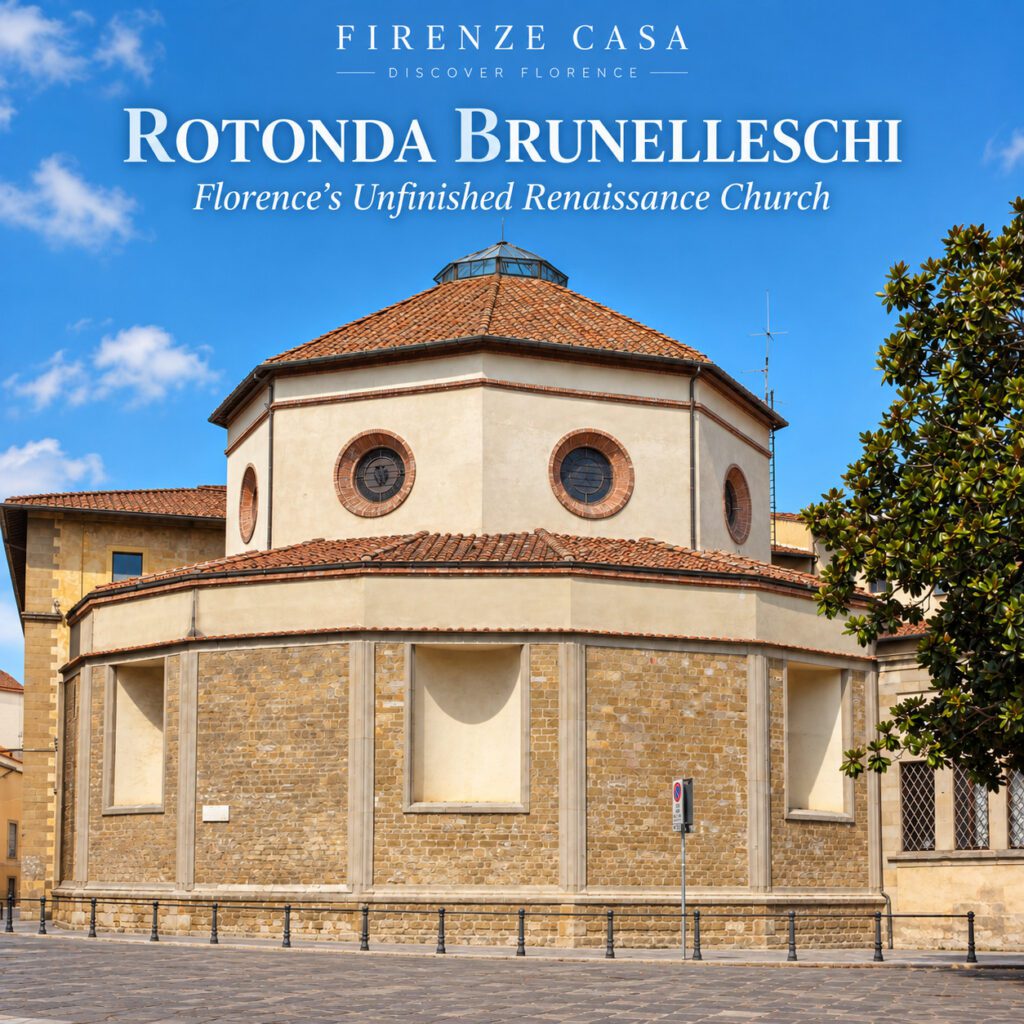
Rotonda Brunelleschi is one of Florence’s most unusual Renaissance buildings. Hidden near Piazza Santissima Annunziata, the structure began as an ambitious experiment by Filippo Brunelleschi. However, the builders never completed his original design.
Today, travellers have another reason to discover it. Since 2023, the Rotonda and adjoining rooms of the former monastery of Santa Maria degli Angeli have housed the Museo de’ Medici. Visitors can now experience this unusual Brunelleschi building from inside as part of a museum visit.
Historic names: Rotonda degli Scolari and Rotonda di Santa Maria degli Angeli
Architect: Filippo Brunelleschi
Period: 1430s
Original purpose: Centrally planned oratory connected with Santa Maria degli Angeli
Special feature: The builders never completed Brunelleschi’s original project
Today: Home of the Museo de’ Medici
Location: Corner of Via degli Alfani and Via del Castellaccio
Why Visit the Rotonda Brunelleschi?
Florence contains several celebrated works by Filippo Brunelleschi. His dome transformed the Cathedral skyline. San Lorenzo and Santo Spirito show how his ideas about geometry and proportion reshaped Renaissance architecture.
The Rotonda Brunelleschi offers something different. Here, visitors can explore one of his most unusual architectural experiments and discover a project that remained unfinished.
For most travellers, the Rotonda should not replace Brunelleschi’s major monuments. Instead, consider it an excellent addition if you enjoy Renaissance architecture, Medici history or quieter places beyond Florence’s main sightseeing routes.
Yes, particularly if Brunelleschi or the Medici interest you. The Rotonda lies only a short walk from Piazza Santissima Annunziata and the Duomo. It works best as an additional stop rather than a major standalone excursion.
Part of Santa Maria degli Angeli
Brunelleschi designed the Rotonda as part of the important Camaldolese monastery of Santa Maria degli Angeli. During the 14th and 15th centuries, the monastery became an important religious, artistic and intellectual centre.
Its influence reached far beyond monastic life. Humanist scholars worked here, while wealthy Florentine families supported artistic and religious projects. Artists including Lorenzo Monaco also had close connections with the monastery.
The Camaldolese general Ambrogio Traversari played a major role in this intellectual environment. He maintained close relationships with leading Florentine families, including the Medici.
Santa Maria degli Angeli was much more than a monastery. Religion, humanist scholarship, manuscript culture and artistic patronage came together here during the early Renaissance.
Why Is It Called the Rotonda degli Scolari?
The historic name Rotonda degli Scolari recalls the Florentine Scolari family. The commission grew from a bequest linked to Matteo and Andrea Scolari. They were relatives and heirs of the celebrated military commander Filippo Scolari, better known as Pippo Spano.
The commission gave Brunelleschi an opportunity to explore an unusual architectural idea. Instead of designing a traditional long nave, he organised the building around a central geometric plan.
Today, visitors often encounter the simpler name Rotonda Brunelleschi. This name immediately connects the building with its famous architect.
Brunelleschi’s Central-Plan Experiment
Brunelleschi designed the Rotonda during the 1430s as a centrally planned religious building. He placed an octagonal space at its centre and arranged eight radiating chapels around it.
The unusual plan reflected new Renaissance ideas about architecture. Circles, squares and regular polygons allowed architects to explore mathematical harmony and ideal proportion.
The Rotonda therefore belongs to a larger transformation in architectural thinking. Brunelleschi organised space through clear geometric relationships rather than simply following established medieval forms.
Think about geometry rather than decoration when you explore the Rotonda. Brunelleschi placed an octagonal space at the centre and organised the surrounding areas around it. The plan reveals his fascination with proportion and spatial order.
Why Was the Rotonda Never Finished?
Construction began during the 1430s. The date 1437, still visible in the masonry, marks an important stage in the project.
Work soon stopped before the builders could realise Brunelleschi’s complete vision. Financial and political pressures affected the commission. As a result, the walls remained without the upper structure and covering that Brunelleschi had planned.
The incomplete masonry eventually gave the building the nickname Castellaccio, or roughly “ugly castle”. Its fortress-like appearance looked very different from the harmonious Renaissance building Brunelleschi had imagined.
We still do not know every detail of his intended solution for the upper structure. Architectural historians have therefore studied historical sources and early images to reconstruct his possible design.
Brunelleschi never saw his complete design realised. That unfinished history makes the Rotonda both a Renaissance monument and an architectural puzzle.
Centuries as an Unfinished Building
The Rotonda remained incomplete after Brunelleschi died in 1446. During the 17th century, builders finally added a roof to protect the surviving structure. They did not attempt to complete Brunelleschi’s original Renaissance project.
Further changes followed. In the 19th century, new rooms appeared above the surviving structure. The sculptor Enrico Pazzi later used rooms here as a studio.
The building visitors see today therefore combines several periods. Brunelleschi created its Renaissance core, while later generations protected, adapted and reused the unfinished monument.
The 1937 Reconstruction
Architect Rodolfo Sabatini transformed the Rotonda again in 1937. His restoration sought to make Brunelleschi’s geometric concept easier to understand.
Sabatini retained the surviving Renaissance elements while adding modern sections above them. He also made the distinction between old and new fabric visible rather than hiding every intervention.
This history matters when you look at the building today. Brunelleschi did not design everything that visitors now see. The later additions help us understand the geometry of his original project, but they also tell the story of its modern restoration.
Look for the transition between the Renaissance masonry and the later upper sections. The contrast helps reveal how much of Brunelleschi’s original project survived and how later architects interpreted it.
From Forgotten Monument to Museo de’ Medici
The modern history of the Rotonda changed significantly in 2023. The Museo de’ Medici moved into the building and adjoining monumental spaces of Santa Maria degli Angeli.
The museum explores the history of the Medici dynasty through paintings, sculpture, medals, documents, books and other objects. Its location adds another dimension to the visit. A museum ticket also allows visitors to experience the Rotonda from within.
This combination works particularly well because the building belongs to the same cultural world that shaped Medici Florence. Architecture, religion, humanism and family patronage all intersect in the history of Santa Maria degli Angeli.
The museum and the architecture complement each other well. Even if Brunelleschi is your main interest, the museum provides an opportunity to experience a building that visitors once found much harder to see from inside.
Planning Your Visit
The Rotonda stands at the corner of Via degli Alfani and Via del Castellaccio. Piazza Santissima Annunziata and the Ospedale degli Innocenti are only a short walk away.
The Museo de’ Medici now provides access to the building. Check the museum’s official information shortly before your visit. Opening arrangements, admission prices and exhibitions can change, so Firenze Casa does not reproduce detailed schedules that may soon become outdated.
If you are staying at Firenze Casa, the Rotonda fits naturally into a day exploring this part of the historic centre. You can easily combine it with the Duomo and Piazza Santissima Annunziata. There is little reason to plan a separate journey unless Brunelleschi or Renaissance architecture particularly interests you.
Combine the Rotonda with Piazza Santissima Annunziata and the Ospedale degli Innocenti. Together, they reveal two very different sides of Brunelleschi: an elegant public loggia and an experimental centrally planned church.
Following Brunelleschi Through Florence
The Rotonda becomes much more meaningful when you compare it with Brunelleschi’s completed architecture elsewhere in Florence.
At Florence Cathedral, his enormous dome demonstrates his engineering skill. At the Basilica of San Lorenzo, columns, rounded arches and grey pietra serena create a new architectural language based on clarity and proportion.
Across the Arno, the Basilica of Santo Spirito develops these ideas into one of Florence’s most harmonious Renaissance interiors. The Pazzi Chapel at Santa Croce offers another important example of centrally organised Renaissance architecture.
Our Brunelleschi’s Florence – In the Footsteps of Brunelleschi connects these places on foot. The Rotonda adds a fascinating contrast because it shows an architectural experiment that never reached its intended final form.
What to See Nearby
Piazza Santissima Annunziata is the obvious next stop. Brunelleschi’s Ospedale degli Innocenti helped shape the square’s harmonious Renaissance character. The completed loggia offers an excellent contrast with the unfinished Rotonda.
The Duomo is also within easy walking distance. Visiting Florence Cathedral and the Rotonda on the same day creates another revealing comparison. One became Brunelleschi’s most famous achievement; the other remained one of his least familiar experiments.
Continue west if you want to explore San Lorenzo and the Medici district. This route also connects the Rotonda’s present role as the Museo de’ Medici with the family’s larger presence throughout Florence.
Duomo → Rotonda Brunelleschi → Piazza Santissima Annunziata → Ospedale degli Innocenti makes a compact route for travellers interested in Renaissance architecture. You can explore all four without turning the day into a specialised architectural tour.
Frequently Asked Questions About the Rotonda Brunelleschi
What is the Rotonda Brunelleschi?
Filippo Brunelleschi designed this centrally planned religious building in the 1430s for the monastery of Santa Maria degli Angeli. Construction stopped before the project reached completion.
Is the Rotonda degli Scolari the same building?
Yes. Rotonda degli Scolari and Rotonda di Santa Maria degli Angeli are historical names for the building now commonly called the Rotonda Brunelleschi.
Why did construction stop?
Financial and political pressures interrupted construction during the 15th century. The builders stopped before they could complete Brunelleschi’s full design.
Can you visit the Rotonda Brunelleschi?
Yes. The Museo de’ Medici has occupied the Rotonda and adjoining spaces since 2023. Check the museum’s current visitor information before going.
Is the Rotonda worth visiting?
Yes, especially if you enjoy Brunelleschi, Renaissance architecture or Medici history. Most first-time visitors should treat it as an additional stop near Piazza Santissima Annunziata rather than a major destination.
How does it compare with Brunelleschi’s other buildings?
The Rotonda offers something his completed buildings cannot: a glimpse of an architectural experiment interrupted during construction. San Lorenzo and Santo Spirito show his architectural language in a more complete form.
Why the Rotonda Brunelleschi Is Worth Visiting
The Rotonda Brunelleschi reveals an experimental and unfinished side of one of the Renaissance’s greatest architects. Instead of a polished masterpiece, visitors encounter the remains of an ambitious project that later generations repeatedly adapted.
The Museo de’ Medici has also made the visit more practical. Travellers can now combine Brunelleschi’s architecture with another important chapter of Florentine history inside the same complex.
On a first trip to Florence, the Cathedral, San Lorenzo and Santo Spirito remain more important Brunelleschi destinations. But if you want to look beyond the obvious monuments, the Rotonda offers exactly the kind of architectural secret that makes exploring Florence so rewarding.
Further Reading on Firenze Casa
- Brunelleschi’s Florence – In the Footsteps of Brunelleschi
- Piazza Santissima Annunziata – Renaissance Florence
- Florence Cathedral – Complete Visitor’s Guide
- Basilica of San Lorenzo – The Medici Church of Florence
- Basilica of Santo Spirito – Brunelleschi’s Renaissance Church
- Basilica of Santa Croce – Florence’s Monumental Church
- Florence Secrets and Traditions – Complete Guide
References
- FeelFlorence, Comune di Firenze – Rotonda Brunelleschi.
- Università degli Studi di Firenze – research on Santa Maria degli Angeli and the Rotonda Brunelleschi.
- De Benedictis, Cristina; Milloschi, Carla; Tigler, Guido (eds.) – Santa Maria degli Angeli a Firenze. Da monastero camaldolese a biblioteca umanistica, Nardini Editore, 2022.
- Comune di Firenze – Museo de’ Medici and the Rotonda Brunelleschi.
- Museo de’ Medici – history, collections and visitor information.

