
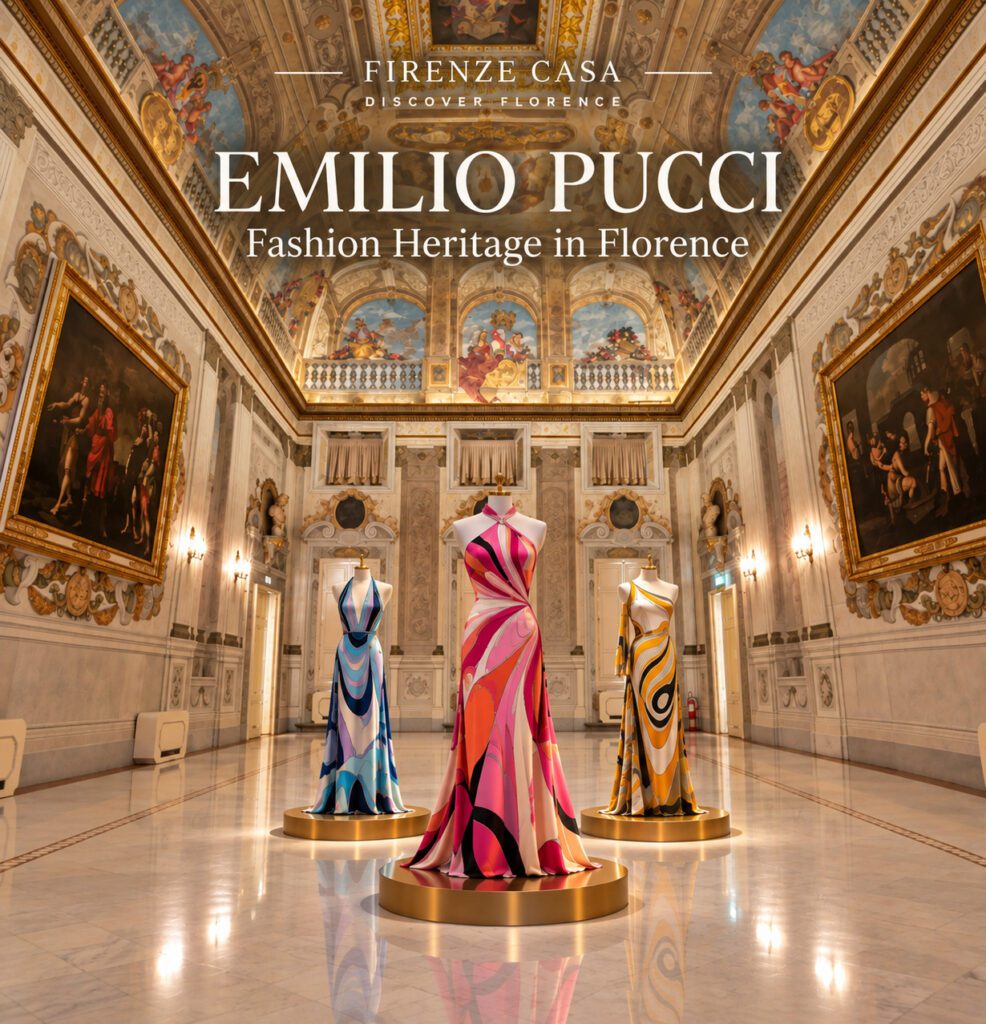
The Emilio Pucci Heritage Hub offers one of Florence’s most unusual encounters with twentieth-century Italian fashion. Hidden inside historic Palazzo Pucci only a few minutes from the Duomo, the archive connects the colourful world of designer Emilio Pucci with a Florentine family whose history stretches back centuries.
Unlike Florence’s major fashion museums, the Emilio Pucci Heritage Hub is not a conventional museum with regular opening hours and walk-in admission. Private tours are available upon request, making advance planning essential. For travellers interested in fashion, design and places normally hidden behind Florence’s historic façades, however, it can be a particularly memorable experience.
The Heritage Hub belongs naturally to the lesser-known institutions explored in our Florence Secrets and Traditions – Complete Guide.
What: Fashion archive and heritage centre dedicated to Emilio Pucci
Where: Palazzo Pucci, Via de’ Pucci 6, Florence
Area: Historic centre, close to the Duomo
Founded: 2018
Access: Private tours upon request
Best for: Fashion, design, textiles and modern Florentine culture
Allow: Arrange the length and details when requesting your visit
Important: Do not arrive expecting normal museum-style admission
What Is the Emilio Pucci Heritage Hub?
The Emilio Pucci Heritage Hub is a centre dedicated to preserving and interpreting the creative legacy of Florentine fashion designer Emilio Pucci. It occupies spaces within Palazzo Pucci that were once closely connected with the fashion house itself.
Rather than presenting the archive as a static museum, the project brings together historic clothing, prints, accessories, drawings, photographs, videos and other material connected with Pucci’s creative world. These objects are shown within rooms that also preserve the atmosphere and decoration of the historic family palace.
The result is quite different from visiting a conventional fashion exhibition. Here, fashion history remains connected with the building where much of that history actually unfolded.
The Heritage Hub is simultaneously an archive, a historic family setting and a place devoted to contemporary interpretation. Its appeal comes from seeing Pucci fashion within Palazzo Pucci rather than inside a purpose-built museum.
Where Is the Pucci Heritage Hub?
The Heritage Hub is located at Via de’ Pucci 6, in the historic centre of Florence. The location could hardly be more convenient: Florence Cathedral is only a short walk away.
This makes the Heritage Hub easy to combine with sightseeing around Piazza del Duomo, San Lorenzo, Via de’ Servi or Piazza della Santissima Annunziata. Travellers staying centrally can reach the area comfortably on foot.
Visitors should distinguish the Heritage Hub at Palazzo Pucci N6 from the broader architectural complex discussed in our guide to Palazzo Pucci – Historic Noble Palace in Florence. The palace itself has a much longer history extending back through Renaissance Florence.
Because Palazzo Pucci is so close to the Duomo, there is little reason to plan a separate journey across Florence. If you secure a private visit, build it into a day already devoted to the historic centre.
Can You Visit the Emilio Pucci Heritage Hub?
Yes, but this is the most important point to understand before planning your visit. The Emilio Pucci Heritage Hub is not operated like a normal public museum. The official Heritage Hub information states that private tours are available upon request.
You should therefore contact the Heritage Hub in advance rather than simply going to Via de’ Pucci and expecting to enter. Availability may depend on the activities taking place within Palazzo Pucci and should be confirmed directly for your travel dates.
This distinction matters because the location can easily appear to travellers like another small Florentine museum. It is better understood as a private heritage and archive experience that may be accessible by prior arrangement.
Do not rely on walk-in access. Contact the Emilio Pucci Heritage Hub before your trip and ask whether a private tour is possible on your preferred date. Confirm the time, duration, language and any conditions directly with the Heritage Hub.
Why Palazzo Pucci Matters to the Story
The setting is an essential part of the experience. The Pucci were already one of Florence’s established families centuries before Emilio Pucci became an internationally recognised fashion designer.
The family’s history encompasses Florentine politics, artistic patronage and a complicated relationship with the Medici. It includes Botticelli commissions as well as the famous conspiracy of Pandolfo Pucci against Cosimo I de’ Medici.
We explore this much older story separately in The Pucci Family: Art, Power and Medici Connections. Keeping the two stories separate helps explain what makes the Heritage Hub remarkable: modern fashion emerged inside a residence already carrying centuries of Florentine history.
Emilio Pucci and Florence
Emilio Pucci was born into the aristocratic Pucci di Barsento family in 1914. His name became internationally associated with bold colour, geometric patterns and a modern approach to clothing that looked strikingly different from much traditional post-war fashion.
Florence remained central to this development. In 1947, Pucci established his headquarters within his family’s Palazzo Pucci, using spaces in the building for workshops and tailoring. Historic reception rooms provided a dramatically different setting for presenting his modern collections.
The juxtaposition is still one of the most fascinating aspects of Palazzo Pucci: Renaissance and later aristocratic interiors became the backdrop for one of twentieth-century Italy’s most recognisable fashion identities.
Pucci demonstrates that Florence’s reputation for design did not end with the Renaissance. Centuries of textile production, craftsmanship and visual culture formed the background to a city that remained important to Italian fashion in the twentieth century.
From Fashion Headquarters to Heritage Hub
Palazzo Pucci N6 remained the headquarters of the fashion house until 2017. The following year, the Emilio Pucci Heritage Hub opened within the palace to preserve and reinterpret the designer’s legacy.
The intention was not simply to create another museum looking backwards. Instead, the archive became a resource through which Pucci’s visual language, creativity and approach to design could continue to be explored.
This explains why the Heritage Hub combines historical material with research, education and contemporary projects. The connection became even stronger when the Istituto Europeo di Design expanded into Palazzo Pucci N6, where fashion students now study within spaces associated with the history of the Pucci brand.
What Can You Discover Inside?
The archive brings together different parts of the Pucci story rather than concentrating solely on finished dresses. Clothing and accessories appear alongside prints, drawings, photographs, films and other material documenting the development of the designer’s visual language.
For visitors, this can reveal something easily lost when fashion is seen only in shop windows: the creative process behind a recognisable design identity.
Pucci’s extraordinary use of colour and pattern is particularly important. His designs frequently transformed memories of places and landscapes into vivid graphic compositions.
Look beyond individual garments. Pucci’s importance also lies in his use of colour, repeated motifs and printed textiles. The archive helps reveal how a distinctive visual vocabulary could become immediately recognisable as a brand identity.
The Pucci Passport – Travel Transformed into Design
Travel played an important role in Emilio Pucci’s imagination. Places ranging from Capri and Positano to the Alps, Africa, South America and Indonesia inspired designs and prints.
The Heritage Hub’s Pucci Passport explores these geographical influences and shows how landscapes, colours and impressions of travel could be transformed into patterns. It provides an especially appealing way for travellers themselves to understand Pucci’s work.
Rather than treating fashion as something isolated from place, the project reveals how movement through different landscapes became part of the creative process.
A Fashion Archive Inside a Historic Palace
One reason the Heritage Hub deserves its own place on a Florence itinerary is the dialogue between the archive and Palazzo Pucci itself. Historic paintings, frescoes and aristocratic rooms form a setting quite unlike the neutral galleries of most modern museums.
Fashion and architecture therefore compete for attention in the best possible way. The modernity of Pucci’s prints becomes more striking against historic interiors, while the fashion archive gives the old palace an unexpected twentieth-century chapter.
Visitors interested primarily in architecture should also read our separate Palazzo Pucci guide, including the story of the famous bricked-up window associated with the conspiracy against Cosimo I.
Florence, Fashion and Craftsmanship
Pucci belongs to a much broader Florentine tradition. Long before modern fashion houses appeared, Florence was renowned for textiles, leather, goldsmithing and highly specialised luxury production.
The relationship between skilled workmanship, design and luxury can still be explored through the city’s workshops and historic trades. Our Florentine Crafts – Complete Guide provides the wider historical context for these traditions.
The Emilio Pucci Heritage Hub adds a modern dimension to that story. It shows how Florence continued to generate distinctive forms of design long after the Renaissance period that dominates most visitor itineraries.
Is the Emilio Pucci Heritage Hub Worth Visiting?
For travellers with a serious interest in fashion, textiles, design or twentieth-century Italian culture, the answer is clearly yes – provided a visit can be arranged.
It is less essential for a first-time visitor spending only one or two days in Florence and trying to see the Uffizi, Accademia, Duomo and other major monuments. Because access requires advance planning, it should not replace the city’s essential sights simply for the sake of adding another attraction.
For a longer stay, however, the Heritage Hub becomes much more interesting. After several days of Renaissance art and monumental churches, entering the world of twentieth-century Florentine fashion provides a completely different perspective on the city.
Highly recommended: Fashion enthusiasts, designers, textile lovers and repeat visitors to Florence.
Worth considering: Travellers interested in historic palaces and unusual private collections.
Lower priority: First-time visitors with only one or two days and no particular interest in fashion.
How to Include the Heritage Hub in Your Florence Itinerary
If a private tour is available, the easiest approach is to combine it with nearby sights rather than building an entire day around the Heritage Hub.
Start around Piazza del Duomo and walk to Via de’ Pucci. After your visit, continue along Via de’ Servi towards Piazza della Santissima Annunziata. This creates an easy route connecting modern design with Renaissance architecture and Florentine family history.
Alternatively, fashion enthusiasts can use the Heritage Hub as one element of a broader day exploring Florence’s craftsmanship, textiles and design traditions.
Duomo → Palazzo Pucci / Emilio Pucci Heritage Hub → Via de’ Servi → Piazza della Santissima Annunziata.
The distances are short, making this an easy combination even when your Heritage Hub appointment occupies only part of the morning or afternoon.
Planning the Visit from Firenze Casa
For travellers using central Florence as their base, the Heritage Hub is particularly straightforward to integrate into a sightseeing day because no special transport is required. It lies within the compact historic centre and can be combined naturally with other places around the Duomo and Santissima Annunziata.
If you are staying at Firenze Casa or elsewhere within walking distance of central Florence, it makes more sense to approach Palazzo Pucci on foot than to plan the visit around buses or taxis. The important logistical step is not transportation but arranging access to the Heritage Hub before you go.
What If You Cannot Arrange a Private Tour?
Not obtaining access does not mean the Pucci story disappears from your itinerary. Palazzo Pucci can still be viewed from the street, and its famous architectural details connect directly with the family’s Renaissance history.
The Emilio Pucci Heritage website also offers digital material exploring the designer’s work and Palazzo Pucci. This is particularly useful for understanding the archive before travelling or when an in-person visit is unavailable.
You can then combine the palace exterior with other nearby places while using our Pucci family guide to understand the much longer history behind the name.
If a private visit is not possible during your stay, explore the official Heritage Hub online and its virtual material before walking past Palazzo Pucci. Knowing the fashion and family story makes the building considerably more interesting from the street.
Why the Emilio Pucci Heritage Hub Belongs to Hidden Florence
The Emilio Pucci Heritage Hub is worth discovering because it reveals a Florence that sits between Renaissance history and modern Italian design. Behind the façade of a centuries-old family palace lies an archive associated with one of the most distinctive names in twentieth-century fashion.
It also challenges the idea that Florence is primarily a city preserving its past. Palazzo Pucci has continually acquired new roles: aristocratic residence, fashion headquarters, creative workplace, archive and educational environment.
For travellers willing to look beyond the major museums, this mixture of family history, fashion, architecture and contemporary creativity is precisely what makes Florence’s lesser-known institutions so rewarding.
Florence becomes especially interesting when historic buildings are still part of contemporary life. Palazzo Pucci is not simply preserved as a Renaissance monument: centuries of family history now coexist with fashion archives, design education and the continuing creative identity of the city.
Frequently Asked Questions
What is the Emilio Pucci Heritage Hub?
It is a heritage centre and fashion archive dedicated to the history and creative legacy of Emilio Pucci, located inside Palazzo Pucci in central Florence.
Where is the Emilio Pucci Heritage Hub?
It is located at Palazzo Pucci, Via de’ Pucci 6, only a short walk from Florence Cathedral.
Is the Pucci Heritage Hub a museum?
Not in the conventional sense. It is a heritage centre and archive rather than a museum operating with standard daily opening hours and walk-in admission.
Can tourists visit the Emilio Pucci Heritage Hub?
The official Heritage Hub states that private tours are available upon request. Contact the institution in advance to confirm availability for your travel dates.
Do I need to book in advance?
Yes. Visitors should arrange access beforehand rather than arriving at Palazzo Pucci expecting normal museum admission.
Is Palazzo Pucci the same as the Emilio Pucci Heritage Hub?
No. Palazzo Pucci is the historic family residence, while the Heritage Hub occupies spaces within Palazzo Pucci N6 and focuses specifically on Emilio Pucci’s fashion and creative legacy.
Is the Heritage Hub close to the Duomo?
Yes. Via de’ Pucci is only a few minutes’ walk from Piazza del Duomo, making the Heritage Hub easy to combine with sightseeing in central Florence.
Is the Emilio Pucci Heritage Hub worth visiting?
It is particularly worthwhile for travellers interested in fashion, textiles, design and unusual private cultural institutions. For short first-time visits, Florence’s major museums and monuments remain a higher priority.
Further Reading on Firenze Casa
- Florence Secrets and Traditions – Complete Guide
- Palazzo Pucci – Historic Noble Palace in Florence
- The Pucci Family: Art, Power and Medici Connections
- Historic Palaces of Florence – Complete Guide
- Florentine Crafts – Complete Guide
- Hidden Gems in Florence – Complete Guide
References
- Emilio Pucci Heritage Hub – Official Heritage Hub and Palazzo Pucci information
- Emilio Pucci Heritage – Pucci Passport and digital archive
- Istituto Europeo di Design Firenze – Palazzo Pucci N6 and Fashion Department
- Città Metropolitana di Firenze – Emilio Pucci Heritage Hub and Palazzo Pucci N6
- Historical documentation concerning Palazzo Pucci and the Pucci family

